PREV ARTICLE
NEXT ARTICLE
FULL ISSUE
PREV FULL ISSUE
NEW BOOK: ARKANSAS WAR BONDSCharles Derby has published a new book on Arkansas War Bonds and Treasury Warrants. -Editor
Arkansas War Bonds and Treasury Warrants:
History of Their Origins and a New Catalog of Types
To make sense of their diversity, I have analyzed Arkansas TWs and WBs in three ways. First was to create a database with over 1,500 TWs and over 360 WBs. Second was to consider this information in light of actions of Arkansas's legislature and treasury and the ordinances that led to the production of and changes to this currency, and events during the war that caused these changes. Third was to study the men behind the money: engravers and printers who produced unissued TWs and WBs, treasury employees who signed and issued currency, and receivers of the currency. This analysis yields a clear narrative on the production of and relationship among these WBs and TWs and the Auditor's Warrants (AWs) on which they were issued, and how they were used to support Arkansas's war efforts. The product of this research is a new book, Arkansas War Bonds and Treasury Warrants: History of Their Origins and a New Catalog of Types, which allows numismatists and historians to better understand this currency including new ways to collect it. Arkansas's Currency Before the Civil War. To provide currency and other financial resources to fuel Arkansas's growth once it became a state in 1836, Arkansas's legislature approved the formation of two banks, both of which issued currency: The Real Estate Bank of the State of Arkansas and The Bank of the State of Arkansas. These state-supported banks did not last long, both collapsing under the weight of corruption and greed in the 1840s and 1850s. This resulted in Arkansas's legislature passing laws that placed severe regulations on banking in the state, which helped manage the corruption but still left the state with a severe lack of currency. The only state-authorized and issued money that circulated in Arkansas during the 1850s and pre-war 1860s was Swamp Land Scrip. 
Type 1 Arkansas War Bond 
Type 2 Arkansas War Bond Arkansas Authorizes War Bonds and Treasury Warrants During the Civil War. Arkansas seceded from the Union on May 6, 1861, and was admitted into the Confederacy 12 days later. Arkansas's budget was tight, with revenues barely meeting expenditures. If Arkansas were to meet its financial burden in fighting a war on top of its normal expenditures, new sources of revenue were needed. Consequently, Arkansas's Secession Convention passed two ordinances on May 11, 1861, which provided new revenue in several ways including levying a new tax of 0.25% on all assessed property values and issuing WBs and TWs. These WBs and TWs were receivable in payment for all state debts, which were typically made to creditors who held AWs issued to them by the state auditor authorizing the state treasurer to pay state funds to the creditors for their services. About 4,000 AWs were issued over the course of the war, though none are known to exist today. 
Type 3 Arkansas War Bond 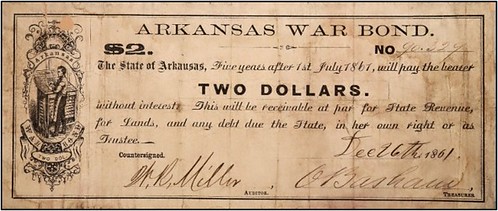
Type 4 Arkansas War Bond War Bonds. The ordinances of May 1861 authorized the sale of $2 million in coupon-bearing WBs. These WBs were to mature five years after July 1861, and in the interim interest was to be paid on them at 8% per year. Payment and redemption of these bonds were largely backed by the faith of the State of Arkansas. WBs were typically issued to individuals who were military officers, quartermasters, commissaries and their agents, surgeons, or government employees responsible for paying soldiers or for purchasing weapons, supplies, food, medicines, and other wartime needs. In total, over 103,000 WBs were issued from June 1861 to January 1862. All were given sequential serial numbers (SNs). Four types of WBs were produced. Type 1 WBs were issued over two weeks from late June to mid-July. Type 2 were issued over three months from late July to late October. Type 3 were issued over three months from mid-October to late January 1862. Types 2 and 3 had sub-types and varieties. Type 4 were a strange issue, hardly WBs at all as they earned no interest and were issued in December 1861 between Type 3a and 3b. 
Type 1 Arkansas Treasury Warrant Treasury Warrants. The May 1861 ordinances authorized the treasury to issue 8% interest-earning TWs. These Type 1 TWs, with examples shown in Figure 3, were first issued in early November 1861 with denominations of $1, $2, $3, $5, $10, and fractionals ($x.xx). Early Type 1 TWs have two subtypes, 1a and 1b, which differ in their vignette: 1a has an Indian Woman vignette, and 1b has an Indian Man vignette. Type 1s also come in two subtypes according to their function as indicated by text on them, either "ON WAR BOND" or "ON AUDITOR'S WARRANT." This text is bordered by two numbers. The left number is the TW's SN, and the right number is the SN of the WB (for TWs with "ON WAR BOND") or the SN of the AW (for TWs with "ON AUDITOR'S WARRANT") on which this TW was issued. Thus, TWs with "ON WAR BOND" were issued to individuals for payment of interest on WBs that they held, and TWs with "ON AUDITOR'S WARRANT" were issued to individuals for payment of the AWs that they held. The May 1861 ordinances placed several limits on WBs and TWs, which had the effect of curtailing their circulation. To overcome this problem, Arkansas's legislature passed acts on November 14 and 18, 1861, which eliminated these restrictions and penalized creditors who refused to accept them. This new legislation led the treasury to issue new TWs, called Type 2. The legislation promoted its TWs and WBs by prohibiting the use of privately issued paper currencies of denominations less than a few dollars. Banks were also prohibited from issuing such notes. But the law allowed for exchange companies formed by local merchants to issue and redeem jointly their low denomination notes. Scrip from such exchange companies is known from Arkansas locations including Washington, Arkadelphia, Helena, Columbia, Fort Smith, and Chicot County. Even if illegal, some merchants and private business issued small denomination currency, Scrip from these Arkansan exchange companies and merchants are highly collectible. Features: 228 pages, soft cover, perfect binding, 8½ x 11 inches. All books are signed by the author. Cost: $35.00 + postage ($7 domestic) Ordering: Electronic: Venmo @Charles-Derby-1, Zelle charlesderbyga@yahoo.com Check by Mail: Charles Derby, 204 Sycamore Ridge Dr., Decatur, GA 30030 Information: Charles Derby: charlesderbyga@yahoo.com, 678-778-8806


Wayne Homren, Editor The Numismatic Bibliomania Society is a non-profit organization promoting numismatic literature. See our web site at coinbooks.org. To submit items for publication in The E-Sylum, write to the Editor at this address: whomren@gmail.com To subscribe go to: Subscribe All Rights Reserved. NBS Home Page Contact the NBS webmaster 
|
