PREV ARTICLE
NEXT ARTICLE
FULL ISSUE
PREV FULL ISSUE
NOTES FROM E-SYLUM READERS: OCTOBER 18, 2026
More on Why WWII Nickels Laminate Here's a response to last week's discussion of why WWII Jefferson Nickels laminate. Vocabulary note: 'warnix' = War Nickels. -Editor Tom DeLorey writes: While I was at Coin World's Collectors Clearinghouse in the mid 1970's, I was updating a chart with the weights, diameters, thicknesses, contents and Specific Gravities for all U.S. Coins that had been created by my mentor there, Ed Fleischmann. We found it very handy when identifying wrong planchet coin errors, and counterfeits. Versions of this chart have appeared in many places over the years. Most values were given expected numbers, but the S.G. for the warnix was given as a range that Ed had observed over the years via testing specimens. He attributed this to the laminations so commonly seen on warnix. I was curious as to what the expected S.G. should be, so I wrote to Dr. Goldman at the Mint Lab in Washington, D.C. Over the years he had always been very helpful in responding to our inquiries, unlike the current Mint administration. I also asked him why so many warnix were found laminated. He gave me an expected figure, but said that the range we used was probably more accurate because of the lamination problems. As to the cause of the laminations, he said basically this:
So, sometimes an easy answer is the correct one. Thank you! Interesting history. -Editor
To read the earlier E-Sylum article, see:
More on Indian Peace Medals Alan Weinberg passed along these notes and images inspired by last week's piece on the Indian Peace medals in the Buffalo Bill Center of the West collection. -Editor 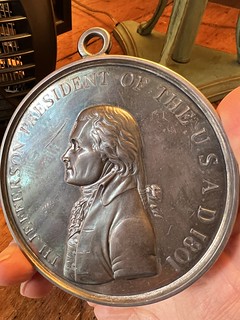

Original 105 mm largest size "hollow shells" silver Thomas Jefferson IPM in mint state. Weinberg collection. Struck at US Mint. Most shell Thomas Jefferson medals exhibit evidence of prying open the shells to see what is inside (wood). Known only in silver early "original dies" bronze specimens (diagnosed by a large diebreak on the reverse) struck by the Mint are scarce and eagerly sought due to the extreme rarity of silver shell originals. 

The so-called "bootleg" fur trade medals are exceedingly rare, rarer than Jefferson Indian Peace Medals. A white metal version just sold in a StacksBowers auction. Also known in silver (Don Partrick, Heritage auction) and copper (Ford-Weinberg collection).
To read the complete lot description, see:
To read the earlier E-Sylum article, see:
On the Coin Photo Rorschach Test "I see scratches-from wear and tear. Maybe an Alien dropped it from Mars and reentry was tough on it."
To read the earlier E-Sylum articles, see:
Audiobook: The Banker Who Made America
"I'm now hard at work on a book on the tumultuous founding of the Bank of England in 1694, which I view as the beginning of the modern era—but that is such a tortuous project that it will be a couple of years before it will be ready for publication. "In the meantime, I hope you enjoy The Banker Who Made America!"
To read the earlier E-Sylum articles, see:
Query: Mystery "ANA" Pins
"I was told that it is NOT from the American Numismatic Association but another society with similar initials. I'd love to hear from anyone who knows about them. I'd sure like to see them go to someone who might get them to collectors who find them quaint. Otherwise, I'll take the melt value from a coin dealer at the upcoming Rochester Numismatic Association show on October 31st."
The classic lamp-of-knowledge design and the Latin motto "De Profundis" (meaning "Of the depths") could well have been adopted independently by other organizations, schools or universities. This particular piece seems of lower quality than typically seen with "our" ANA's medals. It doesn't look right to me, and I'm inclined to agree that it must be something else. But what? I reached out to school medal collector John Sallay whose response is below. Does anyone have information on these? Can anyone help Nick keep them from the melting pot with an offer? -Editor John Sallay writes: "The lamp-of-knowledge sitting on a book is one of the more common devices used on school award medals. It is perhaps most prominently featured on the American Legion School Award medals, of which over one million have been awarded over the last 100+ years. It is not inconceivable that there is or was somewhere a "Something Something Academy" with the initials ANA that used this device and same De Profundis motto as the American Numismatic Association. "However, I am not aware of anything relevant and my own Google AI search came up with, "There is no prominent real-world educational academy with the initials A.N.A. that officially uses "De Profundis" as its institution-wide motto." And to me, the design similarity, initials, and motto seem way too coincidental to be unrelated. "Even without knowing what this is, I think it would be a shame to melt it. The melt value (plus postage) seems like a small cost for a fun research project and, who knows, a potentially rare and valuable addition to someone's collection of ANA memorabilia (or school award medals)!"
AI Plagiarism & Impact on Numismatic Research "I wanted to share a recent news story that may matter to numismatic researchers.
"The lesson for our community is that most AI chatbots train on your conversations by default unless you opt out. Numismatic researchers who work with AI models like ChatGPT, Claude, and Gemini may be feeding unpublished findings into a future model without realizing it. Turning this off is free and takes a minute, and this Engadget guide walks through it for each major company." Good advice. Some years ago the Newman Numismatic Portal had a feature that showed recent user queries. I enjoyed seeing these and learned a lot, sometimes making new E-Sylum articles. I thought it was a great idea, but one researcher pushed back and the feature was removed. -Editor
Query: Coin Provenance Assistance Sought "Have a wee coin mystery I'd like to see if any of the E-Sylum folks may be able to assist with. I recently bought a decent Kushan tetradrachm of Wima Takto. It's a variety I didn't have but what really intrigued me was the inventory card that came with it. It's a decent sized card typed in German with a few handwritten notes here and there, plus a pasted photo of the same coin on the reverse. The reference to the Whitehead reference seems to point it being catalogued before Mitchiner's Ancient and Classical World tome came out in the 1970s. Considering the level of detail on the card, this makes me think it came from a known collector/scholar of Central Asian coins. Do you or anyone recognize this catalog card? I would like to preserve the provenance as much as I can for this coin." 

Can anyone help? -Editor

Wayne Homren, Editor The Numismatic Bibliomania Society is a non-profit organization promoting numismatic literature. See our web site at coinbooks.org. To submit items for publication in The E-Sylum, write to the Editor at this address: whomren@gmail.com To subscribe go to: Subscribe All Rights Reserved. NBS Home Page Contact the NBS webmaster 
|


