Visit our NBS Sponsors










About UsThe Numismatic Bibliomania Society is a non-profit association devoted to the study and enjoyment of numismatic literature. For more information please see our web site at coinbooks.org SubscriptionsThose wishing to become new E-Sylum subscribers can go to the following web page
Subscribe
MembershipThere is a membership application available on the web site Membership Application To join, print the application and return it with your check to the address printed on the application. Print/Digital membership is $40 to addresses in the U.S., and $60 elsewhere. A digital-only membership is available for $25. For those without web access, write to: Jeff Dickerson, Treasurer AsylumFor Asylum mailing address changes and other membership questions, contact Jeff at this email address: treasurer@coinbooks.org SubmissionsTo submit items for publication in The E-Sylum, write to the Editor at this address: whomren@gmail.com 
BUY THE BOOK BEFORE THE COINSale CalendarWatch here for updates! |
- WAYNE'S WORDS: THE E-SYLUM DECEMBER 14, 2025
- REMINDER: LANG NUMISMATIC LITERATURE AUCTION 9
- NEW BOOK: THE ENIGMATIC LINCOLN CENTS OF 1922
- NEW BOOK: PAST TENSE
- NEW BOOK: WHEN COINAGE WAS BORN
- NEW BOOK: SAMARIAN COINAGE FROM THE PERSIAN PERIOD
- NEW BOOK: OUR OWN COINAGE
- NEW BOOK: SAN FRANCISCO HISTORY THROUGH ITS EXONUMIA
- NEW BOOK: MONROE, MICHIGAN COLLECTIBLE COLLECTIONS
- PERIODICAL: NUMISMATIQUE ASIATIQUE NO. 55
- VIDEO: TOPICAL COLLECTING OF WORLD COINS
- NOTES FROM E-SYLUM READERS: DECEMBER 14, 2025
- VOCABULARY TERM: SCREW MEDAL
- 100-YEAR-OLD NUMISMATISTS
- QUERY: EDMUND DELAURENTIS
- ARCHIVES INTERNATIONAL SALE 109 SELECTIONS
- HERITAGE: 1804 CLASS III DOLLAR AT FUN
- CNG: TRITON XXIX AUCTION
- FRANK S. ROBINSON AUCTION 130
- STACK CLASS III 1804 DOLLAR BRINGS $6 MILLION
- MARK FERGUSON ON 1804 DOLLAR RESEARCH
- THE LAST "OMEGA" CENTS HAVE SOLD
- U.S. MINT SEMIQUINCENTENNIAL COIN LAUNCH
- UNCHOSEN SEMIQUINCENTENNIAL COIN DESIGNS
- MORE ON THE UNCHOSEN SEMIQUINCENTENNIAL COINS
- ANOTHER RMS CARPATHIA GOLD MEDAL
- A VIRGINIA TYPE 2 NATIONAL BANK NOTE RARITY
- 1670 HUDSON'S BAY COMPANY ROYAL CHARTER SOLD
- SECRET BOOKS MADE UP BY AI
- JUST USE THE BANKNOTE TELEPORTER
- ABOUT THIS ISSUE: DECEMBER 14, 2025
Content presented in The E-Sylum is not necessarily researched or independently fact-checked, and views expressed do not necessarily represent those of the Numismatic Bibliomania Society.
WAYNE'S WORDS: THE E-SYLUM DECEMBER 14, 2025
 New subscribers this week include:
Max Brand, courtesy John Danreuther;
Kathy Skelton, and
Muthu Krishnan.
Welcome aboard! We now have 6,718 subscribers.
New subscribers this week include:
Max Brand, courtesy John Danreuther;
Kathy Skelton, and
Muthu Krishnan.
Welcome aboard! We now have 6,718 subscribers.
Thank you for reading The E-Sylum. If you enjoy it, please send me the email addresses of friends you think may enjoy it as well and I'll send them a subscription. Contact me at whomren@gmail.com anytime regarding your subscription, or questions, comments or suggestions about our content.
This week we open with a numismatic literature sale, SEVEN new books, a periodical, notes from readers, and more.
Other topics this week include 1922 Lincoln Cents, Samarian and Irish coinage, tokens, topical world coin collecting, screw medals, 100-year-old numismatists, the 1804 dollars, the "Omega" cents, the new semiquincentennial coins, the Carpathia gold medal, and Hudson's Bay Company.
To learn more about Mint operations of the 1920s, the Zhuyuetang Collection, clipped coins of early Imperial China and Feudal Japan, the Franklin D. Roosevelt March, George Marlier, Ed DeLaurentis, a Roman bronze "contorniate", Ruby Bridges, Frederick Douglass, and the banknote teleporter, read on. Have a great week, everyone!
Wayne Homren
Editor, The E-Sylum


Image of the week
REMINDER: LANG NUMISMATIC LITERATURE AUCTION 9
The ninth numismatic literature auction from Numismatic Antiquarian Bookshop Lang closes December 16, 2025. -Editor

We would like to remind you of our upcoming 9th auction of numismatic literature, which will take place on December 16, 2025.
Look forward to the 1st part of the duplicates from the Leu Numismatik AG library. With 798 lots, the auction offers an unusually comprehensive overview of numismatic literature – including 246 reference works on ancient numismatics, 128 titles on the Middle Ages and modern times, and 390 auction catalogues representing major firms and notable collections. Perhaps you will even find a Christmas present? The pleasantly moderate estimated prices make this an attractive proposition.
NEW BOOK: THE ENIGMATIC LINCOLN CENTS OF 1922
Numismatic scholars and bibliophiles have a new treat - a comprehensive book on a popular but very narrow topic - the Lincoln Cents of 1922. I've always enjoyed single-coin books such as those on the 1913 Liberty Nickel and 1933 Double Eagle. And Tom DeLorey is just the numismatist to write it. Congratulations on completing this detailed work and making the research available to the whole community. Here's the announcement from Whitman. -Editor

Whitman announces the official release of The Enigmatic Lincoln Cents of 1922, an all-new numismatic investigation by celebrated researcher and author Tom DeLorey. This landmark reference unravels one of the greatest mysteries in U.S. coinage history: the extraordinary and confounding 1922 Lincoln cents struck at the Denver Mint.
Meticulously researched and richly illustrated, The Enigmatic Lincoln Cents of 1922 combines historical documentation, advanced die analysis, and modern photography to uncover the minting irregularities that gave rise to the "No D" and related varieties. DeLorey's work challenges long-held assumptions and presents groundbreaking findings that redefine how collectors and scholars understand this iconic error issue.

NEW BOOK: PAST TENSE
The American Numismatic Association has compiled Rod Gillis' "Past Tense" monthly columns in The Numismatist in book form. -Editor

Coin collectors and history buffs alike are sure to love this entertaining, large-format book of author Rod Gillis' colorful "Past Tense" monthly column, which appeared in The Numismatist magazine from July 2011 through March 2020.

NEW BOOK: WHEN COINAGE WAS BORN
The American Numismatic Society has published a new book - When Coinage Was Born: Treasures from the Zhuyuetang Collection. -Editor
 When Coinage Was Born: Treasures from the Zhuyuetang Collection
by Wolfgang Fischer-Bossert and Ute Wartenberg
The exhibition catalogue for When Coinage Was Born - Treasures from the Zhuyuetang Collection (held at the Royal Spanish Mint from June 2025 through June 2026) showcases 148 coins illustrating the development of early coinage around the Mediterranean Sea. The many spectacular coins of the Zhuyuetang Collection provide a deep dive into the wonderful world of Archaic Greek numismatic imagery, so different from the aesthetic language of later Hellenistic and Roman coins, and a vivid tableau of monsters, gods, heroes, and animals. More than a mere assortment of metal objects, these coins tell stories from 2500 years ago about war and international conflict, natural disasters, communities, religion, wealth, and much more. Printed in full color with over 180 images and text masterfully researched and written by two of the leading scholars in Archaic Greek numismatics.

NEW BOOK: SAMARIAN COINAGE FROM THE PERSIAN PERIOD
A new two-volume book examines Samarian Coinage from the Persian Period. Here's the announcement. -Editor


A Corpus of Samarian Coinage from the Persian Period, Volumes I & II
By Haim Gitler, Mati Johananoff, and Oren Tal
Numismatic Studies and Researches (NSR) XIII and XIV, Jerusalem 2025, Published by the Israel Numismatic Society
A Comprehensive Re-evaluation of Ancient Levantine Coinage
NEW BOOK: OUR OWN COINAGE
The Numismatic Society of Ireland is publishing a new book on the coinage of Ireland. Here's the pre-publication announcement. -Editor
 The Numismatic Society of Ireland is pleased to
announce the publication of Edward Colgan's new
book:
The Numismatic Society of Ireland is pleased to
announce the publication of Edward Colgan's new
book:
OUR OWN COINAGE
THE POLITICAL AND LEGAL BACKGROUND
TO THE COINAGE OF IRELAND 1926 – 2002
Written by NSI member Edward Colgan this important book brings together many years of research and study which embrace the records of the Houses of the Oireachtas, holdings of the National Museum of Ireland, the Archives of the Central Bank of Ireland, holdings of the Royal Mint, and image libraries of leading auctioneers and other numismatists. Permissions have been granted by them to publish images some of which have never been published previously.
OUR OWN COINAGE traces the story in fourteen chapters of how the coinage of Ireland evolved from the highly acclaimed and now fondly remembered 1928 set of silver, nickel and bronze coins of Saorstát Éireann through the coins of Éire and the Éire Decimal series to the Euro coins of 2002. The early chapters bring insights to the debates in the Houses of the Oireachtas and Seanad, to the work of W B Yeats' Committee and to the engagement of Percy Metcalfe when designing and modelling the first coins. The middle chapters explain the change to cupro-nickel and a new design. These chapters also explain the change to decimal. The final chapters are concerned with the introduction of the Euro series.
NEW BOOK: SAN FRANCISCO HISTORY THROUGH ITS EXONUMIA
The Pacific Coast Numismatic Society has published a new book on San Francisco exonumia. Michael Wehner passed along this announcement. -Editor
A Selection of the Works of Jerry F. Schimmel
 San Francisco History Through Its Exonumia:
A Selection of the Works of Jerry F. Schimmel
A new collection of Jerry Schimmel's writings on San Francisco history and tokens has been released by PCNS. This book is available now as a print-on-demand title from Lulu.
Description
Jerry F. Schimmel (1933-2021) was well-known as a numismatic writer and a collector of tokens and exonumia. A member of PCNS for over fifty years, he contributed hundreds of articles to numismatic and general interest publications, usually focused on San Francisco history as represented by tokens from bars and other entertainment establishments, particularly on the notorious Barbary Coast. This is a collection of twenty-five articles personally selected by Jerry.
- Author: Jerry F. Schimmel
- Editor: Michael Wehner
- Paperback 6X9 Perfect Bound, 135+pages, 25 chapters, over 100 illustrations & color photos.
- Price: $24.95 plus shipping (from Lulu dot com, not from PCNS)

NEW BOOK: MONROE, MICHIGAN COLLECTIBLE COLLECTIONS
A new book has been published on the tokens of Monroe, Michigan. -Editor
 Monroe, Michigan Collectible Collections:
Tokens & More Volume 1
Token collections from Monroe County, Michigan, compiled by Albert Conner. It highlights the historical significance of various tokens, coins, and collectibles, many of which are tied to local businesses, events, and organizations.
The collection spans over a century, showcasing items from saloons, grocery stores, billiard halls, schools, churches, and community events. Each token is detailed with its physical description, historical context, and the establishment or event it represents.
This collection also includes commemorative tokens for anniversaries, centennials, and bicentennials, as well as unique items like wooden nickels, advertising medals, and transportation tokens.
PERIODICAL: NUMISMATIQUE ASIATIQUE NO. 55
Here are the contents of the latest issue of Numismatique Asiatique (Asian Numismatics). -Editor
 EDITORIAL
Les numismates vont-ils disparaître?
Will numismatists disappear?
CHINA/JAPAN
The History and the Types of Clipped Coins of Early Imperial China and Feudal Japan
by Andrey Y. Ivlev
CHINA
Les pouvoirs magiques de la sapèque
by François Joyaux
RUSSIAN FAR EAST
Late Qing award plaquettes from finds in the Amur region
by S. V. Sidorovich

VIDEO: TOPICAL COLLECTING OF WORLD COINS
The David Lisot Video Library on the Newman Numismatic Portal can be found at:
https://nnp.wustl.edu/library/multimediadetail/522852
We highlight one of his videos each week in The E-Sylum. Here's one from 2016 with Bob Hurst speaking about collecting world coins by topic. -Editor

NOTES FROM E-SYLUM READERS: DECEMBER 14, 2025
Chinese Railroad Workers and Coins in Richmond
Regarding Chinese railroad workers and coins in Richmond, VA
Helen Wang writes:
"Readers might be interested in these:
" An Introduction and Identification Guide to Chinese Qing dynasty coins (pdf, 2014) is a handy beginner's guide created by Qin CAO, while she was a trainee at the British Museum. She's now curator of Chinese Collections at the Oriental Museum, Durham University (UK).
" East Asian coins found in the USA is a summary of chapter 4 (Asian Coins in North America) in Numismatic Archaeology of North America – A Field Guide, by Marjorie H. Akin, James C. Bard, and Kevin Akin (New York: Routledge, 2016). ISBN 978-1-61132-920-9 paperback (also in hardback and ebook).
"Rosenkrance, Erin Drin, "Chinese material culture signatures in native North America: a preliminary study of National Museum of the American Indian online collections and plains" (2023). Graduate Student Theses, Dissertations, & Professional Papers 12252.
https://scholarworks.umt.edu/etd/12252.
" The Museum of Chinese in America (MOCA) may also have information. "
Eric Schena writes:
"I think I dimly recall a Qing Dynasty coin found in an archaeological context in the Shenandoah Valley, but I would have to see if I can find that reference. There was at least one Baltimore merchant in the late 19th - early 20th century who used to counterstamp Chinese cash as tokens. That said, I now have a book to buy, courtesy of Helen's email and recommendation, so thank you.
"When I was in college in the 1990s, I went on a dig at a 17th century plantation site in Williamsburg, though no Chinese coins were found while I was there (just a Charles II farthing and a 1773 Virginia halfpenny). I was somewhat surprised at how little some of the folks knew of numismatics. I am sure those days have long since changed, but it is so nice to see textbook level works on the topic."
Thanks - it's a start. -Editor
To read the earlier E-Sylum article, see:
NOTES FROM E-SYLUM READERS: DECEMBER 7, 2025 : Richmond, VA Chinese Workers Paid in Chinese Cash Coins?
(https://www.coinbooks.org/v28/esylum_v28n49a16.html)
Other topics this week include Bill Middendorf, William H. Woodin, the 1922 Hunan Constitution, and ISIS coinage. -Editor

VOCABULARY TERM: SCREW MEDAL
Here's another entry from Dick Johnson's Encyclopedia of Coin and Medal Terminology. -Editor
Screw Medal. A type of box medal in which a medal is cut in half horizontally, the two halves are hollowed out and screw threads are added so the edges may screw back together. Tiny drawings or paintings on paper, mica or such as roundels were placed inside, sometimes these were attached in accordion fold. Knowledge of how the piece unscrews is necessary to open it (all forms of box medals have some kind of hidden release). Such box medals are usually detected by their lighter than normal weight. See box medal.
100-YEAR-OLD NUMISMATISTS
E-Sylum Feature Writer and American Numismatic Biographies author Pete Smith submitted this updated article on 100-Year-Old Numismatists. Thanks! -Editor
The E-Sylum has previously published lists of 100-year-old numismatists. I am updating the list from my notes. Of the twenty people listed, fifteen died in this century. It is likely that many earlier numismatists have not been reported.
Dorothy Baber (5/10/1920 – 7/15/2021) lived 101 years. She was ANA member 59868 effective 2/1/1968.
Carl G. Boehmer (5/8/1906 – 6/8/2011) lived 105 years and joined the ANA in 1936 as member 5422, and just qualified as a 75-Year Member.
James E. Charlton (7/26/1911 – 9/20/2013) lived 102 years. He was life member 1677 of the ANA, joining in 1950 and being a member for 63 years.

QUERY: EDMUND DELAURENTIS
Pete Smith also has a question for our readers. Can anyone help? -Editor
Edmund DeLaurentis (1925-?)
For a biographer, it is a challenge to claim that someone is living. The best that may be said is that a person was living as of the last observation. Coin collector Edmund DeLaurentis was born on December 10, 1925. He may be the latest addition to our list of 100-year-old numismatists.
Edmund was the son of Joseph (1885-1957) and Nicoletta (1896-2004) DeLaurentis. In the 1950 Census, Joseph was listed as the proprietor of a barber shop. Joseph and Nicoletta were both born in Italy. Their children Edmund and Estella were both born in Pennsylvania. I did not find any of the family members in the 1930 or 1940 Census.

ARCHIVES INTERNATIONAL SALE 109 SELECTIONS
Here are some selected lots from the December 16, 2025 sale by Archives International Auctions. -Garrett

Shanghai, China, 1919. 10 Dollars, P-S98s S/M#S53, Specimen Banknote, Blue on m/c underprint with company title and logo at center of note, Back is blue with English text, S/N 000000, Specimen overprints and POCs, PMG graded Choice Uncirculated 64, ABNC.

HERITAGE: 1804 CLASS III DOLLAR AT FUN
Heritage Auctions' FUN Sale will be include the prestigious Presidio Collection, headlined by its 1804 dollar. -Garrett
Arguably the most famous example of an 1804 Class III Draped Bust dollar, widely recognized as "the King of Silver Dollars," headlines an exceptional private collection that will be offered in Heritage's FUN US Coins Signature®Auction Jan. 14-18.


1804 Class III Draped Bust Dollar
The 1804 Class III Draped Bust Dollar is one of just 16 known examples of the 1804 silver dollar. The coin offered here is one of just seven Class III examples, and one of four Class III coins not housed in a museum collection.

CNG: TRITON XXIX AUCTION
Classical Numismatic Group (CNG) will be hosting their Triton XXIX Auction on January 13-14, featuring fabulous Greek and Roman Collections. Here is the press release. -Garrett
A host of rarities from several world-class Greek, Roman Provincial, Roman, World and British coin collections comes to the block in New York City January 13-14 in Classical Numismatic Group's Triton XXIX auction.
With estimates ranging from $500 up to $1 million, Triton XXIX's first four "live" sessions comprise more than 1,130 rare coins with a combined total estimate of $5.1 million. The auction will be called from the podium at the InterContinental Barclay Hotel in New York City, and webcast live on CNG's website, www.cngcoins.com.
Many of the most important rarities derive from private collections of long standing, including:
FRANK S. ROBINSON AUCTION 130
Frank S. Robinson will be holding Auction 130 on January 18, 2026, comprised of Ancient and Early Coins. Select items are discussed below. -Garrett

ATHENS, Tet, 449-413 BC, Athena hd r/Owl stg r, S2526; Virtually Mint State, well centered, good bright metal, quite sharply struck with Athena's hair waves crisply defined, which is what the real condition snobs like me look for. (An EF realized $9200, Triton 1/12.)
To read the complete item description, see:
ATHENS, Tet, 449-413 BC, Athena hd r/Owl stg r, S2526
(https://www.biddr.com/auctions/fsrcoin/browse?a=6609&l=8121508)
STACK CLASS III 1804 DOLLAR BRINGS $6 MILLION
We don't usually discuss grading or prices, and everyone knows this already anyway since it's been all over the media, but we do have to note the exceptional price brought by the James A. Stack Class III 1804 Dollar. Here's the announcement form Stack's Bowers. -Editor
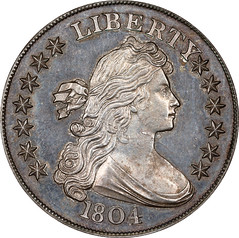

Finest Known Class III 1804 Dollar Brings $6 Million
After months of anticipation and speculation, on December 9 Stack's Bowers Galleries auctioneer Chris Ortega finally dropped the gavel on the newly discovered James A. Stack, Sr. Class III 1804 dollar, along with other rarities that have been off the market since before James A. Stack, Sr.'s death in 1951. Graded Proof-65 (PCGS) with CAC and CMQ approval, the Stack 1804 dollar brought $6 million, surpassing pre-sale estimates and setting a new world record for the issue. It nearly tripled the previous record for a Class III 1804 dollar of $2.3 million, set in 2009. (All prices include a 20% buyer's fee.)
James A. Stack, Sr., a New York textile executive who was not related to the founders of the Stack's Bowers Galleries firm, was an advanced collector of United States and world coins and currency. His wishes were that none of his coins be sold until his youngest grandchild at the time of his death turned 25. The first of the James A. Stack, Sr. sales was conducted by Stack's in 1975, with several more sales held through the 1980s and 1990s. Another James A. Stack, Sr. sale will be conducted by Stack's Bowers Galleries in February 2026.
MARK FERGUSON ON 1804 DOLLAR RESEARCH
CoinWeek published researcher Mark Ferguson's thoughts on the 1804 Dollars in an article earlier this week. Here's an excerpt - see the complete article online. -Editor

On Tuesday, December 9th, 2025, Stack's Bowers Galleries auctioned a previously unknown 1804 silver dollar, the 16th example now known.
Appearing in Session I of the James A. Stack, Sr. Collection (no relation to the auction firm), the coin sold for an astounding $6 Million (including the Buyer's Premium)
THE LAST "OMEGA" CENTS HAVE SOLD
Less enigmatic than the 1804 dollars are the "omega" cents, the ceremonial last U.S. circulating cents. Stack's Bowers sold the final cents on December 11 on behalf of the United States Mint. Here is the post-sale press release. -Editor

The very last circulating pennies, or "cents," sold for over $16.76 million in a special auction by Stack's Bowers Galleries on Thursday, December 12 th , presented on behalf of the United States Mint. Included in the sale were 232 three-coin sets featuring one each of the 2025 penny struck at the Philadelphia Mint, the 2025-D penny struck at the Denver Mint, and a historic 2025 penny struck in 24 karat gold also at the Philadelphia Mint. Each of these special coins exhibits a small "O" privy mark of the final Greek letter Omega, indicating their role as the capstone to a two-centuries long legacy that first began in 1793 with the Chain Cent.
After a slightly delayed start due to unprecedented levels of collector interest, the sale was underway with tremendous excitement stretching across nearly four hours of competitive bidding. Set #1, presented in the first lot of the sale, soared to an incredible price of $200,000 and established this as a landmark offering for the category's most elite collectors. The top price of the session was realized by Set #232, which sold for $800,000 as the last lot, and included the very last circulating penny intended for issuance struck at Philadelphia and Denver, along with the final Omega penny in gold. Also included in the lot were the three sets of canceled dies used to strike this historic series. With this $800,000 result, set #232 now ranks as the most valuable modern U.S. numismatic item, surpassing the prior record of $550,000 also set by Stack's Bowers Galleries in their sale of Space Flown 24 Karat Gold Sacagawea dollars in September 2025. The overall sale total of more than $16.76 million represents an average lot value of over $72,000 for each three-coin set, amounting to nearly 80 times the total combined gold melt value of around $210,000 at the time of the sale. In total, 17 lots each sold for more than $100,000.
THE BOOK BAZARRE
U.S. MINT SEMIQUINCENTENNIAL COIN LAUNCH
Another hot numismatic topic making the rounds of media this week was the announcement of the designs for circulating coins commemorating the U.S. semiquincentennial. First, here's a report on the launch ceremony in Philadelphia. Check out the photo gallery - coin show regulars Ben Franklin, George Washington, and Abe Lincoln were in attendance. -Editor

New coins will bring a change to your pocket change in 2026.
The United States Mint is set to roll out five new quarters and a dime to mark the nation's 250th anniversary. Officials unveiled the coins' designs at a ceremony Dec. 10 in the National Constitution Center in Philadelphia, which is next door to a U.S. Mint facility.
The U.S. Mint will make the coins at its facilities in Philadelphia and Denver. The first coins are to appear in January, but some are to debut later in the year.
UNCHOSEN SEMIQUINCENTENNIAL COIN DESIGNS
But the bulk of the discussion this week centered on Semiquincentennial designs that were NOT used. Thanks to Len Augsburger and Robert Cavalier for sending along this New York Times piece: "The War on ‘Wokeness' Comes to the U.S. Mint." Here's an excerpt - see the complete article online. -Editor

Actors surrounded Brandon Beach, the U.S. Treasurer,
and Kristie McNally, the Mint's acting secretary
George Washington was there. And Benjamin Franklin. And even Abraham Lincoln, who joked that the last time he was in a theater it did not go so well. These paid re-enactors and other dignitaries gathered the other evening in a Philadelphia auditorium for the unveiling of coins designed to celebrate the country's 250th anniversary. They provided a traditional, even simple, take on the American journey, with Pilgrims and founding fathers and a stovepipe hat tip to the Gettysburg Address.
Left unmentioned amid the event's fife-and-drum pageantry was that these coins also represented a rejection of a different set of designs — meant to commemorate certain other inspiring chapters of the nation's history, including abolition, women's suffrage and the civil rights movement.
MORE ON THE UNCHOSEN SEMIQUINCENTENNIAL COINS
The Wall Street Journal delved into the rejected Semiquincentennial coin designs. Here's an excerpt - see the complete article online. -Editor

The Trump administration jettisoned a plan to honor the abolition of slavery, women's suffrage and the civil-rights movement on quarters for the nation's 250th birthday.
Those themes were part of a proposed five-quarter special series that went through years of debate and design but was never officially announced by the U.S. Mint. They were replaced with images inspired by the Mayflower Compact, the Revolutionary War and the Gettysburg Address. Instead of Frederick Douglass, a women's suffrage marcher and Ruby Bridges desegregating an elementary school, the Mint's special quarters for 2026 will feature Presidents George Washington, Thomas Jefferson, Abraham Lincoln and James Madison, along with pilgrims glimpsing America's shores.
The final designs, unveiled late Wednesday by the Mint, come ahead of an even more controversial decision that Treasury officials have teased but not finalized: a $1 coin featuring President Trump.
ANOTHER RMS CARPATHIA GOLD MEDAL
A gold RMS Carpathia medal sold last month at Henry Aldridge Auctions. -Editor
 Henry Aldridge Auctions attracted huge headlines last month for selling the gold watch of Titanic victim Isidor Straus for £1.78 million, the highest amount ever paid for memorabilia from the doomed liner.
Another gold memento in the sale attracted few headlines, but was of interest because it came about through the goodwill of the passengers who survived when the ship sank in April 1912.
This was an RMS Carpathia gold medal, one of the rarest medals relating to the Titanic story.
Shown on the medal's front is the Carpathia steaming to the aid of Titanic's lifeboats amid a sea of icebergs. The scene is framed by King Neptune's head and beard and a fouled anchor and hailing trumpet motif at the bottom.
The reverse bears an engraved inscription to an unknown officer.
A VIRGINIA TYPE 2 NATIONAL BANK NOTE RARITY
Stack's Bowers Currency Specialist & Lead Currency Cataloger Bradley Charles Trotter published an article about a rare Virginia National Bank Note. -Editor

While some may see a well-circulated note that should have been redeemed long ago in the 1930s, this lot is actually one of the rarest National Bank Notes representing the Commonwealth of Virginia in the National Bank Note Census.
At left, is the imprint of the Citizens National Bank of Hampton (Charter# 13775) alongside a familiar portrait of Benjamin Franklin. However, seen at the end of the serial numbers overprinted in brownish ink is "13775," which underscores the reason why this note is special.
1670 HUDSON'S BAY COMPANY ROYAL CHARTER SOLD
The unique and historically important 1670 Hudson's Bay Company Royal Charter has been sold and placed with Canadian museums and archives. -Editor

The 1670 Hudson's Bay Company Royal Charter, considered among one of Canada's founding documents, has been sold for C$18m ($13m; £9.6m) to two of the country's richest families.
The 355-year-old charter, which granted the Hudson's Bay Company wide-ranging powers over large swaths of what is now Canada, ended up at auction when the corporation filed for bankruptcy over the summer.
The offer by firms owned by the Weston family and David Thomson, chairman of Thomson Reuters, will keep the historically significant document in Canada.
SECRET BOOKS MADE UP BY AI
As researcher Pete Smith noted with his question for readers elsewhere in this issue, research is um, hard. It takes brainpower, hard work, and lots of checking of sources. People should be lauded for calling libraries to request copies of references cited by AI chatbots, but some of them don't want to take "no" for an answer. -Editor
Never heard of the Journal of International Relief or the International Humanitarian Digital Repository? That's because they don't exist.
But that's not stopping some of the world's most popular artificial intelligence models from sending users looking for records such as these, according to a new International Committee of the Red Cross (ICRC) statement.
JUST USE THE BANKNOTE TELEPORTER
Despite the rise of artificial intelligence, there's still plenty of natural stupidity to go around without it. A man in Japan was a little unclear on the concept of banking. -Editor
 According to the Shiga Prefectural Police, on 5 December, a 53-year-old office worker received phone calls and video calls over the popular Japanese messaging app Line from men claiming to work for a major telecom company and a man posing as an officer from the Hyogo Prefectural Police.
The victim was told that 40 million yen was deposited and then withdrawn from a bank account in his name, implicating him in a potential crime. They then told him they needed to confirm the serial numbers on the banknotes in his account to know for sure. To do this, he would have to transfer the money from his bank account to theirs, so they could examine his bills and then transfer them back.
ABOUT THIS ISSUE: DECEMBER 14, 2025
It's full-blown holiday party season. Last year I didn't get on a scale until New Year's Day, and I was shocked, SHOCKED to discover that I'd gained weight. Well, not shocked that I had gained weight, but by how shockin' much. I got on the wagon and dropped over 20 pounds by May before diet fatigue set in. But I was still watching the scale and leveled off for a couple months before another "growth spurt" in August when family birthdays and travel got the best of me, like they do every year. I was happy to level off again in the fall. Hopefully I can still arrive at New Year's Day lower than last year. But my wife and daughter made Christmas cookies this weekend and it would be rude not to have a few...
Among the funnier things I came across this week were these from the Good Clean Funnies list:
- Medical experts are now saying obesity is a disease. I'm overjoyed! Tomorrow I'm calling in fat.
- Am I ambivalent? Well, yes and no.
Also, these to-do list items attributed to comedian Steven Wright:
- Buy a parrot. Teach the parrot to say "Help! I've been turned into a parrot!"
- Run into a store, ask what year it is. When someone answers, yell "It worked!" and run out cheering.
Here are some interesting non-numismatic items I came across this week. One on the "robot smaller than grain of salt" has a video showing it in relation to the size of a U.S. cent. What will we use for this purpose without pennies?

Robot smaller than grain of salt can ‘sense, think and act' (https://www.washingtonpost.com/health/2025/12/12/robot-miniature-tiny-solar-computer/)
The Rembrandt Thief Who Came Out On Top (https://hyperallergic.com/the-rembrandt-thief-who-came-out-on-top/)
In a First, AI Models Analyze Language As Well As a Human Expert (https://www.quantamagazine.org/in-a-first-ai-models-analyze-language-as-well-as-a-human-expert-20251031/)
Finally, Tuesday, December 9th was the anniversary of the 1968 "Mother of All Demos" by SRI's Doug Engelbart and team. -Editor
Highlights and descriptions of the December 9, 1968 demo by Douglas Engelbart and his team at SRI (at the time called Stanford Research Institute). It was the first public demonstration of the computer mouse and fundamentals of modern computing. The demo included the world debut of personal and interactive computing, featuring a computer mouse that controlled a networked computer system to demonstrate hypertext linking, real-time text editing, multiple windows with flexible view control, cathode display tubes, and shared-screen teleconferencing.



Editor Wayne Homren, Assistant Editor Garrett Ziss

|
|
| |