Visit our NBS Sponsors











About UsThe Numismatic Bibliomania Society is a non-profit association devoted to the study and enjoyment of numismatic literature. For more information please see our web site at coinbooks.org SubscriptionsThose wishing to become new E-Sylum subscribers can go to the following web page
Subscribe
MembershipThere is a membership application available on the web site Membership Application To join, print the application and return it with your check to the address printed on the application. Print/Digital membership is $40 to addresses in the U.S., and $60 elsewhere. A digital-only membership is available for $25. For those without web access, write to: Jeff Dickerson, Treasurer AsylumFor Asylum mailing address changes and other membership questions, contact Jeff at this email address: treasurer@coinbooks.org SubmissionsTo submit items for publication in The E-Sylum, write to the Editor at this address: whomren@gmail.com 
BUY THE BOOK BEFORE THE COINSale Calendar
|
- WAYNE'S WORDS: THE E-SYLUM FEBRUARY 15, 2026
- KOLBE & FANNING SALE 176 HIGHLIGHTS
- NEW BOOK: PAPER CURRENCY OF HYDERABAD
- PERIODICAL: ORIENTAL NUMISMATIC SOCIETY WINTER 2025
- JOHN R. MELVILLE-JONES (1933–2026)
- JOSEPH ALI DOW (1940-2026)
- DR JOHN RAINEY MBE (1951-2026)
- NNP ADDS AMERICAN TAX TOKEN SOCIETY NEWSLETTERS
- VIDEO: 2016 EAC BOURSE CHAIRMAN JOHN KRALJEVICH
- 2026 TRIAL OF THE PYX HELD AT MANSION HOUSE
- MORE ON THE FIRST OLYMPIC MEDAL
- NOTES FROM E-SYLUM READERS: FEBRUARY 15, 2026
- MODEL DORIS BAUM AND KARL BITTER'S POMONA
- DICK JOHNSON AND NUMISMATIC LITERATURE
- OHIO WELCOMES ANS RELOCATION
- VOCABULARY TERM: SHAPE
- NUMISMATIST MIRRORS
- HERITAGE: ITALY WORLD COINS SHOWCASE
- ARCHIVES INTERNATIONAL SALE 111 SELECTIONS
- KUENKER AUCTION SALES 438-441, PART ONE
- THE TRADE DOLLAR'S LINK TO OPIUM TRAFFICKING
- MAKING CHANGE AT THE LINCOLN PRESIDENTIAL LIBRARY
- CHARTERS OF FREEDOM DECLARATION COIN
- $2.50 SEMIQUINCENTENNIAL COIN PROPOSAL
- HERITAGE: MASSACHUSETTS HORTICULTURAL SOCIETY
- 1978 CAMP DAVID ACCORDS PEACE MEMORIAL
- PUERTO RICAN PAPER MONEY
- HOW TO START A COIN COLLECTION
- ABOUT THIS ISSUE: FEBRUARY 15, 2026
Content presented in The E-Sylum is not necessarily researched or independently fact-checked, and views expressed do not necessarily represent those of the Numismatic Bibliomania Society.
WAYNE'S WORDS: THE E-SYLUM FEBRUARY 15, 2026
 New subscribers this week include:
Mitchell G. Davis, and
Cho Chun Loong.
Welcome aboard! We now have 6,682 subscribers.
New subscribers this week include:
Mitchell G. Davis, and
Cho Chun Loong.
Welcome aboard! We now have 6,682 subscribers.
Thank you for reading The E-Sylum. If you enjoy it, please send me the email addresses of friends you think may enjoy it as well and I'll send them a subscription. Contact me at whomren@gmail.com anytime regarding your subscription, or questions, comments or suggestions about our content.
This week we open with numismatic literature sale highlights, one new book, a periodical, three obituaries, updates from the Newman Numismatic Portal, and more.
Other topics this week include paper currency of Hyderabad and Puerto Rico, the American Tax Token Society, the Trial of the Pyx, Dick Johnson, the ANS move to Ohio, numismatist mirrors, Trade Dollars and the opium trade, the proposed new $2.50 coin, and How to Start a Coin Collection.
To learn more about Numismatic Notes and Monographs, Lorin G. Parmelee's collection, Muhr countermarks, Dr. John Rainey, tax tokens, the first Olympic medal, the Year of the Fire Horse, Karl Bitter's Pomona, auction selections, making change at the Lincoln Presidential Library, and Horticultural Society Award Medals, read on. Have a great week, everyone!
Wayne Homren
Editor, The E-Sylum

Image of the week
KOLBE & FANNING SALE 176 HIGHLIGHTS
Here are some highlights from Kolbe & Fanning's upcoming February 28 numismatic literature sale. -Garrett
 The 50th anniversary auction of Kolbe & Fanning Numismatic Booksellers is being held on Saturday, February 28, 2026. The sale celebrates the 50th anniversary of the first mail-bid sale held by our founder, George Frederick Kolbe, on February 28, 1976. The sale features a wide array of rare and out-of-print works on ancient, world and U.S. numismatics, including a selection of works from Kolbe's personal library.
Some highlights of the sale include:

Lot 5
Lot 5: a complete set of Numismatic Notes and Monographs, comprising 172 monographs published on a variety of numismatic subjects by the ANS from 1920 to 2020
NEW BOOK: PAPER CURRENCY OF HYDERABAD
A new book has been published on the paper currency of Hyderabad, India. Found via News & Notes from the Society of Paper Money Collectors (Volume XI, Number 35, February 10, 2026). -Editor
 Bengaluru-based numismatist Rezwan Razack's latest book, ‘Paper Money of the Princely State of Hyderabad', was launched last Saturday. It traces the story of Hyderabad's currency from the time of the first Nizam in 1724 to its withdrawal in 1959.
The book is a result of three years of in-depth research and builds on his 25-year study of Indian paper money. With little material available online, he relied on frequent visits to Hyderabad, where he explored archives and interacted with dealers, private collectors, and professionals at auction houses.
The book features over 600 photographs of notes, design patterns, and archival material. It goes beyond simple cataloguing and documents details of design, printing, packaging, circulation, and forgery of notes.
It also recounts the 1920 sinking of the SS Egypt, which was carrying Hyderabad notes printed in England, many of which were later salvaged.

PERIODICAL: ORIENTAL NUMISMATIC SOCIETY WINTER 2025
The Winter 2025 issue of the Journal of the Oriental Numismatic Society has been published. -Garrett
 Journal of the Oriental Numismatic Society
262 | Winter 2025
Editorial
Paula Turner
XRF and other new evidence on the dating of the boar/lion coins of Bactria
Pankaj Tandon
The Western K?atrapa ruler Visvasi?ha and a (not so) new Brahmi inscription
Shailendra Bhandar

JOHN R. MELVILLE-JONES (1933–2026)
The American Numismatic Society submitted this announcement of the passing of author John R. Melville-Jones. I added some images. -Editor
In Memory of John R. Melville-Jones (1933–2026)
 The ANS is deeply saddened to learn of the passing of John R. Melville-Jones AM, ANS
Life Fellow, and Emeritus Professor in the Department of History and Classical Studies
at the University of Western Australia.
The ANS is deeply saddened to learn of the passing of John R. Melville-Jones AM, ANS
Life Fellow, and Emeritus Professor in the Department of History and Classical Studies
at the University of Western Australia.
Born in the United Kingdom, Melville-Jones was a graduate from the University of Cambridge and earned his Ph.D. from the University of Western Australia in 1963. While at the University of Western Australia, he became a junior lecturer, first teaching Ancient Greek history and language. He went on to become a well-known educator in numismatics, particularly ancient Greek and Roman coinage. His seminal book Testimonia Numaria: Greek and Latin Texts Concerning Ancient Greek Coinage (vol. 1, Spink, 1993; vol. 2, Spink, 2007) has become a resource that many researchers keep within arm's reach when studying the nature of ancient money. His other prominent publications include A Dictionary of Ancient Greek Coins (Seaby, 1986), A Dictionary of Ancient Roman Coins (Seaby, 1990), and Testimonia Numaria Romana: Greek and Latin Texts Concerning Roman Coinage (Spink, 2023), which have been used by numerous students and collectors.
JOSEPH ALI DOW (1940-2026)
Joseph A. Dow, author of Ancient Coins through the Bible, has passed. Here's an excerpt from his obituary. -Editor
 Joseph A. Dow, age 85, passed away Thursday, February 5 at Mercy Hospital in Oklahoma City. Joseph was born March 17, 1940 in the city of Latakia, Syria to Ali and Zaynab Dow. He immigrated to the gulf coast of the United States when he was 25, where a few years later he met his wife and lifelong partner, Marjorie Havard Dow.
Joseph graduated from Louisiana State University with a Bachelor of Science in Petroleum Engineering. His true passion was, however, history. He was an accomplished numismatic scholar, lifetime member of the American Numismatic Association, and published author on biblical coins.
He loved his friends and family deeply and cared greatly for his community. He served as treasurer on his neighborhood homeowners association and led a Bible study group at his church. Joseph was a devoted husband and adoring father. His warmth, selflessness, and care left its mark on everyone who knew him.

DR JOHN RAINEY MBE (1951-2026)

Dr John Rainey, chairman of Denman and Denroy
On Tuesday, February 10, 2026, Keith Mawhinney, Secretary of the Numismatic Society of Ireland (Northern Branch) wrote:
"It is with deep sadness that I need to inform you of the passing of Dr. John Rainey early this morning. John was the current vice-Chair the Numismatic Society of Ireland (Northern Branch) and an important and enthusiastic member since its founding. He will be very much missed.
"As a mark of respect, the Members' meeting scheduled for the 13th February been cancelled."
Thanks to Darryl Atchison for passing along this news. -Editor

NNP ADDS AMERICAN TAX TOKEN SOCIETY NEWSLETTERS
The latest addition to the Newman Numismatic Portal is a set of the American Tax Token Society Newsletter. Project Coordinator Len Augsburger provided the following report. -Editor

Newman Portal Adds American Tax Token Society Newsletters
Courtesy of John Ostendorf, NNP has added the American Tax Token Society (ATTS) Newsletters for the years 2011-2025, completing a 50+ year run of the publication that began in 1971. The ATTS concluded its operation at the end of 2025, and the club leaves an extensive legacy of related research.
For those not familiar, tax tokens represent a short-lived fiscal convenience created to handle fractional sales taxes that arose when states and municipalities imposed rates like 1%, 2%, or 3% on low-priced goods. States authorized inexpensive metal or fiber tokens, typically valued at 1 mill (one-tenth of a cent), to make exact change possible. Retailers used these tokens to collect the precise tax due, then returned them in bulk to state tax authorities or wholesalers for redemption. Their use peaked in the late 1940s and early 1950s, and faded as prices rose, rounding rules were adopted, and tax rates were adjusted to avoid fractions. Today, tax tokens hearken to an era when a penny remained substantial enough that splitting it into further parts actually made sense (pardon the pun).

VIDEO: 2016 EAC BOURSE CHAIRMAN JOHN KRALJEVICH
The David Lisot Video Library on the Newman Numismatic Portal can be found at:
https://nnp.wustl.edu/library/multimediadetail/522852
We highlight one of his videos each week in The E-Sylum. Here's one from 2016 with EAC Show Chairman John Kraljevich. -Editor


2026 TRIAL OF THE PYX HELD AT MANSION HOUSE
The Royal Mint's ancient ceremony, the Trial of the Pyx, has been held in a new venue this year, only the second time since 1871 that it has been held outside of Goldsmiths' Hall. -Editor
The Royal Mint has submitted 7,838 coins for testing at one of the UK's oldest judicial ceremonies, the Trial of the Pyx.
For the first time, this has been held for the first time in its 777-year history at Mansion House in the City of London.
The official residence of the Lord Mayors of the City of London since 1752, in November 2025 Mansion House became home to the first Lady Mayor, Dame Susan Langley, DBE.
A freeman of the Goldsmiths' Company, the Lady Mayor welcomed spectators to the Egyptian Hall, which is based on designs by the classical Roman architect Vitruvius of Roman buildings in Egypt.

MORE ON THE FIRST OLYMPIC MEDAL
Jeff Pritchard submitted these notes of the 1896 Olympic medal discussed last week. Thank you. -Editor

As we're still watching our Olympic team compete for gold, I thought I'd follow up to the 1896 Olympic medal portrayed in last week's E-Sylum currently offered for sale by Danish auction house Bruun Rasmussen. The 1896 silver Olympic medals were only awarded to the winners of the 43 events which were held in nine different sports. Engraved by Jules-Clement Chaplain, the Paris Mint's official medalist at the time, the medals were struck, had a dull or brushed finish, and measured 50 millimeters in diameter.
The medal's obverse portrays Zues with beard and curling hair, often remarked for its similarity to the famous mask of Jupiter found at Otricoli, Italy, and now housed in the Vatican Museum. In his right hand Zues holds a globe upon which balances the winged figure of Victory holding a laurel branch. On the left is a perpendicular "Olympia" in Greek. The reverse portrays the Acropolis topped with the ruins of the Parthenon, with the Propylaea to the left. On the far left, barely visible, rises the peak of Corydallus, from which, according to legend, Xerxes viewed the Battle of Salamis and the destruction of his Persian fleet. The Greek legend atop the reverse reads, "International Olympic Games," and in the exergue, in two lines, it reads, "At Athens, 1896."

NOTES FROM E-SYLUM READERS: FEBRUARY 15, 2026
More on the Keinen Mann, Keinen Pfennig Poster

Regarding the question by Steve Roach about the German Poster "Keinen Mann, Keinen Pfennig", Ron Guth writes:
"The poster promotes a referendum (Volksbegehren) that opposed remilitarization during the Weimar Republic. The Treaty of Versailles, imposed on Germany following World War I, severely restricted the size of Germany's army and its war machine. The Germans chafed under the restrictions and began to secretly rearm. The illustration of the front of a battleship and the printing date of 1928 most likely relates to the construction (beginning in 1929) of three battleships: Deutschland, Admiral Scheer, and Admiral Graff Spree. Though the Treaty of Versailles permitted construction of these ships, the Germans violated the specifications and made the ships heavier and larger than allowed. Any referendum to prevent their production failed, as all three ships were completed and all three went on to see service in World War II.
"The German Pfennig illustrated is of the type issued between 1923 and 1936, which spanned the period from the early years of the Weimar Republic to the third year of the Nazi government. This fits in with the reported printing date of 1928."
Thank you! E-Sylum readers are a smart bunch. -Editor
To read the earlier E-Sylum article, see:
NOTES FROM E-SYLUM READERS: FEBRUARY 8, 2026 : Keinen Mann, Keinen Pfennig Poster
(https://www.coinbooks.org/v29/esylum_v29n06a18.html)
Other topics this week include Philip Skingley, the Foxfire Collection catalog, Quantitative Coin Grading, and a Franklin Peale Galvano. -Editor
MODEL DORIS BAUM AND KARL BITTER'S POMONA
Mike Costanzo submitted this article about another present-day connection to Doris Baum, who modeled for the Standing Liberty Quarter. -Editor
 In Sara Cedar Miller's 2003 book, Central Park, An American Masterpiece, Miller revealed a
numismatic tidbit regarding model Doris Discher Baum, who posed for Herman MacNeil's
Standing Liberty quarter. While the controversy surrounding the identity of MacNeil's model is
well known, Baum apparently kept her involvement with another statue a secret as well.
In Sara Cedar Miller's 2003 book, Central Park, An American Masterpiece, Miller revealed a
numismatic tidbit regarding model Doris Discher Baum, who posed for Herman MacNeil's
Standing Liberty quarter. While the controversy surrounding the identity of MacNeil's model is
well known, Baum apparently kept her involvement with another statue a secret as well.
In 1916, the Pulitzer Fountain was dedicated at Fifth Avenue and 59th Street, along the outskirts of Central Park. The fountain featured a statue of Pomona, the Roman goddess of abundance. While working on the figure, sculptor Karl Bitter was killed in a car accident, and an assistant completed the piece. For whatever reason, Baum chose to keep her identity a secret and later revealed it along with her revelation that she also posed for a piece of American coinage.
Miller's text reads:
DICK JOHNSON AND NUMISMATIC LITERATURE
A longtime subscriber offers these thoughts on Dick Johnson, numismatic literature and The E-Sylum as Dick's library comes to market. Thank you! -Editor
Twenty-six years ago Fred Lake said he was going to "sign-me-up" to a new and really helpful online publication, and in the January 23, 2000 E-Sylum you announced that I was one of four new subscribers, bringing the total to 275.
You've done a great job, Wayne, with a lot of dedicated time, and with remarkable consistency as well from week-after-week . . . and I also think you're a great dad to take your daughter to Switzerland for a Taylor Swift concert!
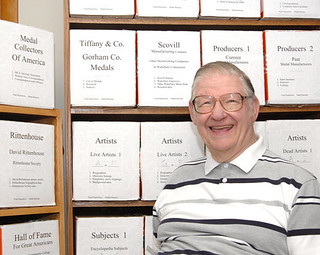 My friend and shoreline neighbor Bryce Brown started to sell Dick Johnson's library in January. You also had a related announcement in a recent E-Sylum. Dick was a prolific E-Sylum contributor. When he died a few years ago at age 90 (D. Wayne Johnson, August 27, 1930 – December 29, 2020) there were many kind tributes to him. However, I don't know if anyone included a photo of Dick on the front page of the March 1960 Volume 1, Whole No. 0 "Sample Edition" of the first issue of Coin World, for which Dick served as Coin World's first editor. The newspaper made its debut with the announcement: "The first weekly newspaper devoted entirely to coins and coin collecting, the Coin World will be published and edited by experienced newspaper people."

OHIO WELCOMES ANS RELOCATION
Ohio media are warming up to the impending relocation of the American Numismatic Society to Toledo. Here's an excerpt of a story published last week - see the complete article online. -Editor

ANS New York Headquarters in 1909
In 1858, the American Numismatic Society was founded by a 16-year-old coin enthusiast in his family apartment in Manhattan. It has since transformed from one hobbyist's passion project into an extensive collection of coins and medals, and now attracts scholars from all over the world.
But the rising cost of living and real estate in New York eventually became an unsustainable burden for the group.
Seeking a new home that better suited their financial and spatial needs, the ANS executive director, Ute Wartenberg Kagan, began looking beyond the island of Manhattan. Ultimately, the solution didn't come from a boardroom or a broker — it came from a fifteen-minute phone call with an old friend.
Now, after 168 years in New York, the ANS and its historic collection are moving their headquarters to Toledo.
VOCABULARY TERM: SHAPE
Here's another entry from Dick Johnson's Encyclopedia of Coin and Medal Terminology. -Editor
Shape. The outer configuration of a numismatic or medallic piece. Most struck numismatic pieces are, of course, round (see circular form) and are formed by blanking or turning off. While most medallic items are also round, some are noncircular and are formed by trimming, jigsawing or silhouetting (see unusual shape). Shape has considerable impact on the meaning of the item; round items are traditional, sensuous and utilitarian. Unusual shapes are symbolic, assertive, and beauteous. Shape not only adds to the symbolic nature of these medallic items, but also adds to their charm, and in the case of a talisman or amulet, to their mysticism. Product shape adds to their commercial appeal, often a token of the product indicated; map shape emphasizes a geographical outline.

NUMISMATIST MIRRORS
E-Sylum Feature Writer and American Numismatic Biographies author Pete Smith submitted this article on Numismatist Mirrors. Thanks! -Editor
This week I return to my occasional articles on numismatic association items. I suspect that most E-Sylum readers are not familiar with the extent of numismatist mirrors. All items illustrated are from my collection.
Typical numismatist mirrors are round and 2.25 to 2.5 inches in diameter. One side has a glass mirror with the other side a steel shell, a printed image and a plastic cover. The machine to make them is also used to make pinback buttons. The machine to make them is sold by Badge-a- Minute Company to individuals who want to make up a small quantity.
HERITAGE: ITALY WORLD COINS SHOWCASE
Heritage Auctions will be hosted their Italy World Coins Showcase auction today, February 15. Select items are discussed below. -Garrett


Republic gold Prova 20 Lire 1925-R MS62 NGC, Rome mint, Pag-565. "PROVA DI STAMPA" on reverse. Mintage: 75. The accompanying Prova 10 Lire we have in this sale. Very rare.
ARCHIVES INTERNATIONAL SALE 111 SELECTIONS
Here are some selected lots from the February 17, 2026 sale by Archives International Auctions. -Garrett


Ethiopia…., 1932. 50 Thalers, P-9, Issued Banknote, Blue-green on m/c underprint, Lion at center with bank building at upper left and arms at right, Back is m/c, S/N C/1 08066, PMG graded Choice Very Fine 35 with comment "Minor Rust," BWC. This is the highest graded example to be offered at auction since 2022, where 2 different examples sold for over $2000 each, one graded a PMG 20 and the second graded PMG 45. A lovely note that is sure to attract attention.
THE BOOK BAZARRE
KUENKER AUCTION SALES 438-441, PART ONE
Künker's Spring Auction Sales feature many highlights – from ancient coins with extensive selections of Celtic and Byzantine issues, to early modern coins from Denmark, the Habsburgs, Malta, Norway, Poland, Württemberg, Saxony, Saxe-Coburg-Gotha and the Habsburg Empire, as well as orders from the estate of Duke Wilhelm in Bavaria. Here's the first part of the press release for sales 438-441. -Garrett
Künker is the place to go when it comes to selling large and important collections. Many collectors know this, as is demonstrated once again by Künker's upcoming Spring Auction Sales. They will be held from 16 to 20 March 2026 and contain numerous important and extensive collections.
Coins from the Ancient World
Auction 438 with coins from the ancient world is dominated by three large collections. On offer are the Topp / Dormagen Collection, the Jürgen and Erika Schmidt / Bovenden Collection as well as the Everglades Collection. Anyone who loves ancient coins will find carefully selected specimens from all areas that will make a collector's heart beat faster.
THE TRADE DOLLAR'S LINK TO OPIUM TRAFFICKING
Recently we excerpted articles by Eric Brothers on the Silver Panic of 1893 and Bust Half Dollars in the China Trade. He also published a nice piece on the Trade Dollar's link to opium trafficking in the May 2023 issue of The Numismatist. Eric submitted these notes on researching and writing that article. Thank you! -Editor
 In 2020, I was researching an article for The Numismatist debunking the tired myth that the
U.S. Trade dollar was an overall failure; it was a success in the Orient for its intended purpose
as an instrument of international trade. Nonetheless, while working on that article I
discovered two sources that grabbed my interest. They were both from the American Journal
of Numismatics, which was published from 1866-1924. I consider the Journal to be among the
best published numismatic source material available. Those two sources were the spark for
my researching and writing a different article: "Blood Money: America's Role in the Opium
Trade" (The Numismatist, May 2023).
In 2020, I was researching an article for The Numismatist debunking the tired myth that the
U.S. Trade dollar was an overall failure; it was a success in the Orient for its intended purpose
as an instrument of international trade. Nonetheless, while working on that article I
discovered two sources that grabbed my interest. They were both from the American Journal
of Numismatics, which was published from 1866-1924. I consider the Journal to be among the
best published numismatic source material available. Those two sources were the spark for
my researching and writing a different article: "Blood Money: America's Role in the Opium
Trade" (The Numismatist, May 2023).
I am including the first two paragraphs of "Blood Money" below. Material from the two sources are incorporated into these paragraphs.
It was in late 1875 that a report in a San Francisco newspaper discussed the U.S. Trade dollar's link to opium trafficking. Devised to compete with the Mexican dollar for trade in China, once the coinage arrives there, "it encounters an ignominious fate. The Chinese send it to India for the purchase of opium. They go into the Calcutta Mint and come out as rupees," according to the article.
MAKING CHANGE AT THE LINCOLN PRESIDENTIAL LIBRARY
Even the Abraham Lincoln Presidential Library and Museum has to come to terms with the phaseout of the Lincoln cent. -Editor

At the Abraham Lincoln Presidential Library and Museum in Springfield, visitors can shop for sweatshirts, pillows, jewelry and chocolates using coins bearing the face of perhaps the most-famous Illinoisian, Abraham Lincoln.
But even here, pennies are growing scarce at the cash register.
The museum gift shop, like the rest of the country, is grappling with a penny shortage after the United States Mint halted production of the coin in November, citing the rising cost of producing them.

CHARTERS OF FREEDOM DECLARATION COIN
While circulating coin designs have gotten a lot of attention lately, they're not the only new U.S. Mint products. Here's a February 4th press release about the 2026 Charters of Freedom Platinum Proof Coin – Declaration of Independence. -Editor


The United States Mint announced today that it is releasing the first coin in the three-year Charters of Freedom Platinum Proof Coin Series on Friday, February 6, 2026, at noon EST. The first coin in the series is the 2026 Charters of Freedom Platinum Proof Coin – Declaration of Independence (product code 26EJ. Each coin is encapsulated and then placed in a stylish clamshell and presentation box. It is accompanied by a certificate of authenticity bearing an image of the obverse. Orders are limited to one coin per household for the first 24 hours of sales. The mintage is limited to 15,000 units.
American Eagle Gold, Platinum, and Palladium Coins are priced according to the United States Mint's Pricing Policy.

$2.50 SEMIQUINCENTENNIAL COIN PROPOSAL
The U.S. House passed legislation calling for a $2.50 coin for the 250th anniversary of the nation. I've also linked to a Greysheet article by Larry Jewett. -Editor

In honor of the signing of the Declaration of Independence 250 years ago, the U.S. House unanimously approved legislation Monday to make $2.50 coins to commemorate the anniversary.
The bicameral, bipartisan $2.50 for America's 250th Act would authorize the U.S. Treasury to mint a collectible $2.50 commemorative coin this year. Rep. Robert Aderholt, R-Haleville, sponsored the bill.
"This coin will memorialize and celebrate our moment in American history," Aderholt said on the House floor.
The legislation also calls for a viability study on a potential circulating $2.50 coin for everyday use. The coins would feature the historical design originally issued for America's 150th anniversary coins.

HERITAGE: MASSACHUSETTS HORTICULTURAL SOCIETY
Heritage published the following article in their latest Coin News email entitled Massachusetts Horticultural Society Award Medals. -Garrett


The Massachusetts Horticultural Society was founded in 1829, and from the beginning some of its primary objectives were "recognition and reward for accomplishments in horticulture." Initially, awards were generally cash prizes given to individuals who were recognized as advancing the Society's objectives. However, in 1845, award medals began to be issued.
The Society's medals and awards went through numerous changes over the course of the ensuing century, not only in design and purpose, but in how liberally they were handed out. By the early 20th century, cash prizes were entirely replaced, and the medal system was redefined.
1978 CAMP DAVID ACCORDS PEACE MEMORIAL
Jim Haas submitted these notes about the 1978 Camp David Accords Peace Memorial medal by Domenico Mazzone. Thank you. -Editor


80.218.1 Jimmy Carter Library and Museum, Atlanta, GA
This is a photo of the Peace Memorial medal modeled by sculptor/artist Domenico Mazzone in 1978 to commemorate the Camp David Accords. On the obverse of the 1¼" bronze medallion are three bas-relief portraits of Prime Minister Menachem Begin of Israel, President Jimmy Carter and Egyptian President Anwar Sadat and the word peace in Hebrew, Egyptian and English. On the reverse is seen a stylized Pyramid on which appears the word Peace in both Hebrew and Egyptian along with a rendering of the stone tablets on which are inscribed the Ten Commandments. The branches and tree leaves are symbolic of the Nile River, the life-source of Egypt and the pharaohs. I do not know the number of copies that were made, but how one came into my possession a quarter century ago has a backstory.

PUERTO RICAN PAPER MONEY
Stack's Bowers Director of World Currency Auctions Aris Maragoudakis published an article summarizing the interesting history of Puerto Rican paper money. Here's an excerpt - see the complete article online. -Editor

Puerto Rico has a rich paper money history. They were the first jurisdiction in the New World to issue local paper money because of a shortage of silver currency that was largely due to piracy. This was the beginning of Puerto Rico's lengthy history of lacking resources due to outside forces.
Provisional paper money known as tengos or papeletas as well as loans from merchants were adopted to confront this emergency. These items were prone to counterfeiting due to their simplicity, which prompted an official issuance of paper money for Puerto Rico in 1766. (Pedro Tomás de Córdova in 1832)
While there are records of the money from 1766, there are no surviving examples known. The earliest discovered example of this type of currency is a 1781 issue of the 8 Reales which would be a second issue in 1769 under Governor Muesas.

HOW TO START A COIN COLLECTION
Donn Pearlman was interviewed for a nice article on "How to start a coin collection." Great advice - I passed it along to an old boss who'd reached out to me about beginning to collect. You could do the same - who do you know who might be interested in starting a collection? Here's an excerpt - see the complete article online. -Editor

This year, the Federal Reserve will begin officially "phasing out" the penny. The plucky little copper-colored coin used to be able to fetch you a piece of candy from the corner store. Then it was found mostly tucked into loafers and floating at the bottom of wishing wells and fountains. As much as we hate to see them go, you have to admit you haven't had an actual use for a penny in years…unless you found one on the street (face up, of course) and picked it up hoping for a good luck boost.
But the idea that a coin could do its duty and then be retired might spark something else in you–maybe a desire to find more out-of-date and discontinued coins. Maybe this leads you to dig into the history of coin production, and the hidden secrets and details that distinguish one from another. Before you know it, you might want to become a full-fledged coin collector. A numismatist, if you want to use the proper term.
ABOUT THIS ISSUE: FEBRUARY 15, 2026
It finally warmed up above freezing this week, melting some of the snow. All day today it rained, which melted even more and washed away some of the salt and dirt. I got out Friday night, taking my wife to a comedy show at a brewery, and Saturday we went out for a nice Valentine's dinner. Nothing numismatic to report other than the usual flood of E-Sylum email.
Here are some interesting non-numismatic articles I came across this week. A history of early photo manipulation shows that AI fakes are nothing new - just another outlet for human creativity and mischief.
And it's come to this: "28% of pupils were not able to use books correctly – for example, they were trying to swipe or tap pages like a phone or tablet." That reminds me of a line from Woody Allen's "Take the Money and Run," where his cello teacher recalled he had "no concept of the instrument...he was blowing into it."
One in four children in England start school without being toilet trained, say teachers (https://www.theguardian.com/education/2026/jan/22/children-england-start-school-without-being-toilet-trained-teachers)
Rijksmuseum unveils 'FAKE!' - A history of early photo manipulation (https://artdaily.cc/news/190870/Rijksmuseum-unveils--FAKE-----A-history-of-early-photo-manipulation)
The Internet Was Imagined Before World War I (https://3quarksdaily.com/3quarksdaily/2026/02/the-internet-was-imagined-before-world-war-i.html)
David J. Farber, ‘Grandfather of the Internet,' Dies at 91 (https://www.nytimes.com/2026/02/14/technology/david-farber-dead.html)
Phonographs, Player Pianos and Betamax: The Inventions That Transformed Entertainment (subscription required) (https://www.wsj.com/business/media/10-inventions-entertainment-phonograph-streaming-a7b97be6)
The oldest building in Virginia is set to undergo a restoration Bacon's Castle is the oldest brick dwelling in North America. (https://www.pilotonline.com/2026/02/11/bacons-castle-restoration/)
What separates a lake from a pond? What about creeks and rivers? (https://www.washingtonpost.com/business/2026/02/09/department-of-data-lake-vs-pond/)
And these words of wisdom: "When you're dead, you don't know you're dead. The pain is felt by others. The same thing happens when you're stupid."
-Editor


Editor Wayne Homren, Assistant Editor Garrett Ziss

|
|
| |