Visit our NBS Sponsors










About UsThe Numismatic Bibliomania Society is a non-profit association devoted to the study and enjoyment of numismatic literature. For more information please see our web site at coinbooks.org SubscriptionsThose wishing to become new E-Sylum subscribers can go to the following web page
Subscribe
MembershipThere is a membership application available on the web site Membership Application To join, print the application and return it with your check to the address printed on the application. Print/Digital membership is $40 to addresses in the U.S., and $60 elsewhere. A digital-only membership is available for $25. For those without web access, write to: Jeff Dickerson, Treasurer AsylumFor Asylum mailing address changes and other membership questions, contact Jeff at this email address: treasurer@coinbooks.org SubmissionsTo submit items for publication in The E-Sylum, write to the Editor at this address: whomren@gmail.com 
BUY THE BOOK BEFORE THE COINSale CalendarWatch here for updates! |
- WAYNE'S WORDS: THE E-SYLUM DECEMBER 14, 2025
- REMINDER: LANG NUMISMATIC LITERATURE AUCTION 9
- NEW BOOK: THE ENIGMATIC LINCOLN CENTS OF 1922
- NEW BOOK: PAST TENSE
- NEW BOOK: WHEN COINAGE WAS BORN
- NEW BOOK: SAMARIAN COINAGE FROM THE PERSIAN PERIOD
- NEW BOOK: OUR OWN COINAGE
- NEW BOOK: SAN FRANCISCO HISTORY THROUGH ITS EXONUMIA
- NEW BOOK: MONROE, MICHIGAN COLLECTIBLE COLLECTIONS
- PERIODICAL: NUMISMATIQUE ASIATIQUE NO. 55
- VIDEO: TOPICAL COLLECTING OF WORLD COINS
- NOTES FROM E-SYLUM READERS: DECEMBER 14, 2025
- VOCABULARY TERM: SCREW MEDAL
- 100-YEAR-OLD NUMISMATISTS
- QUERY: EDMUND DELAURENTIS
- ARCHIVES INTERNATIONAL SALE 109 SELECTIONS
- HERITAGE: 1804 CLASS III DOLLAR AT FUN
- CNG: TRITON XXIX AUCTION
- FRANK S. ROBINSON AUCTION 130
- STACK CLASS III 1804 DOLLAR BRINGS $6 MILLION
- MARK FERGUSON ON 1804 DOLLAR RESEARCH
- THE LAST "OMEGA" CENTS HAVE SOLD
- U.S. MINT SEMIQUINCENTENNIAL COIN LAUNCH
- UNCHOSEN SEMIQUINCENTENNIAL COIN DESIGNS
- MORE ON THE UNCHOSEN SEMIQUINCENTENNIAL COINS
- ANOTHER RMS CARPATHIA GOLD MEDAL
- A VIRGINIA TYPE 2 NATIONAL BANK NOTE RARITY
- 1670 HUDSON'S BAY COMPANY ROYAL CHARTER SOLD
- SECRET BOOKS MADE UP BY AI
- JUST USE THE BANKNOTE TELEPORTER
- ABOUT THIS ISSUE: DECEMBER 14, 2025
Content presented in The E-Sylum is not necessarily researched or independently fact-checked, and views expressed do not necessarily represent those of the Numismatic Bibliomania Society.
WAYNE'S WORDS: THE E-SYLUM DECEMBER 14, 2025
 New subscribers this week include:
Max Brand, courtesy John Danreuther;
Kathy Skelton, and
Muthu Krishnan.
Welcome aboard! We now have 6,718 subscribers.
New subscribers this week include:
Max Brand, courtesy John Danreuther;
Kathy Skelton, and
Muthu Krishnan.
Welcome aboard! We now have 6,718 subscribers.
Thank you for reading The E-Sylum. If you enjoy it, please send me the email addresses of friends you think may enjoy it as well and I'll send them a subscription. Contact me at whomren@gmail.com anytime regarding your subscription, or questions, comments or suggestions about our content.
This week we open with a numismatic literature sale, SEVEN new books, a periodical, notes from readers, and more.
Other topics this week include 1922 Lincoln Cents, Samarian and Irish coinage, tokens, topical world coin collecting, screw medals, 100-year-old numismatists, the 1804 dollars, the "Omega" cents, the new semiquincentennial coins, the Carpathia gold medal, and Hudson's Bay Company.
To learn more about Mint operations of the 1920s, the Zhuyuetang Collection, clipped coins of early Imperial China and Feudal Japan, the Franklin D. Roosevelt March, George Marlier, Ed DeLaurentis, a Roman bronze "contorniate", Ruby Bridges, Frederick Douglass, and the banknote teleporter, read on. Have a great week, everyone!
Wayne Homren
Editor, The E-Sylum


Image of the week
REMINDER: LANG NUMISMATIC LITERATURE AUCTION 9
The ninth numismatic literature auction from Numismatic Antiquarian Bookshop Lang closes December 16, 2025. -Editor

We would like to remind you of our upcoming 9th auction of numismatic literature, which will take place on December 16, 2025.
Look forward to the 1st part of the duplicates from the Leu Numismatik AG library. With 798 lots, the auction offers an unusually comprehensive overview of numismatic literature – including 246 reference works on ancient numismatics, 128 titles on the Middle Ages and modern times, and 390 auction catalogues representing major firms and notable collections. Perhaps you will even find a Christmas present? The pleasantly moderate estimated prices make this an attractive proposition.
Auction details:
- Date: December 16, 2025
- Location: Online on the auction platform Auex.de
- Time: From 4:00 p.m. CET

Please remember to register in good time to participate in the auction.
Take this opportunity to get an overview of the diverse range of items on offer and place your favorites as advance bids.
We are of course available to answer any questions you may have.
We wish you and your families a wonderful pre-Christmas season!
To read the complete catalog ,pdf, see:
https://images.auex.de/img/45/kataloge/2009/Auktion_9.pdf
For more information, see:
https://www.numismatisches-antiquariat.de/
To read the earlier E-Sylum article, see:
LANG NUMISMATIC LITERATURE AUCTION 9
(https://www.coinbooks.org/v28/esylum_v28n49a04.html)
NEW BOOK: THE ENIGMATIC LINCOLN CENTS OF 1922
Numismatic scholars and bibliophiles have a new treat - a comprehensive book on a popular but very narrow topic - the Lincoln Cents of 1922. I've always enjoyed single-coin books such as those on the 1913 Liberty Nickel and 1933 Double Eagle. And Tom DeLorey is just the numismatist to write it. Congratulations on completing this detailed work and making the research available to the whole community. Here's the announcement from Whitman. -Editor

Whitman announces the official release of The Enigmatic Lincoln Cents of 1922, an all-new numismatic investigation by celebrated researcher and author Tom DeLorey. This landmark reference unravels one of the greatest mysteries in U.S. coinage history: the extraordinary and confounding 1922 Lincoln cents struck at the Denver Mint.
Meticulously researched and richly illustrated, The Enigmatic Lincoln Cents of 1922 combines historical documentation, advanced die analysis, and modern photography to uncover the minting irregularities that gave rise to the "No D" and related varieties. DeLorey's work challenges long-held assumptions and presents groundbreaking findings that redefine how collectors and scholars understand this iconic error issue.
"Tom's scholarship represents the best of what Whitman's Professional Series stands for—depth, precision, and passion," said Patrick Ian Perez, Chief Publishing Officer at Whitman Brands. "This is not just a book about a famous cent—it's a masterclass in how numismatic science and history intertwine."
"For more than a century, these coins have puzzled collectors and professionals alike," added Tom DeLorey, author. "Through decades of research, firsthand examination, and newly discovered evidence, I've sought to explain how such dramatic differences could emerge from a single year and mint. The result is a clearer picture of one of America's most enigmatic coinage stories."
About the Book
For over 100 years, collectors have marveled at—and sometimes struggled to explain—the strange
case of the 1922 Denver-minted Lincoln cents. While some examples display strong details and a
clear "D" mintmark, others appear blurred, weakly struck, or completely missing the "D" altogether.
These dramatic variations, caused by complex die wear, maintenance issues, and production
shortcuts, created a mystery that endures to this day.
In The Enigmatic Lincoln Cents of 1922, DeLorey traces the story from the Mint floor to the collector community, exploring how economic pressures, technology, and human ingenuity converged to create one of numismatics' most sought-after varieties.
Highlights include:
- Exhaustive die-state analysis of 1922 Denver cent varieties
- Archival research revealing new insights into Mint operations of the 1920s
- Detailed diagnostic charts and high-resolution images
- Examination of long-standing myths surrounding the "No D" cent
- New theories that reshape conventional understanding of these errors
This new classification of die varieties will assist in unifying the various reference works, including the well-known and widely circulated Cherrypickers' Guide®.
This is the second title published in Whitman's new Professional Series™, a line of advanced collector references designed to expand expertise in specialized areas such as mint errors, varieties, patterns, and more.


Availability
The Enigmatic Lincoln Cents of 1922 is available in two formats—a Regular Edition and a Limited
Collector's Edition—both available for purchase at Whitman, Amazon, Ebay, Walmart and
bookstores, hobby shops, and other authorized retailers nationwide in the coming weeks.
 Release Date: December 9, 2025
Author: Tom DeLorey
Formats: Regular Hardcover & Limited Collector's Edition
Retail Price: $34.95 / $59.95
Publisher: Whitman®
About the Author
Tom DeLorey is a distinguished American numismatist and writer, recognized for his decades of
groundbreaking research and contributions to coin authentication and education. A former Senior
Authenticator at the American Numismatic Association Certification Service, DeLorey has earned
multiple ANA and Numismatic Literary Guild awards, including Numismatist of the Year (2009) and
Lifetime Achievement (2020). His articles have appeared in Coin World, the Red Book, and countless
other publications.

NEW BOOK: PAST TENSE
The American Numismatic Association has compiled Rod Gillis' "Past Tense" monthly columns in The Numismatist in book form. -Editor

Coin collectors and history buffs alike are sure to love this entertaining, large-format book of author Rod Gillis' colorful "Past Tense" monthly column, which appeared in The Numismatist magazine from July 2011 through March 2020.
The beautifully rendered, 112-page softcover volume provides snapshots in time – beginning with Continental Currency in 1776 and concluding with the Westward Journey nickel in 2004. In addition to sharing obscure information about select coinage, each page includes fascinating historical information from that year. "Past Tense is a wonderful example of how coins help illustrate history and how history provides context to coin collecting," says Doug Mudd, curator of the American Numismatic Association's Money Museum.
With a foreword by Kenneth E. Bressett, editor emeritus of A Guide Book of United States Coins (the ubiquitous "Red Book"), Past Tense presents Gillis' columns chronologically by subject date and alphabetically by denomination. A coin index at the back of the book helps readers quickly find their favorite denomination.
Past Tense: History through the Lens of American Coinage – a perfect gift for collectors and history buffs alike – can be purchased for $21.95, plus $4.50 shipping and handling ...
For more information, or to order, see:
https://info.money.org/past-tense

NEW BOOK: WHEN COINAGE WAS BORN
The American Numismatic Society has published a new book - When Coinage Was Born: Treasures from the Zhuyuetang Collection. -Editor
 When Coinage Was Born: Treasures from the Zhuyuetang Collection
by Wolfgang Fischer-Bossert and Ute Wartenberg
The exhibition catalogue for When Coinage Was Born - Treasures from the Zhuyuetang Collection (held at the Royal Spanish Mint from June 2025 through June 2026) showcases 148 coins illustrating the development of early coinage around the Mediterranean Sea. The many spectacular coins of the Zhuyuetang Collection provide a deep dive into the wonderful world of Archaic Greek numismatic imagery, so different from the aesthetic language of later Hellenistic and Roman coins, and a vivid tableau of monsters, gods, heroes, and animals. More than a mere assortment of metal objects, these coins tell stories from 2500 years ago about war and international conflict, natural disasters, communities, religion, wealth, and much more. Printed in full color with over 180 images and text masterfully researched and written by two of the leading scholars in Archaic Greek numismatics.
Hardcover: 194 pages, 181 full color illustrations.
ISBN 9780897227483
$70 for ANS members
$100 regular price
plus shipping and tax
Please contact us at membership@numismatics.org to purchase this title: we apologize for the technical difficulties in order processing.

NEW BOOK: SAMARIAN COINAGE FROM THE PERSIAN PERIOD
A new two-volume book examines Samarian Coinage from the Persian Period. Here's the announcement. -Editor


A Corpus of Samarian Coinage from the Persian Period, Volumes I & II
By Haim Gitler, Mati Johananoff, and Oren Tal
Numismatic Studies and Researches (NSR) XIII and XIV, Jerusalem 2025, Published by the Israel Numismatic Society
A Comprehensive Re-evaluation of Ancient Levantine Coinage
This two-volume monograph, A Corpus of Samarian Coinage, is the definitive culmination of a major research program focused on the Samarian minting authority during the Persian period. This coinage represents one of the earliest and most varied official coinages produced in the southern Levant, likely being issued from the late fifth century BCE until after the Greco-Macedonian conquest.
While building on earlier scholarship, this work offers a substantive re-evaluation of the field. It incorporates numerous newly identified coin types and establishes a robust, modern classification system essential for all future study. The data is based on an exhaustive, multi-year study of the entire corpus of known Samarian issues, involving the global examination of specimens in publications and in public and private collections.
The volumes are designed to serve a broad research and professional community, including historians, archaeologists, numismatists, auction-house specialists, and advanced collectors who require a reliable, critically evaluated framework for the study, attribution, and interpretation of ancient Levantine coinages.
Here's an excerpt from the Introduction. -Editor
The publication of the Corpus of Samarian Coinage originated from an Israel Science Foundation (ISF) Personal Research Grant (No. 2883/20) of the same name, led by Principal Investigator Oren Tal. Throughout this research project, Mati Johananoff and Haim Gitler contributed as equal partners, sharing joint responsibility for all aspects of the work and accordingly the authors are listed alphabetically. Our research on the Persian period minting authority of Samaria, one of the earliest minting authorities in the southern Levant, has culminated in two monographs (Corpus of Samarian Coinage, Volumes I and II). Volume I provides diverse studies on Samarian coinage, with overviews of the history of research on Samarian coinage in the Introduction (Chapter 1); the monetization of Samaria and the associated patterns of coin use (Chapter 2); analysis of hoards containing Samarian coins (Chapter 3); and a review of finds from controlled archaeological excavations (Chapter 4). The core chapters are supplemented by a series of contributions that explore broader contextual themes: minting coins and making payments in Persian period Samaria (Chapter 5 by Jan Dušek); detailed analysis of the coins' iconography (Chapter 6 by Patrick Wyssmann); the religion and ethnic composition of Persian period Samaria with an emphasis on the longue durée (Chapter 7 by Magnar Kartveit). The archaeometallurgical component of the project—conducted in collaboration with Dana Ashkenazi and Maayan Cohen—focuses on the materials characterization of the coins through trace element analysis of their chemical composition (Appendix). A variety of analytical techniques were employed to enhance our understanding of the technologies involved in the production of the coins.
Both volumes of this publication are intended to serve a wide audience, including academics—archaeologists, historians, and other researchers—as well as collectors and auction houses. For archaeologists and historians in particular, the coins are examined within their broader socio-cultural and geopolitical contexts, offering new insights into their purpose and function in the southern Levant during a complex and turbulent historical period. For both archaeologists and historians, the updated and revised analysis of coin distribution provides a valuable tool for assessing the significance and implications of Samarian coin circulation. The complexity and often fragmented understanding of this coinage are reflected VII in the interpretative nuances presented across the diverse contributions to this publication. For researchers interested in the technological aspects of coin production, a comprehensive appendix presents the results of hundreds of SEM-EDS analyses conducted on coins from the Israel Museum, Jerusalem, including specimens from the Nablus (1968) Hoard.
For Orders Please Contact: Yizhar Shamir yizhar.shamir@gmail.com .
Method of Payment – Electronic Bank transfer to:
Beneficiary: Israel Numismatic Society
Bank: Bank Leumi le'Israel B.M., Paz Towers Branch (666), Ramat Gan
Swift (Bic) Code: LUMIILITXXX
IBAN: IL78 010 666 00000 50803612
Please send proof of payment to Tomer Brunner tomerbr@hotmail.com .
NEW BOOK: OUR OWN COINAGE
The Numismatic Society of Ireland is publishing a new book on the coinage of Ireland. Here's the pre-publication announcement. -Editor
 The Numismatic Society of Ireland is pleased to
announce the publication of Edward Colgan's new
book:
The Numismatic Society of Ireland is pleased to
announce the publication of Edward Colgan's new
book:
OUR OWN COINAGE
THE POLITICAL AND LEGAL BACKGROUND
TO THE COINAGE OF IRELAND 1926 – 2002
Written by NSI member Edward Colgan this important book brings together many years of research and study which embrace the records of the Houses of the Oireachtas, holdings of the National Museum of Ireland, the Archives of the Central Bank of Ireland, holdings of the Royal Mint, and image libraries of leading auctioneers and other numismatists. Permissions have been granted by them to publish images some of which have never been published previously.
OUR OWN COINAGE traces the story in fourteen chapters of how the coinage of Ireland evolved from the highly acclaimed and now fondly remembered 1928 set of silver, nickel and bronze coins of Saorstát Éireann through the coins of Éire and the Éire Decimal series to the Euro coins of 2002. The early chapters bring insights to the debates in the Houses of the Oireachtas and Seanad, to the work of W B Yeats' Committee and to the engagement of Percy Metcalfe when designing and modelling the first coins. The middle chapters explain the change to cupro-nickel and a new design. These chapters also explain the change to decimal. The final chapters are concerned with the introduction of the Euro series.
The fourteen chapters are fully illustrated with high quality images and explain the background to the coins that are in Irish collectors' trays. They also tells the story of coins that were planned but never came to production. For some proposals they illustrate plaster models and other designs that were never used. The background to commemorative coins and principal varieties is also mentioned.
It is one hundred years since 1926 when the Irish Government commenced the process of having our own coinage and Edward Colgan's work is the first time that the story of the coins of Ireland have been published as a comprehensive account in book form. OUR OWN COINAGE is the third title in the Numismatic Society of Ireland book series and is a full companion to the first two - IRISH TAVERN TOKENS and GUNMONEY. It is an essential volume for the Irish numismatics library.

Illustrations
The book is extensively illustrated and all of the images are enlarged.
Description
Hardback; x, 124; 178x252mm; bibliography and comprehensive index; ISBN 978-0-
902605-04-6. This edition will be traditionally lithograph printed in Dublin on
130gsm gloss paper in full colour, thread stitched and hardbound by a Dublin
antiquarian bookbinder with buckram cloth finish and gold lettering.
Citation
COLGAN, E. (2026) OUR OWN COINAGE: THE POLITICAL AND LEGAL
BACKGROUND TO THE COINAGE OF IRELAND 1926 – 2002, Numismatic
Society of Ireland, Dublin.
OUR OWN COINAGE is recommended as an essential reference for all Irish numismatics libraries.
 Edward Colgan has been a collector for over 50 years, with
a special interest in Irish, Scottish, British colonial and
Commonwealth coins. This interest began during family
holidays to Kerry when he first came across Percy
Metcalfe's animal designs of the barnyard series. The bull
on the shilling was his favourite then and it still remains to
this day - after all it was meant to be a Kerry Black.
Edward Colgan has been a collector for over 50 years, with
a special interest in Irish, Scottish, British colonial and
Commonwealth coins. This interest began during family
holidays to Kerry when he first came across Percy
Metcalfe's animal designs of the barnyard series. The bull
on the shilling was his favourite then and it still remains to
this day - after all it was meant to be a Kerry Black.
Edward is a member of the Numismatic Society of Ireland, a Fellow of the Royal Numismatic Society, a Member of the British Numismatic Society, and is a past President of the Wessex Numismatic Society. Over several years he has been a regular contributor to COIN NEWS a leading coin publication. He is the author of FOR WANT OF GOOD MONEY - THE STORY OF IRELAND'S COINAGE published in 2003 and for which he was awarded the Royal Numismatic Society's Lhotka Prize. Edward's writing has also been recognised by the American Numismatic Literary Guild.
Subscriber Edition 2026
The publication price of OUR OWN COINAGE is €65 and it is
being offered to members and friends of NSI at a special
discounted pre-publication price of €52, plus postage and
packing, provided their completed Order Form and payment are
received before 22 December, 2025. There is also the popular
package of 3 copies for €145. Simply note that on your Order
Form.
 As part of this special offer the author and the Society are offering the free-of-charge
opportunity to be named in the book among the List of Subscribers to this edition and
to receive the NSI Subscriber's Provenance Medallion for affixing to their individual
copy. This old tradition was well received for our previous books and it is being
continued for this book too. We know from experience that collectors enjoy the
provenance that their naming in this listing gives to their copy. The offer is also
available to dealers who want to include a customer's name in the List of Subscribers.
Members who do not wish to be listed in the List of Subscribers may also avail of the
special discounted pre-publication offer. Simply note your preference to remain
unlisted in the space provided on the Order Form.
As part of this special offer the author and the Society are offering the free-of-charge
opportunity to be named in the book among the List of Subscribers to this edition and
to receive the NSI Subscriber's Provenance Medallion for affixing to their individual
copy. This old tradition was well received for our previous books and it is being
continued for this book too. We know from experience that collectors enjoy the
provenance that their naming in this listing gives to their copy. The offer is also
available to dealers who want to include a customer's name in the List of Subscribers.
Members who do not wish to be listed in the List of Subscribers may also avail of the
special discounted pre-publication offer. Simply note your preference to remain
unlisted in the space provided on the Order Form.
All orders and full payment for the discounted pre-publication offer must be received before 22 December, 2025 to enable the final manuscript and List of Subscribers to be prepared.
For more information, or a copy of the Order Form, contact Ronan Fitzpatrick of the Numismatic Society of Ireland at rfitzp@gmail.com -Editor
NEW BOOK: SAN FRANCISCO HISTORY THROUGH ITS EXONUMIA
The Pacific Coast Numismatic Society has published a new book on San Francisco exonumia. Michael Wehner passed along this announcement. -Editor
A Selection of the Works of Jerry F. Schimmel
 San Francisco History Through Its Exonumia:
A Selection of the Works of Jerry F. Schimmel
A new collection of Jerry Schimmel's writings on San Francisco history and tokens has been released by PCNS. This book is available now as a print-on-demand title from Lulu.
Description
Jerry F. Schimmel (1933-2021) was well-known as a numismatic writer and a collector of tokens and exonumia. A member of PCNS for over fifty years, he contributed hundreds of articles to numismatic and general interest publications, usually focused on San Francisco history as represented by tokens from bars and other entertainment establishments, particularly on the notorious Barbary Coast. This is a collection of twenty-five articles personally selected by Jerry.
- Author: Jerry F. Schimmel
- Editor: Michael Wehner
- Paperback 6X9 Perfect Bound, 135+pages, 25 chapters, over 100 illustrations & color photos.
- Price: $24.95 plus shipping (from Lulu dot com, not from PCNS)
Chapter Titles
- An Old Ship From The Gold Rush
- Old Frisco's East Street and Sailor Saloons With Side Trips to Jackson
- Street and the Cliff House
- A Tale Of Two Thalias More Frisco Dives
- When They Danced The Turkey Trot at The So Different
- A Pearl from the Barbary Coast: The Columbia
- One Tough Lady: The Barbary Coast's Maggie Kelly
- Lost and Found: Arthur Putnam's Salacious Satyrs
- An Ignoble Episode At The Cafe Royal
- 100 Years Ago in Wicked Frisco: A Dance Hall for The Abstemious
- The Ribeltad Vorden
- Febe's
- The Interlude
- John's Grill
- 100 Years Ago: The Night they expelled Maiden Lane's harlots
- A Madam of San Francisco: Dolly Ogden
- The Parisian Mansion and Frisco's Forgotten Resorts of Ill-Repute
- The Central Hotel
- San Remo Hotel: Bar Token Leads to Colorful History of a North Beach Hostelry
- The Artifacts of Sing Chong and Grant Avenue
- The Telegraph Hill Shillelagh
- Stelling's Market
- Union Hall: From Convention Center to Skid Row and Back Again
- The Panama-Pacific Expo: Le Travail Français
- Geissebrecht, Macedo and Perry: What to Do with Your Coins If You Don't Spend Them
- An interview with Jerry Schimmel—May 26, 2019
For more information, or to order, see:
San Francisco History Through its Exonumia
(https://www.lulu.com/shop/jerry-f-schimmel-and-michael-wehner/san-francisco-history-through-its-exonumia/paperback/product-kv5dzyd.html)

NEW BOOK: MONROE, MICHIGAN COLLECTIBLE COLLECTIONS
A new book has been published on the tokens of Monroe, Michigan. -Editor
 Monroe, Michigan Collectible Collections:
Tokens & More Volume 1
Token collections from Monroe County, Michigan, compiled by Albert Conner. It highlights the historical significance of various tokens, coins, and collectibles, many of which are tied to local businesses, events, and organizations.
The collection spans over a century, showcasing items from saloons, grocery stores, billiard halls, schools, churches, and community events. Each token is detailed with its physical description, historical context, and the establishment or event it represents.
This collection also includes commemorative tokens for anniversaries, centennials, and bicentennials, as well as unique items like wooden nickels, advertising medals, and transportation tokens.
This compilation serves as a rich record of Monroe County's cultural and economic history through numismatic artifacts. A great memoir keepsake of Monroe County historic collectible tokens.
Publisher ? : ? ASA Publishing Corporation
Publication date ? : ? December 2, 2025
Language ? : ? English
Print length ? : ? 124 pages
ISBN-10 ? : ? 1960104926
ISBN-13 ? : ? 978-1960104922
Item Weight ? : ? 13.3 ounces
Dimensions ? : ? 8.49 x 0.47 x 11.24 inches
For more information, or to order, see:
Monroe, Michigan Collectible Collections: Tokens & More Volume 1
(https://www.amazon.com/Monroe-Michigan-Collectible-Collections-Tokens/dp/1960104926/ref=sr_1_1)
PERIODICAL: NUMISMATIQUE ASIATIQUE NO. 55
Here are the contents of the latest issue of Numismatique Asiatique (Asian Numismatics). -Editor
 EDITORIAL
Les numismates vont-ils disparaître?
Will numismatists disappear?
CHINA/JAPAN
The History and the Types of Clipped Coins of Early Imperial China and Feudal Japan
by Andrey Y. Ivlev
CHINA
Les pouvoirs magiques de la sapèque
by François Joyaux
RUSSIAN FAR EAST
Late Qing award plaquettes from finds in the Amur region
by S. V. Sidorovich
FRENCH INDOCHINA
Dies Varieties of the French Indochina Zinc 1 Cent
by Nguy?n Van Duy
NEWS
La collection Affra de monnaies chinoises
The Affra collection of Chinese coins
BIBLIOGRAPHY
Analyse par Andrew Harris et al. des coins des monnaies au Soleil levant / Srivatsa à l'aide de méthodes numériques
Analysis by Andrew Harris et al. of the corners of the coins bearing the Rising Sun / Srivatsa motif using numerical methods.
70 pages in full color. A4 format (21 x 29 cm).
To order, see:
https://sites.google.com/site/societedenumismatiqueasiatique/adhesion
For more information on the the Asian Numismatic Society, see:
https://sites.google.com/site/societedenumismatiqueasiatique/home

VIDEO: TOPICAL COLLECTING OF WORLD COINS
The David Lisot Video Library on the Newman Numismatic Portal can be found at:
https://nnp.wustl.edu/library/multimediadetail/522852
We highlight one of his videos each week in The E-Sylum. Here's one from 2016 with Bob Hurst speaking about collecting world coins by topic. -Editor
World coins offer multiple themes and designs for collectors. Learn about the many different possibilities. Speaker: Bob Hurst.
To watch the complete video, see:
Topical Collecting World Coins
(https://youtu.be/WcSya4iX5Ow)
Topical Collecting World Coins
(https://nnp.wustl.edu/library/book/549017)

NOTES FROM E-SYLUM READERS: DECEMBER 14, 2025
Chinese Railroad Workers and Coins in Richmond
Regarding Chinese railroad workers and coins in Richmond, VA
Helen Wang writes:
"Readers might be interested in these:
" An Introduction and Identification Guide to Chinese Qing dynasty coins (pdf, 2014) is a handy beginner's guide created by Qin CAO, while she was a trainee at the British Museum. She's now curator of Chinese Collections at the Oriental Museum, Durham University (UK).
" East Asian coins found in the USA is a summary of chapter 4 (Asian Coins in North America) in Numismatic Archaeology of North America – A Field Guide, by Marjorie H. Akin, James C. Bard, and Kevin Akin (New York: Routledge, 2016). ISBN 978-1-61132-920-9 paperback (also in hardback and ebook).
"Rosenkrance, Erin Drin, "Chinese material culture signatures in native North America: a preliminary study of National Museum of the American Indian online collections and plains" (2023). Graduate Student Theses, Dissertations, & Professional Papers 12252.
https://scholarworks.umt.edu/etd/12252.
" The Museum of Chinese in America (MOCA) may also have information. "
Eric Schena writes:
"I think I dimly recall a Qing Dynasty coin found in an archaeological context in the Shenandoah Valley, but I would have to see if I can find that reference. There was at least one Baltimore merchant in the late 19th - early 20th century who used to counterstamp Chinese cash as tokens. That said, I now have a book to buy, courtesy of Helen's email and recommendation, so thank you.
"When I was in college in the 1990s, I went on a dig at a 17th century plantation site in Williamsburg, though no Chinese coins were found while I was there (just a Charles II farthing and a 1773 Virginia halfpenny). I was somewhat surprised at how little some of the folks knew of numismatics. I am sure those days have long since changed, but it is so nice to see textbook level works on the topic."
Thanks - it's a start. -Editor
To read the earlier E-Sylum article, see:
NOTES FROM E-SYLUM READERS: DECEMBER 7, 2025 : Richmond, VA Chinese Workers Paid in Chinese Cash Coins?
(https://www.coinbooks.org/v28/esylum_v28n49a16.html)
More on Bill Middendorf
Dana Linett writes:
 "Bill Middendorf collected lots of diverse items, from stamps to cars, Americana, truly rare artworks, military and virtually all naval history, and so much more. The images of rare broadsides and documents from the Colonial and Revolutionary War Era decorated his "Chicken Coop" turned into a museum on the property once owned with a farm and house from John Alden. He owned every variety of the Boston Massacre prints engraved by Paul Revere and most items imaged in the history books on the period.
"He was a wonderful customer and most of the period items were sold via Christie's NYC, Sotheby's NYC, and myself at Early American History Auctions. We met multiple times, and it was always a great pleasure to see him. His mind was razor sharp to the end. Thank you for picking up on his story."
To read the earlier E-Sylum article, see:
JOHN WILLIAM MIDDENDORF II (1924-2025)
(https://www.coinbooks.org/v28/esylum_v28n49a18.html)
Who Wrote the Franklin D. Roosevelt March?
Regarding Pete Smith's Smarty Pants question of the week, "What presidential cabinet member wrote the Franklin D. Roosevelt March?",
Pablo Hoffman writes:
"The INTERNET knows everything"
Here's what it told him. -Editor
 The "Franklin D. Roosevelt" March Tune
This is a musical composition (a march) named in honor of the President.
- Composer: It was composed by William H. Woodin, who served as Roosevelt's Secretary of the Treasury.
- Performances: It has been performed and recorded by groups such as "The President's Own" United States Marine Band.
- Availability: You can listen to recordings of this march online, often through platforms like YouTube.
Correct! Thanks for playing. -Editor
For more information, see:
Franklin D. Roosevelt : March With Vocal Trio
(https://digitalcommons.library.umaine.edu/mmb-ps-copyright/18/)
To read the earlier E-Sylum article, see:
JOHN WILLIAM MIDDENDORF II (1924-2025)
(https://www.coinbooks.org/v28/esylum_v28n49a18.html)
The 1922 Hunan Constitution


Michael Zachary writes:
"Last week's E-Sylum included a nice photograph of the Hunan one dollar coin that was issued to commemorate the 1922 Hunan constitution; the coin is being sold in an upcoming Stack's Bowers auction. The 1922 constitution also was commemorated on certain twenty cash coins issued in Hunan and thus became relevant to me when I wrote my recent book on the twenty cash coins of Hunan. Despite having a strong interest in the coins of Hunan, I previously knew nothing about the 1922 constitution and had to do a bit of research. For those who care about Hunan's coinage, Hunan's history, constitutions in general, or short-lived political reforms, here is some of the background information I included in my book about the twenty cash commemorative coins (listed in Krause as Y-403.1 and Y-403.2)."
 The Hunan Constitution: Y-403.1 and Y-403.2 were issued to commemorate the Hunan Provincial Constitution, which was drafted in 1921 and became effective on the date specified on these coins: the first day of the first month of the eleventh year (i.e., January 1, 1922). The constitution was considered progressive for its time; it included such innovations as universal suffrage, compulsory universal education, equality before the law without regard to "sex, tribe, religion, and estate," habeas corpus protections, and freedom of speech and association. Although it did not remain in effect for long, it represented an achievement of the Chinese federalist movement, which advocated for self-governance regarding local matters. It was abolished in July 1926 after various political and military machinations led to Nationalist forces seizing control. An excellent study of the circumstances surrounding the rise and fall of the Hunan Constitution is presented by Michael J. West in his 2018 doctoral dissertation entitled, Federal Frontiers: the Constitution of Hunan Province in 1920s Republican China (University of Hong Kong, April 2018). An English translation of the constitution can be found in the University of Oregon's digital library, oregondigital.org (document entitled "Constitution of the Hunan Province," with inner page reflecting that it was part of the "American University Club of China Lectures 1921-22").
Michael adds:
"Other details concerning the twenty cash commemorative coins can be found at pages 52-54 of "The Hunan Twenty Cash Commentary: The Twenty Cash Coins Of Hunan Province (Including The Hunan Soviet)" (Amazon 2024). "
Thank you! -Editor
To read the earlier E-Sylum articles, see:
NEW BOOK: THE HUNAN TWENTY CASH COMMENTARY
(https://www.coinbooks.org/v27/esylum_v27n36a06.html)
STACK'S BOWERS: ASIAN COINS
(https://www.coinbooks.org/v28/esylum_v28n49a24.html)
More on Coin Show Marketing Spam
Dennis Tucker writes:
"Dick Hanscom's query about coin-show marketing spam brought memories of phishing scam emails I (and other execs) would get with some frequency at Whitman Publishing. The "offer" was selling a list of contact information for every attendee of the ANA World's Fair of Money, or the FUN show, or whatever had been the most recently held big national show. Sometimes this included the Whitman Baltimore Expo! I don't think any show manager sells email lists or other contact information of show attendees. As tempting as such a list would be to a marketer, no such "product" existed. If you tried to buy one you'd end up on a list yourself -- a list of easy dupes.
"Buyer beware!"
Yep - these are best marked as spam and ignored. -Editor
To read the earlier E-Sylum articles, see:
NOTES FROM E-SYLUM READERS: NOVEMBER 23, 2025 : Combating Coin Show Marketing Spam
(https://www.coinbooks.org/v28/esylum_v28n47a08.html)
NOTES FROM E-SYLUM READERS: NOVEMBER 30, 2025 : Combating Coin Show Marketing Spam
(https://www.coinbooks.org/v28/esylum_v28n48a12.html)
Query: ISIS Copper Fils Wanted
Website visitor Nathan Jensen writes:
"I just came across your article: Volume 25, Number 44, October 30, 2022, Article 16.
"Regarding ISIS coinage, I am wondering if you still have the 5, 10 and 25 copper Fils, and whether you would ever consider selling the set?
"I was with the US Embassy In Amman, Jordan from 2016-2019 and acquired a full set of the gold and silver coins, and only lack the copper fils to have a full set.
"I would be interested in any leads you might have for copper fils collectors that may be in the market to sell."
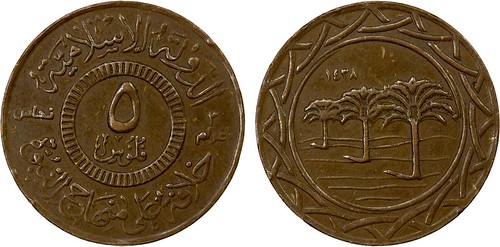
Copper 5 Fils
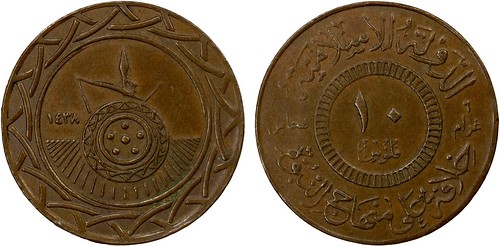
Copper 10 Fils
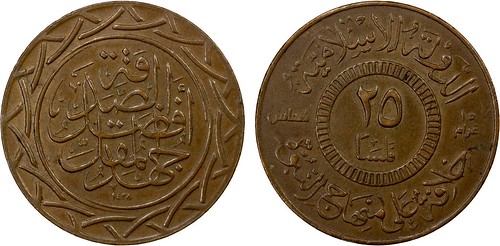
Copper 25 Fils
The article was about my consignment of five denominations of Islamic State (ISIS) coins. My coins were all sold, and if others have come on the coin market I haven't seen them. If anyone has some to sell or knows someone who does, Nathan can be reached at nathan_jensen@jpsiusa.com . -Editor
To read the earlier E-Sylum article, see:
ISLAMIC STATE COINAGE OFFERED
(https://www.coinbooks.org/v25/esylum_v25n44a16.html)
AMSA Medals 250 Project Correction
Mel Wacks indicates that he made an error in the credit for two medals in the MEDALS250 project. They are credited to Lindley Briggs -- they should be credited to Jeff Briggs. -Editor


Briggs, Jeff
Thomas Jefferson "All men are created equal"


Briggs, Jeff
Young Benjamin Franklin
To read the earlier E-Sylum article, see:
THE AMSA MEDALS250 PROJECT
(https://www.coinbooks.org/v28/esylum_v28n46a25.html)
Library of Congress Ormsby
On our NBS Facebook group, Dan Friedus passed along this video, where "At about 1:50, Stephanie Stillo, the Special Collections librarian at The Library of Congress shows off a donated copy of Ormsby's book on banknotes." Thanks! The whole video is a treat for bibliophiles - check it out. -Editor
To watch the Facebook reel, see:
https://www.facebook.com/reel/1035439168528150

VOCABULARY TERM: SCREW MEDAL
Here's another entry from Dick Johnson's Encyclopedia of Coin and Medal Terminology. -Editor
Screw Medal. A type of box medal in which a medal is cut in half horizontally, the two halves are hollowed out and screw threads are added so the edges may screw back together. Tiny drawings or paintings on paper, mica or such as roundels were placed inside, sometimes these were attached in accordion fold. Knowledge of how the piece unscrews is necessary to open it (all forms of box medals have some kind of hidden release). Such box medals are usually detected by their lighter than normal weight. See box medal.
To read the complete entry on the Newman Numismatic Portal, see:
Screw Medal
(https://nnp.wustl.edu/library/dictionarydetail/516711)
100-YEAR-OLD NUMISMATISTS
E-Sylum Feature Writer and American Numismatic Biographies author Pete Smith submitted this updated article on 100-Year-Old Numismatists. Thanks! -Editor
The E-Sylum has previously published lists of 100-year-old numismatists. I am updating the list from my notes. Of the twenty people listed, fifteen died in this century. It is likely that many earlier numismatists have not been reported.
Dorothy Baber (5/10/1920 – 7/15/2021) lived 101 years. She was ANA member 59868 effective 2/1/1968.
Carl G. Boehmer (5/8/1906 – 6/8/2011) lived 105 years and joined the ANA in 1936 as member 5422, and just qualified as a 75-Year Member.
James E. Charlton (7/26/1911 – 9/20/2013) lived 102 years. He was life member 1677 of the ANA, joining in 1950 and being a member for 63 years.
Edward Louis Dence (1917-2021) lived 103 years. He was ANA member 72250 effective 8/1/1972.
William S. Dewey (12/5/1905 – 4/2/2006) lived 100 years, joined the ANA in 1933 and became life member #52 in 1939 making him a member for 73 years.
Pauline Emmett (8/7/1902-10/19/2003) lived 101 years. Born as Pauline Pauling,
Edward Gans (8/30/1887 – 2/13/1991) lived 103 years, joined the ANA in 1940 and was honored for 25 years in 1965.
Dr. Jesse C. Green (12/13/1817 - 7/26/1920) lived 103 years. He was not an ANA member but was mentioned in The Numismatist upon his hundredth birthdate and again upon his death. The Numismatist speculated that he was the oldest collector in the United States.
Robert L. Hendershott (8/7/1898 – 3/22/2005) lived 106 years, 7 months, joined the ANA in 1931 as member 3867, and was a member for 74 years.
Genevieve T. Herdegen (8/30/1886 – 7/12/1989) lived 102 years. She made a donation to the ANA of the Robert T. Herdegen Collection and was given an ANA Medal of Merit. There is no indication that she was a collector or a member of the ANA.
Clyde Hubbard (2/26/1916 – 11/9/2020) lived 104 years, joined the ANA in 1950 as member 18455 and was a member for 70 years. He is in the ANA Hall of Fame.
Honora "Nora" W. Hussey (3/26/1915 - 11/8/2020) lived 105 years. She served as superintendent of the Denver Mint. She was not an ANA member.
Kay Lenker (Catharine Edgerton Lenker) (11/29/1922 - 2/12/2023) lived 100 years. She joined the ANA in 1961 and was life member LM-626.
Robert Hepworth Lloyd (5/18/1906 – 10/10/2009) lived 103 years, joined the ANA in 1926 as member 3024, attaining 83 years of membership. He became the senior member of the ANA in 1995 following the death of 90-year-old John Amos West. Thus, he was the senior member for 14 years.
George Francis Marlier (1/12/1868 – 9/1/1967) lived 99 years, 8 months. He was ANA member 102, joining on June 1, 1899, making him a member for 68 years. He had been the senior member of the ANA.
J. William Middendorf II (9/22/1924 - 10/24/2025) lived 101 years. He served as United States Secretary of the Navy. He was not an ANA member.
Purnie Estelle Doss Moore (8/26/1907 - 5/13/2008) lived 100 years. She joined the ANA as member 23161 effective December 1, 1954,.
Eric P. Newman (5/25/1911 – 11/15/2017) lived 106 years, 6 months. He joined the ANA in 1935 as member 4624 and was a member for 82 years. He would have been the senior member of the ANA for eight years after the death of Lloyd in 2009.
Nellie Tayloe Ross (11/29/1876 – 12/19/1977) lived 101 years. She served as director of the Mint. She was not a member of the ANA.
Carl H. Subak (1/31/1919 – 2/6/2022) lived 103 years, joined the ANA in 1948 as member 15379. He was last mentioned in The Numismatist in 1991 and did not get a 50-Year award.
David R. Denis (born 1/17/1923) ANA member 13304 joined effective 2/1/1947. Recognized as a 75-Year member in 2023.
Felix H. Lenard (born 11/24/1922) ANA member 16921 joined effective 1/1/1949. Recognized as a 75-Year member in 2024.
Edmund DeLaurentis (born 12/10/1925) ANA member 18337 joined effective 6/1/1950. Recognized as a 75-Year member in 2025.
Gail Brichford (born 3/8/1929) ANA member 14164 effective 6/1/1947. Recognized as a 75-Year member in 2022.
Kenneth Bressett (born 10/5/1928) joined AVA as J-14350 effective 7/1/1947, Recognized as a 75-Year member in 2022.
Kenneth L Hallenbeck (born 10/20/1931) Member J-17797 effective 11/1/1949. Recognized as a 75-Year member in 2024.
Howard Cohen Member 18197 effective 5/1/1950 from Brooklyn. Recognized as a 75- Year member in 2025.
Deane H Howard (ca. 1933) Member 18247 effective 6/1/1950 from Manhasset, NY. Recognized as a 75-Year member in 2025.
Since 2000. The ANA has honored twenty-one members for 75 years of membership. However, at least nine of those were dead before their award was announced. This was reported in the December 12, 2021, issue of The E-Sylum.
In 2024, the ANA honored their first two eighty-five-year members. Their deaths were noted in that 2021 issue but the ANA did not notice. Philip Weinberg died in 1997; David Kemp died in 1999.
I'm getting longer in the tooth myself, and am happy to have met and known a number of these hobby stalwarts, including Dorothy Baber, Ed Dence, Bob Hendershott, Kay Lenker, and Eric Newman. While writing the history of my home club, the Western Pennsylvania Numismatic Society, I became aware of George Marlier. And I'm happy to know two Kens who are still going strong (Bressett and Hallenbeck). Have many more happy birthdays ahead! -Editor
To read earlier E-Sylum articles, see:
THE ONE-HUNDRED-YEAR-OLD NUMISMATISTS CLUB
(https://www.coinbooks.org/esylum_v14n22a08.html)
100-YEAR-OLD NUMISMATISTS
(https://www.coinbooks.org/v24/esylum_v24n51a14.html)

QUERY: EDMUND DELAURENTIS
Pete Smith also has a question for our readers. Can anyone help? -Editor
Edmund DeLaurentis (1925-?)
For a biographer, it is a challenge to claim that someone is living. The best that may be said is that a person was living as of the last observation. Coin collector Edmund DeLaurentis was born on December 10, 1925. He may be the latest addition to our list of 100-year-old numismatists.
Edmund was the son of Joseph (1885-1957) and Nicoletta (1896-2004) DeLaurentis. In the 1950 Census, Joseph was listed as the proprietor of a barber shop. Joseph and Nicoletta were both born in Italy. Their children Edmund and Estella were both born in Pennsylvania. I did not find any of the family members in the 1930 or 1940 Census.
He joined the ANA as member 18373 effective June 1, 1950. His address was listed as 513 W. Lehigh Ave., in Philadelphia. He was honored as a 75-Year member in 2025. He has lived more recently with his sister Estella in Havertown, Pennsylvania.
He wrote an occasional letter to Coin World or The Numismatist and was noted for some small donations. Otherwise he is not mentioned.
 There is a tombstone in Springfield, Pennsylvania, with his name on it. Some sources believe this
indicates he is deceased. However, there is no year of death on the stone. It is not unusual for a
tombstone to list family members with their date of birth. His sister, Estelle, is also listed with her
year of birth as 1927.
There is a tombstone in Springfield, Pennsylvania, with his name on it. Some sources believe this
indicates he is deceased. However, there is no year of death on the stone. It is not unusual for a
tombstone to list family members with their date of birth. His sister, Estelle, is also listed with her
year of birth as 1927.
The headstone was erected for his mother, Nicoletta, who died in 2004 at age 108. His father who died in 1957 is buried at a different cemetery.
Can any E-Sylum reader confirm that he made it to his hundredth birthday?
This is the biographer's equivalent of the "Wet Paint" sign problem. Sure, it was probably quite correct when the sign was posted, but now what? Has it since expired? At least with a Wet Paint sign you can touch the surface with your finger to confirm. You can't always poke the old guy sleeping in his rocker on the porch of the Old Numismatist's Home to see if he jumps. For me, maybe just pull my finger. -Editor

ARCHIVES INTERNATIONAL SALE 109 SELECTIONS
Here are some selected lots from the December 16, 2025 sale by Archives International Auctions. -Garrett

Shanghai, China, 1919. 10 Dollars, P-S98s S/M#S53, Specimen Banknote, Blue on m/c underprint with company title and logo at center of note, Back is blue with English text, S/N 000000, Specimen overprints and POCs, PMG graded Choice Uncirculated 64, ABNC.
To read the complete item description, see:
China American Oriental Banking Corp 1919 Shanghai Branch Specimen Banknote
(https://auction.archivesinternational.com/China-American-Oriental-Banking-Corp-1919-Shanghai-Branch-Specimen-Banknote_i58759652)

China, 19196. 5 Dollars, P-S1101 S/M#C102-11, Issued Banknote, Black on green and orange underprint with homes in oval frames at left and right, Back is red and blue with coastal view at center, S/N 256008, PMG graded About Uncirculated 55 EPQ. PHCF.
To read the complete item description, see:
China Bank of Kiangsi 1916 Issued Banknote
(https://auction.archivesinternational.com/China-Bank-of-Kiangsi-1916-Issued-Banknote_i58759654)

Santo Domingo, Dominican Republic, 1876. 5 Pesos, P-S161 RUD141, Issued Banknote, Red print with red border, Title at top with arms at center, Uniface note, S/N 29431 pp B, PMG graded Choice Uncirculated 64 EPQ.
To read the complete item description, see:
Dominican Republic Deuda Consolidada 1876 Issued Banknote
(https://auction.archivesinternational.com/Dominican-Republic-Deuda-Consolidada-1876-Issued-Banknote_i58759698)

India - British Administration, ND (1917-30). 10 Rupees, P-7b Jhun&Rez 3.7.2, Issued Banknote, Dark blue on gray and purple underprint with portrait of King George V at right, Back is blue on gray with text, S/N L/17 810509, PMG graded Choice Very Fine 35 with comment "Spindle Hole at Issue."
To read the complete item description, see:
India Government of India ND 1917 to 1937 Issued Banknote
(https://auction.archivesinternational.com/India-Government-of-India-ND-1917-to-1937-Issued-Banknote_i58759772)
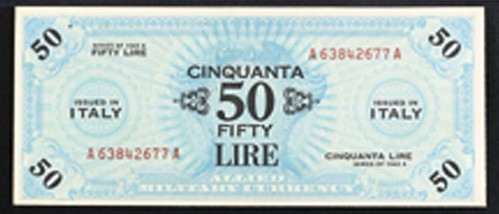
Italy, ND (1946). 50 Lire, P-M14a SB110, Issued Allied Military Banknote, Blue printing with denomination at center, Back is brown with Allied Military at center, S/N A63842677A with letter 'F' in design, PMG graded Choice Uncirculated 63 with comments "Minor Rust, Staple Holes." Only 9 graded in PMG census.
To read the complete item description, see:
Italy Allied Military ND 1946 Issued Banknote
(https://auction.archivesinternational.com/Italy-Allied-Military-ND-1946-Issued-Banknote_i58759801)

Ukraine, 1918. 100 Hryven, P-22a, Issued Banknote, Blue and m/c printing with farmer and farmers wife at right and left, Back is blue, S/N A3634094, PMG graded Choice Very Fine 35.
To read the complete item description, see:
Ukraine State Credit Note 1918 Issued Banknote
(https://auction.archivesinternational.com/Ukraine-State-Credit-Note-1918-Issued-Banknote_i58759903)

San Francisco, California, 1907-08. Lot of 9 items including 8, I/C circulating emergency certificates and one contemporary reference pamphlet. The group consists of 3 distinct types or series featuring denominations from $1 to $20, all issued by the San Francisco Clearing House Association during the 1907 banking panic. The first type includes $1 (brown), and $2 (gray) with ornate design and undertint and very ornate designed backs in the color of the fronts; the second type includes $5 (blue cycloid undertint), $10 (green cycloid undertint), and $20 (orange cycloid undertint), all 3 have ornate cycloid denomination counter on the backs; and, the third type which has simple black frames and text on gray paper), all with plain backs; signatures of the association's officers, and punched "PAID" cancellations. Accompanied by Publications of the Academy of Pacific Coast History, Vol. I, No. 1 – The San Francisco Clearing House Certificates of 1907–1908 by Carl Copping Plehn (University of California, 1909). VF to XF condition. (9). Sold "AS IS" no returns accepted.
To read the complete item description, see:
CA San Francisco Clearing House Certificates and Reference Pamphlet 1907 to 1908 Panic Currency Co
(https://auction.archivesinternational.com/CA-San-Francisco-Clearing-House-Certificates-and-Reference-Pamphlet-1907-to-1908-Panic-Currency-Co_i58759960)

Cohoes, New York, 1885. $5, Series of 1882, Fr.# 468, Ch# E-1347, 2nd Chartered Period, Issued National Banknote, Bruce | Jordan signatures, Large brown seal at right, Fine to Choice Fine condition or better. BEP. This note was last offered in Lyn Knight's auction in 2001 where it was listed as a VF 30 and sold for $630. The note has 3 large margins and is cut close on the bottom where it just touches, with slight fading on the green charter number.
To read the complete item description, see:
NY National Bank of Cohoes New York 5 Series of 1882 Ch E 1347 Issued Banknote
(https://auction.archivesinternational.com/NY-National-Bank-of-Cohoes-New-York-5-Series-of-1882-Ch-E-1347-Issued-Banknote_i58759994)

HERITAGE: 1804 CLASS III DOLLAR AT FUN
Heritage Auctions' FUN Sale will be include the prestigious Presidio Collection, headlined by its 1804 dollar. -Garrett
Arguably the most famous example of an 1804 Class III Draped Bust dollar, widely recognized as "the King of Silver Dollars," headlines an exceptional private collection that will be offered in Heritage's FUN US Coins Signature®Auction Jan. 14-18.


1804 Class III Draped Bust Dollar
The 1804 Class III Draped Bust Dollar is one of just 16 known examples of the 1804 silver dollar. The coin offered here is one of just seven Class III examples, and one of four Class III coins not housed in a museum collection.
"This is an incredible coin, because of its historical significance and its utter rarity," says Todd Imhof, Executive Vice President at Heritage Auctions. "Very few examples exist. Six are in museums, meaning this is one of just 10 examples worldwide in private hands. It's an incredibly rare and significant coin, and one that immediately will become a centerpiece of a new collection."
Several of the Class III 1804 dollars are among the most famous of all 1804 dollars and represent several of the museum pieces known today. Among the most notable are the famous DuPont coin, stolen in 1967 from the DuPont family estate by a band of thieves, later recovered in the early 1980s and subsequently donated to the National Numismatic Collection at the Smithsonian Institution, and the Idler coin, which last appeared at auction in 1985 and was subsequently donated to the ANA.
But the Adams-Carter specimen offered in this auction is arguably the most prominent fixture among the Class III coins, boasting one of the longest provenances of any specimen and ranking for a period of decades as the finest Class III still held in private hands. This was the 1804 dollar owned by many of the most prominent collectors throughout history. Part of its pedigree is its history that includes stints in some of the most significant numismatic collections. Its history began with Captain John W. Haseltine, and later held spots in several elite collections, including but not limited to Phineas Adams, Amon G. Carter Sr., Waldo Newcomer and "Colonel" E.H.R. Green.
The Presidio Collection boasts an enhanced type set of U.S. coins based on condition and rarity and including several coins that are listed in Jeff Garrett's 100 Greatest U.S. Coins book. Part I is being offered in FUN; Heritage will offer Part II of the Presidio Collection in its CSNS Auction April 29-May 3.
The FUN auction will mark the second time the extraordinary Adams-Carter Class III 1804 dollar has been offered at Heritage, where it sold in 2009 for $2.3 million.
This magnificent showstopper is just one of the exceptional offerings among the 41 lots from the Presidio Collection that Heritage will be offering at FUN.
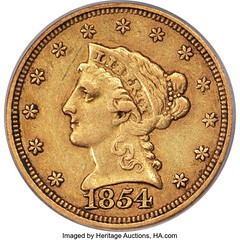

1854-S Liberty Quarter Eagle, XF45 CAC
Also among the collection's highlights is the third-finest privately held 1854-S Liberty Quarter Eagle, XF45 CAC of just 13 known examples. The 1854-S Liberty quarter eagle is one of the landmark rarities of the United States gold series. The coin was created during the height of the California Gold Rush, in the infancy of the San Francisco Mint, and released into circulation far from any numismatic eyes that might have taken notice. Of the 246 pieces struck, most disappeared over the course of decades in the hard-money West, relegating the coin's existence to merely a handful of pieces. Today it is one of the great rarities of the U.S. gold series.


1796 BD-3 With Stars Quarter Eagle, MS62 NGC. CAC
A 1796 BD-3 With Stars Quarter Eagle, MS62 NGC. CAC, which is tied for the sixth-finest of roughly a dozen known Mint State specimens, features 16 stars arranged point to point, in an unusual arrangement that is similar to the orientation on 1794 silver dollars but on no other early U.S. coins. While the 1796 No Stars is the higher-visibility coin with its one-year type design, the With Stars variant is actually considerably rarer. Fewer than half as many With Stars (432) were struck as No Stars (963), and because the With Stars has the same design type as the successive years through 1807, it is an overlooked issue among early quarter eagles.


1808 Quarter Eagle, BD-1, MS63 NGC
An 1808 Quarter Eagle, BD-1, MS63 NGC is among the 100 Greatest U.S. Coins and is tied for the second-finest known example. The 1808 quarter eagle was, along with the cent, part of the second group of denominations to receive the Capped Bust Left redesign, after the half dollar and half eagle the prior year. The Mint only struck a trifling 2,710 examples, making the 1808 quarter eagle a one-year type and a classic rarity in the U.S. series. It also represented the last quarter eagle production until 1821. Heritage experts have traced just 12 1808 quarter eagles in MS62 or finer, and in MS63 or finer, the population dwindles to half that. The finest is a single MS65, formerly in the collections of J. Hewitt Judd and Congressman Jimmy Hayes. After that are five MS63 examples, including the example offered in this auction, tying it for second-finest known.
Images and information about all lots in the Presidio Collection, and in the FUN auction, can be found at HA.com/1390.
It will be interesting to see the results of the Adams-Carter specimen given last week's results for the James A. Stack, Sr. specimen. -Editor

CNG: TRITON XXIX AUCTION
Classical Numismatic Group (CNG) will be hosting their Triton XXIX Auction on January 13-14, featuring fabulous Greek and Roman Collections. Here is the press release. -Garrett
A host of rarities from several world-class Greek, Roman Provincial, Roman, World and British coin collections comes to the block in New York City January 13-14 in Classical Numismatic Group's Triton XXIX auction.
With estimates ranging from $500 up to $1 million, Triton XXIX's first four "live" sessions comprise more than 1,130 rare coins with a combined total estimate of $5.1 million. The auction will be called from the podium at the InterContinental Barclay Hotel in New York City, and webcast live on CNG's website, www.cngcoins.com.
Many of the most important rarities derive from private collections of long standing, including:
- The Westmoreland Collection, an impressive holding of Ancient Greek coinage relating to Alexander III the Great of Macedon and his successors formed by two Australian collectors.
- The Colin Pitchfork Collection, another "down under" collection of Greek coinage assembled by New South Wales numismatist Colin Pitchfork and his wife Sandy, active since the 1950s.
- The Barry N. Rightman Collection of Roman Coins, a holding of more than 800 exceptional Roman silver, bronze and gold coins, including more than 200 plate coins published in David R. Sear's widely used handbook, "Roman Coins and Their Values" volumes I-V.
- The Dr. Thomas E. Beniak Collection of Roman Egyptian coins, including the remarkably imperial run of large bronze drachms from this world-class corpus spanning the reigns from Nero (AD 54-68) to Claudius II Gothicus (AD 268-270).
Other important holdings represented in Triton XXIX include the Deer Creek Collection of Greek and Roman Coins, the W. Toliver Besson Collection of Medallic Coins, The Norman Frank Collection of Chinese Coinage, the James Lock Collection of Medieval Coinage, and the Evergreen Collection of British Coins.
Individual Triton XXIX highlights include:

Lot 975, an Islamic Gold Dinar of the Umayyad Dynasty, struck in the year AH 105 / AD 723/4, with a legend identifying it as being minted in the "Mine of the Commander of the Faithful, in the Hijaz," making it the first known coin Islamic struck in the present-day kingdom of Saudi Arabia. One of three known, this historic piece carries an estimate of $1 million.

Lot 1135, a British Gold Proof Pattern Crown of Charles II, dated 1662 and graded Proof Cameo 63 by NGC. The finest of only five in private hands, this spectacular gold crown is estimated $750,000.

Lot 1139, a magnificent Victoria Proof Five Pounds, dated 1839, with the popular "Una and the Lion" reverse, graded NGC Proof 62 Ultra Cameo, estimated at $200,000.

Lot 61, an ancient Greek silver decadrachm of Syracuse, Sicily, struck circa 405 BC, with dies signed by the renowned die-engraver Kimon. Estimate: $100,000.

Lot 332, an amazing silver dishekel of the Phoenician city of Sidon, struck circa 435-425 BC, with a remarkable design struck in combined incuse-relief depicting a Persian king drawing a bow. Unique and unrecorded, the impressive piece carries an estimate is $50,000.

Lot 778, a Roman Gold aureus of the Emperor Caracalla, with a reverse depicting the emperor distributing largesse to the populace. One of only two known, it is estimated at $25,000.

Lot 894, a Roman bronze "contorniate" (a medallion encircled by a raised rim) depicting the winged steed Pegasus being groomed and fed by a divine retinue. Apparently unique, it carries a $20,000 estimate.
Triton XXIX may be viewed by appointment at CNG's Lancaster, PA offices until January 8, 2026; viewing will pick up on Sunday, January 11, 2026 at 1 pm in the Morgan Suite of the InterContinental New York Barclay Hotel, 111 East 48th Street.
Sessions 1 and 2 of Triton XXIX, featuring Greek, Central Asian and Roman Provincial coinage will commence at the InterContinental Barclay at 9 am Eastern time Tuesday, January 13, and will be webcast on CNG's website, www.cngcoins.com. Sessions 3-4, commencing with Roman Republican coinage and continuing through Roman Imperial, Byzantine, World and British coinage, will start Wednesday, January 14, at 9 am. All sessions can be viewed, and bid upon, online using CNG's Auction Mobility platform.
Classical Numismatic Group Inc. is the foremost U.S. numismatic firm dealing in Ancient, World and British coinage. To receive a printed copy of Triton XXIX, to enquire about lot viewing or bidding, or to ask about consigning to future auctions, call (717) 390-9194 or write to CNG@cngcoins.com.
FRANK S. ROBINSON AUCTION 130
Frank S. Robinson will be holding Auction 130 on January 18, 2026, comprised of Ancient and Early Coins. Select items are discussed below. -Garrett

ATHENS, Tet, 449-413 BC, Athena hd r/Owl stg r, S2526; Virtually Mint State, well centered, good bright metal, quite sharply struck with Athena's hair waves crisply defined, which is what the real condition snobs like me look for. (An EF realized $9200, Triton 1/12.)
To read the complete item description, see:
ATHENS, Tet, 449-413 BC, Athena hd r/Owl stg r, S2526
(https://www.biddr.com/auctions/fsrcoin/browse?a=6609&l=8121508)

BAKTRIA, Menander, 160-145 BC, Drachm, Diademed head r/Athena stg l, EF, centered, good metal with lt tone, excellent portrait quality. (An EF brought $472, F&S 6/08.)
To read the complete item description, see:
BAKTRIA, Menander, 160-145 BC, Drachm, Diademed head r/Athena stg l, EF, centered, good metal with l
(https://www.biddr.com/auctions/fsrcoin/browse?a=6609&l=8121516)

MACEDON, Autonomous, 187-168 BC, Tetrobol, MAKE around club in center of shield/Helmet, monograms; Choice EF, nrly centered, well struck, good metal with lt tone. (A VF of the type realized $415, Peus 4/14.)
To read the complete item description, see:
MACEDON, Autonomous, 187-168 BC, Tetrobol, MAKE around club in center of shield/Helmet, monograms
(https://www.biddr.com/auctions/fsrcoin/browse?a=6609&l=8121552)

PERGAMENE KINDOM, Attalos I, 241-197 BC, Tet, Head of Philetairos (the Eunuch king) rt/Athena std l, A & ivy leaf to left, S7220, SNG Von Aul 1356; Nice EF, a tiny bit off-ctr but complete & uncrowded, good metal with lt old toning, nice sharp portrait. (An AEF realized $4250, Gorny 3/07; VF-EF $3432, Kunker 3/10.)
To read the complete item description, see:
PERGAMENE KINDOM, Attalos I, 241-197 BC, Tet, Head of Philetairos (the Eunuch king) rt/Athena std l, A & ivy leaf to left, S7220, SNG Von Aul 1356
(https://www.biddr.com/auctions/fsrcoin/browse?a=6609&l=8121562)

Vologases VI, 208-28 AD, 88.18, EF, only sl off-ctr, good bright silver, fully sharp portrait. (An EF, double struck rev, brought $245, Kunker 3/08) .
To read the complete item description, see:
Vologases VI, 208-28 AD, 88.18, EF, only sl off-ctr, good bright silver, fully sharp portrait. (An E
(https://www.biddr.com/auctions/fsrcoin/browse?a=6609&l=8121596)

John Hyrcanus I, 135-104 BC, Prutah, Hen-6172a (old 1133var); Lgnd in wreath/ crossed cornucopiae, A at right, VF, nrly centered on somewhat irregular flan, dark patina with strong earthen hilighting, lgnd mostly clear, the obv A very clear. (A Near VF (A at left) brought $329, Kunker 3/20.)
To read the complete item description, see:
John Hyrcanus I, 135-104 BC, Prutah, Hen-6172a (old 1133var)
(https://www.biddr.com/auctions/fsrcoin/browse?a=6609&l=8121598)
STACK CLASS III 1804 DOLLAR BRINGS $6 MILLION
We don't usually discuss grading or prices, and everyone knows this already anyway since it's been all over the media, but we do have to note the exceptional price brought by the James A. Stack Class III 1804 Dollar. Here's the announcement form Stack's Bowers. -Editor
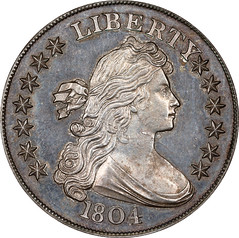

Finest Known Class III 1804 Dollar Brings $6 Million
After months of anticipation and speculation, on December 9 Stack's Bowers Galleries auctioneer Chris Ortega finally dropped the gavel on the newly discovered James A. Stack, Sr. Class III 1804 dollar, along with other rarities that have been off the market since before James A. Stack, Sr.'s death in 1951. Graded Proof-65 (PCGS) with CAC and CMQ approval, the Stack 1804 dollar brought $6 million, surpassing pre-sale estimates and setting a new world record for the issue. It nearly tripled the previous record for a Class III 1804 dollar of $2.3 million, set in 2009. (All prices include a 20% buyer's fee.)
James A. Stack, Sr., a New York textile executive who was not related to the founders of the Stack's Bowers Galleries firm, was an advanced collector of United States and world coins and currency. His wishes were that none of his coins be sold until his youngest grandchild at the time of his death turned 25. The first of the James A. Stack, Sr. sales was conducted by Stack's in 1975, with several more sales held through the 1980s and 1990s. Another James A. Stack, Sr. sale will be conducted by Stack's Bowers Galleries in February 2026.
"The excitement that has surged through the numismatic community these last several months since we announced the discovery of additional coins from the James A. Stack, Sr. Collection has been unlike anything I've ever seen," noted Stack's Bowers Galleries President Brian Kendrella. "Our team worked hard through every part of their process, and their efforts resulted in new world records throughout the sale."
The December 2025 Part I sale included dollars and double eagles, along with a few miscellaneous issues. A second offering in February 2026 will include further highlights of historic importance, ranging from gold dollars through eagles, as well as the superb James A. Stack, Sr. collection of territorial gold.
The discovery of the James A. Stack, Sr. 1804 dollar sent shockwaves through American numismatics, adding a 16th example to the census of known examples that had remained unchanged since the 1962 rediscovery of the King of Siam specimen. Thought by Stack's Bowers Galleries' cataloger John Kraljevich and independent researchers John Dannreuther and Craig Sholley to have likely been owned by former Mint Director A. Loudon Snowden, the James A. Stack, Sr. 1804 dollar is the finest Class III 1804 dollar in private hands by a significant margin and the only one to have ever received CAC or CMQ approval. The sole 1804 dollar to have ever brought more is the finest known Class I 1804 dollar, the Proof-68 (PCGS) Sultan of Muscat specimen that brought $7.68 million in Stack's Bowers Galleries' sale of August 2021. The new record-setting price realized for the Stack 1804 dollar places it as the ninth highest price ever realized for a rare coin, including two different offerings of the only privately held 1933 $20. Among United States Federal coins, only six coins have ever sold for more.
"It's been an absolute honor to work with the descendants of James A. Stack, Sr. these last couple years in shepherding their amazing family legacy into the hands of eager collectors," noted Vicken Yegparian, Executive Vice President of Stack's Bowers Galleries. "It's a testament to the connoisseurship of James A. Stack, Sr. and the connoisseurship of our bidders today that the best coins brought such strong prices."
Competitor Heritage Auctions will be selling the Adams-Carter Class III 1804 dollar specimen, as noted in another article elsewhere in this issue. -Editor
To read the earlier E-Sylum article, see:
STACKS BOWERS: UNPUBLISHED 1804 DOLLAR
(https://www.coinbooks.org/v28/esylum_v28n33a09.html)
MARK FERGUSON ON 1804 DOLLAR RESEARCH
CoinWeek published researcher Mark Ferguson's thoughts on the 1804 Dollars in an article earlier this week. Here's an excerpt - see the complete article online. -Editor

On Tuesday, December 9th, 2025, Stack's Bowers Galleries auctioned a previously unknown 1804 silver dollar, the 16th example now known.
Appearing in Session I of the James A. Stack, Sr. Collection (no relation to the auction firm), the coin sold for an astounding $6 Million (including the Buyer's Premium)
I was able to examine this coin in person, with a loupe, at the American Numismatic Association's World's Fair of Money in Oklahoma City in August. Immediately, I was stunned by the coin's remarkably strong strike all around.
Some 1804 dollars have weak areas here and there, such as in the hair, stars, or eagle's feathers. Additionally, the piece's surfaces appear natural and mark-free, save for a few minor hairlines. In contrast, several 1804 dollars have been cleaned.
I've been studying 1804-dated silver dollars since 1989 when I acquired James V. Dexter's unique commemorative work of art, The Dollar of 1804, that he personally commissioned in 1887 to celebrate his 1804 dollar.
After researching the Dexter Dollar for 25 years, I wrote and published the book, The Dollar of 1804: The U.S. Mint's Hidden Secret and I've built a large collection of memorabilia, numismatic literature, and artworks surrounding the Dexter Dollar and 1804 dollars in general that was the marquee exhibit at the 2024 World's Fair of Money.
Along the way, I've made several important discoveries about 1804 dollars and have had the immense pleasure of holding and examining, in the "raw," the Dexter Dollar and the PCGS Proof 68 Sultan of Muscat coin, the highest-graded example of them all. Thank you, Brent Pogue!
Recently, CoinWeek called me to get my opinion on the newly discovered 1804 dollar, the James A. Stack, Sr. coin. My immediate reaction was, "I'm not entirely surprised."
I've maintained for years that there will be many more discoveries about 1804 dollars that will come to light in the future. I think much of it will be found in correspondence between individuals.
The CoinWeek article also included this talk about the 1804 Dollar by Dr. Jesse Kraft of the American Numismatic Society. It was recorded in 2021 and thus doesn't reference the James A. Stack specimen, but it's a great summary nonetheless. -Editor
To read the complete article, see:
Previously Unknown 1804 Dollar Sells for $6 Million at Stack's Bowers Auction
(https://coinweek.com/previously-unknown-1804-dollar-sells-for-6-million-at-stacks-bowers-auction/)
THE LAST "OMEGA" CENTS HAVE SOLD
Less enigmatic than the 1804 dollars are the "omega" cents, the ceremonial last U.S. circulating cents. Stack's Bowers sold the final cents on December 11 on behalf of the United States Mint. Here is the post-sale press release. -Editor

The very last circulating pennies, or "cents," sold for over $16.76 million in a special auction by Stack's Bowers Galleries on Thursday, December 12 th , presented on behalf of the United States Mint. Included in the sale were 232 three-coin sets featuring one each of the 2025 penny struck at the Philadelphia Mint, the 2025-D penny struck at the Denver Mint, and a historic 2025 penny struck in 24 karat gold also at the Philadelphia Mint. Each of these special coins exhibits a small "O" privy mark of the final Greek letter Omega, indicating their role as the capstone to a two-centuries long legacy that first began in 1793 with the Chain Cent.
After a slightly delayed start due to unprecedented levels of collector interest, the sale was underway with tremendous excitement stretching across nearly four hours of competitive bidding. Set #1, presented in the first lot of the sale, soared to an incredible price of $200,000 and established this as a landmark offering for the category's most elite collectors. The top price of the session was realized by Set #232, which sold for $800,000 as the last lot, and included the very last circulating penny intended for issuance struck at Philadelphia and Denver, along with the final Omega penny in gold. Also included in the lot were the three sets of canceled dies used to strike this historic series. With this $800,000 result, set #232 now ranks as the most valuable modern U.S. numismatic item, surpassing the prior record of $550,000 also set by Stack's Bowers Galleries in their sale of Space Flown 24 Karat Gold Sacagawea dollars in September 2025. The overall sale total of more than $16.76 million represents an average lot value of over $72,000 for each three-coin set, amounting to nearly 80 times the total combined gold melt value of around $210,000 at the time of the sale. In total, 17 lots each sold for more than $100,000.

This $16.76 million sale is now the highest value auction of special coins sold on behalf of the United States Mint, more than doubling the historic $7.5 million result of the 1933 Saint Gaudens double eagle sold by Stack's Bowers Galleries in 2002 (in partnership with Sotheby's). It also ranks among the most valuable single-owner auction sessions held by the firm across their 90-year history as America's oldest rare coin auctioneer.
"It's an extraordinary honor to again be selected to partner with the United States Mint to offer exciting numismatic rarities to the collecting public," noted Stack's Bowers Galleries President Brian Kendrella. "They captured the public imagination like few rare coins we've ever handled. Even our staff of expert numismatists, who see the world's most famous and valuable rare coins day in and day out, were excited by the chance to handle the very last pennies struck before the suspension of circulating production."
Remarkably, this $16.76 million Omega penny sale represents the fifth time Stack's Bowers Galleries has been selected by the United States Mint for a special auction, following their $7.5 million sale of the 1933 Saint-Gaudens $20 in July 2002, their $4.6 million sale of 35th Anniversary American Eagle coins in September 2022, their $8.2 million sale of 230th Anniversary Flowing Hair coins in December 2024 and their $3.2 million sale of the Space Flown 24 Karat Gold Sacagawea dollars in September 2025. No other auction firm in the world—specialized or generalist—boasts this repetitive selection by the United States Mint.
To read the earlier E-Sylum articles, see:
STACK'S BOWERS: THE LAST "OMEGA" CENTS
(https://www.coinbooks.org/v28/esylum_v28n47a23.html)
LOT 10232: THE VERY LAST CENTS AND DIES
(https://www.coinbooks.org/v28/esylum_v28n48a21.html)
THE BOOK BAZARRE
U.S. MINT SEMIQUINCENTENNIAL COIN LAUNCH
Another hot numismatic topic making the rounds of media this week was the announcement of the designs for circulating coins commemorating the U.S. semiquincentennial. First, here's a report on the launch ceremony in Philadelphia. Check out the photo gallery - coin show regulars Ben Franklin, George Washington, and Abe Lincoln were in attendance. -Editor

New coins will bring a change to your pocket change in 2026.
The United States Mint is set to roll out five new quarters and a dime to mark the nation's 250th anniversary. Officials unveiled the coins' designs at a ceremony Dec. 10 in the National Constitution Center in Philadelphia, which is next door to a U.S. Mint facility.
The U.S. Mint will make the coins at its facilities in Philadelphia and Denver. The first coins are to appear in January, but some are to debut later in the year.
The ceremony was marked by speeches from dignitaries, including U.S. Treasurer Brandon Beach and Kristie McNally, the U.S. Mint's acting director.

Benjamin Franklin (Patrick McBride), George Washington (Curt Radabaugh), and Abraham Lincoln (Dennis Boggs)
Benjamin Franklin, George Washington and Abraham Lincoln — their modern-day impersonators, anyway — mingled with the crowd. Members of the U.S. Army Old Guard Fife and Drum Corps provided a presentation of colors to launch the ceremony and a spirited performance near its conclusion.
And at one point, an emcee made a doomed effort to lead the crowd in reciting a more formal term for the upcoming anniversary — semiquincentennial.
The coin designs finally appeared, albeit briefly, during a 3½-minute video that closed the ceremony.
Four U.S. presidents are to appear on newly designed quarters: Washington, Jefferson, Lincoln and James Madison.
A fifth quarter is to feature a man and woman representing the pilgrims who came to America aboard the Mayflower in 1620. That coin salutes the Mayflower Compact, an agreement signed by the colonists that's considered a precursor to the Declaration of Independence and the U.S. Constitution, according to the U.S. Mint.


Semiquincentennial Dime


Semiquincentennial Mayflower Compact Quarter


Semiquincentennial Revolutionary War Quarter


Semiquincentennial Declaration of Independence Quarter


Semiquincentennial Constitution Quarter


Semiquincentennial Gettysburg Address Quarter
Wayne Pearson writes:
"For the one design in the 2026 set of coins that I like-here is a version similar to black ruthenium with enameling. I think this idea might sell."
Enameling and selling coins is perfectly legal, as is damaging them with protest or commercial slogans - you just shouldn't spend them again. Colorization via enameling has a long tradition, and buyers may be found for such items. -Editor
To read the complete article, see:
These new coin designs salute America's 250th year
(https://www.burlingtoncountytimes.com/story/news/local/south-jersey/2025/12/12/us-mint-coin-designs-250th-anniversary-semiquincentennial-what-do-new-quarters-look-like-dimes/87716889007/)
See also:
US Mint gives 2026 coins a new look for America's 250th anniversary
(https://www.usatoday.com/story/money/2025/12/12/us-mint-2026-coins-america-250th-anniversary/87732886007/)
UNCHOSEN SEMIQUINCENTENNIAL COIN DESIGNS
But the bulk of the discussion this week centered on Semiquincentennial designs that were NOT used. Thanks to Len Augsburger and Robert Cavalier for sending along this New York Times piece: "The War on ‘Wokeness' Comes to the U.S. Mint." Here's an excerpt - see the complete article online. -Editor

Actors surrounded Brandon Beach, the U.S. Treasurer,
and Kristie McNally, the Mint's acting secretary
George Washington was there. And Benjamin Franklin. And even Abraham Lincoln, who joked that the last time he was in a theater it did not go so well. These paid re-enactors and other dignitaries gathered the other evening in a Philadelphia auditorium for the unveiling of coins designed to celebrate the country's 250th anniversary. They provided a traditional, even simple, take on the American journey, with Pilgrims and founding fathers and a stovepipe hat tip to the Gettysburg Address.
Left unmentioned amid the event's fife-and-drum pageantry was that these coins also represented a rejection of a different set of designs — meant to commemorate certain other inspiring chapters of the nation's history, including abolition, women's suffrage and the civil rights movement.
An event largely unnoticed by anyone other than coin enthusiasts, then, wound up reflecting the national struggle over how the American story is told, as the Trump administration seeks to frame any focus on the knottier moments in the nation's arc as "wokeness."
The Treasury secretary, Scott Bessent, is authorized by law to make final decisions about coin designs, including these 250th anniversary coins — a dime, a half-dollar and five quarters — which are both collectible and legal tender. But his choices ignored the more diverse recommendations for the quarters by the Citizens Coinage Advisory Committee, a bipartisan group mandated by Congress to review the U.S. Mint's proposed designs for American coins.
To commemorate the abolition of slavery, the committee had recommended an image of Frederick Douglass on the obverse and shackled and unshackled hands on the reverse. To honor women's suffrage, a World War I-era protester carrying a "Votes for Women" flag. And to evoke the civil rights movement, a 6-year-old Ruby Bridges, books in hand, helping to desegregate the New Orleans school system in 1960.
Mr. Bessent opted instead for the more general, and much whiter. For the Mayflower Compact, a Pilgrim couple staring into the distance. For the Revolutionary War, a profile of Washington. For the Declaration of Independence, a profile of Thomas Jefferson. For the Constitution, a profile of James Madison. And for the Gettysburg Address, a profile of Lincoln on the obverse, and on the reverse, a pair of interlocking hands. No shackles.
The rejection of its recommendations, along with the selection of designs it had not vetted, did not sit well with the committee, whose 11 members include numismatists, historians and members of the public. None attended the event last Wednesday, which served as a table setter for another divisive numismatic matter, also unmentioned: the administration's plan to feature President Trump on a dollar coin.
Portraying a sitting president on a coin defies American tradition dating to the first president. Washington rejected proposals to feature his image on coins for fear of echoing the English monarchy from which the new country had just freed itself — a liberation sparked by the Declaration of Independence, which these coins, including one featuring Mr. Trump, are supposed to commemorate.
Donald Scarinci, a New Jersey lawyer and the longest-serving member of the advisory committee, called Wednesday night's unveiling "another sad day for America," because it marked the first time since the board's establishment in 2003 that "the United State Mint announced coin designs that the committee never reviewed."
Len Augsburger notes:
"I can offer one clarification – although speculated for a long time, there is no contemporary correspondence corroborating Washington's reluctance to appear on the nation's coinage. It's completely plausible he weighed in on the issue, either in conversation or writing, we just don't have proof of that. Given the European coinage prominently featured reigning monarchs, it's hard to believe Jefferson (then Secretary of State and with administrative control of the Mint) and Washington never discussed the issue. We do know the issue was hotly debated in Congress, and there are some accounts of that, though not nearly as extensive as we would like."
To read the complete article, see:
The War on ‘Wokeness' Comes to the U.S. Mint
(https://www.nytimes.com/2025/12/14/us/coins-us-250th-anniversary.html)
See also:
Killing the penny was just the start. Trump is rewriting the rules on America's coins
(https://www.cnn.com/2025/12/12/business/trump-changes-coins-policy)
MORE ON THE UNCHOSEN SEMIQUINCENTENNIAL COINS
The Wall Street Journal delved into the rejected Semiquincentennial coin designs. Here's an excerpt - see the complete article online. -Editor

The Trump administration jettisoned a plan to honor the abolition of slavery, women's suffrage and the civil-rights movement on quarters for the nation's 250th birthday.
Those themes were part of a proposed five-quarter special series that went through years of debate and design but was never officially announced by the U.S. Mint. They were replaced with images inspired by the Mayflower Compact, the Revolutionary War and the Gettysburg Address. Instead of Frederick Douglass, a women's suffrage marcher and Ruby Bridges desegregating an elementary school, the Mint's special quarters for 2026 will feature Presidents George Washington, Thomas Jefferson, Abraham Lincoln and James Madison, along with pilgrims glimpsing America's shores.
The final designs, unveiled late Wednesday by the Mint, come ahead of an even more controversial decision that Treasury officials have teased but not finalized: a $1 coin featuring President Trump.
Trump has criticized museums and cultural institutions for being "woke" and said they were too focused on negative parts of American history. On Thursday, in explaining the decision, U.S. Treasurer Brandon Beach told Fox News Digital that the prior administration was too "focused on DEI and Critical Race Theory policies."
"The designs on these historic coins depict the story of America's journey toward a ‘more perfect union,' and celebrate America's defining ideals of liberty," acting Mint Director Kristie McNally said in a statement.
The Citizens Coinage Advisory Committee, a group of coin experts, artists and bipartisan political appointees, consulted historians, the National Park Service, the Smithsonian Institution and others. The law requires that committee to review designs, and after a multiyear effort, it settled on five themes for the five quarters: the Declaration of Independence, the Constitution, abolition, suffrage and civil rights.
"We're trying to be very sensitive to how people will interpret the themes and designs of the coins," said Dennis Tucker, a coin expert who worked on the project before leaving the coin advisory panel last year. "They're much more than just money. They're things that kids are going to be looking at and grown-ups are going to be looking at."
In October 2024, for the abolition quarter, the panel picked a Douglass image on the obverse, or front, and a reverse design showing a shackled hand and a fist breaking free. The suffrage coin showed a marcher with a "votes for women" sign. The civil-rights coin highlighted Bridges on the front and a scene from a civil-rights march on the reverse with the words "we shall overcome."
The Commission of Fine Arts, a separate panel, made its own recommendations within the same themes, disagreeing with some of the coin committee's choices. Under federal law, that arts panel must be consulted on new coin designs; Trump fired all of its members this year and no members are currently listed on its website.
The new dime is nice enough, although the angry eagle looks more like one of Tyranny than Liberty. The quarter obverses are dull; the reverses are OK but not particularly inspiring, although I guess I like the perspective view of Independence Hall. The rejected designs have more character and are better balanced.
To me, they far better depict the story of America's journey toward a ‘more perfect union.' The first amendment protection of free speech is the bedrock right that drives all others, allowing all citizens to discuss the issues of the day and quarrel over proposed solutions until a consensus emerges. That process is painfully slow and can take generations, but it does grind slowly toward better (if still imperfect) solutions. The union may never reach perfection in anyone's eyes, but it does progress amid backsliding and fits and starts toward a more perfect union. -Editor
To read the complete article (subscription required), see:
Trump Administration Scraps Plan to Mint Quarters Featuring Abolition, Suffrage
(https://www.wsj.com/politics/policy/trump-administration-scraps-plan-to-mint-quarters-featuring-abolition-suffrage-073583d4)
ANOTHER RMS CARPATHIA GOLD MEDAL
A gold RMS Carpathia medal sold last month at Henry Aldridge Auctions. -Editor
 Henry Aldridge Auctions attracted huge headlines last month for selling the gold watch of Titanic victim Isidor Straus for £1.78 million, the highest amount ever paid for memorabilia from the doomed liner.
Another gold memento in the sale attracted few headlines, but was of interest because it came about through the goodwill of the passengers who survived when the ship sank in April 1912.
This was an RMS Carpathia gold medal, one of the rarest medals relating to the Titanic story.
Shown on the medal's front is the Carpathia steaming to the aid of Titanic's lifeboats amid a sea of icebergs. The scene is framed by King Neptune's head and beard and a fouled anchor and hailing trumpet motif at the bottom.
The reverse bears an engraved inscription to an unknown officer.
The original notion of honouring the rescuers was the idea of the better-off survivors.
Soon after their return to dry land in America, a Committee of the Rescued was formed to come up with some suitable token of the gratitude they felt for their safe return from the ocean.
When the Carpathia steamed into New York harbour on April 18, the committee members went to work, deciding on a gold medal for the senior officers, a silver medal for junior officers and a bronze medal for the crew.
When the ship returned on May 29, the awards were ready, with only six of the gold medals presented at a ceremony in central New York.
Estimated at £50,000 to £60,000, this rare medal outstripped its pre-sale guide to eventually take £86,000 at the auction.
To read the complete article, see:
COLLECTORS' CORNER TITANIC SURVIVORS' GRATITUDE WAS SET IN GOLD
(https://www.pressreader.com/uk/the-courier-advertiser-angus-and-the-mearns-edition/20251213/284313961161286)
To read the earlier E-Sylum article, see:
BONHAMS'S TO SELL MEDAL AWARDED TO CARPATHIA CREW FOR TITANIC RESCUE
(https://www.coinbooks.org/esylum_v13n38a22.html)
MORE ON MEDAL AWARDED TO CARPATHIA CREW FOR TITANIC RESCUE
(https://www.coinbooks.org/esylum_v13n39a15.html)
CARPATHIA MEDALS FOR TITANIC RESCUES OFFERED
(https://coinbooks.org/esylum_v15n12a16.html)
1912 TIFFANY CARPATHIA MEDAL SOLD
(https://www.coinbooks.org/esylum_v19n47a26.html)
A VIRGINIA TYPE 2 NATIONAL BANK NOTE RARITY
Stack's Bowers Currency Specialist & Lead Currency Cataloger Bradley Charles Trotter published an article about a rare Virginia National Bank Note. -Editor

While some may see a well-circulated note that should have been redeemed long ago in the 1930s, this lot is actually one of the rarest National Bank Notes representing the Commonwealth of Virginia in the National Bank Note Census.
At left, is the imprint of the Citizens National Bank of Hampton (Charter# 13775) alongside a familiar portrait of Benjamin Franklin. However, seen at the end of the serial numbers overprinted in brownish ink is "13775," which underscores the reason why this note is special.
This distinction is unique to the Type 2 National Bank Notes issued under the Series of 1929 at the height of the Great Depression between 1933 and 1935. Issuance during such hard times combined with a lack of demand, create the perfect storm for a future rarity, as today only 454 pieces are recorded by the National Bank Note Census for the entire United States. That figure is deceptive as most survivors are notes from two banks based out of Chicago and San Francisco.
For the entire state of Virginia just two pieces are recorded. The first is an example recorded on the First National Bank of Ferrum (Charter# 12311), a piece that has never publicly traded hands. By contrast, this example from Hampton is a relatively recent discovery that first traded hands in 2018 when it sold for $14,400 in our March 2018 Baltimore Auction (Session 7 – lot 20485).
Next March, we anticipate a similar realization at auction. Type 2 $100s are among the most popular issues of the period even with collectors who don't specialize in a particular state. Here is a significant and rare opportunity for collectors, as notes like this are typically traded after years or even decades.
To read the complete article, see:
A Unique Rarity from Virginia: Type 2 $100 National Bank Note Issued by the Citizens National Bank of Hampton (Charter# 13775) to be Offered in March 2026 Showcase Auction
(https://stacksbowers.com/a-unique-rarity-from-virginia-type-2-100-national-bank-note-issued-by-the-citizens-national-bank-of-hampton-charter-13775-to-be-offered-in-march-2026-showcase-auction/)
1670 HUDSON'S BAY COMPANY ROYAL CHARTER SOLD
The unique and historically important 1670 Hudson's Bay Company Royal Charter has been sold and placed with Canadian museums and archives. -Editor

The 1670 Hudson's Bay Company Royal Charter, considered among one of Canada's founding documents, has been sold for C$18m ($13m; £9.6m) to two of the country's richest families.
The 355-year-old charter, which granted the Hudson's Bay Company wide-ranging powers over large swaths of what is now Canada, ended up at auction when the corporation filed for bankruptcy over the summer.
The offer by firms owned by the Weston family and David Thomson, chairman of Thomson Reuters, will keep the historically significant document in Canada.
And the charter - once housed in a rural manor in the UK in World War Two during the blitz - will be under shared custody of various Canadian museums and archives.
The bid also includes a C$5m donation to those custodian museums for stewardship and public education around the document.
A court still needs to approve the final sale.
The Hudson's Bay Company said in a statement on Wednesday that "the Charter will be placed in the care of trusted institutions committed to, among other things, working in consultation with Indigenous communities so the Charter's complex history can be acknowledged, interpreted and shared with all Canadians".
Granted by King Charles II in 1670, the charter vested power to the company, a key player in the powerful continental fur-trade that later became an iconic Canadian department store, to make laws and establish colonies in parts of now modern-day Canada.
Hudson's Bay Company "was able to use the language of this charter to operate as both a corporation and as a government," Cody Groat, assistant professor of history and indigenous studies at Western University, told the BBC.
There were early colonies where it could pass legislation and negotiate treaties with indigenous peoples, he said - "all kind of associated with this initial document, signed by King Charles II".
The document itself was initially kept at Windsor Castle then moved to the company's headquarters in London until 1940. During World War Two it was stowed at an estate in Hertfordshire for safekeeping before finally finding a home at the new Toronto headquarters of the Hudson's Bay Company in the 1970s.
Many of the Hudson's Bay Company's archival records were donated to the province of Manitoba in the 1990s, but not the charter.

To read the complete articles, see:
A 355-year-old Royal Charter that survived the blitz auctioned for $13m in Canada
(https://www.bbc.com/news/articles/cg4nvr3e1v0o)
Thomson, Weston families win Hudson's Bay charter auction with sole bid
(https://www.cbc.ca/news/canada/manitoba/hudsons-bay-charter-sold-auction-9.7001943)
SECRET BOOKS MADE UP BY AI
As researcher Pete Smith noted with his question for readers elsewhere in this issue, research is um, hard. It takes brainpower, hard work, and lots of checking of sources. People should be lauded for calling libraries to request copies of references cited by AI chatbots, but some of them don't want to take "no" for an answer. -Editor
Never heard of the Journal of International Relief or the International Humanitarian Digital Repository? That's because they don't exist.
But that's not stopping some of the world's most popular artificial intelligence models from sending users looking for records such as these, according to a new International Committee of the Red Cross (ICRC) statement.
AI models not only point some users to false sources but also cause problems for researchers and librarians, who end up wasting their time looking for requested nonexistent records, says Library of Virginia chief of researcher engagement Sarah Falls. Her library estimates that 15 percent of emailed reference questions it receives are now ChatGPT-generated, and some include hallucinated citations for both published works and unique primary source documents. "For our staff, it is much harder to prove that a unique record doesn't exist," she says.
This is not the first time AI has been caught making up false citations. The ICRC recommends that people consult online catalogs or references in existing published scholarly works to find references to real studies instead of assuming anything cited by an AI is real, no matter how authoritative it might sound. The Library of Virginia will be asking researchers to vet their sources for these requests, Falls says, and to disclose if a source originated from AI. "We'll likely also be letting our users know that we must limit how much time we spend verifying information."
To read the complete article, see:
AI Slop Is Spurring Record Requests for Imaginary Journals
(https://www.scientificamerican.com/article/ai-slop-is-spurring-record-requests-for-imaginary-journals/)
Everyone knows that AI chatbots like ChatGPT, Grok, and Gemini can often hallucinate sources. But for the folks tasked with helping the public find books and journal articles, the fake AI bullshit is really taking its toll. Librarians sound absolutely exhausted by the requests for titles that don't exist...
You can't blame everything on AI. Papers have been retracted for giving fake citations since long before ChatGPT or any other chatbot came on the scene. Back in 2017, a professor at Middlesex University found at least 400 papers citing a non-existent research paper that was essentially the equivalent of filler text.
Why might users trust their AI over humans? For one thing, part of the magic trick that AI pulls is speaking in an authoritative voice. Who are you going to believe, the chatbot you're using all day or some random librarian on the phone?
To read the complete article, see:
Librarians Are Tired of Being Accused of Hiding Secret Books That Were Made Up by AI
(https://gizmodo.com/librarians-arent-hiding-secret-books-from-you-that-only-ai-knows-about-2000698176)
JUST USE THE BANKNOTE TELEPORTER
Despite the rise of artificial intelligence, there's still plenty of natural stupidity to go around without it. A man in Japan was a little unclear on the concept of banking. -Editor
 According to the Shiga Prefectural Police, on 5 December, a 53-year-old office worker received phone calls and video calls over the popular Japanese messaging app Line from men claiming to work for a major telecom company and a man posing as an officer from the Hyogo Prefectural Police.
The victim was told that 40 million yen was deposited and then withdrawn from a bank account in his name, implicating him in a potential crime. They then told him they needed to confirm the serial numbers on the banknotes in his account to know for sure. To do this, he would have to transfer the money from his bank account to theirs, so they could examine his bills and then transfer them back.
It wasn't reported how he finally realized he'd been had, but it was probably after none of the money he sent was being returned. He then contacted the real police, who are currently investigating it as a case of "special fraud" (tokushu sagi), referring to scams that randomly target people over the phone or online.
The victim did get a fair bit of ribbing in online comments, but a lot of people also lamented that someone with a rather vague understanding of how banks work has more money than they do.
Did he really think he was sending physical bills?"
"Just use the banknote teleporter."
"When you transfer money, they roll up the bills really tight and send them through the wires."
"Maybe he has an old-fashioned bank that still uses pneumatic tubes."
"This fraud certainly is… special…"
Based on reports, this victim seems to be an average adult with an apparently well-paying job. He just seems to have thought everyone's money is kept in stacks of cash in a bunch of boxes, and perhaps when you use an ATM, a little robot whizzes over and takes out whatever you need.
On the way to my car one evening I told my wife I was going to the ATM - "the bank called and said there was too much money in our account..." Thanks to Wayne Herndon for this joke. -Editor
To read the complete article, see:
Japanese man who didn't know how banks work defrauded out of 21 million yen
(https://soranews24.com/2025/12/13/japanese-man-who-didnt-know-how-banks-work-defrauded-out-of-21-million-yen/)
ABOUT THIS ISSUE: DECEMBER 14, 2025
It's full-blown holiday party season. Last year I didn't get on a scale until New Year's Day, and I was shocked, SHOCKED to discover that I'd gained weight. Well, not shocked that I had gained weight, but by how shockin' much. I got on the wagon and dropped over 20 pounds by May before diet fatigue set in. But I was still watching the scale and leveled off for a couple months before another "growth spurt" in August when family birthdays and travel got the best of me, like they do every year. I was happy to level off again in the fall. Hopefully I can still arrive at New Year's Day lower than last year. But my wife and daughter made Christmas cookies this weekend and it would be rude not to have a few...
Among the funnier things I came across this week were these from the Good Clean Funnies list:
- Medical experts are now saying obesity is a disease. I'm overjoyed! Tomorrow I'm calling in fat.
- Am I ambivalent? Well, yes and no.
Also, these to-do list items attributed to comedian Steven Wright:
- Buy a parrot. Teach the parrot to say "Help! I've been turned into a parrot!"
- Run into a store, ask what year it is. When someone answers, yell "It worked!" and run out cheering.
Here are some interesting non-numismatic items I came across this week. One on the "robot smaller than grain of salt" has a video showing it in relation to the size of a U.S. cent. What will we use for this purpose without pennies?

Robot smaller than grain of salt can ‘sense, think and act' (https://www.washingtonpost.com/health/2025/12/12/robot-miniature-tiny-solar-computer/)
The Rembrandt Thief Who Came Out On Top (https://hyperallergic.com/the-rembrandt-thief-who-came-out-on-top/)
In a First, AI Models Analyze Language As Well As a Human Expert (https://www.quantamagazine.org/in-a-first-ai-models-analyze-language-as-well-as-a-human-expert-20251031/)
Finally, Tuesday, December 9th was the anniversary of the 1968 "Mother of All Demos" by SRI's Doug Engelbart and team. -Editor
Highlights and descriptions of the December 9, 1968 demo by Douglas Engelbart and his team at SRI (at the time called Stanford Research Institute). It was the first public demonstration of the computer mouse and fundamentals of modern computing. The demo included the world debut of personal and interactive computing, featuring a computer mouse that controlled a networked computer system to demonstrate hypertext linking, real-time text editing, multiple windows with flexible view control, cathode display tubes, and shared-screen teleconferencing.



Editor Wayne Homren, Assistant Editor Garrett Ziss
Wayne Homren
Wayne Homren is the founding editor of The E-Sylum and a consultant for the Newman Numismatic Portal. His collecting interests at various times included U.S. Encased Postage Stamps, merchant counterstamps, Pittsburgh Obsolete paper money, Civil War tokens and scrip, Carnegie Hero Medals, charge coins and numismatic literature. He also collects and has given presentations on the work of Money Artist J.S.G. Boggs. In the non-numismatic world he's worked in artificial intelligence, data science, and as a Program Manager for the U.S. Department of Defense.
Garrett Ziss
Garrett Ziss is a numismatic collector and researcher, with a focus on American paper money and early U.S. silver and copper coins. He is also a part-time U.S. coin cataloger for Heritage Auctions. Garrett assists Editor Wayne Homren by editing and formatting a selection of articles and images each week. When he's not engaged in numismatics, Garrett is pursuing a Master's Degree in Quantitative Economics at the University of Pittsburgh.

Contributors Pete Smith and Greg Bennick
Pete Smith
Numismatic researcher and author Pete Smith of Minnesota has written about early American coppers, Vermont coinage, numismatic literature, tokens and medals, the history of the U.S. Mint and much more. Author of American Numismatic Biographies, he contributes original articles to The E-Sylum often highlighting interesting figures in American numismatic history.
Greg Bennick
Greg Bennick (www.gregbennick.com) is a keynote speaker and long time coin collector with a focus on major mint error coins and US counterstamps. He is on the board of both CONECA and TAMS and enjoys having in-depth conversations with prominent numismatists from all areas of the hobby. Have ideas for other interviewees? Contact him anytime on the web or via instagram
@minterrors.


Website host John Nebel and webmaster Bruce Perdue
John Nebel
Numismatist, photographer, and ANS Board member and Fellow John Nebel of Boulder, CO helped the ANA and other clubs like NBS get online in the early days of the internet, hosting websites gratis through his Computer Systems Design Co. To this day he hosts some 50 ANA member club sites along with our
coinbooks.org site, making the club and our E-Sylum archive available to collectors and researchers worldwide.
Bruce Perdue
Encased coinage collector (encasedcoins.info) Bruce Perdue of Aurora, Illinois has been the volunteer NBS webmaster from its early days and works each week to add the latest E-Sylum issue to our archive and send out the email announcement.

|
|
The E-Sylum is an electronic publication of the Numismatic Bibliomania Society Copyright © 1998 - 2025 | |