Visit our NBS Sponsors









About UsThe Numismatic Bibliomania Society is a non-profit association devoted to the study and enjoyment of numismatic literature. For more information please see our web site at coinbooks.org SubscriptionsThose wishing to become new E-Sylum subscribers can go to the following web page
Subscribe
MembershipThere is a membership application available on the web site Membership Application To join, print the application and return it with your check to the address printed on the application. Print/Digital membership is $40 to addresses in the U.S., and $60 elsewhere. A digital-only membership is available for $25. For those without web access, write to: Jeff Dickerson, Treasurer AsylumFor Asylum mailing address changes and other membership questions, contact Jeff at this email address: treasurer@coinbooks.org SubmissionsTo submit items for publication in The E-Sylum, write to the Editor at this address: whomren@gmail.com BUY THE BOOK BEFORE THE COIN |
- WAYNE'S WORDS: THE E-SYLUM AUGUST 23, 2026
- REMINDER: NBS ACTIVITIES AT THE ANA CONVENTION
- KOLBE & FANNING AT 2026 PITTSBURGH ANA
- NEW JOURNAL OF EARLY AMERICAN NUMISMATICS EDITOR
- THE NEW NEWMAN PORTAL!
- VIDEO: 1794 CONGRESSIONAL MINT COMMITTEE
- DOUG WINTER ON THE CABBAGE COINS PODCAST
- 2026 HIGGINS MUSEUM SEMINAR CONCLUDES
- NOTES FROM E-SYLUM READERS: AUGUST 23, 2026
- VOCABULARY TERM: STRIKE UP, STRUCK UP
- FAULKNER PART 1: SHIPS, COLONIES & COMMERCE
- NUMISMAGRAM MEDAL SELECTIONS: AUGUST 23, 2026
- HERITAGE: ANCIENT COINS PLATINUM HIGHLIGHTS
- HERITAGE: 2026 ANA SIGNATURE SALE
- STACK'S BOWERS: NICHOLAS P. BROWN U.S. ERRORS
- MORE SKYLER LIECHTY INDIAN PEACE MEDALS
- STACK'S BOWERS: CANADIAN BANKNOTES
- WAYNE'S NUMISMATIC DIARY: AUGUST 23, 2026
- HERITAGE: 1795 LARGE CENT STRUCK OVER 1794
- Q. DAVID BOWERS AND THE 1894-S DIME,
- THE BIKINI NIGHTMARE SHORT SNORTER
- CONSUMING MASS QUANTITIES... OF BOOKS
- LOOSE CHANGE: AUGUST 23, 2026
- ABOUT THIS ISSUE: AUGUST 23, 2026
Content presented in The E-Sylum is not necessarily researched or independently fact-checked, and views expressed do not necessarily represent those of the Numismatic Bibliomania Society.
WAYNE'S WORDS: THE E-SYLUM AUGUST 23, 2026
 New subscribers this week include:
David Guest and
Jon Seehusen.
Welcome aboard! We now have 6,388 subscribers.
New subscribers this week include:
David Guest and
Jon Seehusen.
Welcome aboard! We now have 6,388 subscribers.
Thank you for reading The E-Sylum. If you enjoy it, please send me the email addresses of friends you think may enjoy it as well and I'll send them a subscription. Contact me at whomren@gmail.com anytime regarding your subscription, or questions, comments or suggestions about our content.
For those living around Pittsburgh or heading there for the ANA convention, here's a reminder that everyone is invited to a Celebration of Life for Pat McBride, the stalwart officer and worker bee for the Pennsylvania Association of Numismatists (PAN) who also channeled Ben Franklin to promote numismatics at shows all across the country. No RSVPs are needed - just show up at The Priory Hotel Sunday August 30th from 1-4pm. It's on the near North Side just across the river from the Pittsburgh Convention Center. The address is 614 Pressley Street, Pittsburgh, PA.
This week we open with NBS and numismatic literature activities at the Pittsburgh ANA, the Journal of Early American Numismatics, updates from the Newman Numismatic Portal, the Higgins Museum Seminar, and more.
Other topics this week include the 1794 Congressional Mint Committee, Ships, Colonies and Commerce tokens, fixed price and auction selections, error coins, Indian Peace Medals, Canadian banknotes, the 1894-S dime, and how AI companies are scanning (and destroying) massive quantities of books.
To learn more about Anburey's Travels, the new Newman Numismatic Portal, Southern gold coins, National Bank Notes, medallist Jaques Wiener, the Quintuple Stella, the Quaker Peace Medal, the Peabody Library, the Bikini Nightmare and what Dave Bowers, J. Fred Muggs, Mrs. Emery Mae Norweb and Cheech Litman have in common, read on. Have a great week, everyone!
Wayne Homren
Editor, The E-Sylum

Image of the week
REMINDER: NBS ACTIVITIES AT THE ANA CONVENTION
It's here! Here's a final reminder of NBS events at the upcoming American Numismatic Association World's Fair of Money in Pittsburgh, including the NBS Charity Auction. We're looking forward to seeing many of you there! -Editor
The annual ANA convention beckons, with this year's installment taking place in Pittsburgh, August 25-29. As usual, the NBS will host a club table on the bourse floor, in addition to our symposium and general meetings.
 The NBS Symposium will be held Thursday, August 27, at 1pm in room 324. Cassie Brand, Rare Books Curator at Washington University in St. Louis, will be our featured speaker, on the topic Book Matters: A Brief History of the Object. Cassie shares an overview:
"The book is a not passive carrier of text, but an active participant in shaping how text is read. This presentation will touch on the history of printing, typography, binding, and illustration, with a focus on how the look of the book changes in response to technological advances. Throughout history, text has been shaped by the technologies available to transmit it, making it impossible to separate the text from the object that carries it. In short, the book matters."
Friday, August 28, the NBS general meeting will take place at 11:30am in room 325. In addition to the presentation of literary awards, we will conduct our annual Charity Auction.
From Dan Hamelberg comes an early work on American tokens, the c. 1860 volume Catalogue of American Store Cards, published by the Numismatic Society of Philadelphia. Dan further contributed a deluxe copy of Breen and Gillio's California Pioneer Fractional Gold (1983), this from a limited edition of a hundred copies.
Many thanks to David Fanning for cataloging this year's sale, as well as to the generous donors who contributed literature on behalf of NBS.


Twining plate and title page (Woodward, 1886)
To read the complete catalog, see:
https://mcusercontent.com/5c68a72f4948c463818f613c2/files/540d3c2d-40bd-d303-9e41-667e26908755/2026_NBS_Auction.pdf

NBS Charity Auction at ANA
The NBS Charity Auction at the ANA Convention will take place as part of the NBS General Meeting, Friday, August 28, at 11:30AM in room 325 of the David L. Lawrence Convention Center. Sale highlights include a plated copy of Woodward's Twining sale, held April 27-29, 1886, donated by Tom Harrison. Any early plated American sale is desirable, and this example is rated A by Adams for colonials and tokens. Joel Orosz donated a copy of Anburey's Travels Through the Interior Parts of America (1791), one of the earliest works to depict Continental Currency.
To read previous NBS sale catalogs, see:
https://nnp.wustl.edu/library/auctioncompanydetail/512295
Link to video of previous NBS meetings:
https://nnp.wustl.edu/library/multimediadetail/515004
To read the earlier E-Sylum articles, see:
REMINDER: NBS ACTIVITIES AT THE ANA CONVENTION
(https://www.coinbooks.org/v29/esylum_v29n32a02.html)
2026 NBS CHARITY AUCTION AT ANA
(https://www.coinbooks.org/v29/esylum_v29n33a02.html)
KOLBE & FANNING AT 2026 PITTSBURGH ANA
Kolbe & Fanning have a table at next week's ANA, as does Charlie Davis (see last week's article, linked below). Bring your checkbook and add some great numismatic literature to your library. I'll be visiting both tables, along with that of our sponsor, the Numismatic Bibliomania Society. Stop by all three and say hello! -Editor

David and Maria Fanning
Kolbe & Fanning are attending the American Numismatic Association's World's Fair of Money, being held August 25–29, 2026 in Pittsburgh. At Booth 644, we will have a choice selection of rare numismatic literature and new publications available for sale. We will be located next to the Numismatic Bibliomania Society and Charles Davis Numismatic Literature booths, so please stop by and say "hello!"
To visit the Kolbe & Fanning website, see:
https://www.numislit.com/
To read the earlier E-Sylum article, see:
CHARLES DAVIS OFFERS LITERATURE AT PITTSBURGH ANA
(https://www.coinbooks.org/v29/esylum_v29n33a03.html)

NEW JOURNAL OF EARLY AMERICAN NUMISMATICS EDITOR
The American Numismatic Society has appointed Jesse Kraft as the new editor of The Journal of Early American Numismatics (JEAN). Here's the announcement. -Editor
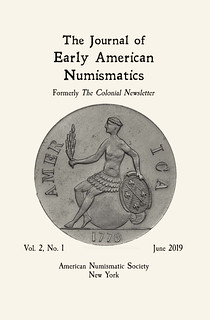 Jesse Kraft, PhD, has been appointed the new editor for The Journal of Early American Numismatics (JEAN). JEAN is a biannually published research publication and the successor to The Colonial Newsletter (CNL), founded in 1960. The CNL published an assemblage of the most seminal studies on colonial and confederation-era coinage of the United States. JEAN expands the focus of the CNL by exploring contributions to colonial numismatics from North, South and Central America.
JEAN has received several Numismatic Literary Guild awards for the Best Club or Not-for-Profit Periodical. Articles published in JEAN which have received NLG prizes include: "The Authentic Fugio Restrike Dies" by Christopher McDowell and Julia Casey, 2020; "Collecting American Colonial Coins in Eighteenth-Century England" by Jeff Rock, 2021; "The Coins Made ‘for the Islands and Mainland of America' by the French West India Company 1670" by Jérôme Jambu, 2022; "John J. Ford: A Life in Three Portraits" by Q. David Bowers, 2020; "The Crane Ring of Rupert, Vermont: A Family of Counterfeiters at Reuben Harmon's Mint" by Julia Casey, 2022: and "The 'Wild Scheme' of Sydney P. Noe: The 1942 Exhibition of Massachusetts Silver at the American Numismatic Society" by Jesse Kraft, 2023.
Issues of JEAN often exceed 200 pages and contain articles on a variety of early American numismatic topics. Since 1960, the pages of the CNL and JEAN have advanced our understanding of the history of colonial numismatics.
Subscribe to JEAN at the American Numismatic Society: https://numismatics.org/about-us/publications/journals/.
JEAN is available as an $100 added benefit to your ANS membership or at $130 per year for non-members. Contact: Jesse Kraft, Editor, jkraft@numismatics.org for additional information.
THE NEW NEWMAN PORTAL!
Newman Numismatic Portal Project Coordinator Len Augsburger submitted this update. Great news! -Editor

Home page of the updated Newman Numismatic Portal
The New Newman Portal
Newman Numismatic Portal Project Coordinator Len Augsburger will speak at the ANA Convention on Friday, August 28, 10AM, on "What's New at the Newman Portal?" This will be part of the ANA Numismatic Theatre program and will take place in room 327 of the convention center.
Since last fall, we've been preparing Newman Portal for the move to a new web platform, and this work is largely complete. Over the next few weeks, we'll be transitioning the old and new sites, and this Numismatic Theatre presentation will cover the rationale and logistics behind this update. E-Sylum readers may wish to explore the new site (URL below), and we'll go more in depth during the convention.
I'll be there for the presentation and hope to see a lot of E-Sylum readers there as well. -Editor
Link to the existing Newman Portal:
https://nnp.wustl.edu/
Link to the new Newman Portal:
https://nnp.washu.edu/
VIDEO: 1794 CONGRESSIONAL MINT COMMITTEE
The David Lisot Video Library on the Newman Numismatic Portal can be found at:
https://nnp.wustl.edu/library/multimediadetail/522852
We highlight one of his videos each week in The E-Sylum. Here's one from 2016 with David Finkelstein speaking about the 1794 Congressional Committee appointed to examine the U. S. Mint. -Editor

David Finkelstein speaks at the 2016 ANA World's Fair of Money, in Anaheim, CA.
To watch the complete video, see:
23-AUG
1794 Congressional Committee Appointed to Examine the Mint
(https://youtu.be/OVyRYG6NCTs)
23-AUG
1794 Congressional Committee Appointed to Examine the Mint
(https://nnp.wustl.edu/library/book/554710)
DOUG WINTER ON THE CABBAGE COINS PODCAST
Longtime E-Sylum supporter Doug Winter guested recently on the Cabbage Coins Podcast. Linked below is an earlier Newman Portal video with Doug at the January 2026 FUN Show. -Editor

Earlier this month (August, 2026) Doug Winter sat down for a chat with Tony Gryckiewicz of Cabbage Coins and the Cabbage Coins Podcast.
Doug is the leading expert in the world on Southern gold coins and he shares his insights and collecting strategies. This video is quite long, clocking in at over an hour, but we think it is worth your time; especially if you are a beginner in this fascinating area of the market.
We suggest you pay particular attention to the middle of the video during which Doug dissects over a dozen high end C and D mint coins and analyzes them for color, surfaces, strike and originality.
To watch the complete video, see:
Ep.55 - Rare Gold Coins w/Doug Winter
(https://www.youtube.com/watch?v=BC0QtyTkpF0)
https://raregoldcoins.com/videos
To read the earlier E-Sylum article, see:
NEW ORLEANS $10 GOLD WHIST MATCH
(https://www.coinbooks.org/v29/esylum_v29n13a10.html)

2026 HIGGINS MUSEUM SEMINAR CONCLUDES
Curator George Cuhaj submitted this note on the recent Higgins Museum Seminar. Thank you. -Editor

General view of the seminar room during Mark Drengson's presentation
The 2026 Higgins Museum seminar was held at the museum in Okoboji, IA.
Speakers and topics included:
Mark Drengson
Overview and Highlights of the Higgins Museum's Minnesota and South Dakota National Bank Notes
Steve Sweeney
Progress with the Iowa National Bank Note Census
George Cuhaj
The National Banks of Dickinson County and a few others nearby
Cody Regennitter
State of the National Bank Note Census: 2026
Joseph Boling
Counterfeit Nationals after the Series of 1875
and Mark Drengson as a endcap: A Discussion on National Bank Note Survival rates.

Left to right: Cuhaj, Boling, Sweeney, Drengson, Regennitter
Seminar attendees were treated to in-house catering by Yesterday's restaurant of Arnold's Park and two lakeside dinners, at Bracco's and Prime Boji, both located lakeside on East or West Lake Okoboji respectfully.
The museum board had its annual meeting and elected Don Mark as President, Steve Sweeney as Vice President, Rick Hickman as Treasurer, and Clifford Mishler as Secretary.
Elected to three year terms as Board Members (December 2026-2028): Mark Anderson, Don Mark.
Elected to three year term ending December 2029: Rick Hickman, Clifford Mishler.
Steve Sweeney and Andrew Shiva are serving terms ending December 2027. Robert Liddell was elected to a two year term ending December 2027 filling the unexpired seat of the late Dean Oakes.
The museum's 50th Anniversary will be celebrated with the 2028 Seminar, Late July date to be determined.
For more information on the museum, see:
https://thehigginsmuseum.org/
To read the earlier E-Sylum article, see:
2026 HIGGINS MUSEUM SEMINAR
(https://www.coinbooks.org/v29/esylum_v29n24a09.html)

NOTES FROM E-SYLUM READERS: AUGUST 23, 2026
Peter Cross and Longacre
Jim Sandy writes:
"Longacre's Diary for 1862 contains multiple mentions of Peter Cross. Researching Longacre's monument at The Woodlands and its missing medallion, brought me to the Library Company of Philadelphia in April. My notes list Cross's death in October of that year. But I recall reading Longacre visited Cross in hospital at least once, and I believe twice, in the prior weeks to the younger man's passing. It seemed to me they were true friends."
To read the earlier E-Sylum article, see:
ENGRAVER PETER F. CROSS
(https://www.coinbooks.org/v29/esylum_v29n33a12.html)
 Fielding's Entry for P. F. Cross
Scott Miller writes:
"Regarding 'Peter Filatreu Cross', there is also a listing for him in Dictionary of American Painters, Sculptors and Engravers by Mantle Fielding. Below is a scan of the listing. Nothing new to add except a typo."

Great typo - the adverse of the medal! That's a new one. -Editor
To read the earlier E-Sylum article, see:
ENGRAVER PETER F. CROSS
(https://www.coinbooks.org/v29/esylum_v29n33a12.html)
WorldBanknotes.eu
Audrius Moskaliovas writes:
"I'd like to introduce WorldBanknotes.eu, a Lithuania-based project dedicated to world banknotes.
The site combines a collector-oriented world banknote catalogue with an online shop specialising in uncirculated banknotes. Individual catalogue entries bring together collector-relevant information including series, issuing authorities, printers, signatures, watermarks, and details of obverse and reverse designs.
WorldBanknotes.eu also includes reference guides and articles covering different aspects of banknote collecting and numismatic research."

Thank you. It's a commercial website with banknotes for sale, but nicely done with a number of well-written articles in English. -Editor
To visit the website, see:
https://worldbanknotes.eu/
Belgian Worker's Multimillion Euro Gold Find
Leon Saryan passed along this video of a CBS segment on the recent gold hoard find in Belgium. Thanks. -Editor
To watch the complete video, see:
Workers discover gold bars, coins worth $10 million while drilling at site of former brewery
(https://www.youtube.com/watch?v=HeebDbS49tI)
To read the earlier E-Sylum article, see:
BELGIAN SEWER WORKER STRIKES GOLD
(https://www.coinbooks.org/v29/esylum_v29n33a20.html)
False Appetite Wordplay
Joseph Barnosky writes:
In one of those episodes of finding unusual importance in something seemingly tangential, the referenced article about Carol Bastable's contribution was important to me. The primary point of the story was that there exists something called "pica" which is, by its short definition, false appetite.
Well, naturally, I made my little journal notes telling the difference between false appetite and font size, and the knowledge of the word explained a lot. I have wondered seriously about this word and lead-based paint poisoning concerns.
I just stumbled onto a word tonight while doomscrolling on Facebook, though, which could possibly explain the circumstance. The word was "paika" and throughout much of the earlier portions of the 20th century it was the word for the daily bread ration in the gulag. Surely regarded as unappetizing with the usual horror stories of sawdust fillers et cetera, but, on a 1200 calorie a day diet while under forced labor quotas... well,.. bon appetite!
Further still, the kind of power of the obsessively compulsive behavior around it was, surely, far beyond anything Dagwood Bumstead and Mr. Dithers ever exemplified. Progressive discipline included rifles.
If you have the foreign language experience to know the feeling of being clam-baked until you tell the people what you know, then you know how clearly the people can present that there is need. But just because you spent an entire academic year on the language doesn't mean you have the vocabulary to take it outside and talk it out loud.
Well in the 1980's I had just finished a year of Russian studies and moved to an apartment in the kind of neighborhood that probably had plenty of lead-based paint around, and in under a week or two, I could tell the new graffiti wasn't about just anyone, it was about me. I couldn't follow the logic because I lacked both the English vocabulary and the Russian vocabulary. I couldn't spill it then or appreciate how it mattered to anyone.
Until tonight.
Its been 40 years and deep inside I can still feel the need. I hope you can find room for this slow-motion unfolding of some strange and mysterious exonumia. Book lovers... word lovers.
Well, we do love words here at The E-Sylum, so I'll allow the digression. Thanks. -Editor
To read the earlier E-Sylum article, see:
STOMACH COIN FINDS
(https://www.coinbooks.org/v24/esylum_v24n34a12.html)

VOCABULARY TERM: STRIKE UP, STRUCK UP
Here's another entry from Dick Johnson's Encyclopedia of Coin and Medal Terminology. -Editor
Strike Up, Struck Up. To bring the surface relief of a numismatic or medallic item to its full intended height by striking in a press with proper dies and proper pressure –or the proper number of impressions (if a multiple-struck item). The pressman is responsible for every piece to be struck during his shift or production run and that they will be fully struck up with all detail intact.. He will frequently examine sample struck pieces (inspection) making sure the relief is as intended.
Press setup and running. To begin a press run of a new coin or medal the pressman or pressroom foreman will SETUP the press, and strike a first specimen or two. This is a trial strike and is purposely at a lower impression than anticipated not to break a die during this stage (thus trial strikes are purposely weakly struck). He will increase the pressure until he feels it will be the proper amount to fully strike up the piece. These are the first strike specimens he will examine very closely.
The pressman looks for the following: (1) every die cavity is filled, (2) all high points are intact, (3) there has been no die draw – metal flowing into then out of a die cavity – and (4) the dies are not misaligned. During the press run his sample inspections will always check the high points maintaining the relief is fully struck up. In addition he will check that no part of the die has broken, there are no hairline breaks, that the rims are intact and the dies have not rotated. He will use a magnifying glass for this inspection.
Multiple striking. Medals that are multiple struck will always exhibit the state not struck up until the final blow. This is very evident in a process set. Only the final blow will have every cavity filled and high points intact (multiple blows are required to move the surface metal to fill every die cavity). Ideally the freshly struck finished piece, either coin or medal, should match the relief of the artist's original three-dimensional model, the galvano pattern or dieshell, though in miniature size.
To read the complete entry on the Newman Numismatic Portal, see:
Strike Up, Struck Up
(https://nnp.wustl.edu/library/dictionarydetail/516836)
FAULKNER PART 1: SHIPS, COLONIES & COMMERCE
Jacob Lipson is selling the Christopher Faulkner Collection, Part 1, showing Ships, Colonies & Commerce tokens. Select items are discussed below. -Garrett
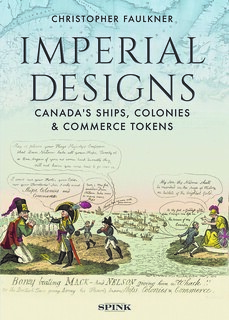 Welcome to the first installment of the Christopher Faulkner Collection. It is my great honour to
present this exceptional selection of Ships, Colonies & Commerce tokens — the opening
chapter in what will be a multi-part offering from this historic collection.
Welcome to the first installment of the Christopher Faulkner Collection. It is my great honour to
present this exceptional selection of Ships, Colonies & Commerce tokens — the opening
chapter in what will be a multi-part offering from this historic collection.
Christopher Faulkner is the author of the seminal works not only on this series, but also on the Prince Edward Island Holey Dollars, the Upper Canada tokens, and the Bouquet Sou series. His scholarship has set a new standard in Canadian numismatics, and his collections in these areas — and others — will be remembered for their quality, completeness, and intellectual rigour.
Each lot in this catalogue is offered at a fixed price and includes a high-resolution image, a physical description (including grades provided by Faulkner), commentary, and provenance. The commentary is drawn primarily from Faulkner's Imperial Designs (2019), the definitive study of the Ships series. In select cases, I have added my own observations, either summarizing Chris's analysis or reflecting on recent auction results and comparative material.
My hope is that this catalogue serves not only as an exciting opportunity to acquire remarkable tokens, but also as a text that will stand the test of time — demonstrating to future generations of collectors that Faulkner's holdings rank among the finest ever assembled.
All lots are offered with a seven-day return policy. A flat shipping rate of $20 will be added to each order, and we are happy to combine shipping. Taxes will be applied to the total according to the buyer's location.
Happy hunting.
Jacob Lipson
Jacob Lipson Rare Coins
451 Daly Ave., Suite 104
Ottawa, Ontario
K1N 6H6
jacob@jlrc.ca
(613) 777-2115

Lot 1
Breton-997. Ships, Colonies & Commerce. 3.67g. Lees-1, R.8. PE-10-1. This condition rarity features full strike definition from rim to rim with the sole exception being the reverse border between 1 and 3 o'clock. Glossy brown. Faulkner AU.
Commentary: "This token was struck in New York, by the firm of Wright & Bale, as the initials W & B N.Y. below the exergue lines attest (without periods after the W and the B)."
Provenance: Brian Cornwell; Todd Hume (1/2012).
Price: $750

Lot 6
Breton-997. Ships, Colonies & Commerce. 6.95g. Lees-3.2, R.7. BL-24A. Obverse Uniface. Only the outline of the ship remains on this smooth, well-circulated Blacksmith token. One of only two known. Faulkner VG.
Commentary: "When the Barton-Wood collection was dispersed in the early 1980s, all of the Blacksmiths, including those in the Ships series, were purchased by Warren Baker. This coin was sold with his Blacksmith collection in 1987, at which time it was acquired by Michael Oppenheim of Montreal. Oppenheim then sold it to Len Buth, who had already purchased the reverse uniface coin, 997.3.2."
Provenance: Edward W. Barton; John A. Wood; Warren Baker Collection (Bowers and Merena, 3/1987), lot 1033; Michael Oppenheim; Len Buth (4/2010).
Price: $5,000

Lot 10
Breton-997. Ships, Colonies & Commerce. 3.65g. Lees-3.5a, R.7. BL-24A. Described in Imperial Designs as follows: "This specimen, in very high grade, is a spectacular double error, inasmuch as it is 20% off-centre." The reverse features a full mirror brockage with the vast majority of ship detail apparent. Faulkner EF.
Commentary: This is one of three such brockage of Lees-3.5a in the Faulkner Collection. Apparently, others exist but, of course, they are highly sought-after by collectors and seldom appear.
Provenance: Charles Moore Sale #50, lot 358; Len Buth (4/2010).
Price: $1,750

Lot 24
Breton-997. Ships, Colonies & Commerce. 5.16g. Lees-13, R.10. PE-10-13. This is an exceptionally well-preserved representative. Each side presents strong strike detail with light high-point rub. Glossy. Appeaers to have oiled long ago by a collector. Faulkner VF/EF.
Commentary: Lees-13 is about as difficult to locate as Lees-4 and Lees-5. Chris Faulkner writes: "It is certainly extremely rare and most examples come in fairly low grade." His collection includes four pieces, this being the finest by a healthy margin. Perhaps only the Robins example is finer.
Provenance: Tim Henderson (10/1998).
Price: $3,500

Lot 25
Breton-999. Ships, Colonies & Commerce. 5.01g. Lees-5A, R.10. BL-24C1. Die axis off upset by 60 degrees clockwise. As the saying goes, beggars can't be choosers when it comes to this ultra-rare Blacksmith issue. Most collectors would be delighted with a low-grade, problematic example. Thankfully, this exceptional offering requires no such compromise. It survives in pleasing mid-grade condition without any problems or defects. The obverse ship and reverse legend are both clear and relatively strong with minor rub. Golden-brown surfaces display areas of darker patina. Faulkner VF.
Commentary: Only eight examples of Breton-999 are known, of which three are permanently housed in institutional collections. That leaves just five specimens in private hands. Writing in Imperial Designs, Chris Faulkner notes that the variety "has become the Holy Grail for collectors of the Ships series" as a result of both its ultimate rarity and its separate listing in Breton. The mystery that surrounds the production and issuance of the type has only added to its popularity and appeal.
To be sure, the present example, which can be traced back to the 1903 Murdoch sale, takes its place on the podium of signature rarities in the Faulkner Collection. Many collectors would call it the pinnacle of the set. Of course, there are so many wonderful gems that any such claim is entirely subjective. Regardless of how one decides to rank this token in the broader context of the collection, it will surely be remembered as a marquee offering that has everything going for it -- rarity, condition, and pedigree.
Provenance: John G. Murdoch Collection (Sotheby's, 7/1903), lot 510; Spink & Son, Ltd; W.W.C. Wilson Collection, Part II (Wayte Raymond, 11/1926), lot 129, realized $105; purchased by L.A. Renaud for Ludger Gravel; unknown intermediaries; Warren Baker (1/1971); Roy Hughes Collection (Jeffrey Hoare Auctions, 2/1995), lot 1858, realized $2900; purchased by Warren Baker for Len Buth; Buth Collection (4/2010).
Price: $30,000
To read the earlier E-Sylum article, see:
NEW BOOK: SHIPS, COLONIES & COMMERCE TOKENS
(https://www.coinbooks.org/v22/esylum_v22n19a03.html)

NUMISMAGRAM MEDAL SELECTIONS: AUGUST 23, 2026
Numismagram's Jeremy Bostwick sent along these five medals from his most recent upload of new material to his site. For all of the new items, please visit https://www.numismagram.com/inventory. -Garrett

103714 | TURKEY. Ottoman Empire. Constantinople. Santa Sophia (Hagia Sophia) bronze Medal. Issued 1858. Most Remarkable Edifices of Europe series (59mm, 86.92 g, 12h). By Jaques Wiener in Brussels and struck at the Geerts mint in Ixelles.
Interior view of the mosque's north nave; in six lines in exergue, STE SOPHIE À CONSTANTINOPLE / BATIE PAR L'EMPEREUR JUSTINIEN 532-537 / CONVERTIE IN MOSQUÉE 1453 / RESTAURÉE SOUS LE RÈGNE DU SULTAN / ABDUL MEDJID 1847-1849 / PAR G. FOSSATI // View of the mosque's central nave. Edge: Plain.
Ross M208 (R3); van Hoydonck 206; Reinecke 60. PCGS SP-64. Rich, glossy brown surfaces, with a good deal of brilliance; inconsequential rim bruise on the obverse noted merely for completeness. A very rare type that is the key to a series that has continued to grow in popularity, and one that can reach rather dizzying heights, such as an NGC MS-63 Brown, which realized a total of $4,560 [!] in the Stack's Bowers September 2024 World CCO, lot 75603.
From what is today eastern Netherlands and western Germany, the Wieners were a Jewish family of exceptional medalists, especially known for numerous numismatic works throughout the Kingdom of Belgium. Eldest brother Jacob (Jacques), along with younger brothers Leopold and Charles, created some of the finest works of medallic art of the 19th century, and all are particularly noted for their work in the highly detailed and intricate work of architectural renderings.
To read the complete item description, see:
103714 | TURKEY. Ottoman Empire. Constantinople. Santa Sophia (Hagia Sophia) bronze Medal.
(https://www.numismagram.com/product-page/103714)

103356 | UNITED STATES. Louisiana Purchase/St. Louis International Exposition bronze award Medal. Issued 1904. Presented at the expo for the "grand" award (65mm x 74mm, 151.10 g, 12h). Spade shape. By Adolph Alexander Weinman at the Philadelphia mint.
VNIVERSAL EXPOSITION SAINT LOVIS VNITED STATES OF AMERICA, Columbia standing slightly right, wearing Phrygian cap and outstretching American flag over Native American maiden standing to right, removing flag with intricate bee design (representing industriousness); rising sun in background; all within central medallion; downward facing flag in background // Eagle, with head left and wings spread, standing facing on oak and laurel branches; below, rectangular cartouche decorated with scallop shell and inscribed • GRAND • PRIZE • / • LOVISIANA • PVRCHASE • / • EXPOSITION • in three lines; two inward-facing dolphins below; all within central medallion; downward facing flag in background. Edge: Plain.
Hendershott 30-90. Choice Mint State. Tan-brown surfaces, with a great matte nature. Includes original box of issue, which is in far superior condition compared to most others encountered. Quite rare when found this attractive and with the original box of issue.
Designed by famed German-born U.S. coinage engraver Adolph Alexander Weinman, this series of award medals displays the elegant artistry that would make appearances the following decade on the 'Mercury' dime and the 'Walking Liberty' half dollar. Issued in various shapes, the entire series (bronze, silver, gold, commemorative, and grand) were nominally named, as all of the award medals were struck in a new bronze alloy (initially referred to as 'government bronze'), and meant to convey the level of recognition for the recipient. The expo itself was held in St. Louis, Missouri, and had, as its backdrop, the centennial of the Louisiana Purchase to commemorate—a factor which prominently influenced many design aspects of the award medals.
To read the complete item description, see:
103356 | UNITED STATES. Louisiana Purchase/St. Louis International Exposition bronze award Medal.
(https://www.numismagram.com/product-page/103356)
103678 | BELGIUM & THE NETHERLANDS. Johannes Diderik van der Waals bronze Medal. Issued 1911. The Belgo-Dutch Society of the Friends of Medallic Art: van der Waals–the Nobel Prize in physics, issue 26 (65mm, 114.20 g, 12h). By Frederik (Fré) Engel Jeltsema.
PROF DR J D VAN DER WAALS ÆTATIS LXXIII, bust left // NED–BELG-VEREENIGING-DER-PENNING-VRIENDEN / NOBELPRIJS-1910, a three-dimensional representation of van der Waals isotherms, with respect to pressure, volume, and temperature, along with his equation: (p + a/v²) = RT/(v-b); all set upon laurel branch. Edge: Plain.
Choice Mint State. Olive-brown surfaces, with a charming matte nature. An excellent representation of mathematics in medallic art.
Johannes Diderik van der Waals was an important Dutch physicist, most notably for his groundbreaking work in molecular theory involving gases and liquids. One of his most famous works, his eponymous "van der Waals equation," is equation of state that generalizes the ideal gas law. In 1910, he was the recipient of the Nobel Prize in Physics—the occasion for the topic of this medal.
The Société hollando-belge des amis de la médaille d'art, similar to American series such as the Circle of Friends of the Medallion, the Society of Medalists, and even the still-active Brookgreen Gardens issues, was an annual series of medallic art, each featuring different designs and themes by some of the most acclaimed sculptors and engravers in Belgium and the Netherlands. The series produced numerous medals from 1901-1920, eventually becoming Les amis de la médaille d'art, active from 1920-1959.
The designer of this medal, Frederik Engel Jeltsema, whose first name was often abbreviated as Fré, was born in 1879 in the Dutch town of Uithuizen. Upon birth however, Fré's sex was ambiguous, with the doctor registering him as female, and with Fré being named Frederika Engelina. He was raised as a girl despite feeling more masculine than feminine from a young age. Fré first pursued his passion of art locally in Groningen, but then studied internationally in Paris and Rome. In 1906, upon a return the Netherlands from his studies abroad, he underwent a physical examination in which the doctor confirmed what Fré had long been feeling—that he possessed much more masculine than feminine characteristics. From this point, Fré set in motion the changes needed to live more authentically, changing his name from Frederika Engelina to Frederik Engel, changing his wardrobe from women's clothes to men's, and informing his friends and family. For more information on Fré Jeltsema, please follow this link.
To read the complete item description, see:
103678 | BELGIUM & THE NETHERLANDS. Johannes Diderik van der Waals bronze Medal.
(https://www.numismagram.com/product-page/103678)

103286 | GREAT BRITAIN. Winston Churchill silver Medal. Issued 1965. Commemorating the death of the former Prime Minister (57mm, 82.14 g [ASW: 2.4 oz], 12h). By Frank Kovacs for Spink & Son in London.
Bust facing slightly left, wearing frock coat and bow tie; in background, books and paint brushes sitting upon a shelf // Soldier standing right in defiance, while a wave roils in background to right; above, airplane flying left; "VERY WELL, ALONE" in exergue. Edge: SILVER.
Eimer 2104a; Engstrom 30C. Choice Gem Mint State. Richly toned near the peripheries on each side, with immense brilliance in the fields. Includes original red leather case of issue, along with informational card.
To read the complete item description, see:
103286 | GREAT BRITAIN. Winston Churchill silver Medal.
(https://www.numismagram.com/product-page/103286)

103587 | UNITED STATES. Albert Einstein bronze Medal. Issued 1970. Jewish-American Hall of Fame series: commemorating the famed theoretical physicist (46mm x 45mm, 75.40 g, 12h). By Robert Russin for the Medallic Art Co.
Head facing slightly right // THE HIGHEST RELIGION IS THE SERVICE OF HUMANITY, radiant peace symbol within the umbra of a solar eclipse; facsimile signature to lower left, with birth and death years. Edge: MEDALLIC ART CO. N.Y. / 589.
JAHF 2. Gem Mint State. Light brown-bronze, with a charming matte aspect. Serially numbered 589 of 810.
A German-born physicist widely considered to be one of history's greatest minds, Albert Einstein was famous, among other things, for his theory of relativity and the equation E=mc². Of Jewish ancestry, he remained in the United States during a visit in 1933, around the time at which Adolf Hitler and his Nazi party came to power. Throughout the ensuring second World War, he was a supporter of the allied cause, and recommended to President Franklin D. Roosevelt that the U.S. begin seriously looking into research of nuclear weaponry, as he believed that the German government was already doing so. Though the results of this nuclear program did not involve the war effort in Germany, as the European portion had come to an end, they were immensely consequential in the ending of the war in the Pacific theater. This medal, issued a decade-and-a-half after Einstein's death, served as the second issue in the still-extant Jewish American Hall of Fame series.
To read the complete item description, see:
103587 | UNITED STATES. Albert Einstein bronze Medal.
(https://www.numismagram.com/product-page/103587)

HERITAGE: ANCIENT COINS PLATINUM HIGHLIGHTS
Heritage Auctions will be hosting their ANA World & Ancient Coins Platinum Session and Signature Auction from September 1-5. The following items were highlighted in Shanna Schmidt's Newsletter #245. Her website is http://www.shannaschmidt.com/. -Garrett


SICILY. Syracuse. Dionysius I (405-370 BC). AR decadrachm (37mm, 42.88 gm, 5h). NGC AU 4/5 - 3/5, Fine Style, light marks. Reverse die signed by Euainetos, ca. 400 BC. Racing quadriga driven left by charioteer, reins in left hand, kentron in right; Nike flying right above to crown him, military arms, including aspis (shield), greaves, cuirass, and crested Attic helmet, all joined by horizontal spear, ?T?? ("prizes") below all in exergue, dotted border / S?-??-?-?-S?O?, head of Arethusa left, hair wreathed with barley ears, wearing triple pendant earring and beaded necklace; four dolphins swimming around, ? below chin, EY-AINE (die-engraver's signature) below bottom dolphin. SNG Lloyd 1413 (same dies). Gallatin (DI/RIX). HGC 2, 1299. A simply beautiful example of this classic issue, struck on a oblong flan in sound metal, with none of the usual obverse die rust. Light iridescent toning.
From the Randy & Nancy Best Collection. Ex Vecchi, Sale 16 (9 October 1999), Lot 76; Hess-Leu, Auction 49 (27 April 1971), Lot 70.
Under the brutal but capable Tyrant Dionysius I (406-367 BC), Syracuse had become the wealthiest and most powerful city-state in the Greek world, and chose this moment to introduce the most extravagant coins yet seen - the stunning series of signed silver decadrachms. These huge, impressive coins were struck to pay the Greek mercenaries who flooded Sicily to fight the expanding power of Carthage. The magnificent decadrachms of the master engraver Euainetos have become a paradigm for classical beauty in the 24 centuries since their creation. His Arethusa is the very ideal of feminine beauty, both human and divine, her hair interwoven with a wreath of barley ears symbolizing the agricultural bounty of Sicily. Likewise, the horses pulling his chariot seem to levitate above the ground line, perhaps preparing to draw the charioteer into the heavens themselves.
To read the complete item description, see:
SICILY. Syracuse. Dionysius I (405-370 BC). AR decadrachm (37mm,
42.88 gm, 5h). NGC AU 4/5 - 3/5, Fine Style, light marks.
(https://coins.ha.com/itm/ancients/greek/ancients-sicily-syracuse-dionysius-i-405-370-bc-ar-decadrachm-37mm-4288-gm-5h-ngc-au-4-5-3-5-fine-style-light-marks/a/3135-30003.s?ic4=ListView-ShortDescription-071515)


MACEDONIAN KINGDOM. Philip II (359-336 BC). AV stater (17mm, 8.61 gm, 11h). NGC Choice MS? 5/5 - 5/5, Fine Style. Late posthumous issue, Colophon, under Philip III Arrhidaeus, ca. 322-319 BC. Laureate head of Apollo right, with features of Alexander III the Great / F???????, charioteer driving fast biga galloping right, kentron in outstretched right hand, reins in left hand; tripod in lower right field. Le Rider pl. 90, 16. SNG Alpha Bank 260. SNG ANS 309. Flashy surfaces with well-centered strikes.
From the Randy & Nancy Best Collection.
While the types of this gold stater issue of Colophon conform to the norm for Philip II (359-336 BC), the magnificent obverse die of this late posthumous issue of Colophon bears a portrait of "Apollo" that is quite distinctive and clearly depicts a real person. Comparison with the coins of Lysimachus and surviving portrait sculpture leaves no doubt the image represents Alexander III the Great himself. The issue seems intended to legitimize the patchwork Macedonian regime put together by Alexander's generals after his death in Babylon under the figurehead rulers Philip III Arrhidaeus, Alexander's half-brother, and the infant Alexander IV, his posthumously born son. As such the "Philip" named on the reverse should probably be seen as referring to Arrhidaeus rather than the traditional attribution to Philip II.
To read the complete item description, see:
MACEDONIAN KINGDOM. Philip II (359-336 BC). AV stater (17mm,
8.61 gm, 11h). NGC Choice MS? 5/5 - 5/5, Fine Style.
(https://coins.ha.com/itm/ancients/greek/greek-macedonian-kingdom-philip-ii-359-336-bc-av-stater-17mm-861-gm-11h-ngc-choice-msand-9733-5-5-5-5-fi/a/3135-30006.s?type=surl-3135--30006)


Trajan Decius (AD 249-251). AV aureus (20mm, 4.14 gm, 11h). NGC Choice AU 5/5 - 4/5. Rome. IMP C M Q TRAIANVS DECIVS AVG, laureate, cuirassed bust of Trajan Decius right, seen from behind / VBERITAS AVG, Uberitas standing facing, head left, purse in outstretched right hand, cornucopia cradled in left arm. RIC IV.III 28. Calicó 3299. Exquisite luster with deep jewel tones rippling across the obverse.
From the Randy & Nancy Best Collection.
To read the complete item description, see:
Trajan Decius (AD 249-251). AV aureus (20mm, 4.14 gm, 11h). NGC
Choice AU 5/5 - 4/5.
(https://coins.ha.com/itm/ancients/roman-imperial/ancients-trajan-decius-ad-249-251-av-aureus-20mm-414-gm-11h-ngc-choice-au-5-5-4-5/a/3135-30086.s?ic4=ListView-ShortDescription-071515)

João VI gold Ingot of Mato Grosso 1818 Genuine NGC, Mato Grosso foundry, Prober-1832-M-188 (this piece). 81x16x6mm. 139.50gm. Markings: N188 (number); 4.7.02 (weight); TOQVE 23 (23 karat); 1818 (DATE); IDBF. A substantial survivor, remarkable both for its weight and historical significance, this gold ingot is among the few remaining examples of a once-abundant form of wealth. The overwhelming majority of Brazilian gold bars were melted as newly mined bullion flowed into the mints during the country's prolific gold production. The connoisseur of this sub-genre of advanced numismatics understands how simply having a gold bar as such in their collection takes it to the next level; but when it comes to a Mato Grosso bar, and one of these measurements, it's beyond impressive. The few bars that reach the market every few years generally contain around an ounce of gold, or roughly 33 grams; this mammoth piece sits at just over four ounces. The bright but satin aureus color, seen in nearly-pure gold shines as bright as the day it was made. All stamps are deeply rendered, including the Mato Grosso shield itself, which according to Prober is the exact die used to regulate 8 Reales coins in 1818 for circulation in the Province. Prober, in his comprehensive work lists all known Brazilian gold bars, studied this piece in 1940 when it belonged to renowned businessman Guilherme Guinle, who built the famous Copacabana Palace Hotel in Rio de Janeiro. From the mere twenty surviving Mato Grosso bars cataloged by Prober, thirteen are in museum collections across Brazil and Portugal, three were stolen from the National Historic Museum of Brazil in the infamous 1939 heist (and are believed to have been melted down by the thieves), leaving only four Mato Grosso possibly in private hands, considering that Prober's book was published in 1990 and some of those could have been acquired by museums, such as the Banco Espirito Santo Collection, which did acquire several bars in the 1990s. First we have the pleasure to handle and only to hit the auction blocks in the past decades, this is sure to entice the most advanced collectors of Brazilian types and any trophy hunter.
During the early 1800s, gold exploration in Mato Grosso focused primarily on the region's rivers and streams, where miners extracted gold from alluvial deposits using relatively simple washing techniques. Although production had declined from its eighteenth-century peak, the deposits were still enough to sustain the production of these now seldom-seen ingots.
Metal: Gold
Diameter: 81mm
AGW: 4.299oz
To read the complete item description, see:
João VI gold Ingot of Mato Grosso 1818 Genuine NGC,
(https://coins.ha.com/itm/brazil/brazil-joao-vi-gold-ingot-of-mato-grosso-1818-genuine-ngc-/a/3135-31001.s?ic4=ListView-ShortDescription-071515)


SICILY. Messana. Ca. 412-408 BC. AR tetradrachm (26mm, 17.24 gm, 8h). NGC XF 4/5 - 4/5, die shift. Nymph Messana driving biga of mules walking left; Nike flying right above to crown driver / ??SS???O?, hare springing right; Ketos swimming left below. Jameson 652. Caltabiano 599. Impressive and powerful obverse, struck in high-relief and sporting deep toning.
From the Ahlden Castle Collection. Ex Gorny & Mosch, Auction 169 (12 October 2008), lot 19.
The coins of Greek Sicily abound with symbolism, the meaning of which is not always obvious to the modern observer. Messana, located on the northwest corner of Sicily and the third most populous city on the island, chose as its civic badges a chariot pulled by a pair of mules (biga) and a leaping hare. On this pleasing tetradrachm, the mule biga is driven by a woman, most likely the nymph Messana, while the hare springs over Ketos. As to what it all means, we can surmise as follows: In 484 or 480 BC, a mule team from Messana won the Olympic Games in the event known as the anape (mule biga race); naturally, civic pride prompted the Messenians to advertise the victory on their coinage. The hare is an animal sacred to the god Pan, who had a temple in Messana and was widely worshipped there.
To read the complete item description, see:
SICILY. Messana. Ca. 412-408 BC. AR tetradrachm (26mm, 17.24 gm,
8h). NGC XF 4/5 - 4/5, die shift.
(https://coins.ha.com/itm/ancients/greek/ancients-sicily-messana-ca-412-408-bc-ar-tetradrachm-26mm-1724-gm-8h-ngc-xf-4-5-4-5-die-shift/a/3135-33004.s?ic4=ListView-ShortDescription-071515)


MACEDONIAN KINGDOM. Alexander III the Great (336-323 BC). AV distater (22mm, 17.21 gm, 10h). NGC Choice AU? 5/5 - 5/5, Fine Style. Lifetime issue, Aegeae(?), ca. 336-323 BC. Head of Athena right, hair in three tight corkscrew curls, upswept at temple, and flowing over left shoulder, wearing pendant earring, double-necklace, and triple-crested Corinthian helmet pushed back on head, long divergent crest ends, bowl decorated with coiled serpent right / ??????????, Nike standing facing, head left, wreath in outstretched right hand, stylis cradled in left arm; vertical thunderbolt in outer left field, AO monogram in left field below wing. Price 191. Superb eye appeal with flashing luster and nearly pristine devices.
At the beginning of his reign in 336 BC, the Macedonian Kingdom was reportedly in debt to the tune of 500 silver talents (a talent being 6,000 silver drachms and a "king's ransom" in earliest Greek times). To give an idea of the vast loot his conquests amassed, at Susa alone Alexander seized 50,000 talents of silver and 40,000 of gold. This huge intake of bullion resulted in hitherto unseen denominations such as the gold distater, tariffed at two staters and ten silver tetradrachms, about 20 day's wages for a Macedonian soldier during wartime. The distater was likely employed to pay many of Alexander's veteran soldiers, who were rewarded for their labors with the equivalent of a silver talent. With the new denomination, a talent could be paid out as 120 gold distaters. Despite their size and enormous buying power, gold distaters evidently circulated heavily, for most specimens found today display considerable wear and numerous contact marks. However, this attractive specimen is nearly mark free.
To read the complete item description, see:
MACEDONIAN KINGDOM. Alexander III the Great (336-323 BC). AV
distater (22mm, 17.21 gm, 10h). NGC Choice AU? 5/5 - 5/5, Fine
Style.
(https://coins.ha.com/itm/ancients/greek/ancients-macedonian-kingdom-alexander-iii-the-great-336-323-bc-av-distater-22mm-1721-gm-10h-ngc-choice-au-5-5-5-5-fine/a/3135-33012.s?ic4=ListView-ShortDescription-071515)


Frederik III gold 10 Ducats (Portugaloser) ND (1668-1669) MS63? NGC, KM-Unl, Fr-Unl, Hede-80B, Bruun-6736. 34.46gm. Mintmaster: Gotfred Krüger. A coin of epic proportions, emanating flashes of light from the semi-reflective surfaces that play host to lightly frosted, intricately engraved devices. Without any discernable weakness of strike or wear to the devices, the star designation is well warranted. We are aware of only a single other example of the type, which resides in the National Museum of Denmark.
Ex. L. E. Bruun Collection (Stack's Bowers, September 2024, Lot
1096); Countship of Brahesminde Collection (Private sale, 1922)
Ex. L.E. Bruun Collection
Metal: Gold
Diameter: 42mm
To read the complete item description, see:
Frederik III gold 10 Ducats (Portugaloser) ND (1668-1669) MS63?
NGC,
(https://coins.ha.com/itm/denmark/denmark-frederik-iii-gold-10-ducats-portugaloser-nd-1668-1669-ms63-ngc-/a/3135-33146.s?ic4=ListView-ShortDescription-071515)

HERITAGE: 2026 ANA SIGNATURE SALE
Heritage Auctions will be hosting their ANA Signature Sale from August 31 - September 5. Here is the press release. -Garrett
The finest of only four privately held examples of the famous Quintuple Stella from one of the most prominent collections in all of numismatics will be among the top attractions at Heritage's ANA U.S. Coins Signature® Auction August 31–September 5.


1879 Liberty Head Quintuple Stella, Judd-1643, Pollock-1843, Low R.7, PR64+ Deep Cameo PCGS
The gorgeous 1879 Liberty Head Quintuple Stella, Judd-1643, Pollock-1843, Low R.7, PR64+ Deep Cameo PCGS is part of The Bob R. Simpson Collection, Part XIII. Simpson's collection is one of the most celebrated in all of numismatics. It is one of five known examples, one of which is held in the National Numismatic Collection at the Smithsonian.
"This issue is extraordinarily rare, and the one offered in this auction, from the acclaimed Bob R. Simpson Collection, is the finest-certified example," says Todd Imhof, Executive Vice President at Heritage Auctions. "This is a numismatic treasure that continues the tradition of elite coins from the collection that Heritage is proud to offer to the most serious collectors."


1876 Liberty Double Eagle, Judd-1490, Pollock-1643, Unique, PR64+ Cameo PCGS. CAC
From the same collection comes a unique 1876 Liberty Double Eagle, Judd-1490, Pollock-1643, Unique, PR64+ Cameo PCGS. CAC. The only known specimen of this magnificent coin has proven elusive, even to some of the most notorious of numismatic collectors. Numismatists view Judd-1490 as a transitional pattern, made to further the design change to the Type Three format in honor of the nation's centennial. Its existence was completely unknown to the numismatic community until the early 20th century, after not being offered at auction or mentioned in the numismatic press even once in the 19th century.
Costa Family Collection
The auction also includes the 51-lot Costa Family Collection, Part III, the third installment of a trove of rare gold, high-end Colonials, type coins, historic Betts medals and gold stellas.


traced of a 1879 Coiled Hair Stella, Judd-1638, Pollock-1838, JD-1, R.6, PR67 Cameo NGC
Among the top offerings from the collection is one of just 14 examples traced of a 1879 Coiled Hair Stella, Judd-1638, Pollock-1838, JD-1, R.6, PR67 Cameo NGC, a magnificent offering that is tied for the finest certified example. One of the rarest and most valuable issues in all of American numismatics, the 1879 Coiled Hair stella traditionally has been listed with the pattern series, but now has been enthusiastically adopted into the regular U.S. gold series, as well. Its rare visits to the auction block help generate significant interest when it is offered.


1880 Coiled Hair Stella, Judd-1660, Pollock-1860, JD-1, Low R.7, PR64 Cameo PCGS
Also from the Costa Family Collection is one of just 10 examples traced of an 1880 Coiled Hair Stella, Judd-1660, Pollock-1860, JD-1, Low R.7, PR64 Cameo PCGS, the rarest of the four stella varieties. The pedigree of the coin offered here has often been combined with the pedigree of the Kern specimen in the past, leading numismatists to believe there were only nine examples of the 1880 Coiled Hair stella extant. But Heritage catalogers had the unique opportunity to study both the present coin and the Kern specimen in hand when that coin sold in Heritage's April 29-May 2 CSNS U.S. Coins Signature® Auction. A world-class rarity in the U.S. federal coinage system, the 1880 Coiled Hair stella is listed among the 100 Greatest U.S. Coins.


1880 Flowing Hair Stella, Judd-1657, Pollock-1857, JD-1, R.6, PR66 NGC
A third Costa Family Collection highlight is one of just 18 examples traced of an 1880 Flowing Hair Stella, Judd-1657, Pollock-1857, JD-1, R.6, PR66 NGC. It also is one of the most famous rarities in American numismatics, a beauty that technically is a pattern, and one never authorized for regular coinage. The 1880 Flowing Hair stella has survived and prospered as a collectible issue and is featured regularly alongside regular U.S. gold coin issues in numismatic publications such as A Guide Book of United States Coins and the 100 Greatest U.S. Coins. USPatterns.com suggests "about 20 are believed to exist," of which Heritage experts have confirmed only 18.
Round Lake Collection


1798/7 Capped Bust Eagle, 7x6 Stars, BD-2, Low R.6, MS62 PCGS
The auction includes more than 60 lots from this impressive assemblage, led by a 1798/7 Capped Bust Eagle, 7x6 Stars, BD-2, Low R.6, MS62 PCGS that is tied for the third-highest known grade. This coin occupies the second position on PCGS CoinFacts' Condition Census for the issue, behind only the finest-known coin in the National Numismatic Collection at the Smithsonian Institution, which has not been certified and remains unavailable to collectors. This piece first surfaced in William Woodin's landmark collection, which was sold by Thomas Elder in March 1911.
Reno-Carson City Collection


1870-CC Double Eagle XF40 NGC. Winter 1-A
Another important collection features 43 lots, including an 1870-CC Double Eagle XF40 NGC. Winter 1-A, a rarity from the inaugural Nevada Mint issue that never was readily available. Interest in large denomination United States gold coins developed slowly during the late 19th and early 20th centuries, and the collecting landscape changed dramatically in the 1930s. Numismatists like Louis E. Eliasberg and Dr. Charles W. Green recognized that collectible United States gold coins represented one of the few lawful methods for private citizens to hold substantial quantities of gold, and today, Carson City gold remains one of the strongest specialties within U.S. numismatics.


1889-CC Morgan Dollar MS64 NGC. CAC. VAM-5
The same collection also produced an exceptional 1889-CC Morgan Dollar MS64 NGC. CAC. VAM-5. The 1889-CC Morgan dollar is one of the key dates in the series, particularly in Mint State. From the original mintage of just 350,000 pieces, many were paid out soon after issue, and more from 1933 on. While hoards can come out from time to time, the fact that few bags survived into the collecting era means that this Mint State population will remain necessarily small. Just six are graded higher at NGC than the example offered in this auction.
Bolt Collection of Lincoln Proof Cents


1909 Cent PR68 Red PCGS. CAC
This 26-lot collection is the all-time finest PCGS Registry Set of 1909-58 proof Lincoln cents, a trove that includes many coins from the well-known Stewart Blay Collection. Among the highlights is a 1909 Cent PR68 Red PCGS. CAC that is the finest example graded by PCGS. Three varieties of proof cents were made in 1909: the outgoing Indian Head design, the short-lived and desirable VDB variety and the less lauded but imminently important 1909 non-VDB. After the new Lincoln cent was introduced to great fanfare in 1909, the initials were removed and the reverse rim relief was reduced. Proof production continued with the new design, with one of the obverse dies used on the VDB coinage carried over to the later non-VDB proofs, which are scarce today. PCGS population reports indicate that two of every seven certifications can boast the same level of preservation. However, the numerical excellence of this example is unmatched, and across the 1909-16 proofs, just two other certifications carry equal grades, with just one finer.
Other highlights from the collection include, but are not limited to:
- A 1909 VDB Cent PR66 Red PCGS. CAC
- A 1914 Cent PR68+ Red PCGS. CAC
- A 1955 Cent PR69 Red Deep Cameo PCGS
Van Cleve Family Collection


1807 Capped Bust Half Dollar, Bearded Goddess, O-111b, High R.4, AU53 PCGS. CAC


1807 Capped Bust Half Dollar, Large Stars, O-114, R.3, MS65 PCGS. CAC
Another featured collection in the auction, this 57-lot assemblage counts among its highlights an 1807 Capped Bust Half Dollar, Bearded Goddess, O-111b, High R.4, AU53 PCGS. CAC. According to Leaman and Gunnet's emission sequence of the Capped Bust half dollar series, the O-111 was the third die marriage produced of the series, and the prominent die crack from the chin to the bust provides the popular "Bearded Goddess" nickname for this late die state of the O-111 die pair. The collection also includes an 1807 Capped Bust Half Dollar, Large Stars, O-114, R.3, MS65 PCGS. CAC. Only four different 1807-dated die varieties are known of this type, and just two examples have been certified in higher numeric grades than this spectacular Gem.


1795 Lettered Edge Cent, S-76, B-4 — Struck Over 1794 S-71 Cent — R.8, AU58+ PCGS
The auction also includes a trio of large cents found by Kentucky numismatist Jeff Garrett at the Berlin Coin Fair. Among them is a 1795 Lettered Edge Cent, S-76, B-4 — Struck Over 1794 S-71 Cent — R.8, AU58+ PCGS that is attributed as S-76 and likely refined as S-76b based on the die state. There are two other 1795 S-76 cents known that show 1794 large cent undertype, both in lower grades. What makes this example really stand out from others is the level of visual clarity that can be seen in the undertype. One example that appeared in Heritage's 2015 Chicago ANA auction offers no evidence of the 1794 date. The other example is identified as a 1795 S-76 cent that was struck over an 80% off-center 1794 S-63 cent that shows the "Fallen 4" date. Until January 2026, the coin offered in this auction was unknown to early copper aficionados.
Other top lots in the auction include, but are not limited to:
- A 1797 Half Eagle with Small Eagle reverse, 16 Stars, BD-4, High R.8, AU58+ PCGS. HBJ-209
- An 1860-O Half Dollar — Indented by Half Dime Planchet, Mated Pair — MS63 PCGS
- The finest known example of an 1897-S $20 MS67 PCGS. CAC
- An 1893-O $1 MS65 PCGS. CAC
- One of just nine known examples of an 1827/3 25C Original, B-1, R.7, PR64 PCGS
- One of no more than seven recognized proofs of an 1849 Gold Dollar No L, JD-1, R.7, PR62 PCGS
Complete results can be found at HA.com/1396.
STACK'S BOWERS: NICHOLAS P. BROWN U.S. ERRORS
Stack's Bowers will be selling the Nicholas P. Brown Collection of U.S. Mint Errors as part of their Summer 2026 Global Showcase Auction on September 1. Select items are discussed below. -Garrett


Famous 1968 No S Roosevelt Dime Rarity Ranked #8 of the 100 Greatest U.S. Modern Coins 1968 No S Roosevelt Dime. FS-501. Proof-69 * (NGC). A stunning example of this landmark modern U.S. Mint Proof issue, as struck, virtually pristine, and possessed of outstanding eye appeal. The obverse exhibits a dusting of pale silvery iridescence, while the equally attractive reverse exhibits iridescent champagne-gold that deepens to a halo of similar, albeit slightly bolder color around the border. The finish is modestly cameoed, especially on the obverse, which feature helps to explain the coveted * designation from NGC for superior eye appeal. Fully struck and exquisite.
The 1968 No S dime was the first of the Proof "S-less" varieties to come to light in numismatics. The Philadelphia Mint discontinued striking annual Proof sets in 1964, the series as a whole taking a short break before resuming in 1968, when the sets were first struck in San Francisco. The master dies for the Proof coins were forwarded to the West Coast facility from Philadelphia and the mintmark was to be added, however, this did not always happen. While striking these 1968-dated Proof coins, it was observed that the S was not added to the die for the dimes being struck. All of the No S dime coins were thought to have been destroyed. However, a few had already been sealed in Proof sets and were not found until received by their original owners. Similar No S varieties appeared in 1971 on a nickel, in 1970, 1975 and 1983 on a dime, and in 1990 on a cent. The rarest by far of all of them are the dimes of 1975 and 1968, with the 1968 No S dime ranked #8 in the fourth (2017) edition of the book 100 Greatest U.S. Modern Coins by Scott Schechter and Jeff Garrett.
By way of insight, we note that NGC currently lists 21 grading events for this elusive issue, a figure that includes 16 pieces in this category, plus an additional four pieces in the Cameo category and a single specimen in their Ultra Camo category. PCGS currently lists 39 grading events for the issue across all categories, none of which are in DCAM. However, as is more typical than not, it is likely that some percentage of these grading events represents resubmissions of identical coins. Clearly, the number extant is very small in an absolute sense. At the pinnacle of numismatic quality, it is infinitesimal and includes a mere 11 grading events in Proof-69 at PCGS and NGC combined, in the Proof and Cameo categories combined. As the only one of these specimens with a * designation as certified, the present example is one of the very finest in this highly select group.
The offering of this rare Proof Roosevelt dime represents an excellent opportunity to obtain one of the most desirable of all late 20th century U.S. Mint coins. Whether you specialize in Roosevelt dimes, modern U.S. Mint Proofs in general, or just love great American coins, the present lot will hold a special fascination for you. Don't be shy when the bidding starts on this lot or you're likely to find yourself wishing you had been more aggressive. The 1968 No S Proof Roosevelt dime comes to market but infrequently, and the importance of the opportunity offered herein cannot be stressed enough.
Provenance: From the Nicholas P. Brown Collection of U.S. Mint Errors.
To read the complete item description, see:
Famous 1968 No S Roosevelt Dime Rarity
(https://auctions.stacksbowers.com/lots/view/3-1UQ83E/1968-no-s-roosevelt-dime-fs-501-proof-69-ngc)


The Unique 1906 Indian Cent Struck in Error on a Quarter Eagle Planchet Ranked No. 2 of the 100 Greatest U.S. Error Coins 1906 Indian Cent. Struck on a Quarter Eagle Planchet. AU-58 * (NGC). 18.3 mm x 18.1 mm, 1.1 mm to 1.2 mm thick. 64.4 grains, which is within the 0.25-grain tolerance for the 64.5-grain authorized weight of contemporary quarter eagle planchets. Plain edge. The physical size of the planchet is also very similar to that of a quarter eagle (17.78 mm), the slightly larger diameter of this specimen accounted for by the spread during striking of the soft gold blank to fill the larger diameter collar (19.05 mm) of an Indian cent. Lovely honey-gold color joins softly frosted luster and universally bold strike detail throughout the Indian cent design.
Both the 2010 reference 100 Greatest U.S. Error Coins and Saul Teichman's census work published on the uspatterns.com website confirm that only four Indian cents struck on gold planchets are positively confirmed to exist: two dated 1900, and one each dated 1905 and 1906. Per Q. David Bowers in his Buyer's and Enthusiast's Guide to Flying Eagle and Indian Cents, p. 427, Michael Hodder reported in a May 14, 1996 letter that he had seen three examples of the 1900 although, if true, the third example has not been confirmed by the wider numismatic community. Writing in his 2014 reference The Flying Eagle & Indian Cent Attribution Guide, Rick Snow also reports a 1900 struck off center on a silver planchet and notes, "Same dies as the gold pieces." The three gold 1900s, as reported by Hodder, vary in weight from 65.8 grains to 67.1 grains, to account for which Fred Weinberg has observed: "the weights vary because in all probability, they were on planchets that might not have been filed down to the proper weight spread." That these coins are all well outside the tolerance for a contemporary quarter eagle planchet suggests that the 1900 Indian cents in gold were deliberately struck as fantasy pieces for the numismatic trade, which conclusion can also be drawn for the off center 1900 in silver struck from the same dies, and (probably also deliberately) struck off center.
The 1905 and 1906 Indian cents struck in gold - both of which are unique by date - are in a different category. The former weighs 64.5 grains, the standard weight for a contemporary quarter eagle planchet, while the 1906 offered here, at 64.4 grains, is within the 0.25-grain tolerance for that wight standard. Armed with this evidence, most numismatic scholars accept the conclusion for these two coins as related by Rick Snow for the 1906 in his aforementioned Flying Eagle & Indian Cent Attribution Guide:
This example is of the correct weight and proves that it is struck on [a] quarter eagle planchet. Only one example [of the 1906] is known and it has light wear which indicates that this might be a circulation find, however at this point, this is undocumented. It doesn't appear to have been struck specially and saved, as is the case with the 1900 pieces. The weight of the 1907 Indian cent in gold is unknown for, while listed in the Judd pattern reference and in Don Taxay's Catalogue and Encyclopedia of U.S. Coins, it is untraced and has not undergone modern numismatic scrutiny.
"That any cents struck in gold exist at all is quite extraordinary," observes Rick Snow. "The gold planchets are presumably tracked and counted along their production route." The author's comments, of course, refer to genuine Mint errors within this small group, which refers to only the 1905 and 1906. These two coins are clearly more numismatically significant and desirable than the 1900-dated fantasy strikings. The 1905 was apparently unknown to the wider numismatic community until its offering in Heritage's January 2010 FUN Signature Auction. Certified MS-64 by PCGS, it realized $253,000 as lot 2433. A more recent Heritage offering for that coin, September 2015 Long Beach Signature Auction, lot 3708, resulted in a lower price of $105,750.
The 1906 offered here is returning to auction for the first time since bringing $276,000 in our (Stack's) Philadelphia Americana Sale of September 2009. It is one of the most famous of all U.S. Mint errors and will command a strong price commensurate with its significance as it transitions into another world-class numismatic cabinet.
Plated in the 2010 reference 100 Greatest U.S. Error Coins by Nicholas P. Brown, David J. Camire and Fred Weinberg, p. 5, and the 2014 reference The Flying Eagle & Indian Cent Attribution Guide by Rick Snow, p. 843.
Provenance: From the Nicholas P. Brown Collection of U.S. Mint Errors. Earlier from our (Stack's and American Numismatic Rarities') Medio and Henry Da Costa Gomez Collections sale, June 2004, lot 4097; our (Stack's) Americana Sale of September 2009, lot 4299.
To read the complete item description, see:
The Unique 1906 Indian Cent Struck in Error on a Quarter Eagle Planchet
(https://auctions.stacksbowers.com/lots/view/3-1UQEJH/1906-indian-cent-struck-on-a-quarter-eagle-planchet-au-58-ngc)


Unique 1993-D Lincoln Cent Muled with Roosevelt Dime Reverse Earliest Dated Modern Muling Error 1993-D Lincoln Cent. Muled with Roosevelt Dime Reverse. MS-66 RD (NGC). Ranking No. 12 in the 2010 reference 100 Greatest U.S. Error Coins by Nicholas P. Brown, David J. Camire and Fred Weinberg, this is one of the most significant modern Mint errors of a type for which all examples are significant. It is not only the earliest dated modern U.S. Mint muling error, but also one of only seven from the Denver Mint. (The others are the 2000-D Sacagawea dollar / South Carolina State quarter mule that surfaced in 2022 and five 2001-D Lincoln cent / Roosevelt dime mules.) Errors of this type - struck using two dies intended for two different coins - are also exceedingly rare regardless of issuing mint or other particulars, as this list of some of the most famous of recent decades makes clear:
- 1993-D Lincoln Cent. Muled with Roosevelt Dime Reverse. Unique. The present example.
- 1995 Roosevelt Dime. Muled with Lincoln Cent Obverse. Unique. Offered below.
- 1999 Lincoln Cent. Muled with Roosevelt Dime Reverse. Unique.
- (2000)-P Sacagawea Dollar. Muled with Statehood Quarter Obverse. 18 known, one of which is being offered in this sale.
- 2000-D Sacagawea Dollar. Muled with South Carolina State Quarter Reverse. Unique.
- 2001-D Lincoln Cent. Muled with Roosevelt Dime Reverse. Five known.
Amazingly, two of the three unique mulings that combine Lincoln cent and Roosevelt dime dies are being offered in this sale, along with one of the 18 Sacagawea dollar / State quarter mules - a gathering of rarities in the segment of the hobby that deals with modern Mint errors that collectors may not see again for many years, if not decades.
Interestingly, the two dies from which the present 1993-D Lincoln cent / Roosevelt dime muling were struck had seen previous use before creating this dramatic error. The obverse exhibits die polish lines behind Lincoln's head, while the reverse show polish lines around the central design elements and a collar clash. As the authors of the 100 Greatest U.S. Error Coins reference point out: "Because both dies had been in use previously, one must wonder why a pair of used dies of different denominations would be paired with each other." Of course, such unsolved mysteries are part of what make major Mint errors such as this so popular with advanced numismatists.
This is a generally well struck and sharply defined coin despite the error, although peripheral softness is noted on the Lincoln portrait side - the result of the smaller diameter of the dime die. The reverse, by way of contrast, has an unusually thick rim, and for the same reason. A lengthy, yet faint die crack on the latter side slants down through the lower part of the torch, where it divides the word PLURIBUS. The surfaces on both sides are virtually as struck with vivid reddish-rose mint color and an impressively smooth appearance overall.
Provenance: From the Nicholas P. Brown Collection of U.S. Mint Errors. Earlier first publicized in February 2003, when it was walked into a coin shop in Denver, Colorado. Later from Heritage's sale of the Alfred V. Melson Collection, Part I, January 2010 FUN Signature Auction, lot 2383. Plated in the 2010 reference 100 Greatest U.S. Error Coins by Nicholas P. Brown, David J. Camire and Fred Weinberg, p. 23.
To read the complete item description, see:
Unique 1993-D Lincoln Cent Muled with Roosevelt Dime Reverse
(https://auctions.stacksbowers.com/lots/view/3-1UQEJS/1993-d-lincoln-cent-muled-with-roosevelt-dime-reverse-ms-66-rd-ngc)


Fascinating and Unique Deep Reverse Die Cap of a Type II Buffalo Nickel Undated (1913-1938) Philadelphia Mint Buffalo Nickel. Type II. Deep Reverse Die Cap. AU-58 (PCGS). An exquisite piece, unique as a deep reverse die cap on a Buffalo nickel, and one which highlights an unusual and little-known aspect of the production process for coins of this type. This series is one of only two produced in the 20th century United States Mint where the obverse was installed in the press as the anvil die and the reverse served as the hammer die. Only the Mercury dime series from this same era shares this die setup. With this in mind, one can more easily understand how this Buffalo nickel die cap was created. The planchet adhered to the hammer die (reverse), which continued to go through the motions of striking coins, during which the planchet gradually wrapped itself around that die. By the time it finally freed itself from the hammer die, the planchet had taken taken on a deep "bottle cap" shape, in the bottom of which is a sharply executed Buffalo nickel reverse impression. No mintmark is present, so this error can be attributed to the Philadelphia Mint, and the Type II Buffalo design is also clearly identifiable. The obverse, however, is a late stage brockage, the multiple impressions into blank planchets resulting in a broad, very distended, indeed ghostly image of the Buffalo nickel obverse. The date is no longer discernible, but the persistent viewer will be able to make out part of the Native American's profile and some of the detail in the feathers. Lightly toned pewter gray overall with hints of champagne-apricot iridescence within the struck portion inside the cap.
This coin is ranked No. 34 in the 2010 reference 100 Greatest U.S. Error Coins by Nicholas P. Brown, David J. Camire and Fred Weinberg, in which it is plated on p. 45.
Provenance: From the Nicholas P. Brown Collection of U.S. Mint Errors. Earlier ex Dr. Conway Bolt Collection, 1974. Illustrated in the July 1946 edition of Numismatic Review, and plated in the 2010 reference 100 Greatest U.S. Error Coins by Nicholas P. Brown, David J. Camire and Fred Weinberg, p. 45.
To read the complete item description, see:
Fascinating and Unique Deep Reverse Die Cap of a Type II Buffalo Nickel
(https://auctions.stacksbowers.com/lots/view/3-1UQEKO/undated-1913-1938-philadelphia-mint-buffalo-nickel-type-ii-deep-reverse-die-cap-au-58-pcgs)


Stunning 1995 Roosevelt Dime Muled with a Lincoln Cent Obverse Unique 1995 Roosevelt Dime. Muled with a Lincoln Cent Obverse. MS-64 (NGC). 2.26 grams. The reverse is rotated approximately 15 degrees counterclockwise from coin alignment. Amazingly, this is the counterpart to the similarly unique 1993-D Lincoln cent / Roosevelt dime muling offered in the preceding lot. On the present example, the planchet is that of a copper-nickel clad dime, the reverse with the expected Roosevelt design, with a broad rim. The edge is fully reeded, which further confirms that it was the Lincoln cent obverse die that was out of place in the dime press. The obverse of this coin presents as a "silver" 1995 Lincoln cent, and it is boldly to sharply defined in all areas except for along the upper left border, where there is no rim and the letters L in LIBERTY and IN GOD WE run nearly to the edge of the flan. Both sides are bright silver gray in appearance with softly frosted luster and no significant post-production blemishes.
This coin is the third officially reported modern U.S. Mint muling error, following the (2000)-P Sacagawea dollar / State quarter and 1999 Lincoln cent / Roosevelt dime. This 1995-dated muling from the Philadelphia Mint first appeared in the numismatic market in 2000, and in 2010 its significant and unique status were recognized by its ranking of No. 13 in the 2010 reference 100 Greatest U.S. Error Coins by Nicholas P. Brown, David J. Camire and Fred Weinberg.
This sale presents numerous fleeting opportunities for advanced Mint error specialists, but perhaps none as significant as the chance to acquire both the 1993-D Lincoln cent / Roosevelt dime, offered in the preceding lot, and its counterpart offered here, the 1995 Roosevelt dime muled with a Lincoln cent obverse. Both are sure to capture the full attention of advanced bidders and see spirited competition during the auction session.
Provenance: From the Nicholas P. Brown Collection of U.S. Mint Errors. First publicized in the numismatic market in 2000. Later from Heritage's sale of the Alfred V. Melson Collection, Part I, January 2010 FUN Signature Auction, lot 2384. Plated in the 2010 reference 100 Greatest U.S. Error Coins by Nicholas P. Brown, David J. Camire and Fred Weinberg, p. 24.
To read the complete item description, see:
Stunning 1995 Roosevelt Dime Muled with a Lincoln Cent Obverse
(https://auctions.stacksbowers.com/lots/view/3-1UQEL3/1995-roosevelt-dime-muled-with-a-lincoln-cent-obverse-ms-64-ngc)


1977-D Half Dollar Struck on a 40% Silver Planchet Rare Transitional Wrong Planchet Mint Error 1977-D Kennedy Half Dollar. Struck on a 40% Silver Planchet. MS-64 (NGC). 11.5 grams. Transitional wrong planchet strikes are one of the most popular subdisciplines within the community of dedicated Mint error collectors, as evidenced by the excitement that greeted our June 2026 offering of a 1970-D Roosevelt dime and 1966 Washington quarter struck on 90% silver planchets. Here we are pleased to present a transitional wrong planchet Kennedy half dollar associated with the two-year Bicentennial coinage of 1975 and 1976. During those years, the Mint struck Bicentennial half dollars (and quarters and Eisenhower dollars) for inclusion in Proof and Mint sets for sale to collectors. All official coinage of these 40% silver coins was confined to the San Francisco Mint, however, so the delivery of some of these 40% silver half dollar planchets to the Denver Mint represents the first blunder in the chain of events that led to creation of this error. At least some of these 40% planchets were then used to strike 1977-dated half dollars for commercial use - a date for which no regular issue 40% strikes were authorized.
Numismatists have discovered several of these wrong planchet errors for the 1977-D half dollar, including at least four in circulated grades, suggesting that they were released from the Mint through normal channels. The present example, however, was spared commercial use and retains full, softly frosted luster and bold to sharp strike detail. The surfaces are brilliant with a bright silver appearance, and the edge show no trace of copper that would be customary for a copper-nickel clad strike. Rare and highly desirable.
Provenance: From the Nicholas P. Brown Collection of U.S. Mint Errors.
To read the complete item description, see:
1977-D Half Dollar Struck on a 40% Silver Planchet
(https://auctions.stacksbowers.com/lots/view/3-1UQELE/1977-d-kennedy-half-dollar-struck-on-a-40-silver-planchet-ms-64-ngc)


Fabulous (1921)-S Dollar Struck 45% Off Center Finest Known Off Center Morgan Without a Date (1921)-S Morgan Silver Dollar. Struck 45% Off Center. MS-63 (NGC). Morgan dollar errors are featured three times in the 2010 book 100 Greatest Error Coins by Nicholas P. Brown, David J. Camire and Fred Weinberg. Entry No. 6 is a double struck 1887, with one strike 40% off center. Entry No. 22 was referred to as the finest known dated off center Morgan dollar - the 40% off center 1880-S certified MS-63 by PCGS that later realized $72,000 in Heritage's May 2022 sale of the Fred Weinberg Collection. Entry No. 23 is the coin offered here - the finest off center Morgan dollar without the date showing. A fourth coin deserves inclusion in this discussion of leading off center Morgan dollar errors, and that is the 1887 struck 55% off center with a brockage on the reverse that realized $78,000 in our November 2024 Showcase Auction; offered as lot 3275, that coin was certified MS-63 by PCGS.
Despite the existence of these landmark rarities, major Mint errors of any type that involve America's favorite silver dollar are rare. Generally speaking, the Mint more closely scrutinized higher denomination coins such as silver dollars (and, of course, the gold denominations) before their release into commerce, with the vast majority of Mint errors discovered and destroyed. With their record high mintages, the 1921-dated issues have yielded the greatest number of off center errors in the Morgan dollar series. Most such pieces are attributed to the Philadelphia or San Francisco mint, most are struck only 5% or 10% off center, and most are in circulated or lower Mint State grades. The (1921)-S without a date struck 20% off center and certified MS-62 by NGC that appeared in our August 2021 Auction was significant both with regard to the error and the level of preservation. It brought $14,400 - an impressive price at the time.
We now come to the amazing NGC MS-63 example offered here. The strike is off center to approximately 7 o'clock, the date far off the planchet on the obverse, but the S mintmark present and crisp on the reverse. The tiny S mintmark and nuances of this revised final-year Morgan dollar design confirm that this dateless error was struck in 1921. Both the struck and unstruck areas are uncommonly smooth, the former nearly Choice in quality, and the latter with no sizeable distractions among the tiny marks that are commonplace on virgin planchets. Brilliant apart from the lightest iridescent gold highlights, with full detail and strong frosty luster to the struck areas.
As related by the authors of the 100 Greatest U.S. Error Coins book, "Although dozens of off-center [sic] Morgan dollars are known, this is one of the most famous pieces." It will certainly see spirited bidding that results in a strong price as it transitions into the next world-class Mint error cabinet.
Provenance: From the Nicholas P. Brown Collection of U.S. Mint Errors. Earlier from Numismatic and Antiquarian Service Corporation of America's New York Sale of July 16-17, 1981, lot 517. Plated in the 2010 reference 100 Greatest U.S. Error Coins by Nicholas P. Brown, David J. Camire and Fred Weinberg, p. 34.
To read the complete item description, see:
Fabulous (1921)-S Dollar Struck 45% Off Center
(https://auctions.stacksbowers.com/lots/view/3-1UQELP/1921-s-morgan-silver-dollar-struck-45-off-center-ms-63-ngc)


Dramatic Obverse Die Cap Bicentennial Ike Dollar Deepest Die Cap of Just Three Known The Brown-Camire-Weinberg Plate Coin 1976-D Eisenhower Dollar. Obverse Die Cap. MS-67 (NGC). This stunning example is ranked No. 40 in the 2010 reference 100 Greatest U.S. Error Coins by Nicholas P. Brown, David J. Camire and Fred Weinberg, and it is plated on p. 51 therein. The authors report only three die caps involving Eisenhower dollars, two obverse and one reverse, and identify the offered example as the deepest. It truly is dramatic, the obverse with a particularly desirable "bottle cap" effect given the depth of the die cap. The obverse still took a full, crisp impression from that die, and it has toned beautifully in light, vivid, reddish-apricot iridescence. The reverse is equally dramatic as a Mint error and shows a broad, distended impression of the obverse design - a late stage brockage. The latter side presents as untoned, but shows a hint of champagne-gold iridescence on closer examination. Both sides are satin to softly frosted in texture, the appearance expectably smooth and close to pristine for the impressive Superb Gem grade assigned by NGC. Clearly the significance of this coin as a major Mint error was recognized right after striking, allowing it to be preserved with the utmost care ever since.
This coin is numismatically significant for a number of reasons, several of which have already been addressed: the depth of the die cap; its stunning visual appearance; ranking and plating in the 100 Greatest U.S. Error Coins reference. To these we add that die caps are typically encountered on smaller denomination coins, primarily small cents, more infrequently on nickels, dimes and, quarters. A 38-mm dollar of any type with this kind of error is far rarer. Additionally, the Bicentennial Eisenhower dollar is a one-year design type, with actual production taking place only in 1975 and 1976, so there was very little press time for an error such as this to have been produced, certainly far less time than for, say, an error in the Lincoln cent series with Memorial reverse. In a sale replete with stunning Mint error rarities, this piece is standout - a position it will surely occupy in the next advanced cabinet in which it is included.
Provenance: From the Nicholas P. Brown Collection of U.S. Mint Errors. Earlier from our (Bowers and Merena's) sale of the Cabinet of Lucien M. LaRiviere, Part III, May 2001, lot 545; our (Bowers and Merena's) Rarities Sale of September 2002, lot 644. Plated in the 2010 reference 100 Greatest U.S. Error Coins by Nicholas P. Brown, David J. Camire and Fred Weinberg, p. 51.
To read the complete item description, see:
Dramatic Obverse Die Cap Bicentennial Ike Dollar
(https://auctions.stacksbowers.com/lots/view/3-1UQEMM/1976-d-eisenhower-dollar-obverse-die-cap-ms-67-ngc)


Extraordinary Sacagawea Dollar / State Quarter Muling Die Pair #1 The Nicholas Brown Specimen One of Only 18 Known (2000)-P Sacagawea Dollar. Muled with a State Quarter Obverse. MS-67 (NGC). Mule #11, as listed in Error News. A gorgeous specimen of this incredible rarity showcasing bright golden-honey surfaces with areas of richer pinkish-rose coloration here and there at the peripheries. The overall pristine surfaces are complemented by frosty, cartwheeling luster and bold definition to the design elements. Die striations at the border are as seen on all known examples, creating a spectacular sunburst effect most dramatic on the obverse.
Mules - coins struck using two dies intended for two different coins - have a "Holy Grail" of error coins for generations. In most cases, mules are intentionally produced using deliberate pairings of entirely unrelated dies purely for the purpose of creating numismatic delicacies in very small quantities intended for highly specialized collections. Such fanciful creations are familiar in many numismatic disciplines and such items may be found in a bewildering array of combinations and metals.
Far rarer are those mules created purely by accident or happenstance, especially employing dies from two different denominations. Among all the coins produced at the United States Mint, muling errors are of the highest rarity and were once branded an impossibility. With modern minting equipment and tracking technologies, it would seem that muling errors are even more unlikely except under very specific and most serendipitous circumstances. Just such an event occurred in early 2000 at the Philadelphia Mint that resulted in the best known of all muling errors, coins struck using State quarter obverse dies and the reverse dies of the newly introduced Sacagawea dollar on the new dollar planchets.
The stage for the Sacagawea dollar / State quarter mule has its origins back in 1979 with the introduction of the Susan B. Anthony dollar. The size of the new smaller dollar coin at 26.5 mm was sufficiently close enough to the quarter (24.3 mm) that the coins were frequently confused with quarters, prompting considerable complaints about the new coins. The Susan B. Anthony dollars were produced for circulation for only two years before the design was shelved in 1981. Nearly 20 years later, the Anthony dollar design was briefly resurrected in 1999 in preparation for the production of a new dollar coin, one that would be sufficiently different from the quarter to minimize the risk of confounding the two denominations. The new design by Glenna Goodacre featured a representation of the Lemhi Shoshone woman Sacagawea on the obverse and a flying eagle on the reverse was introduced the following year. While the new Sacagawea dollar employed an entirely new golden colored alloy and bore a smooth edge, one thing that did not change was the diameter. The 2.2 mm difference between the two denominations may indeed have been equally confusing to Mint personnel.
There may have been another contributing factor at work. According to leading error coin expert Fred Weinberg, around 1998 or 1999, the Mint instituted an Occupational Safety and Health Administration rule that employees in specific roles be rotated into other positions on a periodic basis. Sometime in either April or early May of 2000, just such a staff rotation may have occurred at the Die Room. A coin press operator arrived at the Die Room requesting an obverse die for the new Sacagawea dollar. The employee in the Die Room picked out what they thought was a Sacagawea obverse die, but was instead an obverse die for a quarter. Neither the Die Room employee nor the press operator took off the protective plastic cover off the die to double check, and so it was put in the hammer (or upper) position in the press and coining began with the Sacagawea dollar reverse die in place. Perhaps lack of familiarity with die sizes as well as procedure in the Die Room alongside the failure to check the dies before installation led to a "perfect storm" of events leading to the error. What makes this error especially perplexing is that three different die pairs have been identified among the known specimens. Precisely how this occurred is pure supposition at this point; it is quite possible that the Die Room handed out incorrect dies to three separate press operators before the error was caught after several thousand impressions. The die pairs can be identified thusly:
-Die Pair 1: There is a die crack on the reverse in the letter F in OF unique to this pairing. The obverse die shows the radial stress striations typically found when dies from two different sizes are used together. This is the most frequently seen of the three die pairs with a total of 13 specimens known, including the present coin.
-Die Pair 2: The obverse die is perfect with no distinguishing marks, but the reverse bears three die cracks: one projecting from the star above the letter E in ONE, a second by the star above the letter D in DOLLAR, and a third crack running by the wing above the same two letters. Only three coins are known from this die pairing.
Die Pair 3: The obverse die is mostly fresh with the exception of a tiny gouge in front of Washington's lips. The reverse die is in pristine with no distinguishing marks of note. Two coins are known from this pair.
Once discovered, Mint employees combed through the bins where the freshly struck coins were deposited and culling out all the muled coins they could and destroyed all of them, or so they thought. A few managed to escape and in late May of 2000 the first example was found in a roll of the new Sacagawea dollars by Frank Wallis in Arkansas. Attention was already being paid to the new coin design when news reports started to come out through various press channels and the hunt was on. While there was some initial debate as to the authenticity of the error, as well as the legality of owning the coins, the Mint acknowledged the error as genuine on June 19. We (Bowers and Merena) sold that rare discovery piece at the August 2000 American Numismatic Association Millennium Sale for $29,900. This shocked everyone as this mule was virtually unknown at the time. It had been reported that examples sold privately in the neighborhood of $250,000 in 2007/2008, and our most recent auction offering (March 2018 Baltimore Auction, lot 2382) resulted in a realized price of $192,000 for an example also certified MS-67.
Precisely how they escaped the Mint's dragnet is unclear, though most seem to have passed through normal official channels. A couple of coins seemed to have had questionable origins and the resulting investigation found two Mint employees complicit in smuggling a few out and selling them for personal gain, for which both individuals were found guilty and sentenced to probation, house arrest, and fines. In its sentencing memorandum in 2005, the Treasury made it clear that their goal was not to seize the coins but "to punish the defendant and to deter theft by current and future Mint employees and other government employees," effectively resolving any question of legality.
How many Sacagawea dollar / State quarter mules escaped into circulation is not known, but considering how few coins have so far been found in the intervening years even with the media attention, it is unlikely many more (if any) will be found. Among world coins, muling errors occur on a comparatively more frequent basis and are an especially popular field for specialists. This is not the case for U.S. coins where the opportunities to obtain a mule of a coin intended for circulation are precious few and very far between. This is especially true for the Sacagawea dollar / State quarter mule for, not only are there just 18 specimens confirms, but most are tightly held by New Mexico numismatist Tommy Bolack, who has acquired pieces as they appear at market over the past 20+ years. Here, then, is a fleeting opportunity to acquire a fantastic Superb Gem example of a famous and coveted modern U.S. Mint error rarity that will be talked about for generations to come.
The Sacagwea dollar / State quarter mule is ranked No. 1 in the 2010 reference 100 Greatest U.S. Error Coins by Nicholas P. Brown, David J. Camire and Fred Weinberg, and No. 5 in the fourth (2017) edition of the reference 100 Greatest U.S. Modern Coins by Scott Schechter and Jeff Garrett.
Provenance: From the Nicholas P. Brown Collection of U.S. Mint Errors.
To read the complete item description, see:
Extraordinary Sacagawea Dollar / State Quarter Muling Die Pair #1
(https://auctions.stacksbowers.com/lots/view/3-1UQEMX/2000-p-sacagawea-dollar-muled-with-a-state-quarter-obverse-ms-67-ngc)


Jaw-Dropping 1901/0-S Half Eagle Struck 10% Off Center Only Three to Five Known Lovely NGC MS-64 * PL Quality 1901/0-S Liberty Head Half Eagle. FS-301. Struck 10% Off Center. MS-64 * PL (NGC). As related above in our description for the 45% off center (1921)-S Morgan dollar also being offered in this sale, major Mint errors are particularly rare on high denomination U.S. Mint coins. This is especially true for the gold denominations, mintages of which were subjected to rigorous quality control procedures designed to identify and weed out misstrikes before they were released into commerce. In this endeavor the Mint was very successful, to the disappointment of today's collectors, who have precious few gold coin errors to admire and collect. Yet a small number of these numismatically significant pieces did manage to escape the Mint during the classic era of its operations, and they are eagerly sought by the most advanced collectors in today's market.
The Liberty Head half eagle offered here is plated in the 2010 reference 100 Greatest U.S. Error Coins by Nicholas P. Brown, David J. Camire and Fred Weinberg, in which it is ranked No. 10. As of that printing it was the third confirmed of just three to five off center errors known for the 1901/0-S FS-301 variety. The strike is off center exactly at 12 o'clock - one of the most desirable positions for errors of this type - although all major design elements are not only present, but sharply defined and crisp. As well, remnants of the 0 underdigit are unusually bold and plainly evident under low magnification. There is no denticulation along the upper obverse and lower reverse borders, with crescents of virgin planchet in the opposite areas further identifying the error type. As the authors of the 100 Greatest U.S. Error Coins book observe:
All [examples of this error] look almost exactly like this specimen as far as their percentage and position off-center [sic], the degree of metal flow, and the design elements missing (the denticles on both the obverse and reverse). These denticles are on the actual coin die, so if they are missing on the struck coin, the coin is considered a true off-center [sic] strike. Because there are three such pieces that appear to have been struck at the same time, we can assume that instead of being a one-of-a-kind striking, this piece is a survivor of a malfunction of the coining press. On the other hand, the three examples confirmed at the time of that writing are not alike in terms of preservation. Two are similar - the present coin and another certified MS-65 PL by NGC - but the third is an NGC AU-55 that appeared in Heritage's August 2006 sale of the Henderson Collection of U.S. Gold Errors.
One of the finest known for this off center overdate half eagle, and famous as the 100 Greatest U.S. Error Coins plate, this is a spectacular classic U.S. Mint gold coin error that would serve as a centerpiece in a world-class cabinet.
Provenance: From the Nicholas P. Brown Collection of U.S. Mint Errors. Plated in the 2010 reference 100 Greatest U.S. Error Coins by Nicholas P. Brown, David J. Camire and Fred Weinberg, p. 20.
To read the complete item description, see:
Jaw-Dropping 1901/0-S Half Eagle Struck 10% Off Center
(https://auctions.stacksbowers.com/lots/view/3-1UQEND/19010-s-liberty-head-half-eagle-fs-301-struck-10-off-center-ms-64-pl-ngc)

MORE SKYLER LIECHTY INDIAN PEACE MEDALS
Stack's Bowers will be selling the Skyler Liechty Collection of Indian Peace Medals on August 31. Additional selections are discussed below. -Garrett


Possibly Unique 1781 Tupac Amaru Revolt Rarity (ca. 1781) Tupac Amaru Revolt Medal. Silver. Medina-14. Extremely Fine. 39.8 mm. 33.79 grams. Lima (?) Mint. Plain edge. Pleasing antique silver gray with lively, attractive surfaces highlighted with old traces of pale violet and rich gold. Nicely centered and well struck on both sides. Scattered marks are seen, rims a bit knocked and bruised, but the visual appeal is excellent.
A March 2006 article in Numismatics International by Alan Luedeking offers some insight on the backdrop of this medal. After the execution of Amaru in 1781, the regent at Charcas in Bolivia, Jeronimo Ruedas, wrote to Viceroy Juan Jose de Vertiz at Lima to inform him he had medals made at Potosi to recognize some of natives who remained allied and helpful to the Crown.
In 1783, the surprising response to Viceroy Vertiz's report on Jeronimo Ruedas' [issuance of medals] arrived from King Charles III in Spain, who had decreed on January 28th of that year that he not only approved of Ruedas' actions but instructed Vertiz to cause additional medals in both silver and gold to be made in his name, bearing the inscription "En Premio de la Fidelidad", for the viceroy to award to those Indian chieftains and nobles who deserved it, and in accordance with their rank and merit. The viceroy immediately ordered the mints at Potosi and Lima to strike a few medals in accordance with the king's wishes." Arnaldo J. Cunietti Ferrando illustrated a different medal with the same inscription in a 1976 article on the subject, a piece that used a familiar 4 reales portrait of Carlos III on the obverse but was slightly larger than a 4 reales. Two examples of that medal are now known.
In an October 2011 letter to the MCA Advisory, Fernando Chao theorized that this production must have been produced in Lima in the early 19th century, based upon Medina's inclusion of a medal with this obverse in his 1919 Medallas Coloniales Hispanoamericanas: Nuevos Materiales para su estudio. Mr. Chao did not have the benefit at that time of having seen Medina's actual specimen of that medal, which was cataloged and sold in our January 2017 NYINC sale. That piece, lot 3264, was struck from a heavily rusted obverse die that had been repolished to put into later service. The rust process on a steel die takes decades (distinct from spalling, which can appear rather instantaneously, even before the die strikes a single piece). The present medal shows no trace at all of the rust seen on that medal, strongly suggesting that this piece was struck decades earlier.
Based on the die state and striking texture, this medal appears to be an original piece given to loyal Indians who fought for the Spanish during the revolt of Tupac Amaru, whose three year revolt against Spanish rule in Peru ended in 1783, two years after his own execution. If the other type with these inscription was struck at Potosi, and Medina recognized this obverse as a Lima Mint production, the conclusion is unavoidable that this is the other type authorized by the king in his decree to Viceroy Vertiz. Its extraordinary rarity and importance recommend it for inclusion in a world class cabinet.
Provenance: From the Skyler Liechty Collection of Indian Peace Medals. Earlier from UBS Auction 83, September 2009, lot 3716.
To read the complete item description, see:
Possibly Unique 1781 Tupac Amaru Revolt Rarity
(https://auctions.stacksbowers.com/lots/view/3-1UUCO2/ca-1781-tupac-amaru-revolt-medal-silver-medina-14-extremely-fine)


Historic 1757 Quaker Peace Medal Rarity The First American Indian Peace Medal An Awarded Silver Original 1757 Treaty of Easton or Quaker Indian Peace Medal. Silver. Betts-401. VG-8 (PCGS). 42.8 mm. 25.69 grams. After decades in the collection of Richard August, we sold this piece in our auction of March 2025, where it was described as follows:
Overstruck, with the edge device of the Spanish colonial Pillar dollar or 8 reales that served as a planchet. Holed at 12 o'clock, as typical. One of the most desirable of all American medals, coined in Philadelphia in 1757 by Joseph Richardson the Elder from dies by Edward Duffield. Evenly and lovingly worn, with the lower relief reverse more worn than the high relief portrait of George II, as usually seen. The obverse portrait was copied from a contemporary coin of George II, while the reverse shares a scene with a famous Indian trade gorget made by Joseph Richardson the Elder. The hole is smooth and nicely worn, and both sides show a scattering of tiny contact marks that evince display use but not damage. A horizontal scratch is noted in the lower left obverse field, and a hint of a graffitied initial is hidden beneath the bust. The reverse legend, usually the first design element to be worn off on a well used example, is essentially complete, with only LET US of LET US LOOK TO THE MOST HIGH WHO BLESSED OUR FATHERS WITH PEACE worn away. The visual appeal is superb, blending the collector's desire for a legible specimen with the historian's love of a relic that served its intended function. The Friendly Association for Regaining and Preserving Peace with the Indians was a group of Philadelphia Quaker merchants who had far more to gain from the commercial possibilities of peaceful relationships with Pennsylvania's native Americans than from the French and Indian War. The origin story of this medal is...derived from firsthand documents left by Joseph Richardson the Younger. The senior Richardson was a high profile Philadelphia silversmith, leading Quaker, and member of the Friendly Association. Richardson was a major manufacturer of Indian trade silver, a profitable endeavor that relied on peaceful trading relationships with natives in Pennsylvania and beyond. While the Friendly Association undoubtedly used these medals to solidify existing trading relationships, many were distributed at the Treaty of Easton, signed after several years of intense conferences between local tribes and the government of Pennsylvania. Benjamin Franklin printed the official versions of minutes from the conferences of July and November 1756, July and August 1757, and October 1758. His official printed documents for 1756 and 1758 conferences include inventories of the goods brought to the treaty fire by the Quakers. While no inventory was published in 1757, and the 1758 inventory is silent about medals, the 1756 inventory includes "12 Silver Medals of King GEORGE," which begs the question: were some kind of imported English medals of generic types distributed in 1756 that proved unsatisfactory, or were these medals actually struck and distributed at the end of the year before the date on the medal?
To read the complete item description, see:
Historic 1757 Quaker Peace Medal Rarity
(https://auctions.stacksbowers.com/lots/view/3-1UUCQ3/1757-treaty-of-easton-or-quaker-indian-peace-medal-silver-betts-401-vg-8-pcgs)


Important George III Large Size Shells Rarity Undated (ca. 1776-1814) George III Indian Peace Medal. Struck Silver Shells. First Size. Adams 7.1 (Obverse 1, Reverse A). AU-55 (NGC). 76.0 mm. 61.0 grams. Typical ornamental hanger and pin present at 12 o'clock, as issued. A handsome and high grade example of this largest size George III medal, struck in the far scarcer silver shells format. These medals were made by striking two thin sheets of silver, one with the obverse design and one with the reverse, then wrapping a band of silver around the rim to join them into a single, hollow production. Large, high relief medals were a challenge to strike, even with multiple blows, leading to medals like this and the similarly constructed original Thomas Jefferson Indian Peace medals.
Adams recorded only 11 examples of this type struck in silver shells. We wrote in our Ford sale of these medals that "[John] Adams' research suggests that fewer than half of the largest undated George III medals were made as shells." It is possible that this labor intensive method was phased out early in favor of the easier striking process for solid medals, or that the percentage was much higher initially but that hard use destroyed more of these relatively fragile medals. In either case, they are scarce today and this is a particularly pleasing example of this historic type. Aside from the two examples in the Ford XVI sale (both of which we have resold later), we've offered just one additional George III medal of this type in shells in the last 25 years, a holed example in our April 2024 sale graded Choice Fine. Opportunities to acquire an example this nice occur roughly once in a generation.
This example retains its original hanger, displays a fine deep antique gray patina with lively silver surfaces, and remains sharp and well defined. A few dents are seen, a common issue with these hollow medals made of thin sheets, including on the king's cheek, above the end of his hair tie, below the bust, and around the reverse periphery. The die state is late, with the often seen vertical die crack down the central obverse, quite similar to the die state of the shells example at the ANS depicted as the plate piece for Adams 7.1. Adams cites two examples of Adams 7.1 in his extensive census with known presentations during the Revolutionary War, noting "the sequencing of the dies can be inferred from the surviving provenances of four pieces," including examples of Adams 7.2 and 7.3 with known presentation dates during the War of 1812. This example offers exceptional condition while still being obviously worn and presented, a sweet spot for collectors of Indian Peace medals. For those who already own a solid medal, this type is distinctive enough to clear room for a second specimen of this design.
Provenance: From the Skyler Liechty Collection of Indian Peace Medals. Earlier ex Warren Baker, July 1982, to the following; Heritage's sale of the Donald G. Partrick Collection, March 2021, lot 15177.
To read the complete item description, see:
Important George III Large Size Shells Rarity
(https://auctions.stacksbowers.com/lots/view/3-1UUCQN/undated-ca-1776-1814-george-iii-indian-peace-medal-struck-silver-shells-first-size-adams-71-obverse-1-reverse-a-au-55-ngc)


The LaRiviere Gilt Resolution and Adventure Medal 1772 Captain Cook / Resolution and Adventure Medal. Gilt Bronze or Platina. First Reverse. Betts-552. Extremely Fine. 42.4 mm. 31.22 grams. Holed on edge for screw mount at 12 o'clock, as issued, though the screw mount is no longer present. An old friend, last cataloged by us a quarter century ago. At that time, it was the only gilt Resolution and Adventure medal we had encountered. In 2026, after seeing a couple handfuls of medals of this type, including the multi-generational holdings in the Ford Collection, we have still never seen another! The gilding is nice light yellow gold in color, worn on some high points and around some areas of the edge but almost entirely intact. Some specks and verdigris are present, not unusual on gilt bronze pieces of this era, and the gilding has left some areas of the surfaces appear a bit granular under magnification. This is most notable on the reverse between the ships in the upper field. A portion of the internal reverse rim has been abraded away before gilding, near 6 o'clock below the exergue. An old scratch is present between the king's hair and GR. BRIT, some trivial hairlines, no major marks. The eye appeal is excellent. The die state of this piece is late, with a crack between I of SAILED and A of MARCH in the reverse exergue and related spalling left of it. The die state of the present piece is essentially identical to the example we sold in August 2023 as lot 2022.
While gilding a bronze medal usually suggests a special presentation purpose, the Resolution and Adventure medals made for presentation to VIPs in England were struck from a different reverse in a varieties of finishes (including bronzed copper and silver). This piece was struck from the die pair used for medals distributed to Pacific natives, in the composition used for distributed medals, and with the mount style used for distributed medals. How this came to be gilt is clearly unknown, but the gilding is of the era and has seen wear since its application. This medal was intended to be special. It remains so today.
Provenance: From the Skyler Liechty Collection of Indian Peace Medals. Earlier from Superior's sale of February 1976, lot 1306; Lucien LaRiviere Collection; our (Bowers and Merena's) sale of the Cabinet of Lucien M. LaRiviere, Part II, March 2001, lot 2131.
To read the complete item description, see:
The LaRiviere Gilt Resolution and Adventure Medal
(https://auctions.stacksbowers.com/lots/view/3-1UUCRP/1772-captain-cook-resolution-and-adventure-medal-gilt-bronze-or-platina-first-reverse-betts-552-extremely-fine)


Spectacular High Grade ca. 1777 Lion and Wolf Medal With Provenance to an 18th Century British Officer Undated (1777) George III, Lion and Wolf Medal. Struck Solid Silver. Adams 10.2 (Obverse 1, Reverse B, In Late State). Betts-535, Jamieson Fig. 11. Choice Extremely Fine. 61.2 mm. 60.02 grams, including the ancient buff leather string around the hanger, knotted at top. Original finial-shaped hanger and pin mount at 12 o'clock. One of the most exceptional specimens of this famous type extant, never before auctioned in the United States. Devices on both sides show only whispers of friction on their highest points. The surfaces are lustrous, retaining some of the original freshness of the surfaces despite a trivial (and utterly typical) polishing long ago. Bright splashes of pastel blue and muted gold are seen across the obverse and around the reverse, contrasting with the light silver gray surfaces and deeper antique toning across both sides. Scattered minor contact marks are seen, suggesting this medal was actually worn and displayed as intended. A short scratch is seen above and below the obverse legend at RG of GEORGIUS, single pit or mark at the right outline of the building right of the church on the reverse, scattered inherent granularity is seen around the top of obverse and reverse near the mount, somewhat more muted planchet texture visible across the expanse of the reverse field where it was not fully struck out. The rim is intact and clear of damage. A little hint of jeweler's rouge is seen in some protected areas like within the fur of the lion, harming nothing. The overall eye appeal is breathtakingly positive, and this medal's extraordinary condition suggests how majestic these medals must have looked when brand new. This piece was worn and used as intended, but surely not for very long.
The Adams Census included 19 Lion and Wolf medals, though Michael Hodder commented in Ford XVI that Adams' #17 had been "misrepresented by Mr. Ford and does not exist." To that figure of 18 we may add at least three pieces: the second example in the 2020 Ness sale, this lot, and the third-known example struck in silver shells from our November 2024 sale (at $60,000). At least 10 of these are in institutional collections.
When offered by Baldwin's in 2024, this piece was sold with a provenance built from a family belief that this piece descended from an ancestor who served as a British officer in America. While the precise details of their provenance conclusions are not borne out by more dutiful research (there were no officers named Tudor or Risk who served in America between 1775 and 1783, based upon the most up to date and correct sources), that doesn't mean that the kernel of the family tradition is incorrect. Indeed, if these medals were in fact distributed about 1777, as all sources suggest, it would have been nearly impossible for this medal to have remained so well preserved had it stayed in use (or even on this continent) after the war. So while the finer points may be unknown, this medal is almost certainly a Revolutionary War-era bring-home that spent most of its life cherished as a souvenir of that conflict.
The state of preservation of this piece is positively top shelf, and we've seen only one finer: the remarkable Ford-Margolis specimen that brought $72,000 in our March 2024 as a PCGS AU-55. Between the natural propensity of the reverse to receive wear and the cracked die state that serves to obliterate central detail on many specimens, it is challenging to find an example of this type that showcases the splendid and intricate reverse devices. This example's superlative condition makes it the sort of medal a connoisseur builds a cabinet around.
Provenance: From the Skyler Liechty Collection of Indian Peace Medals. Earlier ex an unknown Revolutionary War-era British officer; family descent; Baldwin's Auction 118, October 2024, lot 670.
To read the complete item description, see:
Spectacular High Grade ca. 1777 Lion and Wolf Medal
(https://auctions.stacksbowers.com/lots/view/3-1UUCS9/undated-1777-george-iii-lion-and-wolf-medal-struck-solid-silver-adams-102-obverse-1-reverse-b-in-late-state-betts-535-jamies)


High Grade 1814 George III Indian Peace Medal Second Size 1814 George III Indian Peace Medal. Silver. Second Size. Adams 13.1. (Obverse 1, Reverse A). Extremely Fine. 60.4 mm. 74.15 grams. Holed as issued, with a small silver jump ring. An exceptionally nice survivor of this elusive issue, showing deep blue, rose, and violet highlights over glossy gray surfaces. The reverse still retains some luster and natural reflectivity. The obverse has been polished during its useful life, long before it was a collectible, but has long since toned over. Scattered marks and hairlines are seen, none particularly serious, though we note a few rim abrasions on the obverse left of 12 o'clock and elsewhere. The overall visual appeal is excellent.
Adams enumerated just 17 specimens of this scarce medal known to him on his modern census. Three of those were in our October 2006 Ford sale. We've offered only four other discrete specimens since then. The last, a particularly beautiful example we graded Choice AU, brought $14,400 in our sale of August 2024.
When sold at Hindman Auctions in 2023, this medal was associated with the lot that followed in that auction - and in this one - namely, a set of two silver armbands and a gorget that was owned by Ojibwa Chief John Aisance. The description stated that "Although this medal was not acquired from the descendants of Chief John Aisance, it has been documented that he 'possessed a military medal'." While true, this medal was not associated with the armbands and gorget until after those items were sold from the collection of Robert Deveaux Woodruff Band by Jeffrey Hoare Auctions in 2015. It appears unlikely that they have shared a provenance at any point before that auction. This piece was included in Sovereignty Gifts by Alan L. Hoover, former curator and manager at the Royal British Columbia Museum, and Ted Brasser, former curator at the National Museum of Ethnology in Leiden, The Netherlands and at the Canadian Museum of Civilization in Gatineau (now Canadian Museum of History), published by Canadian antiquarian Howard Roloff of British Columbia in 2020.
Provenance: From the Skyler Liechty Collection of Indian Peace Medals. Earlier from Hindman Auctions' Sale 1133, April 2023, lot 2.
To read the complete item description, see:
High Grade 1814 George III Indian Peace Medal
(https://auctions.stacksbowers.com/lots/view/3-1UUCTM/1814-george-iii-indian-peace-medal-silver-second-size-adams-131-obverse-1-reverse-a-extremely-fine)


Attractive Large Size 1860 Indian Chiefs Medal For the Visit of the Prince of Wales 1860 Queen Victoria / Prince of Wales Indian Chiefs Medal. Silver. First Size. Jamieson-33, Breton-27, BHM-1975. Choice Extremely Fine. 75.7 mm. 152.56 grams. Original hanger and pin present, hanger lightly bent. Struck in 1840, later engraved with the insignia of the Prince of Wales in the left obverse field and the date 1860 in the right to commemorate the visit of Albert Edward, Prince of Wales (later known as King Edward VII) to Canada that year. The surfaces are toned a deep and elegant shade of antique gray, even and glossy in appearance, with a smoothness in the fields that suggests the reflectivity this piece had when Mint State. The wear is trivial, and no marks are individually notable. A thin hairline extends behind Victoria's head beneath her bun, a scattering of inconsequential nicks are seen around the rims and a few in the fields, nothing significant. The aesthetic appeal is just as it should be for a medal of this purpose and condition. This is a lovely piece.
On September 13, 1860, Albert Edward, Prince of Wales, arrived by the Grand Trunk Railway from London, Ontario to the railroad's western terminus at Sarnia, Ontario. Sitting near the mouth of the St. Clair River as it dumps into Lake Huron, Sarnia sits directly across the St. Clair from Port Huron, Michigan at the knuckle of Michigan's thumb. The arrival of the Prince of Wales was an occasion of enormous import for the locale, not least of which for the gathering of native chiefs which had begun a few days before the Prince's arrival. Estimates suggest about 80 Indian chiefs were among the crowd of 5000 that greeted him at Sarnia, and that each received a medal like this one of a size befitting their rank.
These medals are rare today. We've had just one in the last 20 years since the Ford sales, an example in our 2020 Larry Ness auction. Ford had four of these, likely representing the lion's share of those he encountered. Mike Hodder cited specimens sold in the November 2001 and November 1990 (Chris Schenkel) Bowers and Merena sales. The Schenkel piece reappeared in the 2021 Partrick sale. The roster of examples sold in the last 40 years is quite short, and this one stands out for its quality, easily surpassing all the Ford medals, the Schenkel medal, and the Ness medal. This example was sold in 2017 from the archives of the Nicolet Seminary, a Catholic school in Quebec founded in 1801 that last hosted students in 1969. Its unpolished patina and excellent eye appeal owe much to its long-term care in that collection.
Provenance: From the Skyler Liechty Collection of Indian Peace Medals. Earlier ex Nicolet Seminary Collection; Enchères Champagne Auctions, May 2017, lot 55; Geoffrey Bell Collection; Geoffrey Bell Auctions' Fall Sale 2024, October, lot 429.
To read the complete item description, see:
Attractive Large Size 1860 Indian Chiefs Medal
(https://auctions.stacksbowers.com/lots/view/3-1UUCVH/1860-queen-victoria-prince-of-wales-indian-chiefs-medal-silver-first-size-jamieson-33-breton-27-bhm-1975-choice-extremely-fine)


Exemplary James Madison Indian Peace Medal Large Size 1809 James Madison Indian Peace Medal. Silver. First Size. Julian IP-5, Prucha-40. Choice Very Fine. 75.5 mm, 4.0 mm to 4.2 mm thick. 171.99 grams. Last sold in our 2015 Americana sale, where we described this medal as follows:
Holed at 12 o'clock. A beautiful specimen of this early U.S. Mint Indian Peace medal, the first solid construction silver medal in the Indian Peace medal series and the inheritor of the legacy begun by the legendary peace medals of Thomas Jefferson. The surfaces show an attractive and mostly even tone of dark charcoal gray, somewhat glossy with the usual smattering of fine contact marks. The hole shows honest wear, and the rims reflect years of display, with a variety of fine marks but no heavy bruises. A short scratch is present above N of MADISON, some light surface verdigris or scale at central reverse. The overall eye appeal is original and choice, looking just as an awarded Peace medal from two centuries ago should look. Large size Madison medals are very scarce, and few can match the fine historic appeal of this one. It's been more than a decade since that sale, and we've offered just four examples of this largest Madison medal type since then. Most recently, a nice VF example brought $33,600 in our sale of November 2025. A similar medal brought $36,000 in our March 2024 Ronald Slovick Collection sale. The Ford XVI:112 medal resold in June 2023 at $32,400. The Ness specimen, with some old field graffiti tooled away, brought $20,400 in November 2020. This piece is of similar quality to three of the four sold in our sales since 2015. Its fine old provenance and superb originality recommend it for inclusion in an advanced and thoughtfully assembled cabinet of these historic medals.
Provenance: From the Skyler Liechty Collection of Indian Peace Medals. Earlier ex Carnegie Book Shop (David Kirschenbaum), September 1966; John J. Ford, Jr.; our (Stack's) sale of the John J. Ford, Jr. Collection, Part XVIII, May 2007, lot 66; our Americana Sale of February 2015, lot 24.
To read the complete item description, see:
Exemplary James Madison Indian Peace Medal
(https://auctions.stacksbowers.com/lots/view/3-1UUCWF/1809-james-madison-indian-peace-medal-silver-first-size-julian-ip-5-prucha-40-choice-very-fine)
STACK'S BOWERS: CANADIAN BANKNOTES
Stack's Bowers will be selling A Gentleman's Collection of Canadian Banknotes as part of their Summer 2026 Global Showcase Auction on August 31. Select items are discussed below. -Garrett


Landmark British Guiana Rarity Only Two in Private Hands BRITISH GUIANA. Royal Bank of Canada. 5 Dollars, 2.1.1913. P-S131. CH #630-34-02. PMG Very Fine 20. An incredible rarity for Canadian Chartered and Commonwealth collectors alike. Collectors may be familiar with the 1920 issue of the Royal Bank of Canada for British Guiana, which is sometimes encountered, but it was not the first. This 1913-dated provisional issue was issued in limited quantities (along with a $20 and $100) following the acquisition of the British Guiana Bank by Royal Bank of Canada in 1914, expanding the operations of this Montreal-based bank into South America. These provisional issues are extremely rare in any format. Of this $5, we are aware of three, including the present piece, with one of those permanently impounded in the National Currency Collection of Canada (which is also overprinted 'Specimen'). The present piece traces its pedigree back to a June 1974 Walter D. Allan sale, which appears to be the last public offering of this note, and in the past 50 years, we are aware of just one other example appearing at public auction, at a NASCA sale in 1987. That is also the note that appears in the Canadian Note Registry twice, with serial numbers 011553/D and 044553/D, but a comparison with the note pictured in Pick confirms it is the same note, reducing the number of known examples to just three. An incredible opportunity for the specialist and an offering we certainly don't expect to repeat anytime soon. PMG Comments "Trimmed, Spindle Holes, Ink Stamp."
Provenance: From a Gentleman's Collection of Canadian Banknotes.
To read the complete item description, see:
Landmark British Guiana Rarity
(https://auctions.stacksbowers.com/lots/view/3-1UW77N/british-guiana-royal-bank-of-canada-5-dollars-211913-p-s131-ch-630-34-02-pmg-very-fine-20)


One of Just Six Notes Available for the Bank Major Canadian Rarity CANADA--CHARTERED BANKS. Crown Bank of Canada. 5 Dollars, 1.6.1904. CH #215-10-02. PMG Fine 12. The Crown Bank of Canada formed in Toronto in 1904 and existed for just four years, when it amalgamated with the Northern Bank. Four denominations were issued in 1904, but the $5 is the only denomination that is known in issued form. The present piece is one of just six notes recorded, which is the entire supply of notes available to the collector for the bank. This note, while in heavily circulated condition, still presents well, and the grade seems to be in line with the other examples listed in the Canadian Note Registry. It also traces its pedigree back to the 1986 ANA sale. Considered one of the great rarities in the Canadian Chartered series, a note from this institution has certainly been missing from many great collections assembled over the years. One of those notes where we would not be surprised to see no further offerings for many years. PMG Comments "Annotations."
Provenance: From a Gentleman's Collection of Canadian Banknotes.
To read the complete item description, see:
One of Just Six Notes Available for the Bank
(https://auctions.stacksbowers.com/lots/view/3-1UW7AL/canada-chartered-banks-crown-bank-of-canada-5-dollars-161904-ch-215-10-02-pmg-fine-12)


One of Three Reported CANADA--CHARTERED BANKS. Exchange Bank of Canada. 10 Dollars, 1.11.1872. CH #245-10-08a. PMG Choice Fine 15. The Exchange Bank of Canada, established in Montreal in 1872, was a fairly short-lived bank with a bad reputation. However, when the bank went out of business, holders of notes were compensated for the full amount, which might explain the rarity of surviving notes of this bank today. This example, with letter overprint, is one of three notes known of this variety, with a letter "E" overprint. Of the three, one low-grade example is in the National Currency collection. The overprint appears to indicate the issuing office, which may have been Exeter, as that branch appears on a few lower-denomination notes known to exist. An important opportunity for the Canadian specialist or the student of Montreal financial history. PMG Comments "Rust, Erasure."
Provenance: From a Gentleman's Collection of Canadian Banknotes.
To read the complete item description, see:
One of Three Reported
(https://auctions.stacksbowers.com/lots/view/3-1UW7BD/canada-chartered-banks-exchange-bank-of-canada-10-dollars-1111872-ch-245-10-08a-pmg-choice-fine-15)


Unique in Private Hands Without Overprint CANADA--CHARTERED BANKS. Banque d'Hochelaga. 4 Piastres, 2.7.1877. CH #360-10-04. PMG Choice Fine 15. Fully printed in French, denomination as 'Quatre Piastres.' Second date of the first issue, after 1874. Extremely rare, with the Canadian Note Registry reporting just four examples of this date. However, we must state that the number includes two notes with 'Trois Rivieres' overprint, which constitutes a different variety. For this variety, without overprint, just two are known: the example offered in the present lot and another, in similar grade, permanently impounded in the collection of the Bank of Canada museum. As such, this is a unique offering and an important opportunity for the Canadian specialist. The note is well circulated, with a tear at the top and mounting remnants on the back, although the paper remains otherwise intact and all printed areas are clearly visible, including the attractive vignettes. PMG Comments "Tear, Previously Mounted."
Provenance: From a Gentleman's Collection of Canadian Banknotes.
To read the complete item description, see:
Unique in Private Hands Without Overprint
(https://auctions.stacksbowers.com/lots/view/3-1UW7BY/canada-chartered-banks-banque-dhochelaga-4-piastres-271877-ch-360-10-04-pmg-choice-fine-15)


Iconic 1907 50 Dollars CANADA--CHARTERED BANKS. Merchants Bank of Canada. 50 Dollars, 1.6.1907. CH #460-16-08. PMG Very Fine 20. The 1907 series of the Merchants Bank of Canada is one of the more well-designed series of chartered notes, produced by the British American Bank Note Co. of Ottawa. This rare $50 shows a stag at left, based on the painting 'Monarch of the Glen' by Edwin Landseer. The engraver slightly adjusted the background to give it a more Canadian feel, and promptly forgot that the red deer pictured is native to Europe, not Canada, but in the end it resulted in an impressive and appealing design. A rare type, just six are believed to be in private hands, and this note is surpassed in the PMG population report by just a single finer example. Even circulation, problem-free, with good color and no major distractions.
Provenance: From a Gentleman's Collection of Canadian Banknotes.
To read the complete item description, see:
Iconic 1907 50 Dollars
(https://auctions.stacksbowers.com/lots/view/3-1UW7E2/canada-chartered-banks-merchants-bank-of-canada-50-dollars-161907-ch-460-16-08-pmg-very-fine-20)


Short-Lived Toronto Bank CANADA--CHARTERED BANKS. Metropolitan Bank. 5 Dollars, 5.11.1902. CH #485-10-06. PMG Choice Fine 15. Not to be confused with an earlier bank that chartered under the same name in Montreal in 1871 (and liquidated in 1876), this Metropolitan Bank was established in Toronto in 1902 and existed for just over a decade before it merged with the Bank of Nova Scotia in 1914. Issued notes of this institution are rare, despite a fairly considerable issue. The $5 with Moore's signature at left is probably the most available type of this bank, although there are still fewer than a dozen notes in private hands. With most of those tightly held, opportunities to acquire a note from this institution are few and far between, which is a shame, as the designs are quite pleasing to the eye. This example shows moderate circulation but is entirely problem-free, with good color and originality, and is one of the nicer examples listed in the Canadian Note Registry.
Provenance: From a Gentleman's Collection of Canadian Banknotes.
To read the complete item description, see:
Short-Lived Toronto Bank
(https://auctions.stacksbowers.com/lots/view/3-1UW7EN/canada-chartered-banks-metropolitan-bank-5-dollars-5111902-ch-485-10-06-pmg-choice-fine-15)


Finest Known PMG-Graded Example CANADA--CHARTERED BANKS. Bank of Ottawa. 10 Dollars, 1.9.1913. CH #565-26-04. PMG Very Fine 25. The sole finest example for this type in the PMG census as of the time of cataloging, and according to the listing in the Canadian Note Registry, one of the finest extant examples. The Bank of Ottawa merged out of existence less than a decade after this note was issued, and most must have been redeemed, as surviving examples are rare. Even circulation is seen, with good color, and plenty of originality. The paper is strong, and the overall appearance is fantastic, more akin to a mass-produced Dominion of Canada note, and unlike many other such notes from the various Canadian chartered banks.
Provenance: From a Gentleman's Collection of Canadian Banknotes.
To read the complete item description, see:
Finest Known PMG-Graded Example
(https://auctions.stacksbowers.com/lots/view/3-1UW7HX/canada-chartered-banks-bank-of-ottawa-10-dollars-191913-ch-565-26-04-pmg-very-fine-25)


CANADA--CHARTERED BANKS. Quebec Bank. 5 Dollars, 1.6.1908. CH #620-48-02-02. PMG Fine 12. A well-circulated but nevertheless rare example from the Quebec Bank with good color for the assigned grade. Different varieties exist for the 1908 $5, with this being the first, with the old back and missing the text 'Founded 1818' on top of the front. This example has two red 'M's overprinted on the front, but it is unclear if this is found on all notes of this variety, as the Canadian Note Registry specifically mentions it for this note only. The note in the National Currency Collection does not have the red letters, so it is possible that this note is unique. Regardless if that is the case or not, it is still a rare variety, with only five examples (with or without the red M's) in private hands.
Provenance: From a Gentleman's Collection of Canadian Banknotes.
To read the complete item description, see:
CANADA--CHARTERED BANKS. Quebec Bank. 5 Dollars, 1.6.1908. CH #620-48-02-02. PMG Fine 12.
(https://auctions.stacksbowers.com/lots/view/3-1UW7II/canada-chartered-banks-quebec-bank-5-dollars-161908-ch-620-48-02-02-pmg-fine-12)


Only Issued Example in PMG Population Report CANADA--CHARTERED BANKS. Bank of Toronto. 50 Dollars, 1.10.1929. CH #715-22-78. PMG Very Fine 25. A scarce and attractive bovine-themed issue from the Bank of Toronto. While lower denominations of this series are encountered frequently, the same cannot be said for the $50 denomination, which is rarely seen in the marketplace. This is the only PMG-graded example of the date, which is the highest denomination issued of the series, with its characteristic yellow color on the front and vibrant orange color on the back. While the Canadian Note Registry does not yet list this type, the number of surviving examples is surely in the single digits. Additionally, this is the highest denomination issued by the bank in the 20th century, further contributing to its scarcity. PMG Comments "Erasure, Splits."
Provenance: From a Gentleman's Collection of Canadian Banknotes.
To read the complete item description, see:
Only Issued Example in PMG Population Report
(https://auctions.stacksbowers.com/lots/view/3-1UW7MF/canada-chartered-banks-bank-of-toronto-50-dollars-1101929-ch-715-22-78-pmg-very-fine-25)


Unique in Private Hands CANADA--CHARTERED BANKS. Union Bank of Lower Canada. 2 Dollars, 1.3.1866. CH #740-10-04. PMG Very Fine 25. There were several banks in Canada that had the word 'Union' in their name in the 19th century, including the Union Bank of Lower Canada, established in Quebec in 1865. This $2 note hails from the earliest days of the bank and is the only example of its type in the PMG population report. First variety, with numeral in the underprint on the front. Except for some light staining (mostly visible along the periphery on the back), to be expected for a note such as this, it is entirely problem-free with good originality and eye appeal. The note pictured in the Charlton catalog is permanently impounded in the Bank of Canada museum and is the only example of this type, besides the present offering, that we are aware of. An important opportunity for the Canadian specialist and certainly one of the highlights of this section of the catalog. PMG Comments "Stains."
Provenance: From a Gentleman's Collection of Canadian Banknotes.
To read the complete item description, see:
Unique in Private Hands
(https://auctions.stacksbowers.com/lots/view/3-1UW7N7/canada-chartered-banks-union-bank-of-lower-canada-2-dollars-131866-ch-740-10-04-pmg-very-fine-25)


Small-Town Canadian Rarity CANADA--CHARTERED BANKS. Western Bank of Canada. 5 Dollars, 2.10.1882. CH #790-10-02. PMG Choice Fine 15. The Bank of Western Canada (not to be confused with the earlier, short-lived Western Canada Bank) was founded in Oshawa, Ontario, in 1882 to support manufacturing and exporting business in the region. Just three notes are believed to have been issued: a $5 and a $10 in 1882, and a $20 in 1890. Only six of the 1882 $5 notes are believed to be in private hands, including the present piece. This is one of just two notes of this Charlton number in the PMG population report. More telling, however, is that even though we have offered our fair share of rarities over the years, we have never offered an example of this small institution. An exceptional opportunity for the Canadian specialist to acquire a true 19th-century rarity from what was at the time a fairly small town in Ontario.
Provenance: From a Gentleman's Collection of Canadian Banknotes.
To read the complete item description, see:
Small-Town Canadian Rarity
(https://auctions.stacksbowers.com/lots/view/3-1UW7NL/canada-chartered-banks-western-bank-of-canada-5-dollars-2101882-ch-790-10-02-pmg-choice-fine-15)


French Text Commemorative Specimen CANADA--BANK OF CANADA. Banque du Canada. 25 Dollars, 6.5.1935. BC-12S. Specimen. French Text. Commemorative. PMG Choice Uncirculated 64. Commemorative issue. French text. Surpassed in the PMG population report by just a single finer example. Exceptional opportunity for the Canadian specialist, along with the other lots in this section. PMG Comments "Previously Mounted."
Provenance: From a Gentleman's Collection of Canadian Banknotes.
To read the complete item description, see:
French Text Commemorative Specimen
(https://auctions.stacksbowers.com/lots/view/3-1UW7QI/canada-bank-of-canada-banque-du-canada-25-dollars-651935-bc-12s-specimen-french-text-commemorative-pmg-choice-uncirculated-64)


Difficult $500 Specimen CANADA--BANK OF CANADA. Bank of Canada. 500 Dollars, 1935. BC-17S. Specimen. English Text. PMG Choice Uncirculated 63. Sir John A. Macdonald English text. The two highest denominations, but especially the $500, are extremely rare in issued format. Unfortunately the available supply of specimens is very limited as well, and we suspect this note will be hotly contested. It is surpassed in the PMG population by just two finer examples. PMG Comments "Mounting Remnants Attached."
Provenance: From a Gentleman's Collection of Canadian Banknotes.
To read the complete item description, see:
Difficult $500 Specimen
(https://auctions.stacksbowers.com/lots/view/3-1UW7RH/canada-bank-of-canada-bank-of-canada-500-dollars-1935-bc-17s-specimen-english-text-pmg-choice-uncirculated-63)


Rare French Text $500 Specimen CANADA--BANK OF CANADA. Banque du Canada. 500 Dollars, 1935. BC-18S. Specimen. French Text. PMG Choice Uncirculated 63. Sir John A. Macdonald. French text. The highlight of the specimen section in this catalog, and a note that for all intents and purposes is uncollectible in issued format. As a result, for collectors to complete the series, the extremely limited supply of specimens need to satisfy demand. Just 5,000 notes were printed for circulation, and outside of a piece in the Bank of Canada museum, none appear to be known in private hands. This specimen is surpassed in the PMG population report by just two (slightly) finer examples. An extremely exciting opportunity many will have been waiting for. PMG Comments "Previously Mounted."
Provenance: From a Gentleman's Collection of Canadian Banknotes.
To read the complete item description, see:
Rare French Text $500 Specimen
(https://auctions.stacksbowers.com/lots/view/3-1UW7RO/canada-bank-of-canada-banque-du-canada-500-dollars-1935-bc-18s-specimen-french-text-pmg-choice-uncirculated-63)

WAYNE'S NUMISMATIC DIARY: AUGUST 23, 2026
Since retiring I've been shooting for 10,000 steps a day, and lately I've been averaging over 11,000. Most of my walks are around our neighborhood or the shopping plazas where I stop for lunch or errands. By Monday evening I'd already made my quota for the day, but I looked out and saw a nice sunset. I told my wife, "I'm going for a walk..." I hoofed it over to a nearby lake to get an unobstructed sky view. I took several photos, and this is my favorite.

I ended up at nearly 14,000 steps. It's again true what I once wrote during the Covid lockdown - I've become an online dating profile - I like sleeping in, long walks, sunsets, red wine and chocolate. Sorry ladies - still taken.
Since retiring I've also tried to set aside one day a week for exploring - a long walk, visit to a museum or town (or all three!) Tuesday the 18th was the monthly dinner meeting of my northern Virginia numismatic social group Nummis Nova. Julian Leidman was our host. Getting to Julian's meetings in Maryland used to be straightforward for me - I worked up in Maryland and could drive to the restaurant straight after work. Driving up from Virginia, at least during rush hour, is a much more painful experience. So I made it a day of exploring in Maryland.
In the morning I proved my Stoic credentials. Stopping in at a 7-11, an employee was cleaning the soda fountain and somehow water squirted onto my arm. Many people would curse and complain, but I spontaneously laughed and said, "It's OK - I've had worse things happen to me - I can handle it." I grabbed a paper towel to dry off and went about my business.
I started off meeting Jim Haas, author of the book on Standing Liberty quarter designer Harmon MacNeil. As a fellow history buff, he was game to join me in my adventure. I picked him up at home and after a nice lunch at the Park Tavern in Severna Park, we made our way to Baltimore's "cathedral of books," the George Peabody Library. Since reading about it I'd wanted to visit - what bibliophile wouldn't want to see a beautiful building filled with great books? Here are some photos.
For perspective, Jim had brought along this 1923 photo of the area we were visiting. It's much leafier today!

Mount Vernon Place From Washington Monument toward Cathedral Street, Baltimore 1923


Washington Monument and George Peabody's statue


Wayne Homren at Peabody Library (Jim Haas photo)

H. L. Mencken Collection
Records are also online of course, but the Peabody still has a working manual card catalog. When the power goes out in the zombie apocalypse, we can barricade ourselves in here and rebuild civilization.


Check out the spellings - "Nusismatics" and "Jettons" with two t's

A Van Loon work in Dutch

Fleetwood's 1707 Chronicon Preciosum
I hadn't done my homework before arriving, but I did ask to see one work. The librarian fetched a copy of Crosby's 1875 Early Coins of America. It was a not-terribly-desirable copy with a broken spine, but it was fun to look through. I no longer have my own copy, which was sold with my library through Kolbe & Fanning.


Crosby plate photos by Jim Haas
From there we walked around Baltimore a bit before driving over to Evergreen Museum & Library "housed in a Gilded Age mansion surrounded by 26 acres of gardens and woods. The museum is home to a renowned collection of fine and decorative arts, rare books, and manuscripts assembled by two generations of Baltimore's civic-minded Garrett family (1878-1952). Though originally constructed in 1858, Evergreen was drastically expanded and altered by the Garretts to accommodate their eclectic collections, and today is listed on the National Register of Historic Places."
I was aware of Evergreen through numismatics (of course!). The Garretts collected coins, and they'd been stored here for decades until Johns Hopkins University made the decision in the 1970s to sell the collection through Bowers & Ruddy in four sales from 1979-1981. We arrived too late for the guided tour of the mansion, but did take in the grounds and viewed the Japanese collection. Here are some photos.


It was after 4pm when we left Evergreen and headed back to Severna Park where we stopped for a drink to relax and kill a little time. Then I dropped Jim back at home before heading to my Nummis Nova meeting in Bowie. It was great to catch up with Jim and get his experienced narration of Baltimore sights and history as we drove around. I learned that he's not just a researcher and author, but a great salesman, guitarist, and television show host. And he was right there in the crowd listening to Martin Luther King's "I Have a Dream" speech in the March on Washington in 1963.
Julian chose Jerry's Seafood in Bowie, MD - "Home of the Crab Bomb". We'd been there several times. Julian, Erik Douglas, Mike Markowitz, Dave Schenkman, Jon Radel and John "JK" Kraljevich were already there and I grabbed a seat next to JK. Soon Mike Packard arrived, as did Roger Burdette (after a lengthy, frustrating commute). It was a very enjoyable evening with great food and great company. Here are my photos.


LEFT: Erik as Mike Markowitz looks up something on his phone
RIGHT: Clockwise: Jon, Roger, Julian, Erik (hidden), Mike Markowitz, Mike Packard

Clockwise: Mike Markowitz, Mike Packard, Dave, JK, Jon, Roger,

Dave Schenkman and John Kraljevich
Wayne's Numismatic Literature


Spink America/Christie's. THE BYRON REED COLLECTION OF IMPORTANT AMERICAN COINS AND MANUSCRIPTS. New York, October 8–9, 1996. 4to, original maroon cloth, gilt; jacket. 251, (1) pages; 572 lots. Fine. An important sale, with Spink handling the coins and Christie's the manuscripts (many of which pertain to personages of American numismatic relevance).
Here are more that I'm selling. The second one includes an early sketch of the Washington Before Boston medal.


Dillistin, William H. BANK NOTE REPORTERS AND COUNTERFEIT DETECTORS 1826–1866. New York: ANS, 1949. 8vo, original printed card covers. vi, 175, (1) pages; 19 fine plates. Near fine. Numismatic Notes and Monographs No. 114. The essential work on the subject. Clain-Stefanelli 13624*.
Svinin, Pavel. TRAVELING ACROSS NORTH AMERICA, 1812–1813: WATERCOLORS BY THE RUSSIAN DIPLOMAT PAVEL SVININ. New York, Harry N. Abrams, 1992. Oblong8vo, original white cloth, embossed image on front cover, gilt. Frontispiece, 190, (1) pages; richly illustrated in color. Fine.
The last one I bought when it seemed to be offered too cheaply online. Someone will want it - it's an interesting book.
Wayne's Numismatic Ephemera
I only brought one piece of numismatic ephemera, but it's a doozy - a four-page 1862 Prices Paid For list by W. E. Woodward. It's in lousy shape, but I'd never owned or even seen one before, so I bought it. Is anyone familiar with this?


Wayne's Obsolete Paper Money
The first piece of obsolete paper money I brought is an association piece for the above. I bought it fresh just a week ago, although I sold four or five examples (some signed and issued) with the ephemera section of my numismatic library. It's a Civil War scrip note issued by Woodward at his store.

A couple weeks ago I came across a display of "Dog Money" at the Loudoun Museum - Civil War scrip of Leesburg, VA. I'd like to collect a set of my own and lucked upon this very nice note in an eBay dealer's stock.

Town of Leesburg, VA 25 cents
And while I wasn't planning to collect other Virginia towns, I bought these Winchester, VA notes, too. Once a collector, always a collector.

Winchester, VA 1862-01-15 10 Cents scrip

Winchester, VA 1861-06-24 15 Cents scrip

Winchester, VA 1861-06-14 25 Cents scrip
These are in poor condition, but scarce and represent a real connection to Civil War history.
Mike Markowitz's Byzantine Coins
Mike Markowitz passed out a few draft copies of an article he's writing about The Odyssey on ancient coins, and an accompanying slide deck. He also passed around these coins and provided the images and descriptions for this article. Thanks.

Constantine IV. AD 668-885 Gold Solidus (16mm, 4.42 g). Constantinople mint, 2nd officina. Struck 681-685. Helmeted and cuirassed bust facing slightly right, holding spear over shoulder and shield / Cross potent set on three steps; B//CONOB. DOC 12b; MIB 10; SB 1157. Lustrous, area of weakness on reverse. In NGC holder 4934949-005 MS Strike 4/5 Surface 4/5

Leo III with Constantine V, Gold Tremissis. 1.27 g. 15 mm. Rome mint AD 721-741. DNO LE PA MUL Facing crowned bust with short beard wearing chlamys and holding globus cruciger. Rv: DNO CONTANTIN facing crowned beardless bust, between two stars. S.1584, DO 91. Very rare.
Dave Schenkman's Twelve and a Half Cents
Dave brought three nice colonial era notes of the twelve and a half cents denomination.


Dave adds:
"I've never seen another note with the denomination expressed twelve cents and 5 mills."
Me, neither! Dave also brought this neat Veterinary Dentistry token.


Mike Packard's Massachusetts Half Cent Die
Mike Packard writes:
 While searching for some family items one of my sisters asked me to send her, I came across one of my favorite items of exonumia. It was a wonderful item to bring to our Nummis Nova dinner as a show-and-tell piece. This die of the reverse of a 1787 Massachusetts half cent is not one of the original dies used at the Massachusetts mint, but is a die intended for use in making reproductions of that coin. The die came to me almost 40 years ago. A friend from the Cleveland area found it. Knowing of my growing interest in the copper coinage of Massachusetts, he offered it to me and I happily accepted.
I've never seen a token struck from this die. The flat sides of the die have circular marks indicating it may have been placed in a press and perhaps used to make reproduction pieces. The die was apparently dropped as there is a flat area on the edge at five o'clock.
Neat item! It's amazing what great numismatic objects come around the table at these events. I also saw a heavy counterstamped silver cob. What fun!
Additional conversation topics were inspired by the upcoming ANA convention exhibits and auctions, including the Tyrant Collection Bzyantine exhibit, the Mint's 1933 double eagle exhibit and the 1894-S dime and other great coins from the estate of Pittsburgh dealer Charles "Cheech" Litman.
As usual, it was another great night of numismatic fellowship - a long, but quite enjoyable day.
To read the earlier E-Sylum article, see:
LIBRARIES, BOOKS AND BIBLOPHILES : Baltimore's 'Cathedral of Books'
(https://www.coinbooks.org/v29/esylum_v29n28a26.html)
THE BOOK BAZARRE
HERITAGE: 1795 LARGE CENT STRUCK OVER 1794
Heritage Auctions will be selling a high-grade 1795 S-76 large cent struck over a 1794 S-71 large cent as part of their ANA Signature Sale from August 31 to September 5. It is discussed below. -Garrett


1795 1C Lettered Edge, S-76, B-4 -- Struck Over 1794 S-71 Cent -- R.8, AU58+ PCGS. Ex: Jeff Garrett's European Discovery. 13.6 grams. The cataloger received a text from Kentucky numismatist Jeff Garrett in late January asking about a large cent in the photos that he attached to the text. At the time, Garrett was attending the Berlin Coin Fair in Germany. This is the coin of his query, along with two other large cents that are offered in the present sale: the finest known 1819 N-4 cent and a lovely 1850 middle die state N-13 cent.
The 1795 strike is attributed as S-76 and likely refined as S-76b based on the die state. The date is widely spaced with the flag of the 5 joined to Liberty's bust. The date layout is found only on obverse dies 2 and 3 according to Dr. William H. Sheldon's popular reference, Penny Whimsy. Those two dies were used for S-74, 75, 76, and NC-3. The reverse has ONE CENT placed high inside the wreath as found on S-76 and no others.

This important cent was struck over a
previously struck 1794 large cent that shows the 7, 9, and 4 from
the host coin between the D in UNITED, the first S of STATES, and
the border. Careful examination of the undertype shows a strike
from the dies identified as Sheldon-71, including clash marks from
those dies. The 1794 host coin appears slightly off center while
the 1795 strike is properly centered. The chocolate-brown surfaces
retain cartwheel luster with the appearance of scattered marks that
are primarily remnants of the undertype. Slight wear appears on the
high points, limiting the grade of this impressive piece.
There are two other 1795 S-76 cents known to us that show 1794 large cent undertype, both in lower grade. One example that appeared in our 2015 Chicago ANA auction was cataloged as "possibly struck over an off-center 1794 S-71 cent." That example has no evidence of the 1794 date. The other example is identified as a 1795 S-76b cent that was struck over an 80% off-center 1794 S-63 cent that shows the "Fallen 4" date.
Until January 2026, the present coin was unknown to the current generation of early copper aficionados. Breen mentioned two flip-over double strike 1795 S-76 cents, and the present piece could easily be mistaken for such a mint error. Those pieces and others that are similarly described should be studied carefully to rule out a 1794 undertype.
Just over 20 years ago, the present
writer cataloged a similar item: a 1795 BB-14 silver dollar that
was struck over a 1794 dollar. Unlike that unique early dollar,
this cent shows the 1794 date. The two pieces would make a
fascinating pair for exhibition.
From Jeff Garrett's European Discovery.
To read the complete item description, see:
1795 1C Lettered Edge, S-76, B-4 -- Struck Over 1794 S-71 Cent
-- R.8, AU58+ PCGS.
(https://coins.ha.com/itm/large-cents/1795-1c-lettered-edge-s-76-b-4-struck-over-1794-s-71-cent-r8-au58-pcgs-pcgs-35720-/a/1396-3429.s)
Q. DAVID BOWERS AND THE 1894-S DIME,
Stack's Bowers published an entertaining article about s legendary rarity, the 1894-S dime. We're republishing it here with permission. -Editor

Rarities like the 1894-S dime, an American classic, have layers of desirability. Some collectors are most attracted to a tiny population, some to an elite reputation, some to an oft-recited history.
The 1894-S dime featured in lot 2056 of our Rarities Night session in the Summer 2026 Global Showcase Auction, has a special dimension of importance that no other coin, of this issue or any other, could ever claim.
 This was the coin that made Q. David Bowers a national celebrity.
America's most beloved numismatic storyteller has written books the weight of a lazy housecat. He's not afraid of a stemwinder. But Dave can also boil even the best story down to its simplest elements. In 2016, in his Coin World column "The Joys of Collecting," he summarized the whole episode in two lines: "In 1957 I paid the seemingly ridiculous price of $4,750 for a Gem 1894-S Barber dime at Stack's sale of the Empire Collection. This caused a sensation, and my story was carried in hundreds of newspapers nationwide. I received over 6,000 letters from readers."
Dave Bowers had just turned 19 in November 1957, when Stack's offered the collection of Dr. Charles A. Cass at auction as "The Empire Collection." It was a sizable sale of significant coins, numbering almost 2,000 lots over four nights. The second session was Wednesday night, November 13, at 7:30 PM. 500 lots were slated to be sold that evening, 440 of which had to find new homes before the star of the evening could be offered. The highest price among them was an exceptionally rare 1802 half dime, whose cataloger noted "in our estimation, this coin is worth upwards of $2000.00." It brought $2,300.
The Cass 1894-S dime, cataloged as lot 881, was clearly to be the star of the evening. "We unhesitatingly value this important piece of American numismatics at $5000.00." The time was late, the crowd undoubtedly a bit more subdued after hours of auctioneering. The prize lot got chased almost all the way to its estimate — $4,750. The last card standing was that of young Dave Bowers.

The 1894-S dime was far from the only expensive rarity in the Empire Collection sale. In fact, it wasn't even the most expensive lot — a well circulated 1853-O No Arrows half dollar brought $5,000 and a choice 1794 dollar brought $6,500. But the combination of a lowly dime, a teenager, and a price that seemed extravagant to an average American made Dave's purchase capture the nation's imagination. Dave Bowers went viral before going viral was a thing.
"The NBC Studio in Rockefeller Center picked up on the excitement, and a representative contacted me at Penn State," Dave recalled in 2016. This week, Dave picked up the thread and recalled that heady time. "They paid for my three-day hotel stay and then paid my travel expenses. I appeared at 20 minutes to 8 in the morning, and I was supposed to be on for like 10 or 20 minutes. But the guest coming on the show after me was delayed in traffic. [Today Show host] David Garroway asked during the commercial if I could stay longer to fill in for that guest. I stayed on for nearly an hour; they said that was a record."
 Also appearing on The Today Show that day was Dave Garroway's pet chimpanzee, J. Fred Muggs, a worldwide celebrity in his own right.
Three nights at the Waldorf-Astoria was followed by reviewing an avalanche of mail, which included everything from numismatic inquiries to marriage proposals. Dave had mentioned that 1877 Indian cents were valuable on the show and viewers could send them to him for sale but, as he recalled, "I think I only ever got one or two."
Dave was in business at the time with Jim Ruddy, the elder partner at 24. Dave's relationship with Mrs. Emery Mae Norweb — and knowledge of what the already immense Norweb Collection included — allowed the partnership to make an easy sale of their new prize. Bowers sold Mrs. Norweb the dime for $6,000, and it remained in the Norweb Collection until it was auctioned by our firm in October 1987 for $77,000.
 Dave's viral moment as a teenager helped to launch the greatest career American numismatics has ever seen. The firm built by Q. David Bowers continues to flourish. Consigned from the remarkable collection of Charles "Cheech" Litman, the 1894-S dime Dave bravely bought in 1957 is set to make its fourth ever auction appearance. It has never been sold at auction by anyone but Stack's Bowers Galleries.

John Kraljevich adds:
"It turns out Dave was not physically at the auction -- he sent Jim Ruddy to do the bidding because he couldn't miss class!"

The lengthy lot description is a monograph in itself on the history and lore of this coin. I knew Cheech Litman from my Pittsburgh days - he operated The Coin Exchange on Sixth Avenue and I visited the shop often. He told me once about owning an 1894-S dime. I believed him, but never saw the piece. Glad to see it finally surface. Stack's Bowers has done a wonderful job documenting and promoting it. Who will become the next owner? -Editor
To read the complete lot description, see:
1894-S Barber Dime. JD-1. Rarity-7. Proof-63 (PCGS). CAC. CMQ.
(https://auctions.stacksbowers.com/lots/view/3-1UQ81J/1894-s-barber-dime-jd-1-rarity-7-proof-63-pcgs-cac-cmq)
THE BIKINI NIGHTMARE SHORT SNORTER
Tom Sparks contributed a nice article to the August 20, 2026 MPC Gram about a really interesting atomic age souvenir - a Bikini (Atoll) Nightmare Short Snorter. We're republishing it here with permission. Thank you. -Editor


Here are images of the U.S. Army Air Forces Air Transport Command Short Snorter with reference to "Bikini (Atoll) Nightmare" that I shared at the ANA Summer Seminar.
This certificate was issued to Colonel John K. Hester, AC, on 30 June 1946 for crossing the International Dateline.
It is signed by the following who were traveling together as part of an official global military inspection trip that coincided with Operation Crossroads, the historic postwar atomic bomb tests at Bikini Atoll:
- Robert E. Hannegan (Postmaster General)
- General George C. Kenney, USAF (Commanding General Strategic Air Command)
- Senator Millard E. Tydings (Maryland, coauthor of the Tydings-McDuffie Philippine Independence Act)
- Lieutenant General Ennis C. Whitehead, USAF (Commanding General Pacific Air Command US Army)
- Major General John K. Cannon, USAF (Commanding General US Army Air Forces Training Command)
- (undecipherable)
- George G. Carey, Jr. (Deputy Director CIA)
- Colonel Harold W. Bowman, USAF (U.S. Strategic Air Forces Chief of Staff for Public Relations)
- Colonel John K. Hester, USAF
- (undecipherable)
- Gael Sullivan (Assistant Postmaster General)
- W. Stuart Symington (Assistant Secretary of War for Air)
I acquired this a few years ago from Shawn Finley.
For more information on Short Snorters, see:
https://www.shortsnorter.org/
The MPC Gram is an email newsletter for collectors of Military Payment Certificates and other military numismatica. To subscribe to the MPC Gram, see: https://guide.us13.list-manage.com/subscribe?u=10eb366ab80344a56657e0d5d&id=58874b37e1 . -Editor
CONSUMING MASS QUANTITIES... OF BOOKS
Last week we discussed the mysterious bulk orders used and rare bookdealers have been receiving, suspecting that AI labs are scanning them for training data to improve their models. Well, a curious journalist put a tracking device in a rare book, and this is what they learned. -Editor
 Amazon is buying massive quantities of books, scanning them for AI training data, and destroying them in the process.
A 404 Media investigation was able to reveal Amazon's book buying operation, which hasn't been previously reported, by placing a tracking device in a rare book we suspected would be acquired by an AI company for training data, and following it around the country to its final destination.
That final destination was an Amazon warehouse in Las Vegas, Nevada. Amazon employees who work at this location say all they do is receive massive shipments of printed books which they then cut the bindings off in order to scan the books more quickly. The printed book is destroyed in the process. The logo of the Amazon team that works at this warehouse, called VGT3, is a dinosaur, brandishing its teeth and with a book in its hands.
"Amazon purchases books through commercial channels to help develop and improve the products and services our customers use," an Amazon spokesperson told me in a statement.
The world's AI companies are constantly looking for, and spending extreme resources to locate, more material to train their AI models. With books, that sometimes means destroying them in the process, something that large parts of the public have spoken up against, and which we can now confirm Amazon is doing.
In July, I published a story about booksellers who reported a historical spike in sales starting in the past year. They suspected this spike in sales was due to AI companies acquiring any books they can in search of new training data. Printed books are valuable as training data because a lot of the text they contain is not readily available on the internet, which AI companies have already scraped.
"I work at VGT3 here in Vegas, and all we do is scan books," one Amazon employee wrote on a forum for Amazon workers. "Some are assigned to cut books, and others go to receive where they get books and scan the bar codes. We didn't have rates, but now we do, but it's not stressful."
"Working at VGT3 is nice all we do is scan books," another Amazon employee wrote. "It's so cool."
To read the complete article, see:
We Tracked a Shipment of Rare Books. It Ended at an Amazon AI Training Facility
(https://www.404media.co/we-tracked-a-shipment-of-rare-books-it-ended-at-an-amazon-ai-training-facility/)
The scanning crews record the ISBN of each book scanned. That makes me think that older books from before ISBNs were used are immune, at least for now. But is that book-munching dinosaur coming for our numismatic literature, too?
An E-Sylum reader passed along a very detailed Pulitzer-worthy article about this. Here's an excerpt - see the complete article online. This is industrial digitization at a boggling scale. -Editor
Millions of books are being destroyed to train AI? Nope, it's tens of millions.
News reports have centered on Anthropic's book scanning because details of its program, called Project Panama, came to light in court filings. The company's goal was to "destructively scan all the books in the world." However, it is far from the only company involved. The book scanning ecosystems includes AI developers, book acquisition firms, and scanning companies.
AI Developers
In a statement to The Guardian, Anthropic implied that destructive scanning was standard operating procedure, saying, "sourcing books is a widely used approach for training large language models across the AI industry."
We should believe them.
In 2024 and 2025, the AI scanning projects mostly happened under the radar. Everyone involved signed NDAs and the companies primarily bought from mega-sellers, like Better World Books, World of Books, and Thrift Books. Individual bookstores, even Powell's and The Strand, were considered too small.
Eventually, the need for books, particularly specialized titles, outgrew the mega-sellers, and orders began to flow last December through the used book marketplaces, beginning with Alibris before spreading to Biblio.com, Abebooks, and Amazon's Marketplace.
ARC Document Solutions
As far as I can tell, no news outlet has reported on ARC Document Solutions, which is scanning as many books every month as Anthropic's Project Panama envisioned scanning in its entirety.
ARC's current rate of scanning of 2 million books per month is up from the 1.5 million books claimed on a trade show banner six weeks ago, at the beginning of July.

In a promotional video, an ARC executive says that many of the company's scanning locations "run twenty-four hours a day, three shifts, including weekends," adding, "It's very exciting for us."
A sign above a monitor at one of their scanning facilities appears to set a production goal of 200 books per day. For a roomful of scanners, that would be about 3,000 books per shift. In a year, one group of scanners working seven days a week can process more than two million books.
Suddenly, ARC's two-million-books-per-month claim doesn't seem so far fetched. Do the math. That's 20+ million books per year, and we are in the second or third year of AI book scanning. ARC is just one company. The total number of books destructively scanned to feed AI could easily be more than 50 million.
Just two weeks ago, a story on book scanning was headlined, "Someone Is Mysteriously Snapping Up Used Books." That already seems quaint. It's more like "Every Serious AI Company Is Buying All the Books It Can Find."
To read the complete article, see:
All the Books in the World
(https://downtownbrown.substack.com/p/five-fallacies-ai-and-destructive-scanning-of-books)
In the Soylent-Green-is-People department, some of those destructively scanned books may be turned into toilet paper in Mexico. -Editor
 A bookseller I know received an order for a book to be sent to a Trifinity warehouse in Kenosha, Wisconsin, a common destination for AI company orders. My friend put a tracking device in the book and watched as it went to Kenosha, then Las Vegas, and finally to a warehouse in Mexicali, Mexico. The warehouse is part of a large Papel San Francisco paper plant.
The plant is a leader in manufacturing post-consumer recycled products, including toilet paper.
If there is any remaining doubt that AI is destructively scanning books, I hope that this ends it. There is no plausible reason for a company to pay for a book and then send it to a paper recycling plant unless it has been cut up and turned into loose paper during a scanning process.
Books are, in the words of AI company engineers, perhaps the most valuable data for training their large language models.
And now we learn that at least one AI companies is trucking their destroyed books thousands of miles and disposing them in a foreign country. The brave bookseller who put the tracking device in the book doesn't want to be named because the AI companies have bottomless resources to pursue their critics.
To read the complete article, see:
AI Is Literally Flushing Books Down the Toilet
(https://downtownbrown.substack.com/p/ai-destructively-scans-books-and-turns-them-into-toilet-paper)
To read the earlier E-Sylum article, see:
https://www.coinbooks.org/v29/esylum_v29n33a21.html
(https://www.coinbooks.org/v29/esylum_v29n33a21.html)
LOOSE CHANGE: AUGUST 23, 2026
Here are some additional items in the media this week that may be of interest. -Editor
Syracusan Gold Coin Found in Ancient Necropolis
 Archaeologists have uncovered a rare fifth-century BC Syracusan gold coin during an emergency excavation at the Maddalusa necropolis near Agrigento, Sicily.
The discovery was made during the recovery of a Greek tile-covered burial, known as a cappuccina tomb, in the coastal dunes west of the mouth of the Akragas River. The excavation, carried out under the direction of the Agrigento Superintendency, revealed an exceptionally well-preserved gold coin dating to the final decades of the fifth century BC.
Archaeologists have uncovered a rare fifth-century BC Syracusan gold coin during an emergency excavation at the Maddalusa necropolis near Agrigento, Sicily.
The discovery was made during the recovery of a Greek tile-covered burial, known as a cappuccina tomb, in the coastal dunes west of the mouth of the Akragas River. The excavation, carried out under the direction of the Agrigento Superintendency, revealed an exceptionally well-preserved gold coin dating to the final decades of the fifth century BC.
The obverse depicts the head of Heracles facing left, wearing the leontè—the skin of the Nemean Lion, which the Greek hero defeated during his first labour. The reverse features a quadripartite incuse square enclosing a small female head, accompanied by the inscription Syra, identifying the coin as an issue from Syracuse.
According to archaeologists, the coin belongs to an extraordinary series of gold issues struck by Syracuse during the Carthaginian invasion of Sicily at the end of the fifth century BC. The city minted these coins to help finance its military campaign as it allied with Akragas against the advancing Carthaginian forces.
To read the complete article, see:
Rare Syracusan gold coin unearthed in ancient necropolis
(https://www.heritagedaily.com/2026/08/rare-syracusan-gold-coin-unearthed-in-ancient-necropolis/158873)
Sierra Holt of Bank Note Reporter interviewed Iain Murphy, the new CEO of Stanley Gibbons Baldwin's. -Editor
 Although now recognized under a conjoined name, for over a hundred years, Stanley Gibbons Baldwin's was two individual auction houses. Both houses were established by namesakes whose legacies would continue for over a century: Stanley Gibbons in 1856 and Albert Henry Baldwin in 1872. And as the years went on and these founders ended their tenures, the leadership of these companies has continued despite evolving technology, world wars, and even after their famous merger in 2013.
A shift in leadership has come upon the company again after the recent sabbatical of former CEO Victoria Lajer. Filling this vacancy is Iain Murphy, a philatelic professional who is no stranger to the auction world. Murphy began his career in philatelic auctions in 2006, becoming an auctioneer and later Managing Director of Stanley Gibbons Baldwin's. Now, as CEO of the auction house, Murphy has taken on the responsibilities of leading the company's development.
To read the complete article, see:
Interview with Iain Murphy
(https://www.numismaticnews.net/interview-with-iain-murphy)
Patrick Heller published a Numismatic News article on numismatic exhibit judging. -Editor
Judging an exhibit involves evaluating whether its contents reflect the title, the extent of numismatic information provided, the quality of the exhibit layout and presentation, and the significance of the items displayed. Beyond simply judging the exhibit, the judges are also supposed to compliment what was good about the exhibit and where it could use improvement. The exhibitors are given copies of the judges' reports to review (there are three judges for each category to reduce the impact of any judge's personal biases) so that they may improve this or another future exhibit.
The exhibits I have judged have almost all been on subjects outside my previous numismatic exposure. Along with many numismatists, I love history. Therefore, one of the benefits of serving as a numismatic exhibit judge is enjoying a new historical perspective. I have viewed some extraordinary pieces of history, several great rarities, and gained a greater appreciation of the wide range of numismatics.
Numismatic judges tend to be seasoned collectors. A significant percentage of them are themselves exhibitors (where judges are not allowed to judge categories where they might have their own exhibit), a few are coin dealers (being a judge may involve 3-5 hours of your time at a convention, which may preclude sole dealers being able to be away from their table for that long), and several are noted numismatic researchers or authors. Another benefit of being an exhibit judge is the opportunity to meet and learn from some people I might otherwise not encounter.
To read the complete article, see:
Benefits Of Numismatic Exhibit Judging
(https://www.numismaticnews.net/benefits-of-numismatic-exhibit-judging)
ABOUT THIS ISSUE: AUGUST 23, 2026
My Diary this week covers most of my numismatic activity outside The E-Sylum. Despite my great start on Monday my walking slowed a bit for the week with a couple rainy days. I expect I'll make up for it hoofing across the bourse floor at next week's ANA in Pittsburgh.
Seen online:
- I named my dog "Five Miles" so I can tell people I walk Five Miles every day
- Just because your dog drinks from the toilet, doesn't mean you should
Finally, here are some interesting non-numismatic articles I came across this week.
Gotha: A family tree of the world's royalty (https://gotha.world/)
Ordinary Abundance (https://ordinaryabundance.com/)
How much medicine has progressed (https://worksinprogress.co/issue/future-of-medicine/)
A father of silicon carbide, this centenarian still works at Pitt: 'I like doing physics. Why should I retire?' (https://www.post-gazette.com/news/health/2026/08/14/jim-choyke-pitt-physicist/stories/202608160007)
Scoop: Stripe says "the singularity" has begun (https://www.axios.com/2026/08/19/stripe-payments-openrouter-singularity)
Stripe's August 2026 Investor Letter (https://www.documentcloud.org/documents/28565866-stripes-august-2026-investor-letter/)
I Saw the Future of AI in a Robot That Can Learn on the Spot (https://www.wired.com/story/generalist-ai-robots-learn-like-clever-toddlers/)
World-first biological data center uses 16 million living human neurons to process data (https://interestingengineering.com/innovation/world-first-biological-data-center)
LBJ would prank guests at his ranch by driving his car into the lake. (https://historyfacts.com/famous-figures/fact/lbj-amphicar-prank/?lctg=fc99d453-51bd-454f-b10d-ed4d7ce03f91)
-Editor


Editor Wayne Homren, Assistant Editor Garrett Ziss
Wayne Homren
Wayne Homren is the founding editor of The E-Sylum and a consultant for the Newman Numismatic Portal. His collecting interests at various times included U.S. Encased Postage Stamps, merchant counterstamps, Pittsburgh Obsolete paper money, Civil War tokens and scrip, Carnegie Hero Medals, charge coins and numismatic literature. He also collects and has given presentations on the work of Money Artist J.S.G. Boggs. In the non-numismatic world he's worked in artificial intelligence, data science, and as a Program Manager for the U.S. Department of Defense.
Garrett Ziss
Garrett Ziss is a numismatic collector and researcher, with a focus on American paper money and early U.S. silver and copper coins. He is also a part-time U.S. coin cataloger for Heritage Auctions. Garrett assists Editor Wayne Homren by editing and formatting a selection of articles and images each week. When he's not engaged in numismatics, Garrett is pursuing a Master's Degree in Quantitative Economics at the University of Pittsburgh.

Contributors Pete Smith and Greg Bennick
Pete Smith
Numismatic researcher and author Pete Smith of Minnesota has written about early American coppers, Vermont coinage, numismatic literature, tokens and medals, the history of the U.S. Mint and much more. Author of American Numismatic Biographies, he contributes original articles to The E-Sylum often highlighting interesting figures in American numismatic history.
Greg Bennick
Greg Bennick (www.gregbennick.com) is a keynote speaker and long time coin collector with a focus on major mint error coins and US counterstamps. He is on the board of both CONECA and TAMS and enjoys having in-depth conversations with prominent numismatists from all areas of the hobby. Have ideas for other interviewees? Contact him anytime
via instagram @minterrors.
He can also be reached by email at
minterrors@gmail.com.


Website host John Nebel and webmaster Bruce Perdue
John Nebel
Numismatist, photographer, and ANS Board member and Fellow John Nebel of Boulder, CO helped the ANA and other clubs like NBS get online in the early days of the internet, hosting websites gratis through his Computer Systems Design Co. To this day he hosts some 50 ANA member club sites along with our
coinbooks.org site, making the club and our E-Sylum archive available to collectors and researchers worldwide.
Bruce Perdue
Encased coinage collector (encasedcoins.info) Bruce Perdue of Aurora, Illinois has been the volunteer NBS webmaster from its early days and works each week to add the latest E-Sylum issue to our archive and send out the email announcement.

|
|
The E-Sylum is an electronic publication of the Numismatic Bibliomania Society Copyright © 1998 - 2026 | |