Visit our NBS Sponsors









About UsThe Numismatic Bibliomania Society is a non-profit association devoted to the study and enjoyment of numismatic literature. For more information please see our web site at coinbooks.org SubscriptionsThose wishing to become new E-Sylum subscribers can go to the following web page
Subscribe
MembershipThere is a membership application available on the web site Membership Application To join, print the application and return it with your check to the address printed on the application. Print/Digital membership is $40 to addresses in the U.S., and $60 elsewhere. A digital-only membership is available for $25. For those without web access, write to: Jeff Dickerson, Treasurer AsylumFor Asylum mailing address changes and other membership questions, contact Jeff at this email address: treasurer@coinbooks.org SubmissionsTo submit items for publication in The E-Sylum, write to the Editor at this address: whomren@gmail.com BUY THE BOOK BEFORE THE COINSale Calendar
|
- WAYNE'S WORDS: THE E-SYLUM SEPTEMBER 13, 2026
- KOLBE & FANNING SALE 178 HIGHLIGHTS
- NEW BOOK: MONNAIES ROYALES FRANCAISES, 1461–1610
- NEW BOOK: MONEDA ESPANOLA 1868–2024
- NEW BOOK: GERMAN COINS SINCE 1871, 2026 EDITION
- NEW BOOK: COINS AND MEDALS OF JOURNEYS OF POPE JOHN PAUL II
- VIDEO: THE MOUNTAIN THAT EATS MEN AND JOHN REICH
- VIDEO: THE SECRET WORLD OF RARE COIN BOOKS
- THE 1936 DOT CENT THAT GOT JOHN REGITKO STARTED
- NOTES FROM E-SYLUM READERS: SEPTEMBER 13, 2026
- WB WREATH-WREATH MEDAL UPDATE
- BUFFALO NICKELS SOUGHT FOR JUNIOR RANGERS
- VOCABULARY TERM: STRUCK COPY
- THE ENDERS LEGACY
- SBG: SEPTEMBER 2026 COLLECTORS CHOICE
- STEPHEN ALBUM RARE COINS AUCTION 56
- SOVEREIGN RARITIES AUCTION XXIII: SCOTTISH
- ST. JAMES AUCTION 127
- NOONANS: ERIC HODGE BRITISH MERCHANT COINS
- WAYNE'S NUMISMATIC DIARY: 2026 ANA, PART 2
- WAYNE'S NUMISMATIC DIARY: 2026 ANA, PART 3
- FAKE BEER TOKENS INSPIRE IMPROVED VERSIONS
- COLUMBIAN EXPO BOARD OF LADY MANAGERS MEDALS
- KOREAN BANKNOTE ARTIST LEE JONG-SANG
- LOOSE CHANGE: SEPTEMBER 13, 2026
- FEATURED WEBSITE: NUMISTRENDS
- ABOUT THIS ISSUE: SEPTEMBER 13, 2026
Content presented in The E-Sylum is not necessarily researched or independently fact-checked, and views expressed do not necessarily represent those of the Numismatic Bibliomania Society.
WAYNE'S WORDS: THE E-SYLUM SEPTEMBER 13, 2026
 New subscribers this week include:
Dale Batko (via Facebook).
Welcome aboard! We now have 6,364 subscribers.
New subscribers this week include:
Dale Batko (via Facebook).
Welcome aboard! We now have 6,364 subscribers.
Thank you for reading The E-Sylum. If you enjoy it, please send me the email addresses of friends you think may enjoy it as well and I'll send them a subscription. Contact me at whomren@gmail.com anytime regarding your subscription, or questions, comments or suggestions about our content.
This week we open with more highlights of the Robert A. Schuman, M.D. numismatic library sale, four new books on world coinage and medals, a video from the Newman Numismatic Portal, notes from readers, and more.
Other topics this week include French, Spanish and German coins, Pope John Paul II's travels, the 1936 dot cent, struck copies, auction previews, my ANA convention diaries, fake beer tokens, the Board of Lady Managers, and NumisTrends,
To learn more about the American Journal of Numismatics, Lyman Low's 1899 Hard Times Tokens, Spanish silver and the early U.S. Mint, gold slug design spoons, the numismatic Enders family, the Battle of the Cowpens medal, Mary Queen of Scots coinage, a Gothic crown, the Heeren Brothers company, the 1933 Double Eagle panel, and Korean banknote artist Lee Jong-sang, read on. Have a great week, everyone!
Wayne Homren
Editor, The E-Sylum

Image of the week
KOLBE & FANNING SALE 178 HIGHLIGHTS
Here are more highlights of Kolbe & Fanning's 178th numismatic literature sale, featuring the Robert A. Schuman, M.D. library and closing on September 26, 2026. -Editor
 The exceptional numismatic library formed by Robert A. Schuman, M.D., is being sold by Kolbe & Fanning Numismatic Booksellers on Saturday, September 26, 2026. The online catalogue can be seen at
bid.numislit.com. The focus of the Schuman Library is on U.S. numismatics, and it includes a wide array of classic auction catalogues (including a complete set of Lyman Low and U.S. Coin Company catalogues) as well as important works on large cents, Hard Times Tokens, and much else.
Some highlights include:
The exceptional numismatic library formed by Robert A. Schuman, M.D., is being sold by Kolbe & Fanning Numismatic Booksellers on Saturday, September 26, 2026. The online catalogue can be seen at
bid.numislit.com. The focus of the Schuman Library is on U.S. numismatics, and it includes a wide array of classic auction catalogues (including a complete set of Lyman Low and U.S. Coin Company catalogues) as well as important works on large cents, Hard Times Tokens, and much else.
Some highlights include:


Lot 6
Lot 6: a beautifully bound and remarkably well-preserved complete set of the American Journal of Numismatics, the foundational U.S. numismatic periodical


Lots 40 and 59
Lot 40: the very rare photographically illustrated catalogue of the Ralph R. Barker collection of ancient, modern, and American coins, issued by S.H. & H. Chapman in 1904
Lot 59: the 1919 S.H. Chapman catalogue of the William Sleicher collection, with 6 fine photographic plates depicting exceptional U.S. gold coins, early silver, and large cents


Lots 63 and 97
Lot 63: Harry W. Bass, Jr.'s example of the rare plated edition of S.H. Chapman's 1924 catalogue of the F.G. Simpson collection, one of only five copies traced
Lot 97: an extraordinary framed large-format photograph depicting highlights of the George H. Clapp collection of large cents, with a presentation inscription from Clapp to William Sheldon


Lots 103 and 152
Lot 103: an exceptionally fine example of the very rare large-paper edition of Edward Cogan's 1869 catalogue of the Mortimer Livingston Mackenzie collection, with five fine plates
Lot 152: John J. Ford, Jr.'s example of Tom Elder's 1920 catalogue of the Craig Clare collection, one of only a few copies issued with 13 photographic plates

Lot 207
Lot 207: Lyman Low's heavily annotated and extra-illustrated copy of his landmark 1899 Hard Times Tokens, interleaved and with hundreds of annotations, photographs, and inserted matter


Lots 225 and 233
Lot 225: a deluxe leatherbound copy of Howard Newcomb's 1925 study of The United States Cents of the Years 1801–1802–1803, one of only ten examples thus bound
Lot 233: Wayte Raymond's landmark W.W.C. Wilson sale catalogue of 1925, the special hardcover edition with 45 magnificent photographic plates.
Register early to bid online
Bids may be placed via post, email, phone, as well as online. Kolbe & Fanning use Auction Mobility as our third-party online bidding platform. Auction Mobility is an app-based platform allowing users the ability to participate in the sale through phones, tablets and computers. To register for the sale, bidders must go to bid.numislit.com and sign up. Once you have set up an account, you may browse lots, place advance bids, or participate in the live sale online. Those wishing to participate on their devices can download the Kolbe & Fanning app through the Apple or Google Play Store. The sale has also been listed on Biddr and NumisBids.
The printed catalogue has been mailed to all active customers on our mailing list. As international mail speeds have been inconsistent, we encourage our foreign clients to consult the electronic catalogue in case their printed catalogue does not arrive promptly. A PDF of the printed catalogue has been posted to our main website at numislit.com for those who prefer that format. Bids placed via post, email, or phone must be received by September 25, the day before the sale, in order for them to be processed. Advance absentee bids may also be placed at any time online at bid.numislit.com. Internet bidding will be available during the sale itself through the same platform.
To read the earlier E-Sylum article, see:
KOLBE & FANNING SALE 178 ANNOUNCED
(https://www.coinbooks.org/v29/esylum_v29n36a03.html)

NEW BOOK: MONNAIES ROYALES FRANCAISES, 1461–1610
Maison Gadoury Numismatique has published a new edition of the book on French Royal Coins from Louis XI to Henry IV (1461–1610). -Editor
with Newly Recorded Coins
 Monnaies Royales de Louis XI à Henri IV-2026
Author: S. Sombart
Publisher: Maison Gadoury Numismatique
Year: 2026
Language: French
45,00 €
Shipping from the end of September
The 2026 edition follows Gadoury's traditional and well-established classification system, while incorporating important updates and newly recorded coins.
Coins are arranged by reign in chronological order, then classified by denomination from the lowest to the highest value, according to the monetary system of the period. Metals are presented in their traditional sequence: copper, billon, silver and gold.
Each type is illustrated at actual size and includes its main technical specifications: metal and fineness, official weight and diameter.
A rarity scale ranging from C for common coins to R5 for the rarest types provides an immediate indication of scarcity. Values are given only for coins whose existence has been confirmed and for which at least one example has been seen on the market. Where reliable pricing information is insufficient, a dash "–" is used instead of a valuation.
This new 2026 edition has been carefully revised and expanded, with updated information, new references and additional coins recorded from recent discoveries and market appearances.
For more information, or to pre-order, see:
Monnaies Royales de Louis XI à Henri IV-2026
(https://www.gadoury.com/en/books/monnaies-royales-de-louis-xi-a-henri-iv-2026)
NEW BOOK: MONEDA ESPANOLA 1868–2024
Moneda Española 1868-2024 is a recently published book on Spanish coinage, found via 2026 IAPN Book Prize Nominations. -Editor
 Moneda Española 1868-2024
Rodríguez Soage, J. David
Enumismatic , 2025 , Vigo (Spain).
528 p. 28x21cm. ISBN: 978-84-09-68850-0
A catalogue of coins from the peseta to the euro. Includes variants, proofs, trials, errors, period forgeries, and collectible coins. A deluxe edition with full-size, color photographs and a hardcover. Limited to just 250 copies for the most discerning collectors.
The most comprehensive work on Spanish coinage of this period, providing not only the most extensive catalogue of pieces to date but also previously unpublished information on assayers, engravers, surrenders, decrees, orders, and communications from the Madrid Mint. The result of a collector's experience, 20 years of data collection, and over two years of exhaustive research using documents from the National Historical Archive, published articles, and period newspapers.
It offers valuable information for collectors, such as guides for detecting forgeries, and for those interested in entering the world of collecting, including explanations of basic concepts and coin production.


This is the most comprehensive catalogue of coins, from the peseta to the euro, including all issued pieces, variants, proofs, trials, defects, errors, period forgeries, and collector coins minted by the FNMT-RCM (Royal Mint of Spain). It contains previously unpublished information on many 19th-century coins and, moreover, publishes for the first time ever, proofs and trials located in the Royal Mint Museum and the National Archaeological Museum, previously unknown to the general public.
- 1700 pieces photographed
- 1016 types described
- 2100 sorted coins
- 1834 variants, defects and classified errors
- 53 tests, 90 trials, 73 dies/punches
- 604 period fakes
- 202 wallets and cases from the FNMT-RCM
- 758 collectible coins
- 19 assayers and 50 engravers described
- 538 decrees, orders, laws and communications


For more information, or to order, see:
Spanish currency 1868-2024
(https://www.enumismatic.com/shop/19/en/moneda-espanola-1868-2024)
NEW BOOK: GERMAN COINS SINCE 1871, 2026 EDITION
Künker is selling copies of the 2026 German-language book by Kurt Jaeger on German coinage since 1871 (the year of German unification). Here is the book description translated to English by Microsoft CoPilot. -Editor
 DIE DEUTSCHEN MÜNZEN SEIT 1871
(German Coins Since 1871)
JAEGER, K.
The standard reference and citation work for coin collectors and coin dealers, now in its completely revised 29th edition — an essential resource for every collector.
There are no price lists and no auction catalogs that do not cite according to the catalog numbers of the "Jaeger." First published in 1942, this standard work has since become the foundational reference for the coin trade and collectors, and a numismatic bestseller of which several hundred thousand copies have now been sold. It is indispensable for anyone wishing to accurately identify and evaluate German coins from the founding of the German Empire onward.
The "Jaeger" fully documents all eras of the Mark currency in Germany, including its colonies and occupation issues, from the introduction of the gold currency in 1871 to the golden farewell Mark issued by the Deutsche Bundesbank in 2001. It also covers German euro circulation coins, "starter kits," German euro mint sets, and German euro commemorative coins in gold and silver.
With numerous illustrations — all shown in actual size — introductory historical texts, overview tables for each area, and current, precise mintage figures. All coins, including the latest German euro issues, are expertly cataloged and given up-to-date valuations in euros across multiple grades of preservation.
To read the complete article, see:
DEUTSCHLAND JAEGER, K.
DIE DEUTSCHEN MÜNZEN SEIT 1871 2026.
(https://www.kuenker.de/katalog-deutschland-jaeger-k.-die-deutschen-muenzen-seit-1871-2026./177191)

NEW BOOK: COINS AND MEDALS OF JOURNEYS OF POPE JOHN PAUL II
 Author Roberto Jovel writes:
A new book in Spanish has just been published. It is titled MONEDAS Y MEDALLAS CONMEMORATIVAS DE LOS VIAJES APOSTÓLICOS DEL PAPA JUAN PABLO II.
The new book describes commemorative coins and medals issued during and after the travels of Pope John Paul II to different countries of the world. The book describes not only those commemorative pieces but also provides information on the issues dealt with by the Pope in each country or city visit. As such it is a unique publication that combines numismatics and Papal interventions.
The eBook covers the first fifty such trips undertaken by Pope John Paul II between 1978 and 1991. A second part, covering the other official trips he made through 2005 -- the year of his death -- is under preparation and should be issued shortly.
The eBook is available, free of charge, at http://www.academia.edu/.
Thank you. The title translates to "COMMEMORATIVE COINS AND MEDALS OF THE APOSTOLIC JOURNEYS OF POPE JOHN PAUL II." Here is a Google translation of the book's Foreword. -Editor
This book presents the findings of research into the coins and commemorative medals associated with the numerous apostolic journeys undertaken by Pope John Paul II during his pontificate—travels that took him to many countries across the globe.
John Paul II was one of the longest-serving pontiffs to occupy the Chair of Saint Peter, holding the office for a total of 27 years between his election in 1978 and his death in 2005. Indeed, in the authors' view, he was the most influential Pope of the last 75 years. Beyond leading the Church during that period, John Paul II played a pivotal role in the collapse of the Soviet Union and its Marxist-Leninist ideology, securing religious freedom for the faithful behind the Iron Curtain—freedoms that had previously been denied to them. He oversaw the implementation of the decisions of the Second Vatican Council, a gathering in which he had directly participated prior to his election as Pope. Another significant achievement was ensuring that the so-called "people's church"—rooted in leftist ideologies—did not gain traction in Latin America, and preventing Bishop Lefebvre from advancing his version of liberation theology.


Throughout his pontificate, John Paul II undertook numerous apostolic journeys to countries around the world—totaling 107 trips in all—seeking to better understand the situations and needs of various national churches and to bring the Chair of Saint Peter closer to the faithful in those nations.
The first chapter provides background context in the form of a brief biography of Karol Wojtyla, covering the period from his birth until his election as Pope in 1978; this includes his childhood, youth, and studies, his time in the underground seminary in his native country, his ordination as a priest, and his subsequent appointments as bishop, archbishop, and eventually cardinal. The second chapter addresses the book's specific focus: describing the circulating coins he would have known and used, as well as the commemorative medals marking the numerous apostolic journeys he undertook. Furthermore, as a logical complement to this, the chapter includes a summary of the specific activities carried out during each of these trips, offering the reader a comprehensive overview. Thus, the book goes beyond numismatics and the study of medals, extending its scope to the historical aspects of John Paul II's papacy. This research required significant effort, combining an analysis of John Paul II's biography with the details of his activities in each of the countries visited during his pastoral journeys.
Additionally, consulting numismatic and medallic sources was essential to identify the specific coins and medals under study. Key biographical sources regarding the Holy Father included the exhaustive work by journalist George Weigel—titled *Witness to Hope: The Biography of Pope John Paul II* and *The End and the Beginning*—as well as the personal notes of his press secretary, Joaquín Navarro-Valls (*My Years with John Paul II*), and the book *A Pope and a President* by the American author Paul Kengor. Regarding the addresses and speeches John Paul II delivered during his apostolic journeys, the primary source consulted was the Holy See's official website—managed by the Dicastery for Communication—which provides access to the speeches and homilies given on each occasion. Supplementary information on the trips was gathered by consulting the archives of international news agencies—such as the Associated Press and United Press International—as well as newspaper archives from some of the countries visited by the Holy Father.


To identify the commemorative coins and medals featured in the book, the authors consulted specialized numismatic sources, including the search tool ACSEARCH, international auction catalogs—such as MA-SHOPS, Heritage, eBay, and others—and specialized catalogs like those from Numista and Krause. Additionally, images were obtained of pieces from the authors' personal collections, and the authors enlisted the help of distinguished numismatists residing in the countries visited during the Holy Father's travels; these individuals are members of the *Unión Americana de Numismáticos* (UNAN)—whose names are cited throughout the text—and the authors gratefully acknowledge their cooperation in identifying certain numismatic pieces.
Thus, the book presents the identification, illustration, and description of coins and medals that existed during Karol Wojtyla's life prior to his papacy, as well as those minted to commemorate the apostolic journeys of John Paul II.
To read the complete book, see:
MONEDAS Y MEDALLAS CONMEMORATIVAS DE LOS VIAJES APOSTÓLICOS DEL PAPA JUAN PABLO II
(https://www.academia.edu/169558226/MONEDAS_Y_
MEDALLAS_CONMEMORATIVAS_DE_LOS_VIAJES_APOST%C3%93LICOS
_DEL_PAPA_JUAN_PABLO_II?sm=b)

VIDEO: THE MOUNTAIN THAT EATS MEN AND JOHN REICH
The David Lisot Video Library on the Newman Numismatic Portal can be found at:
https://nnp.wustl.edu/library/multimediadetail/522852
We highlight one of his videos each week in The E-Sylum. Here's one from 2016 with Brad Karoleff speaking about ... well, a long list of historical connections explaining how Spanish silver ended up being recoined at the early U.S. Mint. -Editor

Brad Karoleff speaks at the 2016 ANA World's Fair of Money, in Anaheim, CA.
To watch the complete video, see:
Black Pepper, the Mountain that Eats Men and John Reich
(https://youtu.be/evhkuXGs9zA)
Black Pepper, the Mountain that Eats Men and John Reich
(https://nnp.washu.edu/Documents/Detail/black-pepper-the-mountain-that-eats-men-and-john-reich/4143858)

VIDEO: THE SECRET WORLD OF RARE COIN BOOKS
Another video worth watching is the Official Red Book Podcast on the Secret World of Rare Coin Books with David Fanning. Maybe not so secret for longtime E-Sylum readers and NBS members, but it's a great interview with Jeff Garrett speaking with numismatic literature dealer David Fanning of Kolbe & Fanning. -Editor
In this fascinating episode of the Red Book Podcast, Jeff Garrett sits down with legendary numismatic literature expert David Fanning of Kolbe & Fanning Numismatic Booksellers — the world's longest-running rare numismatic literature firm.
From $14,000 coin books and annotated auction catalogs to the origins of die varieties, provenance research, and the evolution of coin photography, this episode dives deep into the hidden backbone of coin collecting: knowledge.
To read the complete podcast, see:
The Secret World of Rare Coin Books w/ David Fanning | Red Book Podcast
(https://www.youtube.com/watch?v=OGin0p3Jg0E)

THE 1936 DOT CENT THAT GOT JOHN REGITKO STARTED
John Regitko of Toronto, Canada writes:
"The article about your start in numismatics in the last E-Sylum reminded me of how I got my start. Just like what happened with you, someone took the time to get me hooked. Here I am, 70 years later, a past-president and past-executive secretary of the Royal Canadian Numismatic Association, three consecutive ANA Best Local Coin Club Bulletin Awards, three consecutive RCNA Best Local Coin Club Bulletin Awards, owner of the Toronto International Coin Fair (the largest privately owned Canadian coin show at the time), recipient of national numismatic awards, and so much more.
"I got my start thanks to a coin dealer who took the time when I visited him when I thought I found what today is a million dollar coin in change...the famous 1936 dot cent."
With permission, we're republishing an article John wrote several years ago. Thanks. -Editor
I always wonder how...and why...some members of the Waterloo Coin Society started collecting coins. I think my start is somewhat unusual in that I was thoroughly disappointed with my first visit to a coin dealer. But I caught the bug anyway and stayed in the hobby for the past 60-plus years.
During my school days, I worked most evenings and week-ends at a Cigar Store (now called a variety store or mini mart), where we sold ice cream, soft drinks, magazines, newspapers, candies, confectionary items such as candies and chocolate bars, cigarettes (underaged employees could sell cigarettes back then) and a-hundred-and-one sundry items. I used to find George V, George VI and the newly minted QEII coins, even a number of "Victorias." I put the older ones into a small box which would become part of my pay at week's end.
I had come across ads by Subway Coins & Stamps owned by Neil Carmichael, advertising to buy certain dates and denominations of Canadian coins
Although I accumulated a number of coins, I consider the beginning of being a true coin collector the day I became so excited for finding a 1936 dot cent.
The 1936 dot cent was on top of the list of their "wanted" ads, offering to pay thousands of dollars for it.
And I had found one that an unknown customer had presented as part payment for a purchase!
I took the coin to Subway Coins & Stamps in Toronto. I was greeted by Neil Carmichael, the owner. When I showed him my rare find, he pulled out a copy of the Charlton coin catalogue (which I didn't know existed) and opened it at the page showing the Canadian 1936 dot George V cent.
Even though there were a number of customers waiting to be served, he took the time to educate me, to my great disappointment, as it turned out.
Apparently, the dot had to be below the date, not above it between parenthesis.

The rare type listed in the catalogue, much to my chagrin, had a small dot between the 9 and the 3 below the date. The one I found had a much larger dot between parenthesis above the date...just like millions of others. Darn!
The want lists from the dealers didn't illustrate it. How was I to know that the big dot in the brackets ABOVE the date wasn't the one I should be looking out for?
I credit my start as an organized coin collector not because of my ongoing quest to find an elusive real 1936 dot cent (that nobody has ever found in circulation), but due to the time a dealer took to educate me.
I visited Subway Coins & Stamps on numerous occasions after that, as payback for the time he took to educate a young beginning collector, always adding different dates to my collection. I started with Canadian 1-cents, advancing to 5 cents, and later moving up to the silver coinage. I recall one time spending the princely sum (to me) of a whole $2 on a coin I wanted to fill a hole in the blue Whitman holders that I also had purchased from him.
Every time I see a George V cent, I still think of Neil Carmichael and the kindness and patience he showed me so many years ago. I also became a believer in the adage "Buy the book before you buy the coin" and how important customer relations is during the first contact.
To read the earlier E-Sylum article, see:
EDITOR PROFILE: WAYNE HOMREN
(https://www.coinbooks.org/v29/esylum_v29n36a15.html)
NOTES FROM E-SYLUM READERS: SEPTEMBER 13, 2026
Duane Feisel Contacted
Thanks to everyone who reached out with contact information for Duane Feisel. We got in touch, and he's doing well, still lifting logs in his 90s. -Editor
To read the earlier E-Sylum article, see:
NOTES FROM E-SYLUM READERS: SEPTEMBER 6, 2026 : Duane Feisel Contact Sought
(https://www.coinbooks.org/v29/esylum_v29n36a10.html)
Mystery Metal Rods Theories
Last week, Len Augsburger asked about a group of metal rods fell out of the spine of a copy of Ancient Art in Bowdoin College by Kevin Herbert. -Editor
Tom Sparks writes:
"My theory is that the six "Mystery Metal Rods Found in Book on Ancient Art" are a show & tell example of what the ancient Greeks defined as a fistful of six metal sticks (called obols) that people held together in one hand for trading, commonly referred to in the day as a drachma.
"I was able to purchase a silver obol of the Kingdom of Bactria, Eucratides I (c170-145 BC) at the ANA WFM Pittsburgh from Mid-American Rare Coin Galleries for our Bozeman Coin Club Coins in the Classroom program. This will be a fine piece of show & tell."


Rob Luton writes:
 "While there are other possibilities, I believe that the metal rods found in the Ancient Art in Bowdoin College book were likely put there by a professional binder who added reinforcement materials to strengthen a failing spine. They typically use spine boards or other non-metallic stiffeners but for heavy, oversized or just heavily-used important texts they might resort to metal rods."
Pabitra Saha writes:
"Rods were inserted in the spines of books while bookbinding. See https://henryhebert.net/2011/12/."
Well, the consensus seems to be on the bookbinding artifact theory. Thanks, everyone! -Editor
To read the earlier E-Sylum article, see:
MYSTERY METAL RODS FOUND IN BOOK
(https://www.coinbooks.org/v29/esylum_v29n36a05.html)
MS-Word Image Compression and Resolution Settings
In a discussion with Alan Luedeking about book image quality, he offered this great tip for authors drafting manuscripts in MS-Word: "Make sure under Options\Advanced that you have these settings selected." -Editor

Great tip - thanks! -Editor
Gold Slug Design Coin Spoons
Jonathan Brecher writes:
 "The gold slug coin design spoon from last week's E-Sylum is reasonably well-known, and also fairly valuable. There are a couple that have been on eBay for a long time, without buyers at $2500+ (https://www.ebay.com/sch/i.html?_nkw=california+slug+spoon), so it's apparently worth "less than that". There's still a lot of room less than that.
"Stack's has sold almost two dozen examples of several different designs at prices from just under $1,000 to over $2,500 (https://archive.stacksbowers.com/?q=89d9449a-3137-452a-8b37-dfa2b7827fca).
"They suggest these spoons were produced for the 1915 Panama-Pacific International Exposition in 1915. That seems unlikely, given that this example is engraved July 1st 1898."
Michael Wehner writes:
"This was made by Albrecht Kuner, the famous gold rush engraver in San Francisco. See the signature at the bottom. No connection to Nebraska that I am aware of. Kuner died in 1906 but not in the earthquake and fire. All his records were destroyed however.
"The spoons are not particularly rare but trade regularly at about $1000+. There are different handle varieties. But the attached slug facsimile from the same dies is very rare. I have only seen one. I should have bought it when I had the chance..."

Thanks, everyone! -Editor
To read the earlier E-Sylum article, see:
NOTES FROM E-SYLUM READERS: SEPTEMBER 6, 2026 : July 1898 Gold Slug Design Coin Spoon Information Sought
(https://www.coinbooks.org/v29/esylum_v29n36a10.html)

WB WREATH-WREATH MEDAL UPDATE
Jonathan Brecher submitted this research update on an unusual engraved silver medal with wreath designs on both sides. Thank you! -Editor


I finally identified the wreath dies I asked about in 2019: Those are the dies of Washington and Lee University's Santini Prize Medal, Julian SC-63.
SC-63 is a very rare medal. It's not pictured in Julian. It took me seven years to find that the New York Historical Society has an example.
There are no examples in any auction catalog in the Newman Numismatic Portal. Even now that I know what to look for, I still can't find another example online.
Since we now know these were indeed US Mint dies, it is even more likely that the WB signature was for William Barber. Dick Johnson (in American Artists, Diesinkers, Engravers, Medalists and Sculptors of Coins and Medals, 1652 to Date) also attributes SC-63 to William Barber. That strongly suggests that he saw an example, given that Julian doesn't mention the signature at all.
The US Mint records show that an example of the Santini Prize medal was delivered on May 25, 1915, in between the dates shown on this medal. The Santini medal was only ever produced in gold.


The New York Historical Santini Prize Medal in Gold
There are no unidentified silver medals mentioned in the US Mint records for April through June of 1915, so we still don't know the exact circumstances that led to the production of this silver striking.
Thank you for your dogged perseverance on this mystery. I was unfamiliar with any of these until your first submission in 2019. Can anyone add to this discussion? Please be on the lookout for more examples and information. -Editor
For more information on the New York Historical Society example, see:
Santini Prize Medal
(https://emuseum.nyhistory.org/objects/55898/santini-prize-medal)
To read the earlier E-Sylum article, see:
MORE ON THE MYSTERY WB WREATH-WREATH MEDAL
(https://www.coinbooks.org/v22/esylum_v22n15a12.html)

BUFFALO NICKELS SOUGHT FOR JUNIOR RANGERS
Allan Schein is requesting worn Buffalo nickels for youngsters learning about the American Bison at a Utah State Park. -Editor

The Bison Inspires
Antelope Island is the largest island in Utah's Great Salt Lake. Being isolated from the mainland it has been the home to American Bison since they were first brought on island in 1893. Pioneers first took up residence on the island in 1848, and the old farmhouse at the Fielding Garr Ranch is the oldest pioneer building still standing on its original foundation in Utah.
The Garr ranch is now a museum with the old buildings and original farm equipment maintained. The entire 28,000 acre island is a Utah State Park. Anywhere from 500 to 700 Bison roam freely over the fifteen mile long five-mile-wide island. Over a million people a year visit, and the numbers will only increase now that the new 15,000 sq ft visitor center was completed just a month or so ago.
For collectors of elongated pennies, the group Antelope Island Friends has funded two elongated machines. One is at the Fielding Garr Ranch on the south end of the Island. The other is at the new visitor center on the north end. Each has four distinctive designs and costs 25c and the penny. The Ranch designs are a Bison, Mule Deer, Brine Shrimp, and an Avocet.


But mostly, people come to see the herds of Bison. It is much like a Yellowstone experience where cars line up to see them close and far. It is actually very cool and a short drive from Salt Lake City.
Part of the Park experience for young folks visiting the ranch is having the opportunity to meet the park rangers and become a Junior Ranger themselves. Kiddos get taught a few things about the animals and plants on the island, must go out and do some identification, then answer some questions about nature or the island. Having done this, they take an oath to protect nature, the environment, animals and the planet. The Ranger signs their official certificate, and they receive a Junior Ranger pin. They earn it while learning more about the natural world around them.
 Personally, I am a fan of coins with strong graphic images such as Mexico's Caballito
peso and Pratts Gold Indian Half Eagle. I thought the young rangers would appreciate
the immediately recognizable images of the classic Buffalo Nickel, just as I do. It is a
wonderfully unique coin that even worn to a no date condition is still immediately
identifiable.
Personally, I am a fan of coins with strong graphic images such as Mexico's Caballito
peso and Pratts Gold Indian Half Eagle. I thought the young rangers would appreciate
the immediately recognizable images of the classic Buffalo Nickel, just as I do. It is a
wonderfully unique coin that even worn to a no date condition is still immediately
identifiable.
Since no date buffalo nickels have little value, I asked the ranch manager Owen Carrol if they would give out a no date nickel to every junior that completed the short course. He agreed, and I have since provided hundreds of no date buffalo nickels that Owen says the kiddos are loving. They came to see the Bison and went home having had an exciting experience, gained new knowledge and earned a pocket sculpture. A memento to remind them of an experience they will likely long remember. Now we are seeing that many hesitant kiddos or their siblings are joining in just to get their coin. Earn their coin, more precisely. It's the only way to get one at the Ranch. This is a recent addition to the parks program and will only be offered at the Garr Ranch. Aspiring Junior Rangers can earn their badge in most Utah state parks. But you have to get your buffalo nickel where the Bison roam. It is my expectation that over time this little giveaway will spark the interest of more young people to collect coins.
Every badge & nickel earned puts a priceless smile on a young persons face and is a seed planted towards future collecting. We need thousands of no-date or partial date Buffalo nickels. Just worn, not damaged. We want all the kiddos that get one to be happy and carry that nickel to school or play show and tell. That's a routine we all know so well as collectors. Just maybe, of the seeds planted, some will mature into new members of our numismatic community. Please send us your nickels so we can keep the program going indefinitely.
Thank you.
Contact Allan Schein in Salt Lake City for shipping details or more information.
801-942-8002
Allan@taekwondograndmaster.com
Great project. Can anyone help? -Editor

VOCABULARY TERM: STRUCK COPY
Here's another entry from Dick Johnson's Encyclopedia of Coin and Medal Terminology. -Editor
Struck Copy. A replica made by striking with copy dies. A struck copy is not cast and not an electrotype, it is not struck with the original die nor made from the original hub (if it was so make). It must be from new dies, each side a copy die of the original; which could be cut by hand or machine, and will always have minor differences from the original. Numismatists seek to identify these minor differences to identify one or more diagnostic details to differentiate the original from the copy.
To classify or describe a struck copy it is necessary to know the intent of the maker: if the intent was honorable a struck copy can be considered a reproduction or facsimile; if the intent was questionable, it is an imitation; if the intent was dishonorable, the piece is a forgery or counterfeit. A special case of struck copies occurred in Russia where Russian mints made copies of early Russian coins (as an accommodation to wealthy Russian collectors). These are called novodels, a Russian term introduced to American numismatists by writer Walter Breen. See copies and replicas.
In the past, the market for most struck copies, obviously, were coin collectors and the issuers were most often coin dealers. If the later sold these pieces as originals, this was dishonorable; if they identified the struck pieces as replicas, they were entirely legal. However, it is not with the first sale, but when these pieces come on the secondary market that a real test of legality takes place unless the seller identifies them as copies.
Early American struck copies. A number of American colonial coins and early tokens were replicated in struck copies after 1850. These numismatic items were not legal tender, were in short supply and in demand by collectors. There would be no threat of prosecution by replicating these coins and tokens so nineteenth century diesinkers reproduced them as fair game.
The most prolific American copyist was John Adams Bolen, who replicated the Bar Cent, the Confederatio Cent, Higley Coppers, Carolina Token and others. William Idler copied the Lord Baltimore penny, a Washington 1792 cent, and, secretly, the 1792 U.S. half dollar. Other prominent copyists active in the 19th century were Dr. Francis Edwards, J. Rochelle Thomas, Henry Evans, and Alfred S. Robinson. The dies for these struck copies are quite insidious, they never seem to go away. They are passed along or sold to others who issue fresh copies. The Continental Currency dollar, for example, has been issued by four American copyists: Dickeson, Elder, Bowers and Bashlow [see Breen p 111].
The problem worsened in the mid 20th century. In the U.S. a new law, brought about by rampant duplications of political buttons – the Hobby Protection Act – applied to numismatic items as well. It states all copies made after 1973 must be identified as a copy.
To read the complete entry on the Newman Numismatic Portal, see:
Struck Copy
(https://nnp.washu.edu/Documents/Detail/struck-copy/4136811)

THE ENDERS LEGACY
E-Sylum Feature Writer and American Numismatic Biographies author Pete Smith submitted this article on five generations of the Enders family, and their numismatic interests and connections. Thanks! Great hobby history. -Editor


Charles Enders, Jr. and his c1886 Price List
David Enders Tripp corresponded with Eric Newman in 2002. In a December 16, 2002, response, Eric commented, "Your middle name reminded me that you might have numismatic genes in your DNA." At the time, David was not aware of the family connection.
Eric provided a copy of an Enders price list and David provided an old family letter and they both came from 15 Sheriff Street in New York City. In fact, the numismatic DNA runs through at least five generations of the family.
As the first American generation, Charles Enders (1842-1905), the father of Charles Enders, Jr, was not a numismatist. He came to America from Bavaria around the middle of the nineteenth century and settled on a New York fruit farm. He was married to Katherine Schultz (1845-1928). The family lived at 15 Sheriff Street from about 1876 to 1893. Their son Charles was the oldest of fifteen children including two named William, two named Christian, four named George and two named Frank. The reuse of names indicates that six sons died as infants. The 1870 census listed his profession as "Huckster." At the time the term had no negative connotation. It was an appropriate way to describe a fruit peddler.
 In the second generation, the biography of Charles Enders, Jr. was published in the August 30
issue of The E-Sylum. Enders was a coin dealer for about a decade.
In the second generation, the biography of Charles Enders, Jr. was published in the August 30
issue of The E-Sylum. Enders was a coin dealer for about a decade.
In the third generation was Howard Crosby Enders (1892-1973). He served with the American Expeditionary Forces in England and France during the First World War. He graduated from Colgate University in 1915. He was a professor of business administration at Rutgers University and sales manager of the Alexander Hamilton Institute, Inc. in New York.
He was married to Ada Beatrice Jursch (1893-1985). They had two children, Ruth and Howard. Howard Crosby Enders was the grandfather of David Enders Tripp.
 Howard and Ada had a fourth-generation daughter, actress Ruth Beatrice Enders (1920-1999)
who married Paul Tripp (1911-2002). Paul was a film and television actor and writer. He is
noted for creating "Tubby the Tuba." Paul and Ruth were the hosts of pioneering educational
children's TV shows. They were the parents of children's book author Suzanne Enders Tripp
(Jurmain) and David Enders Tripp.
Howard and Ada had a fourth-generation daughter, actress Ruth Beatrice Enders (1920-1999)
who married Paul Tripp (1911-2002). Paul was a film and television actor and writer. He is
noted for creating "Tubby the Tuba." Paul and Ruth were the hosts of pioneering educational
children's TV shows. They were the parents of children's book author Suzanne Enders Tripp
(Jurmain) and David Enders Tripp.
 Fifth generation Tripp is a numismatic consultant, researcher and writer. He has worked on many
of the most famous collections to come to auction in the past fifty years including Garrett, Brand,
Hunt, Athena funds, Bloomfield, Zabriskie, SS Central America, Dallas Bank, Huntington,
Pogue, and both auctions of the 1933 double eagle. He is the author of Illegal Tender: Gold,
Greed and the Mystery of the 1933 Double Eagle, published in 2004. He became an expert
witness in the Langbord case. Tripp served on the inaugural class of the Citizens Coinage
Advisory Committee.
Fifth generation Tripp is a numismatic consultant, researcher and writer. He has worked on many
of the most famous collections to come to auction in the past fifty years including Garrett, Brand,
Hunt, Athena funds, Bloomfield, Zabriskie, SS Central America, Dallas Bank, Huntington,
Pogue, and both auctions of the 1933 double eagle. He is the author of Illegal Tender: Gold,
Greed and the Mystery of the 1933 Double Eagle, published in 2004. He became an expert
witness in the Langbord case. Tripp served on the inaugural class of the Citizens Coinage
Advisory Committee.
David recalled that his grandfather encouraged him to collect coins and was thrilled when David got his first job as head of Sotheby Parke Bernet’s coin department. Tripp was also encouraged by his uncle, Howard Charles Enders.
David is married to Susan Turner Gerwe. She was a curator and Director of Collections at Johns Hopkins University and worked with the Garrett collection at Evergreen House.
 Howard and Ada also had a fourth-generation son, Howard Charles Enders (1925-2001). He was
married to Mary Elizabeth "Betty" Hanlon (1927-2022). During the Second World War, he
served in the Army. He was another graduate of Colgate University. He was Public Relations
Director for RCA Corp., in New York City. Howard was the uncle of David Enders Tripp and
grandfather of Jack McNamara.
Howard and Ada also had a fourth-generation son, Howard Charles Enders (1925-2001). He was
married to Mary Elizabeth "Betty" Hanlon (1927-2022). During the Second World War, he
served in the Army. He was another graduate of Colgate University. He was Public Relations
Director for RCA Corp., in New York City. Howard was the uncle of David Enders Tripp and
grandfather of Jack McNamara.
Howard and Betty had a fifth-generation daughter. Diane Enders was a secretary for Boswell Engineering and married to John Stephen McNamara, an electrician for Honeywell.
 They were the parents of sixth-generation Jack McNamara. Jack worked at Stack's for seven
years. He is a co-founder of Rare Collectibles TV in 2014 with Rick Tomaska. Jack has been on
the Coin World list of Most Influential People in Numismatics. Jack is married to Patricia Cocco
McNamara.
They were the parents of sixth-generation Jack McNamara. Jack worked at Stack's for seven
years. He is a co-founder of Rare Collectibles TV in 2014 with Rick Tomaska. Jack has been on
the Coin World list of Most Influential People in Numismatics. Jack is married to Patricia Cocco
McNamara.
Jack credits his grandfather, Howard Enders, with influencing his interest in numismatics. Jack and his brother played a bingo game with their grandfather using wheat cents.
Jack is a member of the PNG, and a lifetime member of the ANA. He has contributed to Whitman's Red Book, Blue Book, and Encyclopedia of Colonial and Early American Coins as well as numerous auction catalogs including the John J. Ford Jr. Collection.
 When I worked for a coin dealer, I shipped hundreds of proof and mint sets to Dave's Collectible
Coins in Athens, Michigan. The business began in 2003 with proprietor David Allen Enders
(1957-2026). I wrote to him in 2023 and asked if he was related to Charles Enders, Jr. He was
not aware of a connection. I can trace his Enders family line back to 1729 in Hesse-Nassau,
Prussia, and there is no connection. His great-great-grandfather Phillip came to New York in
1849.
When I worked for a coin dealer, I shipped hundreds of proof and mint sets to Dave's Collectible
Coins in Athens, Michigan. The business began in 2003 with proprietor David Allen Enders
(1957-2026). I wrote to him in 2023 and asked if he was related to Charles Enders, Jr. He was
not aware of a connection. I can trace his Enders family line back to 1729 in Hesse-Nassau,
Prussia, and there is no connection. His great-great-grandfather Phillip came to New York in
1849.
Enders also did business as FAS Coins, Inc. which stood for father and son. It opened for business in 2008 with David and Derrick Enders. There may be more numismatists in the next generation.
To read the earlier E-Sylum article, see:
CHARLES ENDERS, JR.
(https://www.coinbooks.org/v29/esylum_v29n35a10.html)
SBG: SEPTEMBER 2026 COLLECTORS CHOICE
Stack's Bowers will be hosting their September 2026 Collectors Choice Auction from September 17-18. Select items are discussed below. -Garrett


"1781" (1845-1860) Lieutenant Colonel John Eager Howard, Battle of the Cowpens Medal. Paris Mint Restrike from Original Dies. Betts-595. Bronze. Specimen-64 (PCGS). 47.0 mm. Edge marked (pointing hand) CUIVRE, indicating that this medal was struck at the Paris Mint between the years given.
Click here for certification details from PCGS. Image with the PCGS TrueView logo is obtained from and is subject to a license agreement with Collectors Universe, Inc. and its divisions PCGS and PSA.
To read the complete item description, see:
"1781" (1845-1860) Lieutenant Colonel John Eager Howard, Battle of the Cowpens Medal. Paris Mint Restrike from Original Dies. Betts-595. Bronze. Specimen-64 (PCGS).
(https://auctions.stacksbowers.com/lots/view/3-1VO0P0/1781-1845-1860-lieutenant-colonel-john-eager-howard-battle-of-the-cowpens-medal-paris-mint-restrike-from-original-dies-betts-595)
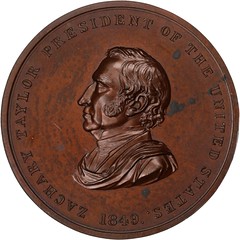

1849 Zachary Taylor Indian Peace Medal. Bronze. Third Size. Second Reverse. Julian IP-29, Prucha-47. MS-62 BN (NGC). 51.0 mm.
Provenance: From our (Bowers and Merena's) sale of the David W. Dreyfuss Collection, April 1986, lot 5159; our sale of the Ronald A. Slovick Family Collection, Spring 2024 Auction, April, lot 2074.
To read the complete item description, see:
1849 Zachary Taylor Indian Peace Medal. Bronze. Third Size. Second Reverse. Julian IP-29, Prucha-47. MS-62 BN (NGC).
(https://auctions.stacksbowers.com/lots/view/3-1VO0TV/1849-zachary-taylor-indian-peace-medal-bronze-third-size-second-reverse-julian-ip-29-prucha-47-ms-62-bn-ngc)


"1862" Abraham Lincoln Indian Peace Medal. Bronze. First Size. Julian IP-38, Prucha-51, Cunningham 22-020Bz, King-520. Second Reverse. Mint State. 75.9 mm.
To read the complete item description, see:
"1862" Abraham Lincoln Indian Peace Medal. Bronze. First Size. Julian IP-38, Prucha-51, Cunningham 22-020Bz, King-520. Second Reverse. Mint State.
(https://auctions.stacksbowers.com/lots/view/3-1VO0U6/1862-abraham-lincoln-indian-peace-medal-bronze-first-size-julian-ip-38-prucha-51-cunningham-22-020bz-king-520-second-reverse-m)


"1776" Declaration of Independence Medal, Historical Tablet Reverse. Musante GW-183, Baker-53, var. Gutta Percha. Mint State. 92.0 mm.
Provenance: From the Ronald Abler Collection of Centennial Medals.
To read the complete item description, see:
"1776" Declaration of Independence Medal, Historical Tablet Reverse. Musante GW-183, Baker-53, var. Gutta Percha. Mint State.
(https://auctions.stacksbowers.com/lots/view/3-1VO11M/1776-declaration-of-independence-medal-historical-tablet-reverse-musante-gw-183-baker-53-var-gutta-percha-mint-state)


1876 U.S. Centennial Exposition Danish Medal. MDCCLXXVI Obverse. Musante GW-932, Baker-426A, var., Abler-800gi. Copper, Gilt. MS-62 (PCGS). 52.7 mm.
Provenance: From the Ronald Abler Collection of Centennial Medals.
To read the complete item description, see:
1876 U.S. Centennial Exposition Danish Medal. MDCCLXXVI Obverse. Musante GW-932, Baker-426A, var., Abler-800gi. Copper, Gilt. MS-62 (PCGS).
(https://auctions.stacksbowers.com/lots/view/3-1VO22E/1876-us-centennial-exposition-danish-medal-mdcclxxvi-obverse-musante-gw-932-baker-426a-var-abler-800gi-copper-gilt-ms-62-pcgs)


1876 U.S. Centennial Exposition See How We Prosper Medal. Musante GW-936, Baker-428A, Unlisted SCD-7c, SH 2-86 BZ, Abler-890bz. Bronze. MS-65 (PCGS). 44.8 mm.
Provenance: From the Ronald Abler Collection of Centennial Medals.
To read the complete item description, see:
1876 U.S. Centennial Exposition See How We Prosper Medal. Musante GW-936, Baker-428A, Unlisted SCD-7c, SH 2-86 BZ, Abler-890bz. Bronze. MS-65 (PCGS).
(https://auctions.stacksbowers.com/lots/view/3-1VO261/1876-us-centennial-exposition-see-how-we-prosper-medal-musante-gw-936-baker-428a-unlisted-scd-7c-sh-2-86-bz-abler-890bz-bronze-)


1870 United States Assay Commission Medal. JK AC-8. Rarity-3. Copper. MS-65 BN (NGC). 33.0 mm.
Provenance: From our (Bowers and Merena's) sale of Selections from the F.C.C. Boyd Estate, Chris Schenkel Collection sale, November 1990, lot 4049; our Spring 2023 Auction, lot 2092.
To read the complete item description, see:
1870 United States Assay Commission Medal. JK AC-8. Rarity-3. Copper. MS-65 BN (NGC).
(https://auctions.stacksbowers.com/lots/view/3-1VO3U6/1870-united-states-assay-commission-medal-jk-ac-8-rarity-3-copper-ms-65-bn-ngc)


Undated (ca. 1902) William Augustus Muhlenberg / John Wakefield Francis, M.D. Medal Muling. By Victor David Brenner. Obverse of Smedley-19, Miller-10 / Reverse of Smedley-10. Silver. Mint State. 50.8 mm. 64.52 grams, .999 fine, 2.074 troy ounces ASW.
Provenance: From the Charles Prioleau Collection. Earlier from Presidential Coin and Antique Co., Inc.'s Landmark II Collection sale, June 1990, lot 557.
To read the complete item description, see:
Undated (ca. 1902) William Augustus Muhlenberg / John Wakefield Francis, M.D. Medal Muling. By Victor David Brenner. Obverse of Smedley-19, Miller-10 / Reverse of Smedley-10. Silver. Mint State.
(https://auctions.stacksbowers.com/lots/view/3-1VO470/undated-ca-1902-william-augustus-muhlenberg-john-wakefield-francis-md-medal-muling-by-victor-david-brenner-obverse-of-smedley-)


1898 American Numismatic and Archaeological Society National Conference of Charities and Correction Medal. By Victor David Brenner. Smedley-27, Miller-12. Silver. Mint State, Rim Bruise. 76.0 mm. 153.62 grams.
Provenance: From the Charles Prioleau Collection. Earlier from Presidential Coin and Antique Co., Inc.'s Great Eastern Collection sale, June 1989, lot 241.
To read the complete item description, see:
1898 American Numismatic and Archaeological Society National Conference of Charities and Correction Medal. By Victor David Brenner. Smedley-27, Miller-12. Silver. Mint State, Rim Bruise.
(https://auctions.stacksbowers.com/lots/view/3-1VO499/1898-american-numismatic-and-archaeological-society-national-conference-of-charities-and-correction-medal-by-victor-david-brenner-smed)


1876 U.S. Centennial Exposition. American Star With NO-Independence Hall Dollar. HK-47a, SH 2-19 CU, Abler-1330bz. Rarity-8. Copper. MS-62 BN (PCGS). 38.1 mm.
Provenance: From the Ronald Abler Collection of Centennial Medals.
To read the complete item description, see:
1876 U.S. Centennial Exposition. American Star With NO-Independence Hall Dollar. HK-47a, SH 2-19 CU, Abler-1330bz. Rarity-8. Copper. MS-62 BN (PCGS).
(https://auctions.stacksbowers.com/lots/view/3-1VO6DQ/1876-us-centennial-exposition-american-star-with-no-independence-hall-dollar-hk-47a-sh-2-19-cu-abler-1330bz-rarity-8-copper-ms-)


1876 U.S. Centennial Exposition. Exposition Building Dollar, Art Gallery. HK-83a, SH 2-40 S, Abler-1020si. Rarity-9. Silver. MS-63 (PCGS). 41.9 mm.
Provenance: From the Ronald Abler Collection of Centennial Medals.
To read the complete item description, see:
1876 U.S. Centennial Exposition. Exposition Building Dollar, Art Gallery. HK-83a, SH 2-40 S, Abler-1020si. Rarity-9. Silver. MS-63 (PCGS).
(https://auctions.stacksbowers.com/lots/view/3-1VO6MI/1876-us-centennial-exposition-exposition-building-dollar-art-gallery-hk-83a-sh-2-40-s-abler-1020si-rarity-9-silver-ms-63-pcgs)


1892 World's Columbian Exposition. Liberty Head Dollar. Low Relief. HK-222a, SH 6-80 AL, Eglit-51. Rarity-5. Aluminum. MS-68 DPL (NGC). 35.0 mm.
Click here for certification details from NGC.
To read the complete item description, see:
1892 World's Columbian Exposition. Liberty Head Dollar. Low Relief. HK-222a, SH 6-80 AL, Eglit-51. Rarity-5. Aluminum. MS-68 DPL (NGC).
(https://auctions.stacksbowers.com/lots/view/3-1VO713/1892-worlds-columbian-exposition-liberty-head-dollar-low-relief-hk-222a-sh-6-80-al-eglit-51-rarity-5-aluminum-ms-68-dpl-ngc)


NEW YORK. New York. 1860 George H. Lovett. Miller-NY 491A. White Metal. Plain Edge. MS-64 (PCGS). 28.0 mm.
Click here for certification details from PCGS. Image with the PCGS TrueView logo is obtained from and is subject to a license agreement with Collectors Universe, Inc. and its divisions PCGS and PSA.
To read the complete item description, see:
NEW YORK. New York. 1860 George H. Lovett. Miller-NY 491A. White Metal. Plain Edge. MS-64 (PCGS).
(https://auctions.stacksbowers.com/lots/view/3-1VOCCP/new-york-new-york-1860-george-h-lovett-miller-ny-491a-white-metal-plain-edge-ms-64-pcgs)


1913 50th Anniversary of the Battle of Gettysburg Medal. By Jonathan M. Swanson, Struck by Whitehead & Hoag. Gold. No. 14. Mint State. With Original Case. 38.6 mm. 49.46 grams, 10 karat, 0.662 troy ounces AGW. Obv: Liberty holding palm fronds and fasces with kneeling Union and Confederate soldiers, the whole enveloped in an American Flag, legend FIFTIETH / ANNIVERSARY / OF THE / BATTLE OF / GETTYSBURG above a keystone in the right field. Rev: Clasped hands over a map of Pennsylvania on which is the legend REUNION / CIVIL WAR / VETERANS / 1913. Edge: Marked and numbered 10K 14 WHITEHEAD-HOAG at 6 o'clock. Produced for the Grand Reunion of the Blue and the Gray at Gettysburg Battlefield. The present example was awarded by the Commonwealth of Pennsylvania to Major James Edward Normoyle (1866-1916), quartermaster for the 1913 Gettysburg 50h Anniversary Reunion. The original case is crushed and tattered, some portions missing. It is marked on the inside cover, in gilt lettering, THE WHITEHEAD & HOAG CO. / NEWARK, N.J. Also included in this lot is a packet of printouts containing research on the medal and its recipient. (Total: 1 medal; 1 case)
Provenance: Ex Commonwealth of Pennsylvania, awarded to Major James Edward Normoyle (1866-1916), quartermaster for the 1913 Gettysburg 50th Anniversary Reunion; Emma Margaret Normoyle, by descent; Margaret Ecker Normoyle, by descent; Caroline Parker Kuhn, by descent; Peter S. Bloy, current consignor, by descent.
To read the complete item description, see:
1913 50th Anniversary of the Battle of Gettysburg Medal. By Jonathan M. Swanson, Struck by Whitehead & Hoag. Gold. No. 14. Mint State. With Original Case.
(https://auctions.stacksbowers.com/lots/view/3-1VOCQR/1913-50th-anniversary-of-the-battle-of-gettysburg-medal-by-jonathan-m-swanson-struck-by-whitehead-hoag-gold-no-14-mint-state-w)

Love token pin fashioned out of (3) Liberty Head quarter eagles. Includes (3) Liberty Head quarter eagles, one an 1847-C, the second an 1851, and the third an undated Dahlonega Mint piece. The first and second coins are unengraved, but the Dahlonega Mint coin has had its obverse planed off and converted into a Love token with the initials DE at top, monogrammed HL in center, the initials enhanced by enamels. All three coins have been looped and are suspended from a 14 karat gold pinback with Cupid motif on front. 62.5 mm x 32.0 mm, 18.74 grams, total dimensions and weight.
To read the complete item description, see:
Love token pin fashioned out of (3) Liberty Head quarter eagles.
(https://auctions.stacksbowers.com/lots/view/3-1VOEKH/love-token-pin-fashioned-out-of-3-liberty-head-quarter-eagles)
STEPHEN ALBUM RARE COINS AUCTION 56
Stephen Album Rare Coins will be holding their Auction 56 from September 17 to 20, 2026. Here's the press release. -Editor
Stephen Album Rare Coins will hold its Auction 56 from September 17 to 20, 2026, at their offices in Santa Rosa, California. The auction is made up of 3,450 lots of Ancient, Islamic, Indian, Chinese, and World Coins and Banknotes. The first two days will be in-person bidding as well as on the internet, while the third and fourth days will be internet-only sessions.
Featured in the auction will be the Bob "Swamperbob" Gurney Collection of Cap & Rays 8 Reales, the Edward W. Rataj Collection of World, Ancient & Islamic Coins, the Dr. Dirk Löer Collection of Chinese Coins, and the Bernd Löer Collection of Chinese Coins.
Some highlights of the sale follow:

LOT 675: INDIA: MUGHAL EMPIRE: Akbar Adil Shah, 1753, AR rupee (11.35g), Allahabad, year 1, KM-763, Zeno-78896 (same dies), obverse couplet sikka zad dar jahan ba-fazl alah // shah-i-'alam panah akbar shah (struck coin in the world by the grace of God // King Akbar Shah, refuge of the world), one shroff mark on reverse, a coin of the utmost rarity and worthy of a spot in any top-tier Mughal collection, PCGS graded XF details, RRR. The only other example listed on Coin Archives is the Paul Stevens piece that we offered in our Auction 24, Lot 1544 (January 2016). Akbar Adil Shah, the grandson of Kam Bakhsh, was placed on the throne by Safdar Jang in opposition to Ahmad Shah Bahadur in May 1753, but vanished from history in late November of the same year. This is only the fourth known example of this very rare Mughal Emperor, and all are dated year one from the mint of Allahabad. This is only the second example ever offered on the market. For more information see the article by Jan Lingen & Paul Stevens in JONS vol. 201 (2009), pp. 44-46, and the description of Zeno-78896. Only coins from the ruler Nikusiyar are rarer, with just 2 pieces known, as discussed on Zeno. Estimated at $15,000 to $10,000.

LOT 115: MEDIEVAL ISLAMIC: ARAB-SASANIAN: Khusraw type, 691-693, AR drachm (dirham) (2.28g), Dimashq, AH72, A-D6, Malek-524-var, standard obverse with the name of Khusro right of the portrait, and the Islamic statement bism Allah / muhammad rasul / Allah in the margin // normal reverse (fire altar & two attendants), mint name to right, date written out to left, both in Arabic; clipped down to the post-reform Umayyad standard, XF, RRRR. This is the first Islamic coin to bear the Hijri date written out in Arabic, always in Pahlavi for earlier dates. There are two subtypes, one with the mint right and date left (this piece), the other with mint left and date right, as sold in our Auction 55, lot 56. Estimated at $12,000 to $15,000.

LOT 435: MEDIEVAL ISLAMIC: WAJIHID: 'Umar b. Yusuf, 952-961, AV dinar, 'Umân (Oman), AH344, A-A1163, with the Sunni kalima divided between obverse and reverse: ruler's name below, mint/date formula in inner margin, Qur'an 30::3-4 in outer margin // caliph al-muti' lillah / wajîh below, Qur'an 9:33 in the margin; unpublished and of the highest rarity (probably unique); gold mount added, bold VF, RRRR. Darley-Doran cited no coins in any metal dated 344 (on his page 132), and cited the existence of gold dinars of 'Umar b. Yusuf dated 345, 347 and 350. The only gold dinar of 'Umar b. Yusuf listed on CoinArchives is dated 341 (sold in our Auction 30, lot 401, in January 2018). Silver dirhams of 'Umar b. Yusuf are listed on CoinArchives dated 340, 341, and 343, and Darley-Doran lists dirhams dated 341, 343, and 350, and Zeno adds 342. We have found no reference to any Wajihid coin dated AH344. Estimated at $10,000 to $15,000.

LOT 947: WORLD: SOUTH AFRICA: George V, 1910-1936, 10-coin proof set, 1923, KM-PS1, PCGS Certified Set including:1) AE 1/4 penny - PF64, KM-12.12) AE 1/2 penny - PF64, KM-13.13) AE penny - PF64, KM-14.14) AR 3 pence - PF64, KM-15a5) AR 6 pence - PF64, KM-16a6) AR shilling - PR63, KM-17.17) AR florin - PR64, KM-188) AR 2½ shillings - PR64, KM-19.19) AV 1/2 sovereign - PR65, KM-2010) AV sovereign - PR65, KM-21a lovely well matched set in the original case of issue marked "FIRST COINAGE OF SOUTH AFRICAN MINT / PRETORIA / 1923," mintage of only 655 sets, rare, set of 10 coins. Estimated at $10,000 to $15,000.

LOT 1472: CHINA: REPUBLIC: AR dollar, Wuchang, ND (1912), Y-320, L&M-43, K-638B, Li Yuan Hong wearing Wuchang New Army military cap, Tripled Die Reverse type, surfaces smoothed, PCGS graded UNC details, ex Åke Lindèn Collection. Li Yuanhong was a Chinese politician during the late Qing dynasty and the Republic of China. He was the president of the Republic of China between 1916 and 1917, and between 1922 and 1923. Estimated at $10,000 to $15,000.

LOT 806: INDIA: BRITISH: George VI, 1936-1947, AR rupee, 1939(b), KM-555, S&W-9.13, Prid-235, reeded edge type, an attractive nearly mint state example of one of the greatest rarities of British Indian coinage! PCGS graded AU58. The British Indian Government stopped minting the 1922-dated silver one rupee coins in 1923 according to mint records and never authorized another one rupee coin for circulation until more than 15 years later. This meant that the British Government had not resumed production until late 1939 or January 1940, when the 1938 one rupee coins were minted and released. The only reason new coinage resumed in 1939 was because of the increase in commerce in India from World War II. The majority of the 1938 one rupee issue was minted in the year 1940, and "a small quantity 1938 coins were minted in the end of 1939," as noted by Pridmore. It was not possible to strike the 1938 one rupee with the Type II obverse any sooner than late 1939. It is likely that the 1938 one rupee mintage was issued in its entirety, but that's not true for the 1939 one rupee. It had been speculated that the actual number of coins struck for the 1939 one rupee was between 7,500 to 10,000 coins with a survival rate of 1% to 2% making it one of the greatest rarities of British Indian coinage! Estimated at $6,000 to $8,000.

LOT 1457: CHINA: AR sycee (1930.9g), cf. Cribb Class XIV, 50-tael trade ingot, made during the late Qing Dynasty, bank name yong chang within rectangular field stamped three times, GBCA graded AU58, ex Bernd Löer Collection, ex Numismatik Lanz Auction 142, Lot 534. Estimated at $5,000 to $7,500.

LOT 1081: UNITED STATES: AR 25 cents, 1918/7-S, KM-45, Standing Liberty type, very rare over date, lustrous fields, cleaned, PCGS graded AU details. The 1918/7-S Standing Liberty quarter is one of the key date silver coin rarities of the 20th century. This variety was first noticed in the late 1930's, and the first auction appearance was in December 1937. Collectors began saving the few they could find in circulation. Today, the 1918/7-S is rare and relatively expensive even in the lowest grades. Estimated at $5,000 to $7,000.

LOT 1312: WORLD: PAKISTAN: Islamic Republic, 2-coin set, 1976, Conservation Series set with Gharial silver 150 rupees KM-42 PCGS graded PF-69DCAM and Astor Markhor gold 3000 rupees KM-44 PCGS graded MS-63, both with COAs and set in the original British Royal Mint case of issue, set of 2 coins. A very interesting and rare set produced by the British Royal Mint for the Government of Pakistan with a mint state gold coin and a proof silver coin issued together in the same set. Estimated at $5,000 to $7,000.

LOT 98: ANCIENTS: SASANIAN KINGDOM: Shahpur I, 241-272, AV dinar (7.40g), G-21, type IIc/1b, Sunrise-740, diademed bust right, wearing mural crown with korymbos // fire altar flanked by two attendants, holding long spears, each looking away from the fire and wearing mural crowns, fravahr to left of the flames, small graffito on reverse, scattered hairlines, lovely, bold strike, XF-AU. Estimated at $3,500 to $4,500.
The firm is currently accepting consignments for its Auction 57, which will take place on January 21-24, 2027, as well as future internet-only sales. Please visit www.stevealbum.com for more information.
SOVEREIGN RARITIES AUCTION XXIII: SCOTTISH
Sovereign Rarities will be hosting the Kilmarnock Collection & Part III of The Highcliff Collection on September 22. Additional select items are discussed below. -Garrett

Mary Queen of Scots (1542-67), Mary Queen of Scots (1542-67), silver Testoon of Five Shillings, dated 1558 both sides, first period before marriage (1542-58), Type IIIb, wide arched crown over Scottish arms, plain interior and crown band, M to left, R to right over a smaller letter A for Achesoun the die sinker, initial mark cross, legend with date surrounding, + MARIA. DEI. G. SCOTOR. REGINA. 1558., stop after date, rev. large cross potent with cross in each angle, legend with date surrounding, initial mark crown, IN. VIRTVTE. TVA. LIBERA. ME. 1558, 6.00g (S.C.B.I. 35:- Ashmoleon & Hunterian; S.C.B.I. 58:353 Edinburgh; S.C.B.I. 71:601, 602, 603 Stewartby; Burns 20 fig. 795; S.5408). Toned, one small rim chip, a couple of other rim nicks, well struck and centred, with clear identifying details, a bold very fine and extremely rare.
To read the complete item description, see:
Mary Queen of Scots (1542-67),
(https://auctions.sovr.co.uk/index.php?option=com_timed_auction
&view=lot_detail&auction_id=33&lot_id=761125)

Scotland, Mary Queen of Scots (1542-67), Scotland, Mary Queen of Scots (1542-67), silver portrait Testoon of Five Shillings, dated 1561, third period (1560-65) first widowhood, date on tablet below bust of Queen in contemporary costume facing left, legend commencing lower left and outer beaded border surrounding, MARIA. DEI. GRA. SCOTORVM. REGINA., rev. crowned dimidiated arms of France and Scotland, four pellets on crown band, crowned M either side, legend and beaded border surrounding commencing at top, .SALVVM. FAC. POPVLVM. TVVM. DOMINE., 5.85g (S.C.B.I. 35:1111 Hunterian; S.C.B.I. 58:1150 same obverse Edinburgh; S.C.B.I. 71:1017 same obverse Stewartby; Burns 2 fig. 896; S.5422). Unevenly toned, hairline short scratch from cheek to field and another vertical short scratch in right obverse field, other light surface marks, some wear to higher points, otherwise with a great Renaissance style portrait of the Queen, very fine and highly desirable, rare.
To read the complete item description, see:
Scotland, Mary Queen of Scots (1542-67),
(https://auctions.sovr.co.uk/index.php?option=com_timed_auction&
view=lot_detail&auction_id=33&lot_id=761138)

Mary Queen of Scots (1542-67) Mary Queen of Scots (1542-67), silver Ryal of Thirty Shillings, dated 1567, fifth period, Second Widowhood, crowned Scottish arms, thistle each side, cross on crown breaks inner beaded circle surrounding with legend and outer beaded circle, .MARIA. DEI. GRA. SCOTORVM. REGINA., rev. tortoise scaling a palm tree, DAT GLORIA VIRES on banner scroll across tree trunk, date either side at bottom of field, beaded circles and legend surrounding, initial mark thistle with two leaves, .EXVRGAT. DEVS. &. DISSIPENTR. INIMICI. EI., 30.38g (S.C.B.I. 35:1133, 1134 Ashmoleon, 1131 Hunterian; S.C.B.I. 58:1220 Edinburgh; S.C.B.I. 71:- Stewartby; Burns 1 Fig. 912; Rampling dies C8/78; S.5429). Toned, a little double struck at top of reverse, nick under 67 of date, other light spots and nicks, otherwise a pleasing example, good very fine and rare, the final issue of the reign of Mary and the plate coin in the current Standard Catalogue.
To read the complete item description, see:
Mary Queen of Scots (1542-67)
(https://auctions.sovr.co.uk/index.php?option=com_timed_auction
&view=lot_detail&auction_id=33&lot_id=761140)

Mary Queen of Scots (1542-67), Mary Queen of Scots (1542-67), copper Penny, type I (1547), undated, bust of facing infant wearing arched crown, beaded borders and legend surrounding, MARIA. D. G. R. SCOTORVM, rev. long cross fourchée, crown in first and third opposing angles heraldically, cinquefoil with pellet centre in other two opposing angles, beaded borders and legend surrounding, OPI DVM EDN BVR, 0.77g (S.C.B.I. 35:1065 Ashmoleon, 1066 Hunterian; S.C.B.I. 58:865 - 872 inclusive Edinburgh; S.C.B.I. 71:848, 850 Stewartby; Burns 2, fig.864; S.5440). Toned, rim a little ragged, a thin layer of silver wash still evident from when coin was newly struck, well centred with excellent detail, portrait one of the finest we have seen for this most desirable minor denomination of this reign, good very fine and of the highest rarity so well preserved.
To read the complete item description, see:
Mary Queen of Scots (1542-67),
(https://auctions.sovr.co.uk/index.php?option=com_timed_auction
&view=lot_detail&auction_id=33&lot_id=761151)

Mary Queen of Scots (1542-67), Mary Queen of Scots (1542-67), silver Half-Testoon with crowned thistle revaluation countermark of 1578, value therefore increased from Two Shillings and Sixpence to Three Shillings and Eightpence, dated 1557 both sides, first period before marriage (1542-58), Type IIIa, initial mark cross potent on obverse, narrow high arched crown over Scottish arms, M over annulet to left, R over annulet to right, legend with date surrounding, MARIA DEI G. SCOTOR. REGINA. 1557, rev. large cross potent with cross in each angle, revaluation countermark to upper left, legend with date and stops surrounding, initial mark crown, IN. VIRTVTE. TVA. LIBERA. ME. 1557, 2.91g (S.C.B.I. 35:- Ashmoleon & Hunterian; S.C.B.I. 58:- Edinburgh; S.C.B.I. 71:- Stewartby; cf.Burns 11 fig. 804; S.5411 and p.78). Unevenly toned, flan a little undulating where the countermark was punched from reverse, a couple of other light marks, otherwise very fine host coin and revaluation countermark, extremely rare to find on this date of host coin.
To read the complete item description, see:
Mary Queen of Scots (1542-67),
(https://auctions.sovr.co.uk/index.php?option=com_timed_auction
&view=lot_detail&auction_id=33&lot_id=761110)

James VI of Scotland (1567-1625), James VI of Scotland (1567-1625), second coinage, silver Two Merks or Thistle Dollar of Twenty Six Shillings and Eightpence, dated 1579, crowned Scottish arms, legend surrounding, .IACOBVS. 6. DEI. G. REX. SCOTORVM., rev. thistle with stem and two leaves, I to left, R to right, date in legend surrounding, initial mark crown, .NEMO. ME. IMPVNE. LACESSET. 1579., 21.64g (S.C.B.I. 35:1232 Ashmoleon, 1233 Hunterian; S.C.B.I. 58:1443-4 Scotland; S.C.B.I. 71:1156 Stewartby; Burns 1, fig.930; S.5480). Toned and a little uneven in shape, one short flan crack at 4 o'clock on obverse and at corresponding part of reverse, old ink mark number in obverse field to right of shield, otherwise good very fine, with a particularly pleasing rendition of the reverse with a detailed thistle, extremely rare.
To read the complete item description, see:
James VI of Scotland (1567-1625),
(https://auctions.sovr.co.uk/index.php?option=com_timed_auction
&view=lot_detail&auction_id=33&lot_id=761058)

James VI of Scotland (1567-1625), James VI of Scotland (1567-1625), second coinage, silver One Merk or Half-Dollar of Thirteen Shillings and Sixpence, dated 1580, the 0 of date struck over a higher and lower 0 or possibly a 9, crowned Scottish arms, legend surrounding, .IACOBVS. 6. DEI. G. REX. SCOTORVM., rev. thistle with stem and two leaves, I to left, R to right, date in legend surrounding, initial mark crown, .NEMO. ME. IMPVNE. LACESSET. 1580., the zero of date triple entered, 10.55g (S.C.B.I. 35:- Ashmoleon & Hunterian; S.C.B.I. 58:1447 Scotland; S.C.B.I. 71:1159 Stewartby; Burns 1b, fig.930B; S.5481). Toned with some degree of wear from use across half the coin both sides, otherwise good fine for issue, with important details clear, extremely rare.
To read the complete item description, see:
James VI of Scotland (1567-1625),
(https://auctions.sovr.co.uk/index.php?option=com_timed_auction
&view=lot_detail&auction_id=33&lot_id=761059)

James VI of Scotland (1567-1625), James VI of Scotland (1567-1625), third coinage, silver Eight Shillings, 1581, crowned Scottish arms, legend surrounding, .IACOBVS. 6. DEI. GRATIA. REX. SCOTORVM., penultimate O struck over a T, rev. crowned thistle with stem and two leaves, small annulet below, I to left, R to right, date in legend surrounding, .NEMO. ME. IMPVNE. LACESSET. 1581, 5.57g (S.C.B.I. 35:1235 Hunterian; S.C.B.I. 58:1450 Edinburgh; S.C.B.I. 71:1161 Stewartby; Burns 1a, fig.-; S.5483). Attractively toned, a little green verdigris on a couple of letters of legend, well struck on a circular flan, a little doubled on shield, some hairline scratches on obverse, otherwise a superb example of this denomination, almost extremely fine and extremely rare.
To read the complete item description, see:
James VI of Scotland (1567-1625),
(https://auctions.sovr.co.uk/index.php?option=com_timed_auction
&view=lot_detail&auction_id=33&lot_id=761061)

James VI of Scotland (1567-1625), James VI of Scotland (1567-1625), Sixth Coinage, silver balance Half-Merk of Six Shillings and Eightpence, dated 1591 with larger 1s, crowned Scottish arms, thistle in field either side, legend with date and beaded borders surrounding, initial mark pierced cinquefoil both sides, .IACOBVS. 6. D. G. R. SCOTORVM. 1591., rev. upright sword with scales of Justice, beaded circles and legend surrounding, .HIS. DIFFERT. REGE. TYRANNUS., the letter Ns more loosely formed from separate puncheons, 4.55g (S.C.B.I. 35:1247 Ashmoleon, 1248 Hunterian; S.C.B.I. 58:1495 - 1497 inclusive Edinburgh; S.C.B.I. 71:1186 - 1191 inclusive Stewartby; Burns 2, fig.937; S.5491). Toned with a grey silver colour, weak in parts with some light flan adjustment marks on rim, a bold very fine.
To read the complete item description, see:
James VI of Scotland (1567-1625),
(https://auctions.sovr.co.uk/index.php?option=com_timed_auction
&view=lot_detail&auction_id=33&lot_id=761068)

James VI of Scotland (1567-1625), James VI of Scotland (1567-1625), Ninth Coinage (1604-09), silver Sixty Shillings of Three Pounds, after Accession to the English Throne, undated, type II, crowned and armoured king on horseback right, thistle on housings, holding upright sword, beaded borders and legend surrounding, initial mark thistle head both sides, .IACOBVS. D'. G'. MAG'. BRIT'. FRAN'. &. HIB'. REX., rev. flat topped quartered coat of arms, Scottish arms in the first and fourth quarters, .QVÆ. DEVS. CONIVNXIT. NEMO. SEPARET., 30.00g (S.C.B.I. 35: 1369 Ashmoleon; S.C.B.I. 71:1410, 1411 Stewartby; Burns 11, Fig 983; S.5502). Toned, well struck and centred, some light surface marks and striations both sides, some nicks and hairlines in obverse fields, otherwise almost extremely fine with an excellent rendition of the King on horseback and the rarer type, extremely rare this well preserved.
To read the complete item description, see:
James VI of Scotland (1567-1625),
(https://auctions.sovr.co.uk/index.php?option=com_timed_auction
&view=lot_detail&auction_id=33&lot_id=761079)
See www.sovr.co.uk for much more detail about all of these coins, medallions and more!

ST. JAMES AUCTION 127
St. James Auctions will be holding its Auction 127 on September 25. Select items are discussed below. -Garrett

Commonwealth, crown, mm. sun, 1656/4, English shield of arms within wreath, rev. conjoined shields, mark of value above (S.3214; N.2721), certified and graded by PCGS as About Uncirculated 55
To read the complete item description, see:
Commonwealth, crown, mm. sun, 1656/4, English shield of arms within wreath, rev. conjoined shields, mark of value above (S.3214; N.2721)
(https://bsjauctions.auctionmobility.com/lots/view/1-DC7Z4M/british-coins)

George II, two guineas, 1738, young laur. head facing l., rev. crowned garnished square shield, date above split by crown, legend consisting of abbreviations of the king's numerous titles, reeded edge (S.3667B), certified and graded by PCGS as Genuine, Cleaned, Uncirculated Detail
To read the complete item description, see:
George II, two guineas, 1738, young laur. head facing l., rev. crowned garnished square shield, date above split by crown, legend consisting of abbreviations of the king's numerous titles, reeded edge (S.3667B)
(https://bsjauctions.auctionmobility.com/lots/view/1-DC7Z4S/british-coins)

Victoria, proof ‘Gothic' crown, 1847, crowned dr. bust, younger portrait wearing a richly embroidered bodice, rev. crowned cruciform shield, legend neatly quartered by the crowns, Garter Star at very centre, in angles a rose, a thistle, a second rose, and a shamrock, all within a tressure of arcs, UNDECIMO edge (S.3883; Bull 2571; old ESC.288), certified and graded by PCGS as Proof 60
To read the complete item description, see:
Victoria, proof ‘Gothic' crown, 1847, crowned dr. bust, younger portrait wearing a richly embroidered bodice, rev. crowned cruciform shield, legend neatly quartered by the crowns, Garter Star at very centre, in angles a rose, a thistle, a second rose, and a shamrock, all within a tressure of arcs, UNDECIMO edge (S.3883; Bull 2571; old ESC.288)
(https://bsjauctions.auctionmobility.com/lots/view/1-DC7Z5E/british-coins)

USA, gold 2.5 dollars, 1845 O, Liberty head l., rev. eagle on branch, shield on breast, certified and graded by PCGS as Genuine, Cleaned, Extremely Fine Detail, scarce
To read the complete item description, see:
USA, gold 2.5 dollars, 1845 O, Liberty head l., re
(https://bsjauctions.auctionmobility.com/lots/view/1-DC7Z6H/world-coins)

Elizabeth II, gold proof five pounds, 2020, The 75th Anniversary of the End of the Second World War, head r., wearing tiara, rev. WAR / PEACE through centre, wt. 39.94gms. (S.L96), in case of issue, with certificate, FDC
To read the complete item description, see:
Elizabeth II, gold proof five pounds, 2020, The 75th Anniversary of the End of the Second World War, head r., wearing tiara, rev. WAR / PEACE through centre, wt. 39.94gms. (S.L96)
(https://bsjauctions.auctionmobility.com/lots/view/1-DC7Z6J/a-collection-of-modern-coins)

Elizabeth II, piedfort gold proof fifty pence, 2020, Withdrawal from the European Union, head r., wearing tiara, rev. PEACE, PROSPERITY AND FRIENDSHIP WITH ALL NATIONS, 31 JANUARY 2020, wt. 31.1gms. (S.H72), in case of issue, with certificate, FDC
To read the complete item description, see:
Elizabeth II, piedfort gold proof fifty pence, 2020, Withdrawal from the European Union, head r., wearing tiara, rev. PEACE, PROSPERITY AND FRIENDSHIP WITH ALL NATIONS, 31 JANUARY 2020, wt. 31.1gms. (S.H72)
(https://bsjauctions.auctionmobility.com/lots/view/1-DC7Z7B/a-collection-of-modern-coins)
THE BOOK BAZARRE
NOONANS: ERIC HODGE BRITISH MERCHANT COINS
Longtime E-Sylum contributor Eric Hodge writes:
Thanks for your weekly blog. Mondays would not be the same without it. Also congratulations on reaching retirement. It seems you are already looking back and wondering how you had time to go to work.
 Over the years I have communicated with your readers through your site whenever I needed advice, ideas or help with any research project. Generally the responses have been so positive and helpful that I thought some readers may be interested to know that now I have reached my 80th year I have decided to sell my collection. I wanted to be involved in the sale so now seems the right time. I wanted the catalogue to be more an historical document with provenance and other references. The sale is with Noonans of Mayfair, London on the 29th September 2026 and I belief they have met my brief.
My research will continue and your blog will remain one of the highlights of the week."
Congratulations on reaching 80! Here's the Noonan's press release. Good luck with the sale! -Editor
 More than 100 British Merchants Coins - foreign silver coins that had been countermarked for use in Great Britain, mainly in Scotland (87 lots), plus a few banknotes will be offered at Noonans in an auction on Tuesday, September 29, 2026. The collection has been amassed by Eric Hodge, who lives in Lancashire.
As Mr Hodge says: "I built up a reasonable collection of silver crowns from 1551 to the present. This collection was sold privately in 2002. It was whilst forming this collection that I became aware of the paucity of circulating crowns during the long reign of George III (1760–1820). Though there were very few circulating crowns I knew there were a large number of patterns and proofs. I decided to investigate this period to discover the reasons for this lack of crowns. It was during this research that I discovered the UK merchant countermarked dollar series which was to become my passion for the future. It was my good fortune that it coincided with Harrington (Harry) Manville completing his opus on merchant countermarked dollars, finally entitled ‘Tokens of the Industrial Revolution – Foreign Silver Coins Countermarked for use in Great Britain, c. 1787–1828'." He continued: "This research journey has now lasted over 25 years and is ongoing. Though I am now passing my collection onto the next generation, my research is still keeping me active using my little grey cells. In April 2024 I published, privately, a two-part catalogue of my research records."
As Jim Brown, Coin Specialist at Noonans explains: "From copper mines in Anglesey to cotton mills in Scotland, from tin mines in Cornwall to iron foundries in Warwickshire, it was businesses at the forefront of the industrial revolution that began issuing copper tokens. Whilst the private provision of copper tokens aided in the conduct of low value, local exchange, it failed to address the pressing issue brought about by a general lack of silver coinage In Great Britain. When insufficient domestic silver specie is produced by a government, the gap tends to be filled by the import and use of foreign silver."
He continued: "Unlike copper, which almost always was used as a token coinage, silver coins were normally traded at or close to their intrinsic value and in this lies the problem that their weight and fineness differed from the accepted local coins. Their face value had to be continually assessed and agreed for every individual transaction with all the resultant opportunities for confusion, disagreement and error that that entailed. To avoid this, various merchants and manufacturers decided to stamp the coins with a value in local currency, normally pitched just above the intrinsic value of the metal. This system, begun in the 1780s and 1790s in the newly built mills in Cark-in-Cartmel, East Retford, Lanark and Rothesay amongst others, was even briefly (and unsuccessfully) adopted by the government. In March 1797, the Treasury authorised the Bank of England to utilise the large quantities of Spanish Dollars it was holding in its vaults to provide an emergency coinage. These coins were to be hallmarked with the largest of the current hallmark stamps used by the Goldsmiths Hall."

Lot 6007
Highlights of the collection include from Blantyre in Lanarkshire, Scotland, a countermarked 8 Reales coin from the reign of Ferdinand VII of Mexico, dating from 1814 that was used at the Blantyre Works which is estimated at £4,000-£5,000. Only six of these coins are known to exist.
Erected by David Dale and James Monteith in 1785, ownership passed to Monteith in 1792 and to Monteith's brother Henry in 1802. The mill was run as Henry Monteith & Co., from then until at least 1840. Its most illustrious employee was the future explorer David Livingstone who entered the mills at the age of 10 as a piecer and became a spinner when he was 19. It is recorded of him that "he contrived to read in the factory by placing his book on the spinning jenny, so that he could catch sentences as he passed at his work." [lot 6007].

Lot 6002
While also from Lanarkshire, a very rare example using an 8 reale coin from the reign of Charles IIII of Mexico, dating 1795 for Ballindalloch Cotton Works in Balfron is estimated at £3,000-4,000. Ballindalloch was acquired in 1800 by James Finlay & Co,, Glasgow merchants, who also operated mills at Catrine and Deanston, and the tokens were probably issued between about 1800 and 1810. 11 examples are known with five in institutions [lot 6002].

Lot 6004
Also, from Ballindalloch Cotton Works is a very rare 5 Shilling check dated 24 March 1830, that is estimated at £300-400 and is one of eight specimens noted by the vendor [lot 6004].

Lot 6081
Several half coins are among the collection. These include from Rothsay Mills on the Isle of Bute a very rare cut half-segment of a Spanish-American 8 Reales, with date and moneyer uncertain which is estimated at £1,500-£2,000. Only 10 of these are known with five in institutions. This was originally bought on Ebay from a seller in New Zealand [lot 6081].
Eric adds:

Lot 6057
These prices did not last because it was in 2001 that the late great Harrington (Harry) Manville of Washington DC published his book Tokens of the Industrial Revolution which took this series out of obscurity and placed it into the mainstream of British numismatics.

Lot 6012
My second memory is for my lot 6012. It relates to the upset at the ANS when the Hispanic Society of America decided to retrieve their collection and put it up for sale. The history and background to Archer Milton Huntington (1870-1955), who was made Honorary President of the American Numismatic Society in 1910, seemed quite fascinating.
Archer first visited Spain in 1892 and developed a passion for the Hispanic world. He founded the Hispanic Society of America in 1904 and then placed his collection with the ANS in 1946 for study and publication. The pieces represented the most spectacular collection of coins relating to the entirety of Spanish history that was housed outside Spain. The collection, completed in 1905, provided a comprehensive review of world history – from the 5th century B.C. to the 20 th century – with Spain as the primary focal point. I knew that there was only one UK merchant countermarked dollar in this collection and was lucky enough to trace its sale to Switzerland in 2012 and was the eventual purchaser. What a history! What a coin!

Lot 6065
My third memory would be my lot 6065 a Lanark Mills 4/6. There are two types for Lanark Mills 4/6, the first with a star stop in the name, the second with a lozenge stop in the name. My purchase was the first type. There are now seven examples known with six of them being held in museums or institutions. So mine is the only one available to commerce. What is interesting to me is that the coin was sold at a small auctioneer in southern Germany that dealt mainly in art, certainly not coins. It went under the radar and I seemed to be the only bidder. It arrived in the post towards the end of March 2020 about a week after the first UK Covid lockdown. The first two to three months of lockdown just flew by as I studied my new coin. What a purchase just at the right time.
There may not be any future purchases but there is still plenty of research left to do.
For more information, or to bid, see:
The Eric Hodge Collection of British Merchant Coins
(https://www.noonans.co.uk/auctions/calendar/944/)
WAYNE'S NUMISMATIC DIARY: 2026 ANA, PART 2
 My last 2026 ANA Diary covered only my first day of the show in Pittsburgh - Tuesday, August 25. Much of that day was spent visiting with current and potential advertising sponsors, and I only made it thru part of my extensive list. I resumed my quest on subsequent days, often having to miss talks and meetings I planned to attend. I even missed an NBS event, the Symposium. But it was a productive, if tiring show.
Here's the T-shirt I wore Tuesday - a retirement gift from neighbors.
The rest of this installment covers Wednesday the 26th. I stayed at my hotel in the morning, working a bit on The E-Sylum, but mostly reviewing a collection of J.S.G. Boggs material I wanted to make an offer on. There was a lot of material, and the hotel bedspread was a convenient work surface to spread out and organize it. I also made a side trip downstairs to sell a box of excess books to numismatic literature dealer Jeff Starck. We missed seeing the Oscar Mayer Weinermobile, although it was back in front of my hotel by evening.
Token and Medal Society
After getting lunch the main event of the day was the Token and Medal Society (TAMS) General Meeting where I was scheduled to give a presentation on the Heeren Brothers company, longtime Pittsburgh makers of medals, tokens and jewelry.

My laptop set up and ready to go

Dave Schenkman introducing me
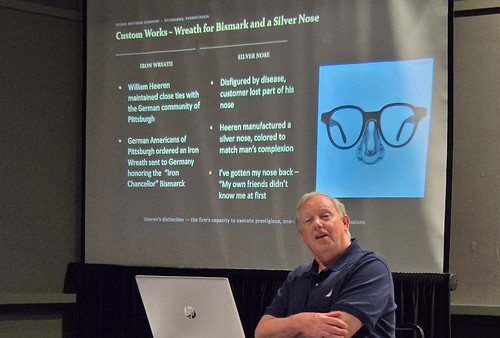
Not numismatic, but I couldn't resist including the story of the Silver Nose.

Crowd shot
I met with a number of people afterwards, including these two old friends from the Western Pennsylvania Numismatic Society (WPNS).

Larry Dziubek, Wayne Homren, Richard Crosby
Richard Crosby and I stepped out onto the 2nd floor deck where I snapped these photos of the Allegheny River.


Back on the bourse floor, I stopped to see this exhibit.
The Colonial Coin Collectors Club (C4) Exhibit


Walking Around
I managed to meet with additional current and potential advertising sponsors that afternoon before heading back to my hotel to change clothes for dinner. I was soon on my way to the TAMS Banquet, the first one I'd ever attended. Who could say no to Fogo de Chao?

Here are some sights along the way and at the restaurant.


The domed building at the end of the street view is the Keenan Building — now Midtown Towers. I used to work in an office across the street from it, and always imagined that penthouse as my evil scientist lair. Way cool.
The relief sculpture is The Lassoer, on display at Fogo de Chao.
The banquet was delightful. I sat near old friends Dave Schenkman and Eric Schena, and between TAMS Journal editor Greg Burns and medal researcher Harry Waterson. Great conversation all around, and the meal was excellent.
Harry spent a career in television and was testing equipment for an inaugural broadcast from the Grand Old Opry in Nashville when a young 20-something singer sat down to talk with him. She told him all about the history of the building, which was originally a church, later expended to a full auditorium. She was very helpful and friendly. Her name? Dolly Parton.
To read the earlier E-Sylum article, see:
WAYNE'S NUMISMATIC DIARY: 2026 ANA, PART 1
(https://www.coinbooks.org/v29/esylum_v29n35a16.html)
WAYNE'S NUMISMATIC DIARY: 2026 ANA, PART 3
This segment discuses my time at the Pittsburgh ANA on Thursday, August 27th. I was working in my room again for the morning and missed a couple more meetings and talks. My first event was the Numismatic Bibliomania Society Board Meeting at 11:30, where I gave a report on The E-Sylum, touching on subscriber counts, advertising revenue, metrics (people really do click on the sponsor banners), and our use of artificial intelligence to assist with preparing the issue - not to write articles, but to gather text and images from webpages, crop images, and streamline formatting.
Numismatic Literary Guild (NLG) Luncheon
I ducked out of the NBS Board meeting to get across the street to the Numismatic Literary Guild Awards Luncheon at the Westin Hotel. Arriving late I spoke briefly with Jeff Rock and Julia Casey before finding an open seat at another table between ANA Numismatist Editor Caleb Noel and ANS Executive Director Dr. Ute Wartenberg Kagin.
Luckily, it wasn't too late to get served a tasty and filling lunch while a number of awards were given out. The event went very smoothly. NBS itself didn't take home a plaque this year, but I picked up a plaque on behalf of one prominent NBS personality (David Fanning) and photographed a plaque for another (Joel Orosz).


NLG Awards for David Fanning and Joel Orosz
Jerry Jordan shared these photos of the bursting-at-the-seams event.


1933 Double Eagle Panel
Every ANA has lots of highlights, and one that sticks out for me was sitting in the front row with Len Augsburger for the panel session at the U.S. Mint booth on the 1933 Double Eagle. The next day the Mint would unveil an exhibit of eleven of the ultra rare and controversial coins. Kudos to the Mint for sponsoring the session, with was recorded by the Newman Numismatic Portal.


LEFT: Lianna Spurrier sets up recording equipment
RIGHT: Mint Director Paul Hollis making initial remarks


Crowd shots

Panelists Stephen Fenton, Greg Weinman, David Tripp

Julian Leidman with photo of an example he'd handled
It was a memorable event, and everyone should watch the video once it's available. The Mint deserves credit for hosting the event and allowing Leidman and Fenton to express opinions not entirely in line with the Mint's position. And is the story over - or are there more examples of the coin yet to come to light?
The Massive Bourse Floor
While on my way to the ANA Awards event in the convention center ballroom, I snapped these shots of the bourse from the skybridge. It was a huge event, with never enough time to experience it all.

Exhibit Area in yellow at upper left

A view of the other side
ANA Awards
The ANA Awards event was another large affair. I wanted to see my old friend and former NBS officer Dave Hirt of Maryland get his 50-year membership pin.

Dave Hirt and others get 50-year membership pins

ANA 2026-08-27 Awards membership pins John Zebel, Dave Hirt, Robert Van Ryzin, Judy Schwan


After a quick pass through the bourse floor I returned again to my hotel for another change of clothes and a nice walk across town with Tom Harrison and Jeff Dickerson. We were heading to the Grand Concourse Restaurant at Station Square, a refurbished train station on the South Side. It was for a dinner of the Attinelli Followship of numismatic bibliophiles. A great time was had by all, and the walk there and back brought my step count for the day up to 18,984. Whew!
To read the earlier E-Sylum article, see:
WAYNE'S NUMISMATIC DIARY: 2026 ANA, PART 1
(https://www.coinbooks.org/v29/esylum_v29n35a16.html)

FAKE BEER TOKENS INSPIRE IMPROVED VERSIONS
There's a special place in Hell reserved for counterfeiters who shove their wares at fundraisers for Girl Scouts and firefighters. Counterfeiters in Canada struck a local festival last year, inspiring new beer tokens with an anti-counterfeiting feature. -Editor
Esquimalt Ribfest drink tokens
When the organizers of southern Vancouver Island's largest Ribfest realized they had been the victim of a 3D printer beer token scam last year, they were shocked and disappointed, but this year the BBQ sauce-soaked event came prepared.
After months of work, sharing tech from major international music and food festivals and a local approach, organizers hope a new beer token will thwart any tech-savvy criminals.
"We found the security flaws from last year were simply that the old coin was extremely duplicatable," Esquimalt Ribfest's coin developer, Jeremy Notheisz, told CTV News.
The major BBQ event and local fundraiser tasked Notheisz and his team with creating a new token or coin that would stump another attempt to replicate it with a 3D printer.
The result, after months of work, is a token that not only spins but is also outfitted with a digital signature that constantly communicates with a central radio hub.
The spinning function, similar to a child's fidget spinner, is designed to make it very difficult to replicate in a commercially available 3D printer.
The digital signature, according to Notheisz, aims to ensure every dollar and transaction is logged and accounted for.
"The vendor taps it. The vendor then sees it's accepted, it goes in the bucket, and then they go back in for recollections," Notheisz said while spinning the new token in his fingers.
Victoria police launched an investigation in 2025 after Esquimalt Ribfest organizers realized, after the event had concluded, they were short about $2,000 dollars all while having some extra odd-looking beer tokens.
To read the complete article, see:
B.C. man develops digital scam resistant beer tokens following Ribfest theft
(https://www.ctvnews.ca/vancouver/article/bc-man-develops-digital-scam-resistant-beer-tokens-following-ribfest-theft/)
COLUMBIAN EXPO BOARD OF LADY MANAGERS MEDALS
Jim Haas for submitted this article on the medals of the Board of Lady Managers for the 1893 Worlds Columbian Exposition. Thanks! -Garrett

The Board of Lady Managers for the 1893 Worlds Columbian Exposition that was originally scheduled for 1892, was organized in late November 1890. It was chaired by Bertha Honoré Palmer, wife of Potter Palmer, owner of the Palmer House Hotel in Chicago. She was a most formidable and capable woman who oversaw the construction of the Fair's Woman's Building that showcased art, inventions, and the industries of women from around the world.
The Board included two representatives from each state, territory and the District of Columbia, one of them, Susan Gale Cooke, a widow, was first appointed woman manager from Tennessee and was later chosen as one of the twenty-six members of the executive committee, a powerful position. Communication with reference to the any and all work of the board had to be addressed to her. Described as being "a very rapid worker, clear-headed and expeditious, exceedingly patient and sweet tempered, Cooke, 1845-1932, was born and educated in New York City. After completing her education she married Sidney Cooke, a member of the New York Stock Exchange. For health reasons, he and Susan moved to Tennessee where he died in 1883.


While it never made the papers, in her role as Secretary, Cooke was most certainly involved with all aspects of Isabella Quarter and the Silver Half Dollars.
With regard to the Quarter, in April 1893 the mint secretary sent two models of the head of Isabella to the Board of Lady Managers, thus to Secretary Cooke. One presented her as a young queen in profile; the other as a mature Queen. Both Bertha Palmer and secretary Cooke preferred the profile view. The design for the reverse depicted a figure of beautiful young woman, kneeling, holding a distaff unwinding flax, emblematic of woman's industry.


One of the special features of the coin was that it was the government-issued coin bearing the portrait of a woman. Other coins had featured idealized versions of women, but this was the first. Congress authorized the minting of $10,000, or 40,000 quarters, at the time, believing it would become extremely rare. The coins were minted in Philadelphia and sold for a dollar. Each Board member was given one of them. Mrs. Porter requested that her salary, $6,045 arrears of salary due her, be paid in Isabella Quarters, but not with a view to speculation for her personal benefit. Rather, she explained, whatever profit derived from these coins was to go to the credit of the lady managers.
In January 1893 the question arose as to whether or not the Columbian souvenir half dollar designed by Charles E. Barber could be classed as a current coin. The purchaser of one of these souvenirs paid a dollar for a piece of silver worth about thirty-eight cents, and that it appeared that the extra price should entitle a buyer to some extra privilege in the disposition of the product. No reply was given, but nine months later about 500,000 of the coins were being stored in subtreasury vaults awaiting orders for their disposition. It appeared the fairgoers were not particularly anxious to buy them, but those who did, held on to them. However, another article published a week later said they were selling like hot cakes and that orders for the most distinctive and highest prized cheap souvenir of the World's Fair were being received from all parts of the United States.
The fair ended on October 31st. Nearly all of the Isabella Quarters minted for the board of lady managers had been sold and the rest were going fast. The Columbian half dollars, a considerable amount, were soon to be sent back to the mints possibly to become ordinary 50-cent pieces or anything else the government decided to do with them. At this time about 50,000 of them were in the fair's model of the treasury building, and about 7,000 of them in the model of the Washington monument. Of the 3,858,240 of the coins, only 1,022,445 had been sold up to the middle of October leaving 2,835,795. On that amount the exposition was minus $1,417,897.50 of expected profit. It so happened that over the summer not a great many attendees had dollars, which they cared to give up for souvenir 50-cent pieces.
Neither the Isabella Quarter or the half dollar enjoyed the popularity that was expected, but in the final analysis both were not mere medals or tokens, they were good money and legal tender, not to mention today's collectibles.
After the Chicago Fair closed its doors, Susan Gale Cooke left for Paris. Cooke was charged with heading the woman's exhibits at the Exposition Universelle scheduled to open in 1900. During the event the women had not only won medals, some had their entire exhibit purchased by French connoisseurs. Upon her return Susan Gale Parlin settled in New York until her death in 1932 at age 86. She was buried in Beechwoods Cemetery in New Rochelle, NY.
KOREAN BANKNOTE ARTIST LEE JONG-SANG
Korean painter Lee Jong-sang, whose portraits were featured on Korean banknotes, died at the age of 88. -Garrett

Korean painter Lee Jong-sang, best known for creating the portraits of Confucian scholar Yi I and his mother, Shin Saimdang, featured on Korean banknotes, died Tuesday. He was 88.
Lee, who worked under the pen name Ilrang, was born in Yesan, South Chungcheong Province, in 1938. He graduated from Daejeon High School and Seoul National University's (SNU) College of Fine Arts, where he studied painting, before earning his master's and doctoral degrees in philosophy from Dongguk University.
He joined the faculty of SNU's Department of Oriental Painting in 1968 and later served as director of the SNU Museum. He also served as an expert member of the museum subcommittee of the Cultural Heritage Committee.

Known primarily for traditional Korean paintings, including murals and portraits, Lee was recognized for seeking to modernize Korean painting through new subjects and techniques while pursuing an indigenous aesthetic distinct from Western traditions.
He conducted extensive research into murals from ancient Goguryeo tombs, presenting them as a source of Korean color painting. He also experimented with modes of expression through his "Original Form" series, which rendered landscapes in a semi-abstract style.
After visiting Dokdo in 1977 and painting its landscape, Lee continued to produce works depicting the easternmost Korean islets and became involved in activities aimed at promoting and protecting them.
To read the complete article, see:
Artist behind portraits on Korean banknotes dies at 88
(https://www.koreatimes.co.kr/lifestyle/people-events/20260909/artist-behind-portraits-on-korean-banknotes-dies-at-88)

LOOSE CHANGE: SEPTEMBER 13, 2026
Here are some additional items in the media this week that may be of interest. -Editor
Coins have been worn as jewelry for thousands of years. An ancient coin discovered in Poland was found holed for suspension. -Editor
 Archaeologists found a bronze coin minted during the reign of Seuthes III, ruler of the Odrysian kingdom of Thrace, between 323 and 316 BC. It was produced at Seuthopolis, near present-day Kazanlak in Bulgaria, roughly 1,500 kilometers in a straight line from Lysa Góra.
The coin bears a mounted figure and mint mark on one side, while the other depicts Zeus wearing a laurel wreath. At some point after it left the mint, someone pierced it. Wear around the hole indicates that it was probably suspended from a cord or leather thong and worn as a pendant rather than simply carried as money.
Researchers regard it as the earliest well-documented ancient coin recovered from an archaeological excavation in Poland and an important piece of evidence for contact between Mazovia and southeastern Europe during the Early Iron Age.
To read the complete article, see:
2,500-Year-Old Longhouse and Thracian Coin Reveal Unexpected Iron Age Links in Poland
(https://arkeonews.net/2500-year-old-longhouse-and-thracian-coin-reveal-unexpected-iron-age-links-in-poland/)
Coin Flipping Study
 Coin flipping is a time-honored tradition for making decisions. Long before the NFL used the method to determine opening kickoffs, Romans employed coin tossing to settle personal disputes (though they called it "heads or ships," a reference to the Roman coin's two-faced Janus on one side and prow of a ship on the other). While the logic of coin flipping is simple enough — guess a side and flip — the physics of how a coin flips are anything but. By exploring this complicated motion, scientists have discovered that coin flips are not as random (and thus impartial) as most of us think.
To read the complete article, see:
Coin flips are not actually random.
(https://interestingfacts.com/fact/coin-flips-are-not-actually-random/)
The U.S. Postal Service Shipped Gold to Fort Knox
No visitors are allowed at the Fort Knox Bullion Depository, and for good reason: About half of the U.S. Treasury's gold reserves are stored there, making it one of the most important locations in the country. Also invaluable in its own way is the United States Postal Service, which delivered much of that gold in the first place. One of the most notable shipments occurred when the U.S. entered World War II in 1941, and a portion of the $9 billion was transferred from the New York City Assay Office to Fort Knox via the Railway Mail Service.
The Postal Inspection Service supervised the shipment, which required cooperation between the Army, Treasury, local law enforcement, and the Postal Service.
To read the complete article, see:
In 1941, the U.S. Postal Service moved $9 billion in gold to Fort Knox.
(https://historyfacts.com/us-history/fact/gold-at-fort-knox-wwii/)
FEATURED WEBSITE: NUMISTRENDS
This week's Featured Website is NumisTrends.
NumisTrends is a collector-focused website built around a simple idea: before asking what a coin is worth, learn to identify what is actually in front of you.
Its free Coin Academy currently brings together eight plain-English guides on Morgan and Peace dollars, American Silver Eagles, metal value and premiums, grading language, modern collectible metals, Goldbacks, and preparing a collection for sale. Each guide is designed to help a collector ask better questions and points to supporting sources.
The Academy also includes Coin Quest, a five-question interactive exercise on common collecting decisions. A printable completion certificate is available, but the site clearly labels it as an educational activity rather than a professional credential.

https://numistrends.net/
ABOUT THIS ISSUE: SEPTEMBER 13, 2026
I got moving early Monday morning and ran the equivalent of a 5K around our neighborhood. I'll keep training, but should be in good shape for the race on September 26th. I spent part of the morning on a task for the Newman Numismatic Portal, photographing and packing some literature and ephemera to send off for scanning. Tuesday morning I had my first full exercise session with my new trainer, and later that morning I was on an NNP Zoom call with Len Augsburger.
While continuing to clear off my desk this week, I took some time to read the December 2025 issue of The Journal of Early American Numismatics, particularly the articles by Julia Casey and Chris McDowell on the Fugio Copper and the Stepney Hoard, respectively. The latter has an extensive genealogical study on numismatist Walter H. Breen, clearing up a number of inconsistencies, omissions and fabrications in Breen's own stories of his upbringing. Quite interesting and revealing.
I also read Bob Van Ryzin's Numismatic News article about a fanciful connection between Shakespeare and early American colonial coinage (hint - the play The Tempest is based on the voyage of a ship connected with the Sommer Islands (Bermuda) and "Hogge Money."
On Saturday my lunch tab ended in .76, and I happened to have 76 cents in coins on me. I paid with those and a larger bill. The young man at the counter handed back the correct amount in paper bills and thanked me for paying with change. "It's a lot easier to count out the paper money." So maybe there's hope for the younger generation after all.
Finally, here are some interesting non-numismatic items I came across this week.
Purdue grad who flew would-be suicide mission on Sept. 11, 2001, shares story (https://www.youtube.com/watch?v=EObvbEcwE-0)
He's Seen Images of 9/11 From Just About Every Angle. Except This One. (https://www.nytimes.com/2026/09/09/nyregion/911-disposable-camera.html)
A Roman emperor died from eating too much cheese. (https://historyfacts.com/world-history/fact/roman-emperor-died-from-eating-cheese/)
7 Things You Forgot Happened During the Revolutionary War (https://historyfacts.com/us-history/article/revolutionary-war/)
6 Popular Foods That Came From the Military (https://historyfacts.com/world-history/article/foods-that-came-from-the-military/)
How to be a word detective (https://psyche.co/guides/how-to-be-a-word-detective)
The Dominican Baseball Factory (https://www.propublica.org/article/how-dominican-republic-baseball-factory-traps-players-mlb-santo-caraballo)
Scientists Are Making Concrete With Human Poop – And It Gets 42% Stronger (https://www.sciencealert.com/scientists-are-making-concrete-with-human-poop-and-it-gets-42-stronger)
-Editor

Editor Wayne Homren, Assistant Editor Garrett Ziss
Wayne Homren
Wayne Homren is the founding editor of The E-Sylum and a consultant for the Newman Numismatic Portal. His collecting interests at various times included U.S. Encased Postage Stamps, merchant counterstamps, Pittsburgh Obsolete paper money, Civil War tokens and scrip, Carnegie Hero Medals, charge coins and numismatic literature. He also collects and has given presentations on the work of Money Artist J.S.G. Boggs. In the non-numismatic world he's worked in artificial intelligence, data science, and as a Program Manager for the U.S. Department of Defense.
Garrett Ziss
Garrett Ziss is a numismatic collector and researcher, with a focus on American paper money and early U.S. silver and copper coins. He is also a part-time U.S. coin cataloger for Heritage Auctions. Garrett assists Editor Wayne Homren by editing and formatting a selection of articles and images each week. When he's not engaged in numismatics, Garrett is pursuing a Master's Degree in Quantitative Economics at the University of Pittsburgh.

Contributors Pete Smith and Greg Bennick
Pete Smith
Numismatic researcher and author Pete Smith of Minnesota has written about early American coppers, Vermont coinage, numismatic literature, tokens and medals, the history of the U.S. Mint and much more. Author of American Numismatic Biographies, he contributes original articles to The E-Sylum often highlighting interesting figures in American numismatic history.
Greg Bennick
Greg Bennick (www.gregbennick.com) is a keynote speaker and long time coin collector with a focus on major mint error coins and US counterstamps. He is on the board of both CONECA and TAMS and enjoys having in-depth conversations with prominent numismatists from all areas of the hobby. Have ideas for other interviewees? Contact him anytime
via instagram @minterrors.
He can also be reached by email at
minterrors@gmail.com.

Website host John Nebel and webmaster Bruce Perdue
John Nebel
Numismatist, photographer, and ANS Board member and Fellow John Nebel of Boulder, CO helped the ANA and other clubs like NBS get online in the early days of the internet, hosting websites gratis through his Computer Systems Design Co. To this day he hosts some 50 ANA member club sites along with our
coinbooks.org site, making the club and our E-Sylum archive available to collectors and researchers worldwide.
Bruce Perdue
Encased coinage collector (encasedcoins.info) Bruce Perdue of Aurora, Illinois has been the volunteer NBS webmaster from its early days and works each week to add the latest E-Sylum issue to our archive and send out the email announcement.

|
|
The E-Sylum is an electronic publication of the Numismatic Bibliomania Society Copyright © 1998 - 2026 | |