Visit our NBS Sponsors











About UsThe Numismatic Bibliomania Society is a non-profit association devoted to the study and enjoyment of numismatic literature. For more information please see our web site at coinbooks.org SubscriptionsThose wishing to become new E-Sylum subscribers can go to the following web page
Subscribe
MembershipThere is a membership application available on the web site Membership Application To join, print the application and return it with your check to the address printed on the application. Print/Digital membership is $40 to addresses in the U.S., and $60 elsewhere. A digital-only membership is available for $25. For those without web access, write to: Jeff Dickerson, Treasurer AsylumFor Asylum mailing address changes and other membership questions, contact Jeff at this email address: treasurer@coinbooks.org SubmissionsTo submit items for publication in The E-Sylum, write to the Editor at this address: whomren@gmail.com BUY THE BOOK BEFORE THE COINSale Calendar
|
- WAYNE'S WORDS: THE E-SYLUM MARCH 29, 2026
- FRED HOLABIRD OFFERS RESEARCH LITERATURE
- NEW BOOK: THE KUNINDAS AND THEIR COINS
- WHITMAN SEMIQUINCENTENNIAL COIN ALBUMS
- DEAN G. OAKES (1936-2026)
- NNP ADDS HONDURAN PROVISIONAL EIGHT REALES PAPER
- VIDEO: NUMISMATIC EDITOR'S FORUM
- ENGRAVERS JOHN GREGORY HANCOCK AND HIS SON
- NOTES FROM E-SYLUM READERS: MARCH 29, 2026
- NEW ORLEANS $10 GOLD WHIST MATCH
- ED SCHEDLER COUNTERSTAMP INFORMATION SOUGHT
- THURSDAY LUNCH CLUB REPORT MARCH, 2026
- VOCABULARY TERM: SIGNATURE
- MORE ASSOCIATION ITEMS
- CSNS AWARDS HOLLIS WITH BOWERS AWARD
- CSNS TALK ON THE SEMIQUINCENTENNIAL COINS
- STACK'S BOWERS: RENAISSANCE MEDAL OFFERINGS
- HERITAGE: EARLY COPPER AND COLONIAL COINS
- STACK'S BOWERS: THE KAPRINSKI COLLECTION
- STACK'S BOWERS: NOMAD COLLECTION OF HOBO NICKELS
- ANCIENT COINS SEIZED FROM SMUGGLER
- AUSTRALIA'S NEW ROO
- LAWSUIT FILED OVER PROPOSED TRUMP GOLD COIN
- JEFFREY BRIGGS WINS MEDALS250 COMPETITION
- TRUMP TO PUT SIGNATURE ON U.S. CURRENCY
- PUBLISHERS ARE BLOCKING THE INTERNET ARCHIVE
- LOOSE CHANGE: MARCH 29, 2026
- ABOUT THIS ISSUE: MARCH 29, 2026
Content presented in The E-Sylum is not necessarily researched or independently fact-checked, and views expressed do not necessarily represent those of the Numismatic Bibliomania Society.
WAYNE'S WORDS: THE E-SYLUM MARCH 29, 2026
 We now have 6,594 subscribers.
Thank you for reading The E-Sylum. If you enjoy it, please send me the email addresses of friends you think may enjoy it as well and I'll send them a subscription. Contact me at whomren@gmail.com anytime regarding your subscription, or questions, comments or suggestions about our content.
This week we open with a research literature sale, one new book, new Whitman coin albums, an obituary, updates from the Newman Numismatic Portal, notes from readers, and more.
Many thanks to Ian Marshall, who was able to provide a copy of our May 11, 2008 issue, when we switched over from plain text to a spiffy new format with color and images. We'll add this history-making issue to our archive.
Other topics this week include numismatic editing, engravers John Gregory Hancock and his son, New Orleans gold eagles, artist signatures, the Central States show, numismatic association items, auction previews, Australia's new kangaroo, and Trump's new signature.
To learn more about coins of the Kuninda kingdom, the Honduran Provisional Eight Reales, proof silver coinage, numismatic literature Instagram reels, Ed Schedler's counterstamp, the Vexator token, Victor David Brenner's hidden signature, the semiquincentennial coins, the 1787 Immunis Columbia, Civil War Tokens, QR codes on banknotes, a numismatic whist match, and the dealer who attended shows in his underwear, read on. Have a great week, everyone!
Wayne Homren
Editor, The E-Sylum

Image of the week
FRED HOLABIRD OFFERS RESEARCH LITERATURE
Books on mining, metals, numismatic and historical research are offered by recently retired dealer Fred Holabird. Here's the announcement from a March 25, 2026 emailing. -Editor
 All of the following books are duplicates from my research library. As many of you know, I had two libraries, one at my regular office and another at my home office. After two weeks of unpacking and organizing, I've sorted out about seven boxes of duplicates. These items are key to mining, metals, numismatic and historical research. My primary focus has always been on primary source material, of which most of this group is.
The prices listed are of my own construct, as are the accompanying notes, which are kept to a minimum.
During this tedious process, I rediscovered why I gathered so much material, and how excited I've been in collecting books for my research library. I've written hundreds of papers and articles, and have undoubtedly cited each of these somewhere along the way. One of the fun parts of going through a major private library is rediscovering the signed books. In my case, I went after the great mining geologists and mining engineers.
I've never counted how many volumes I have in the library, but it fills two rooms, wall to wall, side to side, floor to ceiling.
The "book thing" is in my blood and genes. My great grandfather William H. Holabird was also a die-hard reader, collecting along with his friends Henry Huntington and Harriman. Unfortunately, most of his library, with books from the great authors like Sam Clemens, were all signed to him and stolen during WW2 when my Dad was in New Guinea for three years. None have ever surfaced to my knowledge. They missed a number of boxes, thank goodness, of which I still have many.
If anyone is interested in any of this material, please email me or give me a call: fredholabird@gmail.com or 775-843-0229.
I've already begun to write a series of essays for web publication. I hope all enjoy!
You can view my book list and prices here

NEW BOOK: THE KUNINDAS AND THEIR COINS
A new book has been published on the coins of the Kuninda kingdom of northern India and western Nepal. Here's the seller's description. -Editor
The Kunindas and their Coins
Devendra Handa
Heritage of India Series
 Known from literary sources like the epics, Puranas, classical and specialized texts under various names, the republican Kunindas continued to strike their coins in silver, copper or some alloys in the name of Amoghabhuti. The silver specie based on the module of the Indo-Greek hemi-drachms but purely Indian in form and devices are a visual feast to the eyes. Having purely indigenous types their preference for an alien weight-standard is an interesting feature.
The objects were first discovered by canal diggers near Behat, a location in the Saharanpur district (in modern-day Uttar Pradesh, India) in 1834. These objects are now known from numerous hoards and stray finds, currently in the prized possession of collectors, museums, and institutions. Hoards refer to large collections of objects that are often buried together, while stray finds refer to items discovered randomly, not in structured archaeological excavations.
The objects were also found throughout the mid-Himalayan regions of Himachal Pradesh and Uttarakhand, in the plains of Punjab, Haryana, Uttar Pradesh, and even Taxila (which is in present-day Pakistan). This wide distribution points to the far-reaching influence and trade networks of the Kuninda people.
In the present work, an effort has been made to explain the significance of various devices and symbols occurring on these coins.
This work is the first of its kind to systematically analyse and classify the Kuninda coins in a detailed catalogue. Those interested in the economy, production of total volume by the Kuninda coins and die studies may find it quite useful.
For more information, or to order, see:
The Kunindas and their Coins
(https://www.bagchee.com/books/BB139674/the-kunindas-and-their-coins)

WHITMAN SEMIQUINCENTENNIAL COIN ALBUMS
Whitman Publishing is launching its U.S. 250th Anniversary collection of albums and folders for semiquincentennial coins entering circulation. -Garrett

Whitman Brands™, a leading full-service provider of data, media, and product distribution for the numismatics and collectibles marketplace, proudly announces the launch of its U.S. 250th Anniversary Collection of coin albums and folders, created to celebrate the nation's Semiquincentennial in 2026.
The year 2026 marks a historic milestone: 250 years since the founding of the United States. To commemorate the occasion, the U.S. Mint has introduced a special series of circulating coins featuring one-year-only designs, authorized by the Circulating Collectible Coin Redesign Act of 2020. Spanning denominations from the dime through the half dollar, these coins honor America's founding ideals, pivotal historical moments, and aspirations for the future—offering collectors a once-in-a-generation opportunity to assemble a meaningful set straight from circulation.
Whitman's new collection rises to meet that moment with 10 unique products, encompassing both albums and folders across four established product lines, each thoughtfully designed to serve collectors at every level, from beginners and families to advanced enthusiasts.
"We're incredibly excited at Whitman to celebrate 250 years of our nation's coinage," said Michael Pfeiffer, Whitman's COO. "From the earliest stages of product development, our goal was to create something for every collector—whether you're just starting out, building a family tradition, or assembling a complete set with both mintmarks."
2026 Coins Entering Circulation
Among the most anticipated releases are the redesigned dime, half dollar, and a series of commemorative quarters, each offering a fresh artistic perspective rooted in America's founding story. The new "Emerging Liberty" dime, already receiving strong praise within numismatic circles, features a determined Liberty with windswept hair and a liberty cap adorned with stars and stripes—symbolizing both the birth of a nation and a nod to early American coinage. Its reverse depicts an eagle in flight carrying arrows, accompanied by the powerful inscription "LIBERTY OVER TYRANNY."
The commemorative quarter series explores defining moments in American history through five themes: the Mayflower Compact, the Revolutionary War, the Declaration of Independence, the U.S. Constitution, and the Gettysburg Address—each capturing the ideals and turning points that shaped the nation. The Enduring Liberty half dollar continues this narrative, reinforcing the enduring values that have defined the American experiment for 250 years.
The Collection
Whitman's U.S. 250th Anniversary Collection brings these designs to life through a range of formats tailored to different collecting styles. The Whitman Prestige™ coin albums offer a premium collecting experience, featuring an expanded size, upgraded construction and four refined color options—brown, blue, burgundy, and black. With multiple embossing finishes and a matching slipcover for added protection and visual appeal, the Prestige is the ultimate showcase for commemorative collections.


For collectors seeking a timeless approach, the Whitman Classic® coin albums—with more than 75 series and volumes—deliver the trusted "Whitman blue" design that has defined generations of collecting. Durable, well-organized, and rich in historical detail, the Classic line remains a cornerstone of the hobby.

Rounding out the collection are the collector-friendly H.E. Harris® and Official Whitman® coin folders, rooted in the original coin boards produced in the 1930's by Whitman Publishing Company, then a division of Western Publishing. Together, these formats provide accessible and engaging entry points for collectors of all ages while carrying forward Whitman's legacy as a pioneer in numismatic publishing and supplies—a legacy that began with simple coin boards and grew into foundational references like the Blue Book (1942) and the legendary Red Book (1946).
In addition to traditional offerings, Whitman is introducing a special children's folder titled Happy Birthday America!, designed to spark curiosity and inspire the next generation. Featuring engaging artwork and an educational narrative inspired by our recent children's release Kids Love Coins!, it invites young collectors to explore the new coin designs while learning about the events and ideals that shaped the United States—turning each coin into a hands-on piece of history.
"This collection was designed to capture both the significance of the 250th anniversary and the excitement of collecting in real time," said Matt Jeffirs, Whitman's Creative Director. "We wanted each product—whether premium or entry-level—to feel meaningful, accessible, and worthy of the moment."
Whitman Prestige™ Line Continues to Expand
The launch builds on the continued expansion of the Whitman Prestige™ line, introduced in May 2025, which now spans more than 20 series across U.S., Canadian, and Mexican coinage. With additional products in development—including albums for popular modern and classic series, as well as dedicated Proof-only sets—Whitman remains committed to innovation while honoring its legacy.
Whitman's U.S. 250th Anniversary Collection will be widely available through major retail and hobby channels, including Whitman.com, Hobby Lobby, Amazon, eBay, Barnes & Noble, Walmart.com, and leading numismatic distributors such as Transline Supply and Wizard Coin Supply.
As the nation prepares to celebrate 250 years of independence, Whitman invites collectors everywhere to take part—preserving history, one coin at a time.
For more information about the U.S. 250th Anniversary Collection, upcoming book releases, and other collecting supplies, visit whitman.com.

DEAN G. OAKES (1936-2026)
Higgins Museum Curator George Cuhaj writes:
"Dean Oakes, Iowa City, Iowa, has died at the age of 89. Higgins Foundation board member since 1974, and served as president from 1999-2017."
Sorry to hear the news. Here's Pete Smith's entry in his book, American Numismatic Biographies; the photo is courtesy George Cuhaj, who took it at the 2024 Central States show. -Editor
 Born in Jefferson in rural Emmet County, Iowa. Graduate of the University of Iowa in 1961. Married to Evelyn Feddersen in 1958. They have two sons and two daughters.
He began collecting coins in 1949. In 1962 he formed A & A Coins, Inc. with Ben Marlenee and Roger Schnittjer. By 1965 he had become sole owner and sold the store in Iowa City in 1978. PNG member 1fter 1966. Oakes bought out Hickman and Waters in 1972. He joined partner John Hickman in 1972 to conduct sales of currency under the name of Hickman-Oakes. They conducted 38 auction sales from 1976 through 1989.
Oakes was a founder of the Iowa City Coin Club. He has served as president of the Iowa Numismatic Association. He served as a governor of SPMC in 1981 to 1999. as treasurer in 1986-1993, vice president 1993 to 1995 and as president 1995 to 1997. He was a board member of the Higgins Foundation after 1974 and president 1999 to 2017.
He collected half cents, large cents, and national bank notes. He had the finest known collection of Iowa obsolete notes. Selections were sold at auction by Lyn Knight in October 2025 and the Dean Oakes Family Collection was sold by Stack's Bowers in February 2026.
He also collected old cars and was the founder of the Antique Car Museum of Iowa.
Author of Iowa Obsolete Notes and Scrip in 1982. It was one of the series published by the SPMC. Author with John Hickman of Standard Catalog of National Bank Notes published in 1982. Co-Author of Standard Guide to Small-Size U.S. Paper Money 1928 to Date. In 2021 he was inducted into the SPMC Hall of Fame.

To read the complete article, see:
Dean Oakes
(https://nnp.wustl.edu/Library/PersonDetail/1477)
Here's a lengthy excerpt from his online obituary. -Editor
 Dean Gordon Oakes was born at Christmastime in 1936. He was raised by Joe and Evelyn Oakes on a farm in rural Emmet county, where he learned to appreciate livestock and the land, and to be capable, thrifty, and resourceful. Dean was always curious, with wide-ranging interests. He was fascinated with history seemingly from birth and collected historical artifacts and stories throughout his entire life. In particular, Dean enjoyed cars. He learned to drive on the "putt-putt" go-cart his father made for him (using a washing machine motor) to travel the two miles to and from his country school, dog trotting alongside. Dean was six.
After high school, Dean attended Iowa State University, where he began dating his high school classmate, Evelyn. They married in 1958 and moved back to rural Iowa to farm for several years before completing their education at the University of Iowa. While at the U, Dean and two friends decided to open a coin shop, which began his second career, as a numismatist. Dean continued to work as a farmer and numismatist throughout his life. But his wide ranging interests, his keen entrepreneurial sense, and his impressive work ethic contributed to success for Dean in a remarkable range of endeavors. He has been the owner of the Oakes Family Century Farm and has been involved in real estate development in Johnson County and elsewhere. He served on the board of the Iowa State Historical Society for decades. He also established the Antique Car Museum of Iowa and is co-founder of the Museum of Money in Okoboji Iowa.
His professional accolades are many, including awards for outstanding contributions to the field of paper money collecting, awards for specific collections, and literary awards for his books about national bank notes. He is a past president of the Iowa Numismatic Association. He was awarded a Lifetime Achievement Award from the Professional Numismatists Guild in 2025 and was admitted to the Society of Paper Money Collectors Hall of Fame in 2021.
However, all who knew him knew the real foundation and center of Dean's life was not his work, but his faith in Jesus Christ and his love and care for his family. He was a three time elder at St. Andrew Presbyterian church. He served on the board of Young Life in Iowa City for many years, and has given generously to support charitable Christian organizations locally and around the world.
He was a man who defied easy categorization. Equally at home in coveralls and business suits, in boardrooms, banks, and barns, Dean enjoyed getting to know people from all walks of life and from anywhere in the world. And while he was a serious and successful businessman, he was a caring and often whimsical husband, father, and grandfather. He loved life, from traveling around the world to walking down the hill to feed Horace, his bull. His children and grandchildren love to tell stories about Dad/Grandpa's latest exploits, and there were always new stories to tell. He was unfailingly generous but also didn't believe in needless waste. No pop can went unretrieved if Dean Oakes saw it. He was comfortable with who he was and acted accordingly. He was a character, in all the best ways one can inhabit that term.
Dean believed in doing work that was useful and interesting, and in working hard. He was known for being honest and fair in his business dealings, seeking to make mutually advantageous deals. He was always self employed, and astounded his medical team when they discovered he was still going to the office or meetings several days a week in his last months of life. Dean refused to tell his trainer at the gym how old he was, lest the trainer think he was less capable than he was. He worked hard to stay active and in shape, and yet when he got sick, he practiced his belief that we should not worry about tomorrow, as scripture advises us, but do our best to enjoy each day we are given.
Dean's growing family has been his greatest joy, especially since he was an only child. He is survived by his much beloved wife of 67 years, Evelyn, and their four children and their spouses.
To read the complete article, see:
Dean Oakes
1936 - 2026
(https://gayandciha.com/tribute/details/5406/Dean-Oakes/obituary.html)
Here are some photos from other sources. -Editor

Evelyn, Dean and son Scott Oakes visit with William Jenson at the Krause Publications office in Iola, 1965. Photo courtesy George Cuhaj.

John Hickman, William Higgins Jr. and Dean Oakes. Iowa Numismatic Association Convention, October 10-12, 1974. Scanned by Matt Hansen from Peter Huntoon's album. See https://www.facebook.com/groups/nationalbanknotecollectors/permalink/2012672586045597/ .

Image courtesy of the Numismatic Portraits formed by Krause Publications at the Iola Historical Society via George Cuhaj
Lyn Knight writes:
"I am deeply saddened to share that Dean Oakes, a giant in the numismatic community since 1952, has passed away.
"Dean was a dedicated collector, dealer, and student of currency. His collecting interests began in Iowa and expanded to U.S. National Bank Notes, Type Notes, and Small Size currency, and later included Philippine replacements, Panama, and Brazil.
"Generous with his time and expertise, Dean contributed to the Small Size Catalog, the National Banknote Project, The Iowa Obsolete Book, and served for many years with the Higgins Museum and the Iowa Car Museum.
We will see his fingerprints on the world for generations to come."
Len Glazer writes:
"I would like to share my favorite Dean story. It goes to the heart of what a consummate gentleman Dean was. In 1987 when the Professional Currency Dealers Association was being formed I asked Dean if he would be one of the founding members, he declined immediately. Several years later, when the PCDA was off to a great start I again invited Dean to join. Again he immediately declined. This time I asked him why, as everyone else involved in currency dealing had joined. Well, one of the founding PCDA members was extremely casual in his dress style and often wore baggy gray sweat shorts to conventions. Dean said that he would never be a part of an organization that had a member who attended shows in his underwear."
Allen Mincho writes:
"I first met Dean when my wife and I sat with Dean and Evelyn and Austin Sheheen and his wife at the 1971 SPMC breakfast at the Washington ANA show. Despite the fact that I was comparatively new to the hobby, both Dean and Austin were incredibly gracious in their welcome. In the years that followed, in every business transaction between us, we never had reason to disagree. Dean was a true gentleman, in the finest sense of the word, and he will be sorely missed."
Clifford Mishler writes:
"I attended the funeral Friday. Words of heartfelt nostalgia were shared by five or six close lifetime associates. It was very moving... one of my most memorable funeral experiences. In the mail I picked up yesterday morning there was a note and collectible enclosure from Dean, posted on March 18th, and now a forever keepsake!"
Thanks, everyone. Thanks also to Mark Anderson for assistance and contributions. -Editor

NNP ADDS HONDURAN PROVISIONAL EIGHT REALES PAPER
The latest addition to the Newman Numismatic Portal is a paper on the 1857 Honduran Provisional State Copper 8 Reales. Project Coordinator Len Augsburger provided the following report. -Editor


NNP Adds John Lorenzo Paper on Honduran Eight Reales Composition Testing
John Lorzeno's recent paper, "Surface and Grading Issues in Honduran Provisional Eight Reales at the Tegucigalpa Mint: Insights from a Dual Analysis Method: XRF and SEM/EDS Analysis," is now available on Newman Portal. XRF and SEM/EDS work differently and answer different questions – XRF is typically used for alloy identification, while SEM/EDS is more useful for analyzing microstructure, including specific particles or spots. Lorenzo's objective here is to characterize the "signature" of authentic examples.
The paper demonstrates that Honduran provisional eight reales (1856–1861) were struck from highly inconsistent copper–lead alloys, with XRF showing most coins containing ~1–4% lead and occasional extreme cases up to ~14%, while SEM/EDS confirms that lead is immiscible in copper and segregates into discrete inclusions at grain boundaries; these inclusions act as weak points that fracture during striking, producing characteristic micro-cratering, pitting, and surface defects. The study concludes that many surface issues long attributed to environmental damage are actually intrinsic metallurgical and manufacturing flaws—stemming from poor planchet preparation, inadequate annealing, crude minting technology, and alloy instability—while higher lead levels exacerbate but do not solely cause defects such as lamination and fissuring. Overall, the combined XRF and SEM/EDS analysis reframes these coins as products of erratic metallurgy and primitive production methods, explaining both their degraded surfaces and frequent misgrading in numismatic practice.
Images: Honduran Provisional State Copper 8 Reales 1857 T-FL (Heritage 8/23/2018, lot 33231, realized $192). Images courtesy of Heritage Auctions.
Link to John Lorenzo papers on NNP:
https://nnp.wustl.edu/library/booksbyauthor/524382

VIDEO: NUMISMATIC EDITOR'S FORUM
The David Lisot Video Library on the Newman Numismatic Portal can be found at:
https://nnp.wustl.edu/library/multimediadetail/522852
We highlight one of his videos each week in The E-Sylum. Here's one from the 2016 Central States show, where numismatic editors including yours truly discuss our work in a panel session. -Editor
America's most prominent coin editors share their secrets about having a successful publication. Speakers: Gerry Tebben, Beth Deisher, Steve Roach, Wayne Homren, & Dave Harper. Running time: 77:43. From the 2016 Central States Numismatic Society convention.

Tebben, Deisher, Harper, Roach, and Homren
To watch the complete video, see:
Numismatic Editor's Forum
(https://youtu.be/spABHMcPIv8)
Numismatic Editor's Forum
(https://nnp.wustl.edu/library/book/540212)
ENGRAVERS JOHN GREGORY HANCOCK AND HIS SON
Julia Casey submitted these notes on engravers John Gregory Hancock and his son. -Editor

Clarifying Biographical Detail for John Gregory Hancock and his son
In last week's E-Sylum, Allan Davisson wrote about the "DIE ENGRAVING PRODIGY JOHN GREGORY HANCOCK." While there does exist a charming series of tokens made by the young John Gregory Hancock (born c. 1791), the fine work attributed to J.G. Hancock was done by his highly skilled artistic father.
As I wrote in a footnote to my article "John Harper, J.G. Hancock, and the Washington Cents," which was published in the Journal of Early American Numismatics (December 2004) and republished in Penny-Wise earlier this year:
Unfortunately, John Gregory Hancock's biographical details have been misreported in numismatic references with an erroneous date of birth of 1775, which was instead the first year he is estimated to have been active as a diesinker. J.G. Hancock has also been conflated with his son, John Gregory Hancock, Junior (born c. 1791), who, as a pre-teen, produced charming tokens while working in his father's shop. See Pete Smith "The Hancocks, Die Engravers Part II: John Gregory Hancock, Jr.," The Conder Token Collectors Journal, vol. VIII, no 3, Fall 2003, 20–9. Even with Smith's attempt to correct the record, these errors are now seemingly embedded in numismatic references.
In preparing for this article, I spent much time poring through baptismal records before I was able to find information about the elder John Gregory Hancock and his family in Wales.
John Gregory Hancock (1750–1805) and his older brother, William, had been apprenticed to Matthew Boulton's Soho shop in their early teens in the mid-1760s. Their father was Robert Hancock (1714–1792), who worked for Boulton as an engraver at Soho. The Hancock family moved to Birmingham from Kerry, Montgomeryshire, Wales, sometime in the mid-1750s. John Gregory Hancock is shown in the Montgomeryshire records with a baptismal date of June 27, 1750. He was the son of Robert and Anne, and the surname was recorded as Hancox. Also shown in the Montgomeryshire records are the baptisms of his older brothers, Robert, on November 20, 1740, and William, on September 9, 1747.
J.G. Hancock's elder brother, Robert Hancock, immigrated to Philadelphia and was involved there with John Harper and Harper's brother Richard. This creates a link between John Gregory Hancock and the early history of the U.S. Mint.

To read the earlier E-Sylum article, see:
DIE ENGRAVING PRODIGY JOHN GREGORY HANCOCK
(https://coinbooks.org/v29/esylum_v29n12a15.html)
NOTES FROM E-SYLUM READERS: MARCH 29, 2026
Numorum Hungariae Transilvaniae Information Sought
Michael Wehner writes:
"I went to the 57th California International Antiquarian Book Fair last month. A fascinating experience. I am not a book collector but I bought this old book on Hungarian and Transylvanian numismatics because I liked the pictures of some of the coins and medals. I presumed that I would never see some of these but your March 1 issue of The E-Sylum described a coin (LOT 906: WORLD: HUNGARY: Leopold I, 1657-1705, AV 5 ducats) from Steve Album's sale that I found in my book.
"Would any of our bibliophiles have more information about this book?"

The coin

The coin image


Nice purchase! Can anyone help? -Editor
To read the earlier E-Sylum article, see:
STEPHEN ALBUM: AUCTION 54 AND ACCUMULATIONS 4
(https://www.coinbooks.org/v29/esylum_v29n09a09.html)
Vitry Publication Sought
Trey Todd writes:
"I am searching for a complete citation of a publication by Vitry dealing at least in part with French commemorative medals of the First World War. The enigmatic citations (e.g. Vitry 59; Vitry II, 13) were used in descriptions for a number of medals by Pierre Roche in the Stack's Bowers Fall 2024 World Collector Choice Auction of the David B. Simpson Collection.
"I contacted the writer of those descriptions, but he explained that he had merely copied Mr Simpson's brief notes accompanying the medals, and that he was at a loss to provide a further bibliographic reference. If any reader could supply more information, I would be grateful."
Can anyone help? -Editor
Dannreuther U.S. Proof Coins Vol. III: Silver Shipped
John "JD" Dannreuther reports that his new two-part volume on proof silver coinage has been shipped to everyone who ordered, so be on the lookout. -Editor
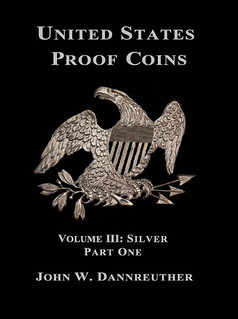

JD adds:
"Of course, the USPS might take their sweet time delivering them! Most should arrive this coming week."
To read the earlier E-Sylum articles, see:
BOOK AVAILABLE: U.S. PROOF COINS VOL III: SILVER
(https://www.coinbooks.org/v29/esylum_v29n11a05.html)
NEW BOOK: U.S. PROOF COINS VOL III: SILVER
(https://www.coinbooks.org/v28/esylum_v28n49a06.html)
A Renaissance for Bois Durci (Hemacite)
Last week I mentioned that Bois Durci seems to be having a renaissance lately, but didn't know why. -Editor
Brett Follmer writes:
"Last year I saw this post from x.com. This is the first time I had heard of it and wanted to know more. I wonder if the surge in interest comes from the same source."

To read the earlier E-Sylum article, see:
RESEARCHER SEEKS BOIS DURCI, A NATURAL PLASTIC 1855-1927
(https://www.coinbooks.org/v29/esylum_v29n12a06.html)
Melted Buffalo Nickels Paperweight
 Donn Pearlman writes:
"This is my paperweight: a small pile of fused, Indian Head/Buffalo nickels from a hotel fire in Salt Lake City, Utah in the 1930s."
Neat - thanks. Last week I'd joked with Donn about a gold bar I thought would make a fun paperweight. -Editor
To read earlier E-Sylum articles, see:
NOTES FROM E-SYLUM READERS: FEBRUARY 2, 2025 : Melted Coins
(https://www.coinbooks.org/v28/esylum_v28n05a12.html)
EUREKA BAR PARTIAL OWNERSHIP OFFERED
(https://www.coinbooks.org/v29/esylum_v29n12a11.html)
Uniface Rogers Coal Company Trade Note $5 Sample Note
Thanks to my picking an obsolete email address for Dave Schenkman, I didn't get his input in time for my Numismatic Diary article last week - so here's a belated addition. Sorry Dave - thanks! -Editor
Dave writes:
I brought three or four notes, but here's a picture of the one I think most interesting. I purchased it a couple of months ago; here's the seller's description.
RARE UNIFACE SAMPLE $5 ROGERS COAL CO TRADE NOTE SCRIP c1885 LITCHFIELD KANSAS
The provenance of this obsolete note: found in a huge scrapbook compiled by a Chicago engraver named Enzweiler / Ensweiler who was employed as a "steel and copper engraver" (according to the Federal Census). This individual - using very oversized scrapbooks with extremely sturdy pages - preserved hundreds of engraving examples / samples (likely professional mementos) from the early 1890s up to the mid-1920s. He MAY have worked for the Western Bank Note and Engraving Company, the Western Division of the American Bank Note Company, but that is a strictly a mere guess on my part. I was not able to ascertain his employer. He passed away in the mid-1900s. This is from his estate, having passed through several generations of descendants.

Nice note - great vignettes. The Latin motto "Ad Astra Per Aspera" translates to "to the stars through the rough terrain." -Editor

To read the earlier E-Sylum article, see:
WAYNE'S NUMISMATIC DIARY: MARCH 22, 2026
(https://www.coinbooks.org/v29/esylum_v29n12a21.html)
New Coin Grading Scheme
David Pickup writes:
I think we are all agreed coin collectors need a reliable, accurate and scientific method of grading coins.
This new scheme that will be used from 1st April. It is based on the rarity of a coin, token or medallion and is guaranteed to be ok. The grades are:
- EU: Extremely unique
- VU: Very unique
- NU: Nearly unique
- NQU: Not quite unique
- NVU: Not very unique
- NUAA: Not unique at all
Please check your coins and regrade your collection now!
Remember everyone is one of a kind and enjoy National Unique Day!
A uniquely unique system! -Editor
Aureo & Calicó Has Changed Ownership
A press release this week announces a change of ownership for Spanish firm Aureo & Calicó. -Editor

Aureo & Calicó S.L. is a globally recognized name in the numismatic world, headquartered in the Calicó building near the Roman walls in the historic center of Barcelona. The company's origins date back to 1784, making it the oldest numismatic firm on the European continent. In 2007, the company Aureo purchased Calicó to form the present organization.
Managing Director Ms. Teresa Sisó has decided to transfer the ownership of the company in order to ensure its long-term future as an independent numismatic auction house.
As of March 11, 2026, the ownership of the company has been transferred to Mr. Hugo Vanhoudt and Mr. John Saunders, a European American cooperation, prompting a major step into the future of the company.
The experienced and dynamic team will continue to develop and expand the business under the leadership of Ms. Teresa Sisó.
For more information, see:
https://www.aureo.com/
Michelle Benton's Harriet Tubman 20 Dollar Bill
I've written before about J.S.G. Boggs' "Women's Series" of imagined banknotes including the $100 note depicting Harriet Tubman. Hiep Hoang notes that Tubman was also the subject of a recent work by artist Michelle Benton. The painting was sold by Weschler's of Rockville, MD. Thanks. -Editor
Lot 187: Michelle Benton (American 20th/21st Century), Harriet Tubman 20 Dollar Bill, Acrylic on Board, Signed l.r., Unframed: 24 x 36 in. (61 x 91.4 cm.)
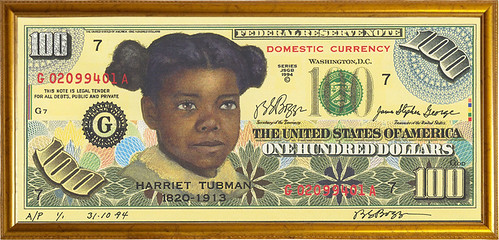
The J.S.G. Boggs Tubman Note
To read the complete lot description, see:
Lot 187: Michelle Benton (American 20th/21st Century), Harriet Tubman 20 Dollar Bill, Acrylic on Board, Signed l.r., Unframed: 24 x 36 in. (61 x 91.4 cm.)
(https://www.invaluable.com/auction-lot/michelle-benton-american-20th-21st-century-harrie-187-c-a70ea425c7)
Kolbe & Fanning Instagram Reels
For our bibliophiles, I just wanted to mention the new Instagram Reels Kolbe & Fanning have been posting. Well done - check them out. -Editor

See:
https://www.instagram.com/kolbefanningnumislit/
NEW ORLEANS $10 GOLD WHIST MATCH
Len Augsburger submitted this note and video about an interesting numismatic event that took place during the recent FUN show. What fun! -Editor
Doug Winter Arbitrates a Whist Match

Stephen Petty, Doug Winter and Len Augsburger
"Old cent whist," a game for comparing large cent collections, was popularized by William H. Sheldon in Early American Cents (1949). Sheldon named the collector George French as the inventor of the game, and half the fun seems to be that the rules were never precisely formalized. Sheldon described such a contest between French and Howard Newcomb:
"Dr. French, always a jolly extravert, had caught a Tartar in Mr. Newcomb who was of quiet, taciturn disposition. The two were of opposite temperaments and they provoked a little more than friendly rivalry in one another. A game of old cent whist had been arranged between them, with some wagers set. It was the onlookers who did the betting. The score was very close, something like 122 to 119, when Dr. French began to present several of his ‘new varieties' of 1796. The argument which straightway broke out on those attributions would be unfit to print. Some disagreement seemed to be detectable too as to the grading of condition. The game was finally adjourned pending further research on attribution, and I am afraid it was never finished, and the bets never paid."
This year's January FUN convention served as a meeting point for a "whist match" between Stephen Petty and Len Augsburger, both collectors of New Orleans ten-dollar gold pieces. This is a 37-coin set, spanning from 1841 to 1906. Rare gold coin specialist Doug Winter acted as the arbiter, evaluating each example and offering comments on the overall series. The author did not win (and did not expect to) but the real value of the exercise was tapping Doug's considerable expertise, which is fully evident here.
The author acknowledges Lianna Spurrier of Numismatic Marketing, who handled all aspects of the video and still image production.
Great idea! Check it out. -Editor
Link to "New Orleans $10 Whist Match" on YouTube:
New Orleans $10 Whist Match
(https://www.youtube.com/watch?v=XgIVPRPcgK8)

ED SCHEDLER COUNTERSTAMP INFORMATION SOUGHT
Adrian Gonzalez-Salinas is looking for information on a rare counterstamp on a coin of the second Mexican Empire. Can anyone help? -Editor


I am searching for information about a rare counterstamp on a coin of the second Mexican Empire. It was auctioned in Mexico City by Briggs and Bustos Auction XII (04 April 2025), lot # 345 (1).
Coin's characteristics:
- Denomination: $1 Peso
- Obverse: Bust of Maximilian Emperor of Mexico (1864-1867) with counterstamp "ED SCHEDLER" and "E S".
- Reverse: Crowned arms of the Mexican Empire with counterstamp "S" below eagle.
- Year: 1867
- Mint: Mexico City (M°)
- Metal: Silver 90.27%
- Host coin: KM # 388.1
- Graded: PCGS Damage AG-Detail
I couldn't find any reference of this counterstamped coin in:
- American and Canadian Countermarked Coins by Gregory G. Brunk. World Exonumia Press. 1987.
- Merchant Countermarks on World Coins by Gregory G. Brunk. World Exonumia Press. 1987.
- Standard Catalog of United States Tokens 1700-1900 3rd Edition by Russell Rulau. Krause Publications. 1999.
Who was Ed Schedler?
Well, I found information about a 40 years old French jeweler named Edward Shedler (2). He lived in the Fifth Ward of New York City on 15 August 1850 with his family:
- Charlotte A. (34 years old) from France
- Pauline E. (4 years old) from France
- Caroline S. (2 years old) from New York
- Matilda (1 year old) from New York
- Dorothea Melzie (67 years old) from France

Because the coin shows a lot of wear (graded as About Good), it could be a coin carried daily by Ed Schedler himself.
I would be grateful for any help to identify who Ed Schedler was.
Notes:
(1)
https://bid.bbauctions.com.mx/lots/view/5-1PR7L5/km-3881-ed-schedler-es-s-peso-1867-mxico-mo-maximiliano-pcgs-ag-damage
(2) Maybe, Eduard Schadler (or Schädler) was born in Bas-Rhin in Alsace, France.
Thank you so much!

THURSDAY LUNCH CLUB REPORT MARCH, 2026
Ray Williams of New Jersey submitted this report on the latest meeting of their colonial coin and currency lunch group. Thanks - great people, great coins. -Editor
We had another numismatic lunch here in Bordentown, NJ. I am so lucky to live within driving distance of so many fellow colonial collectors! And the diner has no problem with us using up 2½ hours at their tables. It has been brought up that our lunch group be named "C5" for Colonial Coin and Currency Collectors Club, but we need to seriously discuss this. Being humbled to be a part of this group, it looks more like a society than a club.

Pictured clockwise Ray Williams, Carol Wolf, Alberto Washington, Wayne Shelby, Roger Moore, Don Hartmann, Mike Brooks hiding behind Leo Shane and John Louis.
I'll share some of the items for our show and tell session… Roger Moore brought a beautiful example of a Vexator Token. That's something you don't see every day!

"1811" Vexator Token
Alberto and I knew each other had a fascination with Washington Medals and unknown to each other, we both brought in Eccleston Medals! I brought in a copper example along with a Deeds of Peace Medal and an Eccleston Conder Token. Eccleston (1805) plagiarized the image of the Native American from the Deeds of Peace Medal (1775). Then Alberto WOWED me with two Eccleston Medals, both gold fire guilt and one having the secret marks discovered by Vicken Yegparian. He also brought several other related items.

Gold Fire Gilt 1805 Eccleston Medal

Gold Fire Gilt Eccleston Medal with secret marks below bust, below feet and in the crook of the Indian's arm

1775 By Deeds of Peace Medal
Check the similarity of the Native American to the Eccleston Medal

Don Hartman brought in two full pages of dug State Coppers, mostly NJ

Lord Baltimore 6d VF35, one of Wayne's favorite coins

Wayne purchased this from Tom Rinaldo in 2005, slabbed at Proof 65!

1695 Crown and 1693 Half Crown
There were many other items shared at this lunch and hope to get more images for the C4 Newsletter write up. But something happened at this lunch that sets it aside from others, many of us took quite a while sharing stories of our experiences over the decades. It was like sitting around the campfire! So much fun! I encourage anyone reading to get together socially with others of similar numismatic interests. It adds another dimension to your hobby fun.
To read earlier E-Sylum articles, see:
THURSDAY LUNCH CLUB REPORT JULY, 2023
(https://www.coinbooks.org/v26/esylum_v26n32a28.html)
C5 COLONIAL GROUP HOLDS OCTOBER 2025 LUNCH
(https://www.coinbooks.org/v28/esylum_v28n42a16.html)
VOCABULARY TERM: SIGNATURE
Here's another entry from Dick Johnson's Encyclopedia of Coin and Medal Terminology. Dick was such a treasure to the numismatic community - while minting technology has moved on, his dictionary entries remain comprehensive, useful and often timeless. This one is a great discussion of all aspects of artist signatures on coins, tokens and medals. I added some images. -Editor
Signature. Any of a variety of ways the creator of a work of art signs that work. Signatures can be initials, monograms, symbols, a single name, or a signature in script. Artists have used such a variety of signatures, symbols and pseudonyms that art researchers and historians must use extreme diligence to identify the correct author of any given work of art. Signatures on coins are often the shortest of all, usually one, two or three initials.
Extreme limited space on coins and medals requires brevity, however full names have appeared on numismatic works. Published lists of initials and monograms revealing the original artist are required references for the person who must identify, describe or authenticate coins or medals. A numismatic item without a signature is unsigned (even though the creator may be identified by research). The item is called anonymous when it is unsigned and no amount of research reveals the artist.
Because a signature is so much a design element, the artist often renders it in an artistic way. An elaborate monogram is occasionally created (possibly obscuring the sequence of the letters, or the most prominent letter by intertwining of the initial letters). One artist, Augustus St-Gaudens, created a different monogram for nearly every work of art; while a charming mannerism, this trait requires more diligence necessary for the art historian.
Signature locations. Signatures on coins and medals are always found in the lowest part of the design, usually to the right. This is like signing a document or letter at the bottom right; this similar position is predominantly chosen for paintings, prints, other works of art.
For those coin and medal designs with an exergue, the signature can often be found on the side of the listel (a bar going across the base line), slightly below, or on top of the listel. Also for those portraits of a bust, the signature is occasionally found on the truncation of some part of the bust.
Signature abbreviations. Signatures sometimes contain arcane letters following the name or initials on medals. These reveal what part the signer had in the creation of that medallic item. Once these abbreviations are learned an entire division of labor is sometimes revealed. The most encountered is fecit, a Latin word (pronounced FEE-set) meaning he (or she) did it, or made it, or created it, or engraved it. The letters f or fec after a name or initials indicates this Latin term. It is used in medallic art more often than any other signature form.
Other letters following a signature are listed in the chart. Four of these begin with the letter D and D has been used as an abbreviation for any of these (further obscuring the meaning). Also the abbreviation edit is for the French word editeur; it is not the editor as we know it in English, but instead the publisher or issuer of the piece.
Signature confusion. Problems arise when two or more artists used the same initials. There are, for example, four J.R.s, two Americans and two British. There are eight C.W.s. For single initials signatures, the problem increases; there are 48 artists listed in Forrer who have signed H, and 36 who signed W. It becomes necessary to know who was working in what geographical area in what specific time period. Even a somewhat limited series of medals like the Society of Medalists in America has two medals signed exactly the same by two different artists (number 14 by Albert Stewart, and number 114 by Alex Shagin), both obviously signed "AS".
Monograms compound the problem. First it is often unclear in the sequence of letters once they are deciphered from intertwining. Also monograms of artists are often confused with those of the medallic firm that made it, or with a client's or issuer's monogram. Even the registration, copyright or trademark symbols required by law in some countries add to the confusion.
Sales agents and importers sometimes have their initials or monograms placed on medallic items. For a period in the 1960s Nebraska Numismatics imported European mint medals and had their logo of a double N placed on those imported. And the FK initials of another importer (F. Knight of New York) appeared on the John Philip Sousa Centennial Medal he brought to America in 1954.
Artists who have collaborated on a medal infrequently have created a new monogram incorporating both last name initials. Mario Cooper and Robert Foster did this for a CF monogram on the Society of Illustrators Medal of 1950.
Women artists who take their husband's name after marriage may change their monogram. Anna Vaughn Hyatt who married Archer Milton Huntington used both AVH and AHH monograms in her lifetime.
For some unknown reason sculptor Gifford MacGregor Proctor placed a symbol – what looks like two birds in flight – in a location normally reserved for signatures, under the device on the reverse slightly to the right on the Aldo Leopold Medal of 1951.
Finally, the world of numismatics abounds with unidentified initials, monograms and symbols. We may never learn who was he creator of objects signed by these carefree artists.
Family signatures. Other areas of confusion are the dynasties of engravers or firms extending over several generations, all members of which signed a similar name, initials or monogram. The most famous of these are the Wyon family of English engravers, medalists, diesinkers and sculptors, 15 of which created coins and medals.
In Belgium there were two Weiners. In Germany two Mayers. In France three or more medalists existed in each of the Barre, Dubois, Dupre and Yencesse families.
The Lovetts in America extended over three generations and 80 years of token and medal making; there were five engravers, a father, three sons and a grandson. Many other examples could be listed.
Advice for artists. An artist should not intentionally use a set of initials or monogram already used by any other artist. He can check with published lists of such signatures and ask among his contemporaries if they know of such conflicts. He can also check with numismatic and art societies.
It may sound farfetched, but the medallic artist can also check jewelry trademarks.
Often his work may be reproduced as jewelry and the industry's trademarks are well published, quite extensive and easily referenced.
But here are some specific suggestions: (1) create as simple – but distinctive – a mark as possible for your signature. (American sculptor Donald Miller added the blades of a windmill above his initials for distinction, for instance.) (2) stay away from scrip – model or engrave your signature as clear as possible; and (3) add a date to your signature – this will at least place your work in a precise time period and aid future catalogers immensely (in America if the work is copyrighted a date is mandatory along with the copyright symbol).
Hidden signatures. While signatures are hidden in the design of paper money engravings far more often than in medallic items, these instances do exist. The most interesting example is a medal for a Columbian anniversary activity, the New York Municipal Columbian Entertainment Committee Badge of 1893. The uniface medal was engraved by Victor David Brenner. He had just been employed by the medallic firm of Robt. Stoll in New York City.
Brenner signed the piece in the grass below the city seal – but backwards! (Actually he signed it in the die he had just cut intaglio, but signed it cameo – right to left – so when it strikes a piece it appears with lettering left to right.) Since the lettering is hidden in the grass, it is not obvious upon first inspection. Whether this was done surreptitiously, or with his new employer's permission is, of course, not recorded. But the piece is charming.


1933 Society of Medalists 7th Issue by Carl Paul Jennewein
Signature charm. If a large number of signatures are examined it will be noted some artists are quite adept at signing their works of art in charming ways. John Flanagan placed his JF initials in the O of the obverse legend on the Panama-Pacific International Exposition Medal of Honor in 1915. Look for the JF in the center of the last O of HOMO in the Latin phrase: DIVINE DISIVCTA IVNXIT HOMO.
- Anthony de Francisci underlined his initials with a sculptors burnisher on the United Parcel Service 50th Anniversary Medal, 1957.
-
 Carl Paul Jennewein placed a tiny self-portrait character and date in his 1933 issue of the Society of Medalists (Issue number 7).
- A husband and wife team have all their initials on a center letter. Holger and Helen Webster Jensen have a J monogram with an H on one side for him, and H and W on the other side for her. It appeared on the North American Aviation Dedication Medallion, of 1964.
- The Frasers – James Earle and Laura Gardin – did the same for both a coin and medal for the Oregon Trail Memorial Half Dollar of 1926 and the Oregon Trail Medal of 1929. The husband and wife team, both accomplished medalists, collaborated together medallically for these two commissions.
- Marcel Jovine created a bilingual medal for the Apollo Souyez. Obverse was in English and showed the American Apollo capsule; the reverse was the Russian spacecraft with legend in Russian. He signed both sides; in English on the obverse, in Russian on the reverse.

But, perhaps the most charming of all is a concordant medal (the reverse is the back of the obverse as if the medal was sculpture in-the-round). In 1937 sculptor Robert Ingersoll Aitken did a medallic tribute to Love; he showed a couple embracing front and back. He signed the piece on the reverse in reverse. Within an oval he has the six letters of his last name in groups of two – backwards. Charming! The medal was the 15th Issue of the Society of Medalists.
Signatures in history. We know today the identity of Greek and Roman coin engravers because of their signatures: Euainetos of Syracuse, Theodotus of Clazomenae, Lysimachus and Attalus of Greece, and others. Pisanello signed the first art medal in 1438.
Other methods of signing. Some medallic plaques are signed by the manufacturing firm placing a disk on the blank reverse. The disk contains their name, logo, sometimes their location. This is common practice for foundries casting statues. An interesting custom for some of these same foundries is for the artist to place his thumbprint in the original mold. Any replicas not from that mold would show an imperfect thumbprint.
Maker's marks are sometimes in the die of a manufacturer who strikes uniface items; the impression is in the blank reverse die. Owners sometimes place their mark on a numismatic item, such private mark is relished by subsequent collectors if the owner was famous (but unappreciated if he is not).
The most universal means of signing coins and medals throughout the world, however, is the mintmark. This identifies where the item was struck (mints are usually identified with the city where they are located). Mintmarks have been used virtually since mints came into existence and continues to the present time.
While the practice is now discontinued, at one time the master of the mint was allowed to sign his initials on coins as well as the engraver. The mintmaster's mark is treated with equal dignity as the engraver's among numismatists.
Finally there is a method of signing that is not apparent in any struck pieces. Some artists have signed the die outside the design. Obviously this can only be detected from examining the die itself.
To read the complete entry on the Newman Numismatic Portal, see:
Signature
(https://nnp.wustl.edu/library/dictionarydetail/516753)
MORE ASSOCIATION ITEMS
E-Sylum Feature Writer and American Numismatic Biographies author Pete Smith submitted this article on some unique numismatic association items he set aside over the years. Thank you. -Editor
This week I present another article on association items. I will mention a few I gathered to commemorate a meeting with someone.
In 1983, the ANA convention was at the Town and Country Hotel in San Diego. The bourse and meetings were in town and the rooms were out in the country. That is, my room was in a building detached from the main hotel.
One evening I was walking back to my room and saw two men talking in the driveway. I walked up and introduced myself to Ken Bressett and Walter Breen. We chatted briefly and I walked on. At the time I was not prepared to ask either one for an autograph.

As I came back the next morning, I looked around for something to commemorate the event. I picked up a couple of stones from around a landscape planting. I marked their names on each stone so I would not get them confused.
In December 1984, I flew to the Big Apple to participate in the first ANS Coinage of the America's Conference. That Saturday evening Mr. and Mrs. R. Henry Norweb invited the speakers and other special guests to their apartment for dinner.
 I was very impressed with the apartment. What may be even more impressive is that this was not
their primary residence. It was just a convenient place to spend a few nights when they were in
town. This little get-away spot had a dining room that would seat more than twenty people.
I was very impressed with the apartment. What may be even more impressive is that this was not
their primary residence. It was just a convenient place to spend a few nights when they were in
town. This little get-away spot had a dining room that would seat more than twenty people.
Dinner was served by uniformed waiters. I convinced one of the waiters to give me his boutonniere at the end of the evening. This was not for me to remember an individual but rather to remember the event.
During the 1991 ANA 100th Anniversary Convention in Chicago, I was interviewing people for the original edition of American Numismatic Biographies. On the morning of August 15, 1991, I sat outside the show talking with John J. Ford. He had great stories to tell and I could put just a small fraction in the book.
I saved the pencil I used to take notes and put his name on it.

Krause Publications invited visitors for "A Day in Iola" following the Chicago convention on Monday, August 19, 1991. This was not far out of the way for my return trip from Chicago to Minneapolis.
We were waiting for a tour to start when John Wilson came by. He took a picture of me standing next to Ruthann B. Brettell. I had never met her before that and had little contact after that. I did not collect any memento of that meeting.
 One of the optional activities was a boat cruise on the "Chain-O-Lakes" in Waupaca County
about sixteen miles south of Iola. For part of the trip, I sat next to John J. Pittman. He had some
good stories and I wanted to commemorate the meeting.
One of the optional activities was a boat cruise on the "Chain-O-Lakes" in Waupaca County
about sixteen miles south of Iola. For part of the trip, I sat next to John J. Pittman. He had some
good stories and I wanted to commemorate the meeting.
I looked around and could not find anything to save. There were no ticket stubs. There were no loose paper wrappers thrown on the deck. When I got home. I took off my socks and put them in a marked envelope. I haven't worn them since that day in 1991.
And now for something completely different.
In August of 2025, I attended the ANA World's Fair of Money in Oklahoma City and the Rittenhouse Society breakfast on Saturday, August 23, 2025. I asked all the people attending to sign an autograph card as a record of the event.
Later when I picked up the cards, I found one for the elusive numismatic author and cartoonist, Lincoln Vanderblat. I hadn't realized he was there. For years I have tried to pin him down for an interview but never found the opportunity.
So now, I don't have a souvenir to remember someone I met, but rather I have documentation from someone I failed to meet.

To read earlier E-Sylum articles, see:
WILLIAM WOODIN ASSOCIATION ITEMS
(https://www.coinbooks.org/v28/esylum_v28n51a16.html)
ANA CONVENTION BADGES AND RIBBONS
(https://www.coinbooks.org/v28/esylum_v28n52a12.html)
NUMISMATIST MIRRORS
(https://www.coinbooks.org/v29/esylum_v29n07a17.html)
THE BOOK BAZARRE
CSNS AWARDS HOLLIS WITH BOWERS AWARD
CSNS names Mint Director Paul Hollis as the recipient of its prestigious 2026 Q. David Bowers Award. -Garrett
 United States Mint Director Paul Hollis will be presented with the Central States Numismatic Society's prestigious Q. David Bowers Award during his opening day appearance at the 2026 CSNS convention (www.CSNS.org/convention) on April 23 in the Chicago suburb of Schaumburg, Illinois.
The annual award recognizes contributions to the hobby by numismatic professionals and is named in honor of well-known dealer and prolific numismatic author Q. David Bowers. Members of the CSNS Board of Directors select each year's recipient.
"Paul Hollis' appointment as Director of the United States Mint reflects a lifetime devoted to collecting, scholarship, and service to the hobby for which the Bowers Award was created. He has been a coin collector since childhood, and recalled that while classmates wrote reports about Babe Ruth or Amelia Earhart, he chose as a topic early American scientist and first Mint Director David Rittenhouse," said CSNS President Mitch Ernst.
"A graduate of Louisiana State University and longtime member of the American Numismatic Association, Hollis served with distinction in the Louisiana legislature and as a professional coin dealer in New Orleans. He is an award-winning author whose book, American Numismatist, received the 2012 Best Specialized Book on U.S. Coins honor from the Numismatic Literary Guild," explained Ernst.
 "To promote the hobby and the four special designs created for the reverse of Lincoln cents in 2009 to commemorate the 200th birthday of President Abraham Lincoln, Hollis gave away one million Lincoln cents, including some older wheat stalks design coins. A million cents weighs approximately 2.7 tons. That's about 5,400 pounds of pennies," said Ernst.
Each penny was accompanied by an illustrated, educational brochure that Hollis produced explaining the history of the Lincoln cent.
Hollis said he is grateful to be selected as this year's CSNS award recipient.
 "I am deeply honored to have been selected for this award. Q. David Bowers is a true legend in numismatics, and his work has inspired countless collectors, including me. As a lifelong numismatist, I consider my appointment as the 41st Director of the United States Mint—my dream job—as both a privilege and a responsibility. I am committed to advancing this great hobby, strengthening our industry, and inspiring the next generation of numismatists," stated Hollis.
President Donald J. Trump nominated Hollis to be the Director of the United States Mint on July 16, 2025, and the United States Senate confirmed him for this position on December 18, 2025. On January 5, 2026, Hollis took the oath of office, becoming the 41st Director of the United States Mint.
Following his 12 years of service in the Louisiana Legislature, he was elected to the Louisiana State Board of Elementary and Secondary Education in 2023, serving a constituency of 500,000.
He has also served on various professional boards, including the Industry Council for Tangible Assets (now the National Coin & Bullion Association) and the Numismatic Literary Guild.
The CSNS convention will be April 23-25, 2026, with PNG Dealer Day and early bird entry on April 22 at the Renaissance Schaumburg Convention Center, 1551 North Thoreau Drive, in Schaumburg, Illinois.
Director Hollis will talk about the Mint's dual-dated 1776-2026 Semiquincentennial coins at an educational symposium scheduled for 10:30 am on April 23.
For additional information about the Central States Numismatic Society and its annual convention, visit www.CSNS.org.
CSNS TALK ON THE SEMIQUINCENTENNIAL COINS
Numismatic author, publisher and former Citizens Coinage Advisory Committee (CCAC) member Dennis Tucker will speak at the 2026 Central States Newman Numismatic Portal Symposium. Here's the announcement. -Editor
 Award-winning author Dennis Tucker will speak in person at the three-day
2026 Newman Numismatic Portal Symposium in the Chicago suburb of Schaumburg, Illinois. His talk
is scheduled for 5:00 pm Central on Friday, April 24, 2026. The NNP Symposium is accessible three
ways: Visitors to the 87th Central States Numismatic Society convention can attend in person; the
presentation will also be livestreamed via Zoom; and it will be archived online. There will be a Q&A portion at the end.
Award-winning author Dennis Tucker will speak in person at the three-day
2026 Newman Numismatic Portal Symposium in the Chicago suburb of Schaumburg, Illinois. His talk
is scheduled for 5:00 pm Central on Friday, April 24, 2026. The NNP Symposium is accessible three
ways: Visitors to the 87th Central States Numismatic Society convention can attend in person; the
presentation will also be livestreamed via Zoom; and it will be archived online. There will be a Q&A portion at the end.
Tucker's presentation is titled "The Semiquincentennial Coins: What's Going Right . . . and What's Going Wrong." He will give a behind-the-scenes history of how the United States Mint developed its coinage and medals program to celebrate America's 250th anniversary. He will describe the direction the program was headed in for several years, how it dramatically changed just weeks before the Semiquincentennial, and what it all means for American numismatics.
"The 2026 Semiquincentennial is bringing new excitement to the coin-collecting hobby," Tucker said. "It's also ignited a firestorm of controversy and has threatened nearly 250 years of numismatic tradition." He describes the scope of his NNP Symposium talk: "This isn't so much a critique of individual designs, although there will be some analysis along those lines. It's more of a study of how the coins' themes and designs have been developed, later altered, and subsequently challenged."
Tucker will update listeners on the Freedom of Information Act (FOIA) request he submitted to the Treasury Department, and will discuss recent developments like the Donald J. Trump gold coin and the proposed Trump circulating dollar coin. United States Mint Director Paul Hollis will also discuss the Semiquincentennial coins at the NNP Symposium; his talk is scheduled for Thursday morning, April 23.
The 2026 Central States Numismatic Society convention will be held April 23–25 at the Renaissance Schaumburg Convention Center, close to suburban Chicago's Woodfield Mall. This is the 87th CSNS convention. It features more than 425 coin dealer booths, free entrance for Society members and visitors under 18 years old, free entry to auctions and educational programs (including the NNP Symposium), club meetings, activities and giveaways for young collectors, and more.
Dennis Tucker is an author, numismatic researcher, and book publisher. He served as a Treasury Department Special Government Employee and numismatic specialist on the Citizens Coinage Advisory Committee from 2016 to 2024. His book American Gold and Silver: U.S. Mint Collector and Investor Coins and Medals, Bicentennial to Date won "Best Specialized Book" from the Numismatic Literary Guild. Tucker is a Life Member of the Central States Numismatic Society and recipient of the Society's 2024 Q. David Bowers Award for his contributions to the hobby.
Great topic, which should attract a lot of interest. I'll miss the show, but will look forward to the NNP live stream and video. -Editor
For more information on the Central States Numismatic Society and the show, see:
https://www.csns.org/

STACK'S BOWERS: RENAISSANCE MEDAL OFFERINGS
Stack's Bowers is currently offering a group of Renaissance Medals, which are discussed below. Contact Brian Kendrella for more information. -Garrett

Cristoforo di Geremia (fl. 1450-1475). Portrait Medal of Paolo Dotti (fl. ca. 1289) of Padua. Offered at: $1,100 61.5 x 61.3 mm. 108.4 grams. Bronze. Kress 214, Hill 758c. Truncated bust to right, DOTTVS PATAVVS MILITIE PREFETVS PROPTER RES BENEGESTAS / Constancy standing, CONSTANTIA. Medal turn. Neat hole atop portrait. A very early cast with good bold detail on both sides. Medium steel brown with some olive encrustation around peripheries. Some dull marks and evidence of handing, vestiges of vertical chasing lines in reverse field. An unusual 15th century medal, insofar as it commemorates a military leader from the 13th century. Quite scarce.

Galeazzo Mondella, called Moderno (c. 1467-1529). Round Plaquette of The Fall of Phaeton or Death of Hippolytus. Offered at: $42,250 106.5 x 105.8 mm. 197 grams. Bronze. Molinier 191; Bange 467; Lewis ["The Plaquettes of 'Moderno' and His Followers," 1989] 29, fig. 33; Scaglia V.38; Kress 160; Maclagan p. 33; Bargello 174; Warren, Ashmolean, 324. Uniface. Rich charcoal brown patina with some trivial hints of brassy undertones on high points. Well detailed and attractive, with no evidence of chasing on the obverse. Some casting flaws and pits are seen on the blank back. Edges filed and finished, oval depression on edge at 12 o'clock remains from a former mounting. "Moderno" has been written in black ink in an antique script on the back. A magnificent piece of art, dated to ca. 1500-1505 and called "a very fine contemporary cast with dark patina" by Morton & Eden in 2020. Pieces of this quality and age bridge the gap between numismatics and adjacent fields of art and sculpture. This piece set an auction record for a plaquette by Moderno when it sold in 2020, surpassing the £22,800 level set by the more recently-attributed Moderno plaquette of Standing Hercules and the Nemean Lion in Morton & Eden's 2019 Auction 105, offered elsewhere in this sale. As an unquestioned work by Moderno himself of long standing, accomplished with astonishing expertise and vision, this plaquette stands atop his most desirable works. Douglas Lewis' 1989 paper in Studies in the History of Art, Vol. 22. describes this plaquette as "the masterpiece of Moderno s 'archaeologically' classicizing style," continuing to say: "The balance and foil of richly modeled forms, intricate curvilinear detail, and dramatic open space is nowhere better handled by Moderno than in the Phaeton."

Valerio Belli (1468-1546). Pair of Trapezoidal Bronze Plaquettes, Christ's Entry into Jerusalem and Christ in Limbo. Offered at: $31,700 The Entrance into Jerusalem. 100.9 x 63.4 mm. 113.3 grams. Bronze. Molinier 266; Bange 762; Gasparotto 53. Uniface. Deep brown applied patina shows traces of brassy color beneath. A bit of pewter solder is noted at top center of blank reverse. A fine early cast with elegant detail and no sign of chasing, some casting pits but no flaws. Collector mark B.M. incuse stamped, hidden at central base of design near exergue. Beveled edges neatly filed and rounded. A handsome early production.
Christ in Limbo. 100.5 x 61.9 mm. 107.8 grams. Bronze. Molinier 279; Bange 770; Gasparotto 60. Legend VALER BELLVS VICETI at left. Uniface. Deep brown applied patina shows traces of brassy color beneath. A bit of pewter solder is noted at top center of blank reverse where a mount has been lost. A fine early cast with excellent detail and good gloss despite fine granularity, a few little hints of dark verdigris within the design. Collector mark B.M. incuse stamped at top of design left of center. Beveled edges neatly filed and rounded. Fine and early.
As noted in the 2020 Morton & Eden catalog, "These form part of a series of similarly shaped plaquettes of the Passion of Christ referred to in the Kress catalogue, p. 10, of which The Entombment (Kress 10, fig. 352) is also from the Baron de Monville collection."

Unidentified Venetian Medalist (Niccolo da Ponte?). Portrait Medal of Vincenzo Maggi (1498-1564). Offered at: $1,600 33.3 x 33.1 mm. 14.9 grams. Silver. Armand II, 207, 20; Voltolina 534. Draped and bearded portrait to right, VICEN MAGIVS THEODI CONSTI TER EIVS QVI PNP / man rows while putto watches, NON EST VOLENTIS NEQVE CVRRENTIS SED MISERENTIS DEI. Medal turn. Attractive light silver gray with iridescent gold and pastel highlights. Fully chased on both sides, including fine details in the design elements and all peripheral legends. Fields on both sides are elegantly smoothed. Minor depression flaw behind portrait. The obverse inscription comes from Job 14, the reverse from Romans 9. Maggi was a philosophy professor at Padua and Ferrara. A very attractive early casting.

Girolamo Santacroce (1502-1537). Portrait Medal of Andrea Caraffa, Count of Santa Severina and Viceroy of Naples. Offered at: $1,100 37.0 x 37.5 mm. 33.1 grams. Bronze. Armand II, 108, 13; Kress 109; Pollard 155. Helmeted bust to left, ANDREAS CARRAFA - S SEVERINAE COMES / Prudence seated, NILABEST in exergue. Coin turn. A thick early cast with the brassy surface tone of a sestertius. Darker toning and shallow encrustation present around design elements, some smoothing scratches seen in right obverse field. Handsome and well detailed.

Jacopo Nizzola da Trezzo (ca. 1515-1589). Portrait Medal of Gianello della Torre of Cremona (1501-1585). Offered at: $26,400 81.0 mm. 173 grams. Bronze. Attwood 91; Armand I, 170, 38; Kress 441a; Pollard 501; Scher (Currency of Fame) 55. Medal turn. Portrait to right, IANELLVS TVRRIAN CREMON HOROLOG ARCHITECT / Fountain of Science at center with grateful crowd surrounding, VIRTVS NVNQ DEFICIT. An exquisite early casting, with fine detail and glossy surfaces. Two mould cracks are nearly perpendicular in the right obverse field. Edges filed and smoothed to roundness. Obverse fields smoothed with light pin scratches, reverse chased at vertical flaw extending upwards from T of DEFICIT. A minuscule neat hole is noted outside the border at 12 o'clock. A very handsome portrait medal, described as "an extremely fine contemporary cast of high quality with dendritic patterns in the brown patina" by Morton & Eden in 2018. The Italian medallist and engraver Jacopo Nizzolo de Trezzo left Milan about 1555 and eventually ended up in Madrid. He masterfully rendered this lifelike portrait of another Italian in Spain, the clockmaker Gianello della Torre, described as "Gianello della Torre from Cremora, builder of clocks" in the obverse legend. The reverse translates as "Virtue never fails." On being appointed court clockmaker by Charles V in 1529, della Torre relocated to Toledo, where he lived until his death. He was celebrated for his clocks, his engineering feats, and toy-like automatons, then considered feats of mechanical wonder.

Domenico Poggini (1520 - ca. 1590). Portrait Medal of Domenico Fontana (1543-1607), 1586. Offered at: $3,175 38.2 x 38.6 mm. 27.2 grams. Bronze. Armand II, 263, 7; Löbbecke 104; Bargello 839. Portrait to right in ruff collar, DOMINIC FONTANA CIV RO COM PALAT ET EQ AVR. / Vatican obelisk, EX NER CIR TRANST - VLIT ET EREXIT. Medal turn. Holed at 12 o'clock. An extraordinary portrait piece, an attractive early cast. Medium brown with darker peripheries. High relief portrait shows exceptional detail, fields are glossy despite being a bit granular and unchased. Edge filed and smoothed. Some very trivial doubling is seen at the bases of some letters in the reverse inscription. Well preserved and attractive. An important medal, marking the removal of one of Rome's ancient Egyptian obelisks from the Vatican hill to the middle of St. Peter's Square. Caligula brought the obelisk to Rome from Heliopolis in 40 AD. Pope Sixtus V engaged Domenico Fontana, an architect, to move it to its present location on September 10, 1586, a moving process that took 800 men and 160 horses one day after 13 months of planning. St. Peter's Square was designed around the obelisk a century later. This medal marking its placement is rarely encountered today in any form.

Federico Cocciola (fl. 1566-1613). Portrait Medal of Prospero Publicola Santacroce (1514-1589). Offered at: $1,600 50.9 mm x 50.4 mm. 64.1 grams. Bronze. Armand I, 263, 5; Kress 377. Bust to right, .PROS PER.SANCTA CRVCIVS.S.R.E.CARD. / Santacroce's villa, GEROCOMIO around, date 1579 below. Medal turn. A handsome early casting with deep brown applied patina over brassy surfaces. Smoothed to gloss in the fields, lightly granular elsewhere. Edges smoothed and finished to roundness. A very handsome example with a high profile portrait. Santacroce was a cardinal who holds the distinction of being the first European to grow tobacco for his own use.
HERITAGE: EARLY COPPER AND COLONIAL COINS
Heritage Auctions will be hosting their Early Copper & Colonial US Coins Showcase Auction on March 30. Select items are discussed below. -Garrett


1787 Immunis Columbia, Plain Edge,Eagle Reverse, W-5680, High R.4, AU55 Brown NGC. Ex: Eric P. Newman Collection. This late-Federation era copper has sometimes been called a pattern, and the Guide Book states that this variety is 'believed to be a prototype for federal coinage.' It is also the only collectible issue of the Immune or Immunis Columbia coinage, and is highly sought as such. Although dated 1787, many from the issue were struck in 1788 or even as late as 1789. This near-Mint specimen is a splendid example with uniform chocolate-brown patina on satiny surfaces that flash subtle hues of chestnut under light. Marks are trivial and none stand out as individually significant, and the surfaces are surprisingly well-preserved for the grade. Listed on page 25 of the 2026 Guide Book.
To read the complete item description, see:
1787 Immunis Columbia, Plain Edge,Eagle Reverse, W-5680, High
R.4, AU55 Brown NGC.
(https://coins.ha.com/itm/colonials/1787-immunis-columbia-plain-edge-eagle-reverse-w-5680-high-r4-au55-brown-ngc-ex-eric-p-newman-collection-thi/a/60525-50058.s?ctrack=200071&type=featured-3-coinus-news-tem032426)

1652 Oak Tree Shilling, IN at Bottom, Noe-9, W-500, Salmon 7-E, R.5, Fine 15 PCGS. 71 grains. The obverse is struck significantly off-center south, while the reverse is well-centered and of notably higher definition than the weakly impressed obverse. The Narrow O in DOM confirms the Noe-9 Oak Tree shilling attribution. Listed on page 8 of the 2026 Guide Book.
To read the complete item description, see:
1652 Oak Tree Shilling, IN at Bottom, Noe-9, W-500, Salmon 7-E,
R.5, Fine 15 PCGS.
(https://coins.ha.com/itm/colonials/1652-oak-tree-shilling-in-at-bottom-noe-9-w-500-salmon-7-e-r5-fine-15-pcgs-71-grains-the-obverse-is-struck-s/a/60525-50001.s?ctrack=200071&type=featured-1-coinus-news-tem032426)

1773 1/2 P Virginia Halfpenny, No Period, N. 7-D, W-1480, R.2, MS65 Brown PCGS. No Period Virginia halfpence is undeniably scarcer than its Period counterparts. The present Gem likely originated from the keg of Mint State examples pedigreed to Col. Mendes I. Cohen, a scion of a prominent Early American Baltimore banking family. It is a magnificent medium brown example with a good strike. The sole imperfection of note is a diagonal line on the cheekbone.
To read the complete item description, see:
1773 1/2 P Virginia Halfpenny, No Period, N. 7-D, W-1480, R.2,
MS65 Brown PCGS.
(https://coins.ha.com/itm/colonials/1773-1-2-p-virginia-halfpenny-no-period-n-7-d-w-1480-r2-ms65-brown-pcgs-no-period-virginia-halfpence-is-unden/a/60525-50027.s?ctrack=200071&type=featured-2-coinus-news-tem032426)

(1790s) Washington Success Medal, Large, Reeded Edge, Silvered, MS62 PCGS. Baker-265, DeWitt-GW-1792-1, W-10900, GW-41, R.6. Ex: Richard August Collection.
To read the complete item description, see:
(1790s) Washington Success Medal, Large, Reeded Edge, Silvered,
MS62 PCGS. Baker-265, DeWitt-GW-1792-1, W-10900, GW-41, R.6.
(https://coins.ha.com/itm/colonials/-1790s-washington-success-medal-large-reeded-edge-silvered-ms62-pcgs-baker-265-dewitt-gw-1792-1-w-10900-gw-41-r6/a/60525-50106.s?ctrack=200071&type=featured-4-coinus-news-tem032426)


1794 1/2 C Low Relief Head, Small Letters Edge, C-2a, B-2b, High R.2, VF20 PCGS.
To read the complete item description, see:
1794 1/2 C Low Relief Head, Small Letters Edge, C-2a, B-2b, High
R.2, VF20 PCGS.
(https://coins.ha.com/itm/half-cents/1794-1-2-c-low-relief-head-small-letters-edge-c-2a-b-2b-high-r2-vf20-pcgs-cdn-2-125-whsle-bid-for-ngc-pcgs/a/60525-50132.s?ctrack=200071&type=featured-5-coinus-news-tem032426)


1829 1/2 C C-1, B-1, R.1, MS66+ Brown NGC. Manley Die State 1.0. The reddish-brown luster of this example is free from notable abrasions and sharply struck with remarkable eye appeal. The luminous cartwheel effect is rarely seen on any early copper coin. Pieces in Gem are scarce, and those within Premium Gem are seldom seen. NGC has seen just six other pieces graded at MS66, and this is the sole example seen at MS66+ (2/26).
To read the complete item description, see:
1829 1/2 C C-1, B-1, R.1, MS66+ Brown NGC.
(https://coins.ha.com/itm/half-cents/1829-1-2-c-c-1-b-1-r1-ms66-brown-ngc/a/60525-50186.s?ctrack=200071&type=featured-6-coinus-news-tem032426)

STACK'S BOWERS: THE KAPRINSKI COLLECTION
Stack's Bowers will be selling the Kaprinski Collection of Civil War Tokens as part of its April 2026 Tokens and Medals Collectors Choice Online Auction on April 9. Select items are discussed below. -Garrett


1864 Lincoln Portrait / Eagle on Cannon. Fuld-125/160 e, Cunningham 5-360W, King-203, DeWitt-AL 1864-50. Rarity-9. White Metal. Plain Edge. MS-62 (NGC). 19.0 mm.
Provenance: From the Robert Kaprinski Collection.
To read the complete item description, see:
1864 Lincoln Portrait / Eagle on Cannon. Fuld-125/160 e, Cunningham 5-360W, King-203, DeWitt-AL 1864-50. Rarity-9. White Metal. Plain Edge. MS-62 (NGC).
(https://auctions.stacksbowers.com/lots/view/3-1RJV13/1864-lincoln-portrait-eagle-on-cannon-fuld-125160-e-cunningham-5-360w-king-203-dewitt-al-1864-50-rarity-9-white-metal-plain-ed)


1864 Lincoln Portrait / OUR UNION. Fuld-125/201 j, Cunningham 5-380GS. German Silver. Plain Edge. MS-62 (NGC). 19.0 mm. Unlisted in this metallic composition in both the sixth edition of the Fuld reference on Patriotic Civil War tokens and the Cunningham reference on Lincolniana.
Provenance: From the Robert Kaprinski Collection. Earlier from the Robert Kaprinski Collection. Earlier ex "SC", June 14, 1978.
To read the complete item description, see:
1864 Lincoln Portrait / OUR UNION. Fuld-125/201 j, Cunningham 5-380GS. German Silver. Plain Edge. MS-62 (NGC).
(https://auctions.stacksbowers.com/lots/view/3-1RJV1P/1864-lincoln-portrait-our-union-fuld-125201-j-cunningham-5-380gs-german-silver-plain-edge-ms-62-ngc)


1864 Lincoln Portrait / NO COMPROMISE WITH TRAITORS. Fuld-126/432 d, Cunningham 5-510CN, King-224, DeWitt-AL 1864-65. Rarity-9. Copper-Nickel. Plain Edge. MS-65 (NGC). 19.0 mm.
Provenance: From the Robert Kaprinski Collection. Earlier from the Robert Kaprinski Collection. Earlier ex Schwartz; Dorge, June 14, 1973.
To read the complete item description, see:
1864 Lincoln Portrait / NO COMPROMISE WITH TRAITORS. Fuld-126/432 d, Cunningham 5-510CN, King-224, DeWitt-AL 1864-65. Rarity-9. Copper-Nickel. Plain Edge. MS-65 (NGC).
(https://auctions.stacksbowers.com/lots/view/3-1RJV47/1864-lincoln-portrait-no-compromise-with-traitors-fuld-126432-d-cunningham-5-510cn-king-224-dewitt-al-1864-65-rarity-9-copper-n)


Undated (1861-1865) Jackson Portrait / Jackson Portrait. Fuld-135/135 a. Rarity-9. Copper. Plain Edge. Full Brockage. AU-58 BN (NGC). 19.0 mm.
Provenance: From the Robert Kaprinski Collection. Earlier from Presidential Coin & Antique Co., Inc.'s Token and Medal Auction #24, May 1978, lot 91.
To read the complete item description, see:
Undated (1861-1865) Jackson Portrait / Jackson Portrait. Fuld-135/135 a. Rarity-9. Copper. Plain Edge. Full Brockage. AU-58 BN (NGC).
(https://auctions.stacksbowers.com/lots/view/3-1RJVCP/undated-1861-1865-jackson-portrait-jackson-portrait-fuld-135135-a-rarity-9-copper-plain-edge-full-brockage-au-58-bn-ngc)


1863 Washington Equestrian Statue / UNION FOR EVER. Fuld-174/272 f, Musante GW-639, Baker-476. Silver. Plain Edge. MS-63 (NGC). 19.0 mm. Unlisted in this metallic composition in either the sixth edition of the Fuld reference on Patriotic Civil War tokens or the Musante reference on Washingtoniana.
Provenance: From the Robert Kaprinski Collection.
To read the complete item description, see:
1863 Washington Equestrian Statue / UNION FOR EVER. Fuld-174/272 f, Musante GW-639, Baker-476. Silver. Plain Edge. MS-63 (NGC).
(https://auctions.stacksbowers.com/lots/view/3-1RJVG7/1863-washington-equestrian-statue-union-for-ever-fuld-174272-f-musante-gw-639-baker-476-silver-plain-edge-ms-63-ngc)


1863 Monitor / UNION FOR EVER. Fuld-240/341 do. Rarity-9. Copper-Nickel. Plain Edge. Overstruck on an 1863 Indian Cent. MS-65 (NGC). 19.0 mm.
Provenance: From the Robert Kaprinski Collection.
To read the complete item description, see:
1863 Monitor / UNION FOR EVER. Fuld-240/341 do. Rarity-9. Copper-Nickel. Plain Edge. Overstruck on an 1863 Indian Cent. MS-65 (NGC).
(https://auctions.stacksbowers.com/lots/view/3-1RJVNA/1863-monitor-union-for-ever-fuld-240341-do-rarity-9-copper-nickel-plain-edge-overstruck-on-an-1863-indian-cent-ms-65-ngc)


Undated (1864) Lincoln Portrait / White House. Fuld-507/510A b, Cunningham 5-170B, King-58A. Rarity-8. Brass. Plain Edge. MS-62 (NGC). 21.0 mm.
Provenance: From the Robert Kaprinski Collection. Earlier from the Robert Kaprinski Collection. Earlier ex "SC", April 1982.
To read the complete item description, see:
Undated (1864) Lincoln Portrait / White House. Fuld-507/510A b, Cunningham 5-170B, King-58A. Rarity-8. Brass. Plain Edge. MS-62 (NGC).
(https://auctions.stacksbowers.com/lots/view/3-1RJVRY/undated-1864-lincoln-portrait-white-house-fuld-507510a-b-cunningham-5-170b-king-58a-rarity-8-brass-plain-edge-ms-62-ngc)


Undated (1860) Stephen A. Douglas Portrait / White House. Fuld-510/510A e, DeWitt-SD 1860-14. Rarity-9. White Metal. Plain Edge. MS-62 (NGC). 21.0 mm.
Provenance: From the Robert Kaprinski Collection.
To read the complete item description, see:
Undated (1860) Stephen A. Douglas Portrait / White House. Fuld-510/510A e, DeWitt-SD 1860-14. Rarity-9. White Metal. Plain Edge. MS-62 (NGC).
(https://auctions.stacksbowers.com/lots/view/3-1RJVS9/undated-1860-stephen-a-douglas-portrait-white-house-fuld-510510a-e-dewitt-sd-1860-14-rarity-9-white-metal-plain-edge-ms-62-)


Unlisted Muling of Civil War Store Card Dies 1206/1208 1861 Federal Eagle / Federal Eagle Unlisted Muling. Fuld-1206/1208 a. Unique. Copper Plain Edge. EF-45 (PCGS). 20 mm. An unlisted muling of Civil War store card stock dies 1206 and 1208, and this creating a fascinating and possibly unique Patriotic.
Provenance: From the Robert Kaprinski Collection.
To read the complete item description, see:
Unlisted Muling of Civil War Store Card Dies 1206/1208
(https://auctions.stacksbowers.com/lots/view/3-1RJVSL/1861-federal-eagle-federal-eagle-unlisted-muling-fuld-12061208-a-unique-copper-plain-edge-ef-45-pcgs)


MASSACHUSETTS. Boston. 1863 Joseph H. Merriam. Fuld-115E-1a. Rarity-4. Copper. Plain Edge. MS-64 RB (NGC). 19.0 mm. Although not a major rarity, Fuld-115E-1a with the dog's head and GOOD FOR A SCENT stock die (1284) is one of the most eagerly sought issues in the entire Civil War store card series. It was made by Joseph H. Marriam for his own account, the reverse die advertising his skills as a medalist, die sinker and letter cutter.
Provenance: From the Robert Kaprinski Collection.
To read the complete item description, see:
MASSACHUSETTS. Boston. 1863 Joseph H. Merriam. Fuld-115E-1a. Rarity-4. Copper. Plain Edge. MS-64 RB (NGC).
(https://auctions.stacksbowers.com/lots/view/3-1RJW13/massachusetts-boston-1863-joseph-h-merriam-fuld-115e-1a-rarity-4-copper-plain-edge-ms-64-rb-ngc)


NEW YORK. New York. 1863 Morris S. Brown, Eureka. Fuld-630N-5do. Rarity-8. Copper-Nickel. Plain Edge. Overstruck on an 1863 Indian Cent. MS-65 (NGC). 19.0 mm.
Provenance: From the Robert Kaprinski Collection.
To read the complete item description, see:
NEW YORK. New York. 1863 Morris S. Brown, Eureka. Fuld-630N-5do. Rarity-8. Copper-Nickel. Plain Edge. Overstruck on an 1863 Indian Cent. MS-65 (NGC).
(https://auctions.stacksbowers.com/lots/view/3-1RJWHQ/new-york-new-york-1863-morris-s-brown-eureka-fuld-630n-5do-rarity-8-copper-nickel-plain-edge-overstruck-on-an-1863-indian-cent)


NEW YORK. New York. 1863 Hussey's Special Message Post. Fuld-630AK-1d. Rarity-9. Copper-Nickel. Plain Edge. MS-65 PL (NGC). 19.0 mm.
Provenance: From the Robert Kaprinski Collection.
To read the complete item description, see:
NEW YORK. New York. 1863 Hussey's Special Message Post. Fuld-630AK-1d. Rarity-9. Copper-Nickel. Plain Edge. MS-65 PL (NGC).
(https://auctions.stacksbowers.com/lots/view/3-1RJWLD/new-york-new-york-1863-husseys-special-message-post-fuld-630ak-1d-rarity-9-copper-nickel-plain-edge-ms-65-pl-ngc)


NEW YORK. New York. 1863 Monk's Metal Signs (Monks' Metal Signs). Fuld-630BB-9a, Musante GW-630, Baker-562O. Rarity-9. Copper. Plain Edge. MS-65 RB (NGC). 19.0 mm.
Provenance: From the Robert Kaprinski Collection. Earlier from the Robert Kaprinski Collection. Earlier ex Virgil Brand.
To read the complete item description, see:
NEW YORK. New York. 1863 Monk's Metal Signs (Monks' Metal Signs). Fuld-630BB-9a, Musante GW-630, Baker-562O. Rarity-9. Copper. Plain Edge. MS-65 RB (NGC).
(https://auctions.stacksbowers.com/lots/view/3-1RJWQG/new-york-new-york-1863-monks-metal-signs-monks-metal-signs-fuld-630bb-9a-musante-gw-630-baker-562o-rarity-9-copper-plain-edg)
STACK'S BOWERS: NOMAD COLLECTION OF HOBO NICKELS
Stack's Bowers will be selling the Nomad Collection of Hobo Nickels as part of their April 2026 Collectors Choice Online Auction of Tokens and Medals on April 9. Select items are discussed below. -Garrett


Bearded Man with Hat Hobo Lincoln Cent. Host coin: 1936.
To read the complete item description, see:
Bearded Man with Hat Hobo Lincoln Cent. Host coin: 1936.
(https://auctions.stacksbowers.com/lots/view/3-1RJXUA/bearded-man-with-hat-hobo-lincoln-cent-host-coin-1936)


Bearded Man with Hat Hobo Nickel. Host coin: 1913 Type I.
To read the complete item description, see:
Bearded Man with Hat Hobo Nickel. Host coin: 1913 Type I.
(https://auctions.stacksbowers.com/lots/view/3-1RJXVB/bearded-man-with-hat-hobo-nickel-host-coin-1913-type-i)


Bearded Man with Hat Hobo Nickel. Host coin: 1913 Type I.
To read the complete item description, see:
Bearded Man with Hat Hobo Nickel. Host coin: 1913 Type I.
(https://auctions.stacksbowers.com/lots/view/3-1RJXVN/bearded-man-with-hat-hobo-nickel-host-coin-1913-type-i)


Bearded Man with Hat Hobo Nickel. Host coin: undated Philadelphia Mint Type II.
To read the complete item description, see:
Bearded Man with Hat Hobo Nickel. Host coin: undated Philadelphia Mint Type II.
(https://auctions.stacksbowers.com/lots/view/3-1RJY19/bearded-man-with-hat-hobo-nickel-host-coin-undated-philadelphia-mint-type-ii)


Bearded Man with Hat Smoking Cigarette Hobo Nickel. Host coin: undated Philadelphia Mint Type II.
To read the complete item description, see:
Bearded Man with Hat Smoking Cigarette Hobo Nickel. Host coin: undated Philadelphia Mint Type II.
(https://auctions.stacksbowers.com/lots/view/3-1RJY22/bearded-man-with-hat-smoking-cigarette-hobo-nickel-host-coin-undated-philadelphia-mint-type-ii)


Bearded Man with Hat and Legend ICH KIBEBBLE Hobo Nickel. Host coin: 1913 Type I.
To read the complete item description, see:
Bearded Man with Hat and Legend ICH KIBEBBLE Hobo Nickel. Host coin: 1913 Type I.
(https://auctions.stacksbowers.com/lots/view/3-1RJY2C/bearded-man-with-hat-and-legend-ich-kibebble-hobo-nickel-host-coin-1913-type-i)


Bearded Man with Hat and Legend IN THEE I TRUST / Man with Knapsack Hobo Nickel. Host coin: undated Philadelphia Mint Type II.
To read the complete item description, see:
Bearded Man with Hat and Legend IN THEE I TRUST / Man with Knapsack Hobo Nickel. Host coin: undated Philadelphia Mint Type II.
(https://auctions.stacksbowers.com/lots/view/3-1RJY2J/bearded-man-with-hat-and-legend-in-thee-i-trust-man-with-knapsack-hobo-nickel-host-coin-undated-philadelphia-mint-type-ii)


World War I Soldier Hobo Nickel. Host coin: 1923.
To read the complete item description, see:
World War I Soldier Hobo Nickel. Host coin: 1923.
(https://auctions.stacksbowers.com/lots/view/3-1RJY3J/world-war-i-soldier-hobo-nickel-host-coin-1923)

ANCIENT COINS SEIZED FROM SMUGGLER
Aaron Oppenheim passed along this article about ancient coins seized from smuggler near Jerusalem. Thank you. -Editor

Dozens of rare ancient coins, approximately 2,000 years old and bearing inscriptions in ancient Hebrew script, which are suspected to have been looted from Jewish sites dating to the Second Temple period, were seized during an inspection of a Palestinian vehicle by Border Police officers and customs inspectors at the Hizma crossing on the first Friday of the month of Ramadan, about a week before the outbreak of the war with Iran.
The driver of the vehicle, a Hadassah hospital doctor, allegedly attempted to smuggle the coins from the Judea and Samaria area into Jerusalem.
After a box containing the coins was discovered in the vehicle, archaeologists from the Israel Antiquities Authority were called to the scene. Once they confirmed that the items were indeed ancient coins, the suspect was detained by inspectors from the Antiquities Authority's theft prevention unit and taken for questioning at the Shafat police station in the Neve Yaakov neighborhood of Jerusalem. His entry permit to Jerusalem was cancelled in the wake of the incident.
Most of the coins that were seized were minted by Jewish rulers who governed the land during the Second Temple period and during the revolts against the Romans, including the Hasmonean kings John Hyrcanus I and Alexander Jannaeus.
According to Ilan Hadad, the inspector in charge of antiquities trade in Israel, "The coins are suspected to originate from antiquities looting activities carried out using metal detectors. Some of the coins were cleaned improperly, causing irreversible damage, while others, which may have been recently excavated, have not yet been cleaned. In my assessment, the coins were intended to be sold in Israel to parties involved in illegal antiquities trading or to collectors holding artifacts from questionable sources. Some may even have made their way to auction houses abroad. We intend to carry out further investigative actions to trace the origin of the coins and their intended destination."
Trading in antiquities without a permit, as well as bringing antiquities from Judea and Samaria into Israel without authorization, are criminal offenses under Israeli law.
"We are witnessing a daily expansion of this improper phenomenon," said Dr. Amir Ganor, head of the Antiquities Theft Prevention Unit. "Ancient coins from all historical periods are being looted and detached from their archaeological context by individuals using advanced metal detectors. It is important to understand that every ancient coin has immense value for the study of the land's rich past when it is found in its original site and context. Unfortunately, once a coin is looted and removed, the ability to reconstruct history through it is lost forever."
To read the complete article, see:
Dozens Of Second Temple Coins With Hebrew Inscriptions Seized In Smuggling Attempt Near Jerusalem
(https://vinnews.com/2026/03/23/dozens-of-second-temple-coins-with-hebrew-inscriptions-seized-in-smuggling-attempt-near-jerusalem/)

AUSTRALIA'S NEW ROO
Don Cleveland passed along this article about the addition of a sixth kangaroo to the Australian 2026 one-dollar coin to commemorate six decades of Australia's conversion from pounds to dollars. Thanks. Cool idea. -Editor

The Royal Australian Mint has released a new limited edition $1 coin to mark the 60th anniversary of the introduction of decimal currency.
The new coin has been changed subtly, with a sixth kangaroo added to the original design of five.
Titled Mob of Kangaroos, the illustration began circulating in 1984 and was created by designer Stuart Devlin.
But the traditional design with a mob of five kangaroos will be put on hold this year, while the new coins with a sixth kangaroo are minted.
 The Mint said the new coin celebrated the anniversary of decimal currency beginning in 1966, but also the "enduring strength" of Devlin's design.
"Most people might not notice the change straight away, and that's part of the fun," the Mint's chief executive Emily Martin said.
"This is the first time since the $1 coin's introduction in 1984 that we've made a change to its iconic design.
"It's a moment that connects past and present — celebrating not just our coins, but the creativity and craftsmanship behind them."
"Some have wondered if it's a mistake. Some have wondered what the story behind it is. It's exciting to tell everyone it's a part of our celebration.
"It's six kangaroos for 60 years."
To read the complete article, see:
Royal Australian Mint unveils new limited edition $1 coin with subtle change to mark 60 years of decimal currency
(https://www.abc.net.au/news/2026-02-27/mint-unveils-new-limited-edition-1-dollar-coin-extra-kangaroo/106394730)
LAWSUIT FILED OVER PROPOSED TRUMP GOLD COIN
Len Augsburger passed along this article about an Oregon man who filed a lawsuit to block the production of the Trump commemorative gold coin. Thanks. Here's an excerpt - see the complete article online. -Editor

When retired lawyer James M. Rickher heard on the news last week that a federal arts commission had approved a 24-karat gold coin bearing President Donald Trump's image, his legal radar went off.
"I thought that couldn't be right," said Rickher, 56, who now lives in Portland after a career that included more than two decades working for the federal government.
He did a quick search of federal law and found an 1866 statute that bans portraits of living people on U.S. currency. It says: "Only the portrait of a deceased individual" may appear on U.S. currency and securities.
"I was incredulous," said Rickher, 56.
So on Tuesday, Rickher filed a civil lawsuit on his own behalf in U.S. District Court in Portland against the U.S. Treasury and U.S. Mint to block the production of a Trump commemorative coin planned to mark the nation's 250th anniversary.
He urged immediate court action to stop the process before the coin's scheduled distribution on July 4.
The U.S. Commission of Fine Arts, a seven-person advisory board appointed by Trump, approved the coin's general design on March 19. It shows Trump glaring straight ahead and leaning forward with his fists pressed on a desk. The back of the coin features an eagle with its talons on the wooden frame of the Liberty Bell.
The Treasury Department didn't immediately respond to a request for comment on the suit. The Mint is a bureau of the Treasury.
The federal court has assigned the lawsuit to U.S. District Judge Karin J. Immergut, a Trump appointee. A date hasn't yet been set for a hearing.
Rickher, an amateur coin collector, said he spent more than 22 years working for the U.S. Postal Service Inspection Service, first as an inspection agent and later as an attorney. He joined the inspection service in 2000 after working as a public defender in Waukegan, Illinois, north of Chicago.
The only previous case of a sitting president appearing on a U.S. coin involved Calvin Coolidge on the 1926 Sesquicentennial half dollar to commemorate the 150th anniversary of the signing of the Declaration of Independence. On one side of the coin were side-by-side portraits of Coolidge and George Washington, with the Liberty Bell on the back.
Rickher argued in his lawsuit that the Coolidge coin doesn't create a precedent that might allow Trump's image on a coin now.
"That 1926 coin drew immediate controversy and was largely withdrawn from circulation. Far from establishing a settled practice that Congress has acquiesced in, the Coolidge episode was widely regarded as an aberration and has not been repeated in the century since," Rickher wrote.
The Trump administration has argued that a coin isn't currency or a security.
Administration lawyers also have cited federal law they say gives Treasury Secretary Scott Bessent broad authority to authorize the minting of gold coins with "specifications, designs, varieties, quantities, denominations and inscriptions as the secretary, in the secretary's discretion, may prescribe from time to time."
We've discussed this before, along with that 1866 statute and the newer laws. With plenty of room for interpretation, I don't see the suit succeeding. The 1866 statute was triggered by a paper money design and doesn't specifically mention coins, plus I'm not sure the plaintiff has standing. We'll see what happens - stay tuned. -Editor
To read the complete article, see:
Trump commemorative coin spurs Portland man to act: ‘It bugged me'
(https://www.oregonlive.com/politics/2026/03/trump-commemorative-coin-spurs-portland-man-to-act-it-bugged-me.html)
To Frank Robinson's Rational Pessimist blog article, see:
The Coming Illegal Trump Gold Coin
(https://rationaloptimist.wordpress.com/2026/03/27/the-coming-illegal-trump-gold-coin/)
To read the earlier E-Sylum article, see:
THE PROPOSED TRUMP GOLD COIN
(https://www.coinbooks.org/v29/esylum_v29n12a24.html)
JEFFREY BRIGGS WINS MEDALS250 COMPETITION
Here's the announcement of winners in the recent MEDALS250 contest. Congratulations. -Editor


Voting in the MEDALS250 contest for the favorite medal celebrating the 250th Anniversary of America's Declaration of Independence was very close. Readers of E-Sylum and other leading numismatic publications selected "Young Benjamin Franklin" by Jeffrey Briggs as the winner of the $500 prize. Jeffrey describes his medal as his "interpretation of the younger Franklin portrait appearing on the $100 bill and originating as a painting by Joseph-Siffred Duplessis in 1785. It is surrounded by his famous retort made at the signing of the constitution "A REPUBLIC, MADAM, IF YOU CAN KEEP IT.". The reverse is a promotional cartoon printed in his newspaper advocating for the unity of the 13 colonies, with the inscription "JOIN, OR DIE." The 4-inch bronze medal can be obtained for $290 by contacting jeffrey@briggssculpture.com.
Two medals were in a virtual tie as runner-ups, and each medalist will receive $175. These were "Rough Times" by Jim Licaretz and "Rise Up and Resist" by Tracy Mahaffey.

The obverse of Licaretz's "Rough Times" depicts the date "1776" and three elements associated with that historic year – an eagle's head, the Liberty Bell, and 13 stars, while the revere features the year 2026 and a haggard eagle's head that's losing feathers, and a Liberty Bell that is literally falling apart. "Rough Times" is available from Jim at jimlicaretz@gmail.com for $75 plus $8 shipping; the 3 ½ inches bonded bronze medal is being made in an edition of no more than 25/


MacHaffey's "Rise Up and Resist" also contrasts a battle scene of 1776 with present day street protests. The artist indicates that "In todays times freedoms are still being challenged and different battles over liberties are happening. The protest signs on "Rise Up and Resist" showcase statements resonating from the Women's Suffrage movement through to today's struggles for women's reproductive choices. "Rise Up and Resist" is available for $400 plus 15.00 shipping from Tracy Mahaffey at info@tracymahaffey.com.
The MEDALS250 competition was conducted by the American Medallic Sculpture Association (amsamedals.org). To receive pictures and artist contacts for all of the medals entered in the MEDALS250 competition, contact Mel Wacks at directorjahf@yahoo.com.
To read the earlier E-Sylum article, see:
THE AMSA MEDALS250 PROJECT
(https://www.coinbooks.org/v28/esylum_v28n46a25.html)
TRUMP TO PUT SIGNATURE ON U.S. CURRENCY
I suppose we could have predicted this, but it got a lot of attention when it hit the news Thursday. I first saw it in what Vanity Fair said was an exclusive report, but the word traveled like wildfire and I quickly thereafter got alerts from other publications and several readers. Thanks to everyone who sent it along. Here's an excerpt from that Vanity Fair piece. -Editor

Composite image courtesy Greysheet
President Donald Trump has spent much of his second term in office working to leave his mark on Washington, DC. He's draped enormous banners of his face over government buildings, plastered his name onto the Carrara walls of the Kennedy Center, and covered the White House in gold accents while demolishing the East Wing to build a 90,000-square-foot ballroom.
Now the Trump administration is taking another unprecedented step toward brand ubiquity: The Treasury Department plans to add the president's signature to US currency.
Trump's autograph will be added to all denominations of US bills, Vanity Fair has learned, replacing that of the treasurer for the first time in 165 years. The process of developing new printing plates is underway, I'm told, and the new bills will go into circulation in the coming months.
The measure is not temporary: Trump's name will appear on bills until a future administration decides to take it off.
This will be the first time in US history that the sitting president's signature appears on American currency. Trump's signature will replace that of Treasurer Brandon Beach, and sit alongside the signature of Treasury Secretary Scott Bessent.
When reached for comment, Beach confirmed the plan in a statement to Vanity Fair.
To read the complete article, see:
Exclusive: Donald Trump to Add His Signature to US Currency, a First For a Sitting President
(https://www.vanityfair.com/news/story/trump-signature-dollar-currency)
Here's an excerpt from a New York Times piece. -Editor
President Trump's signature will appear on U.S. dollars later this year, the Treasury Department said on Thursday. The decision to have Mr. Trump's John Hancock on America's paper currency represented an unprecedented change, one that the department said was being made in honor of the United States' 250th anniversary.
The history of who gets to sign the money dates to 1861, when President Abraham Lincoln signed a bill allowing the Treasury secretary to delegate the treasurer of the United States to sign Treasury notes and bonds. According to the Bureau of Engraving and Printing, 1914 was the first year that the Treasury secretary and the treasurer started signing the currency together.
During the Biden administration, there was a delay in adding Treasury Secretary Janet L. Yellen's signature to the money because President Joseph R. Biden Jr. was slow to appoint a new treasurer.
It is not clear whether Mr. Trump's signature will appear on all currency notes. The Treasury Department did not respond to a request for comment.
The signatures on the U.S. bank notes traditionally change when a new Treasury secretary assumes the job. The Treasury secretary has the discretion to make changes to currency designs.
Larry Felix, who served as director of the Bureau of Engraving and Printing from 2006 to 2015, said that the addition of Mr. Trump's signature was an "unusual" move but noted previous discussions about adding the signature of the Federal Reserve chair to the currency.
To read the complete article, see:
Trump's Signature Is Set to Be Added to America's Currency
(https://www.nytimes.com/2026/03/26/us/politics/trump-signature-us-dollars.html)
David Axelrod posted:
"A truly ironic way to mark the 250th anniversary of our independence from a mad king!"
One internet wag posted:
"Blimey, that'll keep him busy seeing as he refuses to use an Autopen."
The Reuters news service noted that Trump will now join "a small band of sitting leaders, often associated with autocratic rule, whose autographs or images have through history graced their currencies" - Mobutu Sese Seko of the Congo, Idi Amin Dada of Uganda, Daniel Arap Moi of Kenya, presidents Sukarno and Suharto of Indonesia, Ferdinand Marcos Sr and Jr of the Philippines, and Julius Nyerere of Tanzania. -Editor
To read the complete article, see:
(https://www.reuters.com/business/finance/trumps-signature-100-bill-put-him-small-circle-sitting-presidents-2026-03-28/)
I enjoyed this hot take from the National Review. -Editor.
Look at it this way; at least President Trump isn't putting his face on American currency.
If the U.S. dollar could survive Jack Lew's signature, which looked like either a row of Cheerios or the squiggle you draw when you're not sure the pen is working, it can survive this.
To read the complete article, see:
Trump Signs the (Dollar) Bill
(https://www.nationalreview.com/the-morning-jolt/trump-signs-the-dollar-bill/)

Jacob Lew's signature

Donald Trump's signature
Well, Trump isn't putting his face on American currency yet, but here's a mockup from The Street. -Editor

Nobody ever got upset with (or even noticed) the poor obscure Treasurer of the U.S. whose signature will now be missing from currency. One reader predicted that the new notes "will be widely defaced". It's been a while since I've seen reports of overstamped notes in circulation, but I'll be on the lookout. Another numismatist wrote that with inflation heating up again, the signature will remind the public of who made them "not worth a Continental." -Editor
In the any-publicity-is-good-publicity department, Larry Jewett's article for Greysheet quotes some hobby leaders expecting a boost for numismatics. -Editor
Unconfirmed reports indicate the first of the notes to bear the signatures of Trump and Bessent will be the $100 notes, which are currently only printed at the Washington, D.C. facility. The first notes are expected to be available by summer just in time for the start of the nation's 250th anniversary celebration festivities in July. A request for additional information from the Treasury was not answered.
While the decision can be considered historic, the impact of the action will have different meaning for different factions. The general public likely pays little attention to the signatures on the notes in everyday commerce and may not be keenly aware of the change. For collectors, it's a bit of a different story.
"Anything that increases awareness of paper money is good for collecting and the hobby, said Arthur Friedberg, co-author of Paper Money of the United States. "It can stimulate collecting as it will make people aware of all the signature types that can be collected."
"Some collectors will think this is a great opportunity to set aside something that might gain value," said Dustin Johnston, senior vice president of Heritage Auctions. "However, the volume of notes the Bureau of Engraving and Printing produces daily will make these issues very common."
"I was blown away hearing the news that Trump's signature will soon appear on our United States paper money," said Robert Calderman, current president of the Society of Paper Money Collectors and owner of Paper Money Depot in Georgia. "Whether you love the man or despise him, this is absolutely great news for the paper money collecting community. While we all hoped to see something more akin to the 1896 Educational Series making a modern return, having the president's autograph appear on our currency for the first time in history will send a shockwave throughout the world and no doubt have a ripple effect that will positively impact the growth of our hobby."
In my role here at The E-Sylum I'm an editor, not a reporter, and I'll take this opportunity to again recognize the important role that numismatic reporters hold in the hobby. We need these good folks to dig up new stories, interview experts, and get the word out, especially when new developments occur. -Editor
To read the complete article, see:
Trump Signature to Appear on Future Bank Notes
(https://www.greysheet.com/news/story/trump-signature-to-appear-on-future-bank-notes)
To read the Treasury Department press release (link courtesy Kavan Ratnatunga), see:
Treasury Announces President Donald J. Trump's Signature to Appear on Future U.S. Paper Currency
(https://home.treasury.gov/news/press-releases/sb0425)
To read other articles, see:
Trump's signature will be added to US currency, Treasury says
(https://www.msn.com/en-us/news/politics/trump-s-signature-will-be-added-to-us-currency-treasury-says/ar-AA1ZuwnF)
Trump's signature to appear on paper currency in a first for a sitting president
(https://www.nbcnews.com/politics/donald-trump/signature-appear-paper-currency-dollar-bills-first-sitting-president-rcna265389)
Treasury unveils new details on proposed U.S. dollar changes
(https://www.thestreet.com/crypto/markets/treasury-unveils-new-details-on-proposed-u-s-dollar-changes)
Treasury Secretary Jack Lew unveils new signature after quibbles with his scribble
(https://www.washingtonpost.com/business/economy/treasury-secretary-jack-lew-unveils-new-signature-after-quibbles-with-his-scribble/2013/06/18/5c904a90-d858-11e2-a9f2-42ee3912ae0e_story.html)
To read earlier E-Sylum articles, see:
TREASURY SECRETARY NOMINEE JACK LEW'S LOOPY SIGNATURE
(https://www.coinbooks.org/esylum_v16n02a29.html)
LOOPY LEW'S PENMANSHIP PROGRESS
(https://www.coinbooks.org/esylum_v16n19a17.html)

PUBLISHERS ARE BLOCKING THE INTERNET ARCHIVE
Nothing ever stays the same. And in this case, that's not a good thing. Publishers (including some major numismatic companies) are adding technology to block AI companies from using their content. But in the throwing-the-baby-out-with-the-bathwater department, these changes are also blocking the ubiquitous Internet Archive. -Editor

Imagine a newspaper publisher announcing it will no longer allow libraries to keep copies of its paper.
That's effectively what's begun happening online in the last few months. The Internet Archive—the world's largest digital library—has preserved newspapers since it went online in the mid-1990s. The Archive's mission is to preserve the web and make it accessible to the public. To that end, the organization operates the Wayback Machine, which now contains more than one trillion archived web pages and is used daily by journalists, researchers, and courts.
But in recent months The New York Times began blocking the Archive from crawling its website, using technical measures that go beyond the web's traditional robots.txt rules. That risks cutting off a record that historians and journalists have relied on for decades. Other newspapers, including The Guardian, seem to be following suit.
For nearly three decades, historians, journalists, and the public have relied on the Internet Archive to preserve news sites as they appeared online. Those archived pages are often the only reliable record of how stories were originally published. In many cases, articles get edited, changed, or removed—sometimes openly, sometimes not. The Internet Archive often becomes the only source for seeing those changes. When major publishers block the Archive's crawlers, that historical record starts to disappear.
The Times says the move is driven by concerns about AI companies scraping news content. Publishers seek control over how their work is used, and several—including the Times—are now suing AI companies over whether training models on copyrighted material violates the law. There's a strong case that such training is fair use.
Whatever the outcome of those lawsuits, blocking nonprofit archivists is the wrong response. Organizations like the Internet Archive are not building commercial AI systems. They are preserving a record of our history. Turning off that preservation in an effort to control AI access could essentially torch decades of historical documentation over a fight that libraries like the Archive didn't start, and didn't ask for.
One lesser known activity of the Newman Numismatic Portal is archiving copies of hundreds of numismatic websites using the Internet Archive's Wayback Machine. A nontrivial percentage of these sites are already gone, and the NNP copies may be the only record of their existence. This is a core function of libraries, and especially important in the internet age. -Editor
To read the complete article, see:
Blocking the Internet Archive Won't Stop AI, But It Will Erase the Web's Historical Record
(https://www.eff.org/deeplinks/2026/03/blocking-internet-archive-wont-stop-ai-it-will-erase-webs-historical-record)

LOOSE CHANGE: MARCH 29, 2026
Here are some additional items in the media this week that may be of interest. -Editor
Dick Hanscomb passed along this article on the Trump Gold Coin -Editor
The gold coin depicts Trump leaning over a desk, his fists clenched, pressing against the surface. It displays the word "LIBERTY" across the top, while on the back, a bald eagle is showcased taking off for flight.
The design commission approved the look of the coin with a five-word request: "make it as large as possible."
Can the Trump coin be used as money?
The gold coin cannot, as it's just a commemorative symbol. It's currently unknown how much the gold coin will cost; however, other coins featured on the U.S. Mint's website go for thousands of dollars.
The Trump gold coin will join a line-up of special-edition currencies and medals from the Treasury for the semiquincentennial anniversary.
To read the complete article, see:
Design commission's ludicrous 5-word order for Trump's new gold coin
(https://www.msn.com/en-us/news/politics/design-commission-s-ludicrous-5-word-order-for-trump-s-new-gold-coin/ar-AA1ZyfMG)
Kavan Ratnatunga passed along this December 2025 ANA Reading Room article by Roland Rollins on the development and future of polymer banknotes. Great history, and well illustrated. Nice article. -Editor

The first plastic utilized as a bank-note substrate was a high-density polyethylene (HDPE) thermoplastic polymer made from petroleum. It was patented by the DuPont Company in 1956 with the trade name Tyvek. American Bank Note Company (ABNC) produced a Tyvek four bank-note set for Haiti in 1982, followed by a single note for Costa Rica in 1983. The experiment was abandoned following reports of ink smudging in the hot and humid climates of these countries.
A Liberty 1929 series of test notes, first produced in the 1960s-70s, was chosen to be printed on the Tyvek substrate in the late 1980s. ABNC engraver Alfred Jones created the image of Liberty with Phrygian cap in 1894. The portrait was used on Brazil P73 200 mil reis of 1892 and 1919 Banque de Indo-Chine 500 rubles. The test note has four main types, with 49 variations I have attributed. The Tyvek substrate was used for 10 of these test notes.
To read the complete article, see:
Polymer Innovations
(https://readingroom.money.org/polymer-innovations/)
In a related topic, this Numismatic News article by Roberto Menchaca Garcia examines QR codes on banknotes. -Editor

Look closely - it's on the back
QR-code technology was invented in 1994 by Masahiro Hara. In the March 2026 issue of World Coin News, I discussed its implementation in coins, which started in 2011 with a two-coin series struck by the Royal Dutch Mint.
The insertion of a QR code in bank notes was developed a few years later. The progress achieved has been significant, with many variations currently in circulation that include a QR code. The situation contrasts with that of the coins, where QR codes have so far only been inserted in commemoratives or bullion.
The implementation of QR codes in bank notes provides an additional level of security embedded in the paper. The code also gives users access to dynamic information about the currency, the issuing institution, or the commemorative events celebrated in the design.
In 2012, Sveriges Riksbank announced that it would produce the world's first bank notes to feature QR codes. Swedish artist and engraver Göran Österlund won a 2011 competition to design the notes. Although the new bank notes were expected to enter circulation in 2015, the project was temporarily abandoned due to security concerns. There was a risk that scanning the codes could allow access to users' personal information.
To read the complete article, see:
QR-Codes in Bank Notes
(https://www.numismaticnews.net/qr-codes-in-bank-notes)
ABOUT THIS ISSUE: MARCH 29, 2026
April is around the corner and I suspect some of our submissions are in an April Fool's vein. I also look for "decoy" articles - outrageous stories that have many readers thinking they must be fake, yet turn out to be true after all. Just keepin' y'all on your toes.
As I wrapped up last week's issue my computer mouse decided it didn't want to scroll anymore, making it a little harder to move around all the files and windows I have open. Here I was proud of my December pre-emptive technology upgrade, when I went out and got a new phone and laptop before they got too long in the tooth. Now the voice in my head was saying, "Hey dumba$$, why didn't you pick up a new mouse, too?" Guess I felt lucky. You don't even notice the reliable stuff until it finally breaks. Long live my old mouse.
I've mentioned before that the area where I live (Ashburn, VA) is a popular location for data centers. My wife's cousin came for a visit last week, and I drove her around for a tour, noting that growing up back in Pittsburgh, driving around town you couldn't miss the steel mills, drivers of the economy from the 1850s to the 1970s. My father spent his whole career at one of the steel companies. Where I live now you can't travel anywhere without passing data centers, drivers of the 21st century economy. The building frenzy around here is so intense that they've already bought up and torn down a Gold's Gym and some offices, including part of the old America Online (AOL) campus. This week came word of a rumored potential buyout of an entire neighborhood of single family homes, just a mile and a half from our house:
The Regency neighborhood just off Waxpool Road in Ashburn is beautiful this time of year: 143 spacious half-acre lots, open space, just blocks to the Metro and shopping. But here's the problem: On two sides, the subdivision is flanked by data centers — and more are coming. There is noise, and those data centers can be an eyesore.
That led former HOA President Mital Gandhi, a real estate developer, to devise a plan. He found a data center developer who would pay roughly $4 million to buy out each homeowner. Kept mostly quiet for more than a year, the proposal was just spotlighted in a data center publication and then in a local paper...
https://www.nbcwashington.com/news/local/northern-virginia/were-ashburn-neighbors-offered-4m-each-to-sell-for-data-center-development/4080800/
.
That deal may not come to pass, but it shows how insane the current market is. While these can and are being built anywhere with high-speed connectivity, Ashburn is still special, being faster and more connected. 40% of the world's internet traffic flows through here - the mother of all data center hubs. Think of it as the Strait of Hormuz for shipping bits. All the hyperscalers are here - Google, Microsoft, Amazon, Facebook, Netflix etc. etc. Even at fiber optic speeds a shorter cable performs measurably faster.
There are plenty of nice walkable neighborhoods like ours around here, and we're not hemmed in by data centers. But most of the remaining greenfield sites in the area already have construction cranes on them.
Anyhoo, here are some interesting non-numismatic articles I came across this week. Think coming up with an original Coin Week theme each year is hard? Try your hand at the North American Manure Expo slogan contest.

Can you survive inside a tornado? This scientist did by accident – he's lucky to be alive (https://theconversation.com/can-you-survive-inside-a-tornado-this-scientist-did-by-accident-hes-lucky-to-be-alive-278648)
Inside the Arrest That Led to Banksy's Possible Unmasking Decades Later (https://www.nytimes.com/2026/03/20/nyregion/banksy-identity-robin-gunningham-arrest.html?unlocked_article_code=1.U1A.Glu7.QVr2rbjOAzjl)
For Banksy, Crime Does Actually Pay (https://www.nationalreview.com/2026/03/for-banksy-crime-does-actually-pay/)
John Bengtson, Modern-Day Silent-Film Sleuth, Dies at 68 (https://www.nytimes.com/2026/03/16/movies/john-bengtson-dead.html)
There are more public libraries in the U.S. than McDonald's locations. (https://interestingfacts.com/fact/more-public-libraries-than-mcdonalds-in-us/)
A Phone-Free Childhood? One Irish Village Is Making It Happen. (https://www.nytimes.com/2026/03/25/realestate/ireland-cell-phones-children.html)
10 Classic Comedy Movies That Are Still Masterpieces Today (https://collider.com/classic-comedy-movies-still-masterpieces-today/)
It's that time again: Manure Expo slogan contest returns (https://www.manuremanager.com/manure-expo-slogan-contest-returns/)
-Editor


Editor Wayne Homren, Assistant Editor Garrett Ziss
Wayne Homren
Wayne Homren is the founding editor of The E-Sylum and a consultant for the Newman Numismatic Portal. His collecting interests at various times included U.S. Encased Postage Stamps, merchant counterstamps, Pittsburgh Obsolete paper money, Civil War tokens and scrip, Carnegie Hero Medals, charge coins and numismatic literature. He also collects and has given presentations on the work of Money Artist J.S.G. Boggs. In the non-numismatic world he's worked in artificial intelligence, data science, and as a Program Manager for the U.S. Department of Defense.
Garrett Ziss
Garrett Ziss is a numismatic collector and researcher, with a focus on American paper money and early U.S. silver and copper coins. He is also a part-time U.S. coin cataloger for Heritage Auctions. Garrett assists Editor Wayne Homren by editing and formatting a selection of articles and images each week. When he's not engaged in numismatics, Garrett is pursuing a Master's Degree in Quantitative Economics at the University of Pittsburgh.

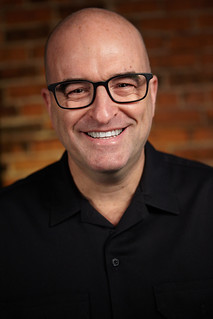
Contributors Pete Smith and Greg Bennick
Pete Smith
Numismatic researcher and author Pete Smith of Minnesota has written about early American coppers, Vermont coinage, numismatic literature, tokens and medals, the history of the U.S. Mint and much more. Author of American Numismatic Biographies, he contributes original articles to The E-Sylum often highlighting interesting figures in American numismatic history.
Greg Bennick
Greg Bennick (www.gregbennick.com) is a keynote speaker and long time coin collector with a focus on major mint error coins and US counterstamps. He is on the board of both CONECA and TAMS and enjoys having in-depth conversations with prominent numismatists from all areas of the hobby. Have ideas for other interviewees? Contact him anytime on the web or via instagram
@minterrors.

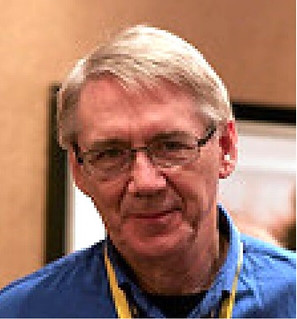
Website host John Nebel and webmaster Bruce Perdue
John Nebel
Numismatist, photographer, and ANS Board member and Fellow John Nebel of Boulder, CO helped the ANA and other clubs like NBS get online in the early days of the internet, hosting websites gratis through his Computer Systems Design Co. To this day he hosts some 50 ANA member club sites along with our
coinbooks.org site, making the club and our E-Sylum archive available to collectors and researchers worldwide.
Bruce Perdue
Encased coinage collector (encasedcoins.info) Bruce Perdue of Aurora, Illinois has been the volunteer NBS webmaster from its early days and works each week to add the latest
E-Sylum issue to our archive and send out the email announcement.

|
|
The E-Sylum is an electronic publication of the Numismatic Bibliomania Society Copyright © 1998 - 2026 | |