Visit our NBS Sponsors









About UsThe Numismatic Bibliomania Society is a non-profit association devoted to the study and enjoyment of numismatic literature. For more information please see our web site at coinbooks.org SubscriptionsThose wishing to become new E-Sylum subscribers can go to the following web page
Subscribe
MembershipThere is a membership application available on the web site Membership Application To join, print the application and return it with your check to the address printed on the application. Print/Digital membership is $40 to addresses in the U.S., and $60 elsewhere. A digital-only membership is available for $25. For those without web access, write to: Jeff Dickerson, Treasurer AsylumFor Asylum mailing address changes and other membership questions, contact Jeff at this email address: treasurer@coinbooks.org SubmissionsTo submit items for publication in The E-Sylum, write to the Editor at this address: whomren@gmail.com BUY THE BOOK BEFORE THE COIN |
- WAYNE'S WORDS: THE E-SYLUM OCTOBER 4, 2026
- WORKMAN'S BOOKS SALE 9
- NEW BOOK: RESTRIKES+NOVODELS+PATTERNS
- NEW BOOK: HADRIAN - COINAGE AND IMPERIAL POLICY
- NEW BOOK: NEWFOUNDLAND NUMISMATICS
- NEW BOOK: PAPER MONEY IN IMPERIAL CHINA
- NEWMAN PORTAL ADDS STEIGERWALT MONGRAPHS
- VIDEO: ELONGATED COINS
- ANS TO BEGIN TOLEDO HEADQUARTERS RENOVATIONS
- LECTURE: HOW THE CIVIL WAR CHANGED OUR MONEY
- JOHN ALBANESE FUNDS NUMISMATIC ORGANIZATIONS
- NOTES FROM E-SYLUM READERS: OCTOBER 4, 2026
- JOHN A. BOLEN'S NUT CARVINGS
- U.S. MINT ARTIST CHRIS POLENTZ
- KEVIN LIPTON OPENS BEVERLY HILLS GALLERY
- VOCABULARY TERM: STUDY COPY
- DAVID RANDOLF DENIS (1923-2026)
- NUMISMAGRAM MEDAL SELECTIONS: OCTOBER 4, 2026
- HERITAGE: U.S. ERROR COINAGE SHOWCASE
- HERITAGE: NEW DISCOVERY COINS IN GACC SALE
- STACK'S BOWERS: CAINE COLLECTION OF OBSOLETES
- GADOURY: AUCTION XXI ROMAN AUREI
- WAYNE'S NUMISMATIC DIARY: 2026 ANA, PART 5
- WAYNE'S NUMISMATIC DIARY: 2026 ANA, PART 6
- THE ODYSSEY ON ANCIENT COINS
- 1715 FLEET SOCIETY: ODDLY SHAPED MEXICAN COBS
- 1835 NORWAY HALF SPECIEDALER STAR TYPE
- HERITAGE: SPANISH CIVIL WAR CURRENCY
- ABOUT THIS ISSUE: OCTOBER 4, 2026
Content presented in The E-Sylum is not necessarily researched or independently fact-checked, and views expressed do not necessarily represent those of the Numismatic Bibliomania Society.
WAYNE'S WORDS: THE E-SYLUM OCTOBER 4, 2026
 New subscribers this week include:
Carmen D.V. and Tom Eden.
Welcome aboard! We now have 6,342 subscribers.
New subscribers this week include:
Carmen D.V. and Tom Eden.
Welcome aboard! We now have 6,342 subscribers.
Thank you for reading The E-Sylum. If you enjoy it, please send me the email addresses of friends you think may enjoy it as well and I'll send them a subscription. Contact me at whomren@gmail.com anytime regarding your subscription, or questions, comments or suggestions about our content.
We have a new sponsor this week - CAC Grading. Thank you for your support! When you're out at coin shows or shopping online and encounter one of our advertisers, please thank them for supporting our weekly effort - we wouldn't be able to deliver our publication at this scale and frequency without their assistance.
This week we open with a numismatic literature sale, four new books, updates from the Newman Numismatic Portal, notes from readers, and more.
Topics this week include U.S. Mint restrikes, novodels and patterns, coins of Hadrian, tokens of Newfoundland, paper money in China, Charles Steigerwalt, elongated coins, the future ANS Toledo headquarters, Civil War numismatics, fixed price and auction previews, more ANA diaries, and Spanish Civil War currency.
To learn more about gold cobs in the State of Florida Collection, Artistic Infusion Program artist Chris Polentz, the oldest ANA member, the Treaty of Travendal medal, error coins, Roman Aurei, Jack's dive bar, oddly shaped Mexican silver reales, and John Bolen's nut carvings, read on. Have a great week, everyone!
Wayne Homren
Editor, The E-Sylum


Image of the week
WORKMAN'S BOOKS SALE 9
Alan Workman has a numismatic literature sale closing November 1, 2026. Here's the announcement. -Editor

Workman's Books is pleased to present its ninth sale, featuring a substantial and carefully curated selection of literary material and related media focused on Spanish and Spanish American, Mexican, United States, Canadian, British, Ancient, and World numismatics, as well as banks and banking history, diving, undersea exploration and salvage, buried and sunken treasure, metal detecting, treasure hunting, underwater archaeology, privateers, buccaneers and piracy. The auction includes a number of rare and desirable works bearing author signatures or inscriptions, with notable names such as David Q Bowers, Capt. Michael Hatcher, Robert Marx, Roland Morris, Russell Rulau, Edward Rowe Snow and David Stick represented. This single-session sale will begin closing at 10:00 AM EST on November 1, 2026, and will offer 850 lots, including rare, vintage, and out-of-print books, post-auction sale catalogs, magazines and journals, postcards, and vintage media formats such as VHS tapes and DVDs.
This bid sale is being held through the online venue iCollector, and all registrations, approvals, and bids will be handled there. For this bid sale the lots will be closing on a timed interval with extensions of 1 minute for any bids placed within 1 minute of closing. If you already have an iCollector account, you still must "GET APPROVED" to bid for each sale by entering and confirming your information for this bid sale, like reviewing your shipping information and choosing your preferred way of payment. Remember, tie bids go to the earliest bidders, so don't wait for the lots to close to bid on anything for which you have a strict number in mind.
Now is the perfect time to register for the bid sale, as any registration issues can certainly be accommodated more easily in advance. Do not wait to register the last day. Registration and bidding online are always FREE (no extra fees or percentages for bidding online). Once you are registered and automatically approved, first be sure to bookmark the items that interest you.


Lots 67 and 82
Lot 67: Borrell Bentz, Pedro Jose. HISTORIA Y RESCATE DEL GALEON NUESTRA SENORA DE LA CONCEPCION. Museo de las Casas Reales: Comision de Rescate Arqueoloogico Submarino, Grupo de Investigaciones Submarinas, Santo Domingo. 1983. Oblong 8vo. (2), 122, (2) pages. original pictorial card covers. First Edition. Maps. Color photos. B&w illustrations, photos. Spanish text. Ex Dick Holt Library. minor shelf wear, rubbing, wear along the spine, Very Good. This book is a historical and archaeological text that details the 1641 tragic sinking and subsequent late 20th-century recovery of the Spanish treasure galleon "Nuestra Senora de la Concepcion" on the Silver Bank north of Hispaniola. Author Pedro J. Borrell B. chronicles both the primary maritime history of the vessel and the precise modern underwater excavations led by the Dominican Republic's salvage and research teams, capturing the historic preservation of its substantial recovered artifacts, coins, and silver splendor through unique archival text and underwater photography. Lot weight: 0 lbs 8oz. Subject(s): Underwater Archaeology, Shipwrecks.
Lot 82: Breen, Walter. WALTER BREEN'S COMPLETE ENCYCLOPEDIA OF U.S. AND COLONIAL COINS. FCI Press, Inc/Doubleday, New York. 1988. 4to. xiv, 754 pages. original black cloth, gilt, jacket. Tables. Glossary. Bibliography. b&w coin photos throughout. English text. Fine. Drawing on a lifetime of research, America's top coin historian presents the most comprehensive guide to U.S. coins ever published. It covers every conceivable aspect of American numismatics. The definitive numismatic reference book for the advanced collector, with over 4,000 illustrations. Lot weight: 5 lbs 0oz. Subject(s): United States Coinage.


Lots 99 and 118
Lot 99: Buxton, Henry. ASSIGNMENT DOWN EAST. Stephen Daye Press, Brattleboro. 1938. 12mo. 294, (2) pages. original red cloth, lettered in black. Third Edition. Illustrated endpages. B&w photos. B&w photo laid in. Pasted firmly to the final rear free endpaper is an exceptional, unrecorded piece of New England folklore history: an original envelope typed and signed by Altea E. Austin, daughter of the builder of the famous "Cuniculocus Castle" in North Hancock, Maine. English text. Ex Edward Rowe Snow Library; Ex Dick Holt Library. noticeable rubbing, slight fraying, and sun-fading, Good to Very Good. This book is a comprehensive collection of oral histories, biographies, and folklore that captures the spirit and daily lives of everyday people in Maine during the early 20th century. Compiled by journalist Henry Buxton from his popular newspaper columns, the book details the grit, humor, and unique traditions of coastal and rural Mainers, ranging from sea captains and fishermen to woodsmen and pioneer families. Enhanced by documentary photographs and artwork by Andrew Wyeth, it serves as a vivid historical portrait of Maine's cultural heritage.
Lot 118: Cayon, Adolfo & Clemente Cayon & Juan Cayon. LAS MONEDAS ESPANOLAS DEL TREMIS AL EURO DEL 411 A NUESTROS DIAS. VOLUMES I & II. Cayon-Jano S.L., Madrid. 2005. 8vo. 1148, (2); (16), 317, (3) pages. original pictorial boards. 13th edition. b&w coin photos throughout. Spanish text. edge of volume I spine has some cracking, else Fine. This book is an illustrated catalog and price guide to the coins of Spain and its colonies for the period 411 through 2005 covering the Visigoth period through the reign of Juan Carlos I. The book is organized by denomination then by date and then by mint. Each date/mint has a type number and prices in euros in VF grade. Each denomination type has an obverse and reverse coin photo where possible. Lot weight: 7 lbs 6oz. Subject(s): Spanish, Spanish American Coinage.


Lots 124 and 156
Lot 124: Christie, Manson & Woods International, Inc. THE RESEARCH COIN COLLECTION. Christie, Manson & Woods International, Inc., New York. 1988. 4to. 48, [4] pages. original gray textured card covers, comb binding. First Edition. 16 B&w coin plates. English text. Fine. This auction catalog describes the 237 silver cobs in the 'Atocha' research collection, including some of the best and rarest coins salvaged. Each coin is illustrated. Lot weight: 0 lbs 11oz. Subject(s): Spanish American Coinage, Sunken Treasure.
Lot 156: Craig, Alan K. SPANISH COLONIAL GOLD COINS IN THE FLORIDA COLLECTION. The University of Florida Press, Gainesville. 2000. 4to. xiv, [2], 94, [2] pages. original dark tan cloth over ochre boards, gilt, jacket. Inscribed by the author. Map. Tables. Appendices. Notes. Bibliography. 16 color coin plates. B&w photos and line illustrations. English text. Ex Charlie Adams Library. Fine. This is a catalog of the gold cobs in the State of Florida Collection that were recovered from the 1715 Spanish Plate Fleet wrecks and handed over to the state as part of their division from the salvors. A history of the salvage operations, the minting processes, the mints, and the coins are covered in this work. Lot weight: 1 lbs 2oz. Subject(s): Spanish American Coinage.


Lots 185 and 731
Lot 185: Driscoll, Charles B. DRISCOLL'S BOOK OF PIRATES. David McKay Company, Philadelphia. 1934. 8vo. 124, (4) pages. original red cloth, lettered in black, color illustrated front cover plate. First Edition. Comic illustrations by Montfort Amory. English text. Ex Dick Holt Library. eight of the comic cells have been colored post-printing, heavy bumping and fraying at the cloth corners, rubbing, shelf wear, and minor fraying along the spine and edges, Good. This book is a pioneering proto-graphic novel that chronicles the real-life historical adventures of notorious buccaneers, most notably Captain Blackbeard. Originally derived from a short-lived 1930s syndicated newspaper comic strip titled "Pieces of Eight", the narrative is uniquely presented in a hybrid comic-strip format. Every page features detailed illustrations by Montfort Amory and dialogue balloons paired with a historical text narrative running directly beneath each panel. Lot weight: 0 lbs 12oz. Subject(s): Pirates, Fiction.
Lot 731: Castells & Castells. NUESTRA SENORA DE LA LUZ. November 6, 1997. 4to. 1-204 Lots. original pictorial card covers. Public Auction Sale. Montevideo. Sale No. 84. 48 pages. color and b&w coin and antiquities photos. Spanish text. Fine. This post auction sale catalog documents 54 lots of gold cobs and portrait coins, 24 lots of silver cobs, 4 lots of pillar dollars, 92 lots of artifacts, and one cannon salvaged from the "Nuestra Senora de la Luz", which sank in 1752 near Montevideo, Uruguay. A very scarce sale. Lot weight: 0 lbs 8oz. Subject(s): Spanish American Coinage, Antiquities.


Lots 758 and 795
Lot 758: Parke-Bernet Galleries, Inc. TREASURE OF THE SPANISH MAIN. February 4, 1967. 8vo. 1-667 Lots. Original blue printed card covers. Public Auction Sale. New York. Frontispiece, color plate. 97, (3) Pages. 1 color antiquities plate. 45 b&w coin and antiquities plates. English text. Ex Louis B. Akers Library. sun-fading, original owner's red pencil/pen marks, Good to Very Good. This auction sale catalog includes numismatic material from Latin America from the wrecks of the 1715 Fleet. Included in the sale are 241 lots of gold and silver cobs, 5 lots of gold and silver ingots, 10 lots of ceramics, 8 lots of jewelry (including the Captain-General's Chain and Badge of Office from the 1715 Spanish Treasure Fleet), and 42 lots of artifacts that were recovered by the Real Eight Corporation from the 1715 Fleet off the east coast of Florida. This was one of the early 1715 Fleet auctions and includes photos of most of the items offered. Lot weight: 0 lbs 11oz. Subject(s): Spanish American Coinage, Antiquities.
Lot 795: Raymond, Wayte. THE COIN COLLECTOR'S JOURNAL. ISSUES 1 TO 160. 1934-1958. 1934-1958. The Coin Collectors Journal. New Series. April 1934, Vol. 1 No. 1, to 1958, Number 160. Volumes 1-21, complete as published in 160 issues [two different issues numbered 116 were published; number 140 was never issued]. New York: Edited by Wayte Raymond, 1934-1958. 3,894 pages, well illustrated. ex Kolbe unknown sale lot 1748. ex Money Tree Sale No. 22 lot 252. A complete set in the original printed paper or card covers. generally all Fine. An indispensable source of useful information covering the entire range of numismatics, from ancient coins to then-current United States and foreign issues, and its numerous monographs often provide useful information found nowhere else. Starting with Volume 19 (No. 142), the remaining issues each comprises a stand-alone monograph. A fine set. Lot weight: 18 lbs 4oz. Subject(s): Ancient, United States, World Coinage, Paper Money, Medals.
To read the complete catalog, see:
Sale 9
A Collection of Numismatic
and Treasure Books, Auction
Catalogs and Magazines
(https://workmansbooks.com/downloads/
WB%20Auction%20009%20catalog.pdf)
For more information, see:
https://workmansbooks.square.site/

NEW BOOK: RESTRIKES+NOVODELS+PATTERNS
Researcher Roger Burdette has produced another important work on American numismatic history based on widely scattered and rarely seen original source materials held by the National Archives and Records Administration. Congratulations! -Editor
 Restrikes+Novodels+Patterns is a research summary designed to convey to future
numismatists and historians the present state of knowledge as determined from original research
by the author. It is intended to open a path toward meaningful, objective analysis largely free of
baseless speculation, assumption and exaggeration commonly associated with this subject.
Restrikes+Novodels+Patterns is a research summary designed to convey to future
numismatists and historians the present state of knowledge as determined from original research
by the author. It is intended to open a path toward meaningful, objective analysis largely free of
baseless speculation, assumption and exaggeration commonly associated with this subject.
Herein, the reader will find no collection of moldy anecdotes; no auction lot descriptions concocted to extract exaggerated bids; no cynical whispered insinuations of "midnight minting" conspiracies. The origins of some of these "traditional anecdotes" will, however, become evident to readers. Rather, the author places documented facts within their historical context, and relates them to Philadelphia Mint operations of the same era. It is a study of the subject by motivation, action and results. This book is, then, a dissection of the restriking of American coins and pattern pieces; a revelation of American numismatic intent, purpose; carelessness, generosity, foolishness and preservation contributing to the construction of a more-or-less complete entity which others may explore, expand, and correct.
 In many respects Restrikes+Novodels+Patterns could not have been written before 2024.
The extent and availability of historical documents was insufficient to support collection and
analysis of this complex story in sufficient detail to make sense. Further complicating U.S. Mint
research is the scattered nature of materials within the National Archives and Records
Administration system. This is a product of inconsistency and apathy within the Treasury
Department and the Mint Bureau in historical record management and organization. As with
previous research projects, the author has studied existing literature, but placed it aside so that
newer information could be analyzed free of bias. Only after both existing and new scenarios were correlated was it possible to produce a clearer picture of events.
In many respects Restrikes+Novodels+Patterns could not have been written before 2024.
The extent and availability of historical documents was insufficient to support collection and
analysis of this complex story in sufficient detail to make sense. Further complicating U.S. Mint
research is the scattered nature of materials within the National Archives and Records
Administration system. This is a product of inconsistency and apathy within the Treasury
Department and the Mint Bureau in historical record management and organization. As with
previous research projects, the author has studied existing literature, but placed it aside so that
newer information could be analyzed free of bias. Only after both existing and new scenarios were correlated was it possible to produce a clearer picture of events.
The book was originally intended to be published only in digital format; however, when discussing the project with collectors at the August ANA Convention it became evident that a majority preferred a printed book and intended to use the volume as a reference.
Restrikes+Novodels+Patterns will be sent for printing the week of October 4 and copies are expected to be ready for delivery by end of the month.
The distributor is Wizard Coin Supply, Chantilly, Virginia. Price has not been determined as of this date.
Stay tuned for updates on availability and pricing. -Editor
NEW BOOK: HADRIAN - COINAGE AND IMPERIAL POLICY
In their October 2026 News from the ANS, the American Numismatic Society announced the publication of the two-volume 764 page hardback book Hadrian - Coinage and Imperial Policy by Martin Beckmann, which is now available for pre-order. Here's the book's description. -Editor
Hadrian
Coinage and Imperial Policy
By Martin Beckmann
 Historians have long sought to understand Hadrian's policies, his priorities, and his approach to his imperial role, but the evidence is elusive. The sparse literary sources, written well after his time, are often unreliable, and epigraphy and archaeology, which are based on fragmentary objects, tend to focus on local audiences. Hadrian's coinage, on the other hand, is of the highest authority: it is available in great bulk, it offers both written and visual evidence, and it was directed at an empire-wide audience. Unfortunately, it also tends to lack the imperial titles that often make imperial coinage easy to date.
Hadrian: Coinage and Imperial Policy addresses the difficulty from a new direction by systematically applying the methodology of die analysis, which previously had been used only in isolated cases. Focusing on coins produced in the name of Hadrian and his relatives at the central mint in Rome, the author uses die analysis to help recreate the sequence of the mint's coin production, which clarifies the interrelationship of the different coin types and allows us to clearly identify the complete iconographic repertoire of the coinage at specific points in time.
The main text details the implications of this analysis for the chronology of Hadrian's coinage, using charts to illustrate the dies and their links. It then traces the development of Hadrian's coinage in detail and across all metals, and summarizes the study's results in a catalogue of reverse types. References to the works of Strack and Abdy (RIC2 II.3) allow readers to look up the relevant coins in the Online Coins of the Roman Empire (OCRE) database hosted by the American Numismatic Society, which provides many more examples of each described and illustrated type. This book is a companion to the recent RIC2 II.3 on the coinage of Hadrian, as some chronological arrangements differ from Abdy.
For more information, or to order, see:
Hadrian: Coinage and Imperial Policy (U.S. orders)
(https://isdistribution.com/work/hadrian/)
Hadrian: Coinage and Imperial Policy (International orders)
(https://www.brepols.net/products/IS-9780897227575-1)

NEW BOOK: NEWFOUNDLAND NUMISMATICS
Chris Faulkner and three other Canadian researchers have produced a new book of essays on Newfoundland numismatics, drawing on upon new primary source materials and making original contributions to Newfoundland numismatics. Here's the book's Preface.
It's a SPINK imprint, but the press is Pen & Sword, which took over Spink Books. It's 286 pages and Chris notes it is also available from Sveto Kovacevic at Ancient Numismatic Enterprise, 2219 Queen St. E, Toronto, Canada M4E 1EB Email: ane@vcoins.com. Tel: 416 686-8019. -Editor
Newfoundland Numismatics
A Collection of Essays
by Christopher Faulkner, David Bergeron, Paul Berry, and Markus Molenda
Six essays on Newfoundland numismatics trace late eighteenth to late nineteenth-century coins, tokens, and paper scrip.
 The essays collected in this volume came together when it was determined that four of us were independently working on some of the mysteries of the numismatics of Newfoundland across a hundred year period between the late eighteenth and late nineteenth centuries. The research represented by the six essays collected here should be considered groundbreaking because it introduces some completely new monetary issues for Newfoundland and unpacks the mysteries surrounding others.
Heralded in 1905 as an important numismatic discovery related to Canada and later demonized as an utter fraud, Spanish American dollars countermarked GR 5 ORD have known a chequered past. Paul Berry's "The Ordnance Dollars of Newfoundland" identifies the parties responsible for their production, proposes where and when they were distributed, and reveals the dollars' surprising connection to Britain's oldest colony in Canada. It catalogues known examples in their many varieties and using numismatic and non-numismatic references, collection databases, and digital sales records traces their appearance over the last hundred plus years among some of the hobby's most prominent dealers and collectors.
The Peter McAuslane farthing-size token for St. John's which advertises "All Sorts of Shop & Store Goods" is said to have been issued in 1844, then suffered destruction by fire in 1846, after which McAuslane left Newfoundland for Ontario. This has been the accepted wisdom about McAuslane and his token for the past 150 years. Unfortunately, none of it is true. By drawing upon primary sources and private correspondence with descendants, Christopher Faulkner provides new biographical information about McAuslane, establishes the real date of the token's issue, and discusses its circulation. The article includes a census, provenance, and sales history of surviving examples of an extremely rare token.
Using contemporary references, newspaper articles, and court documents, Paul Berry sets Newfoundland's iconic Rutherford halfpenny tokens, Breton 952 and 953, against the changing fortunes of the Rutherford family businesses at St. John's and Harbour Grace from the early 1840s to the mid 1860s. The different issues are explained and illustrated, changes to current reference catalogues are proposed and, for the first time, using measurable physical characteristics, the tokens are placed in a plausible order of issue.
"Fresh Fish" by Christopher Faulkner establishes the heretofore unconfirmed dates of issue of the token traditionally listed for Prince Edward Island as Breton 917 and colloquially known as the "Fish halfpenny" or the "Success to the Fisheries" token. Contrary to received numismatic opinion, contemporary documentation confirms that the token was first issued for Prince Edward Island, and a second issue of the token was struck some years later for circulation in Newfoundland. As a result of this research, the author argues that henceforth Breton 917 should be considered a double-island token rather than a token for Prince Edward Island alone.
In "Oysters by the Barrel," Markus Molenda proposes a solution to the riddle of the HEAD QUARTERS SALOON / GADF token listed by D.T. Batty (1878) as 4093E. Early reports had placed the token in the Canadian Maritimes, but the exact location of the saloon, its owner, and the meaning of GADF have remained a mystery to this day. Molenda's discovery of contemporary advertisements and other relevant documents now allow for the attribution of the token to a short-lived oyster saloon in St. John's, Newfoundland, consistent with a reasonable interpretation of the GADF inscription. Moreover, due to the short period of operation of the saloon, the token can now be dated to 1860-61, making it a previously unrecognized Canadian pre-Confederation token. The article presents the above research, explores the known history of the saloon and its owner, and concludes with a catalogue of the known examples of the token.
In his article, David Bergeron examines the notes of the Betts Cove Mining Company issued for use in the eponymous copper-mining town located in Notre Dame Bay, Newfoundland. The few notes extant are not signed and no specifics are available about their printing, circulation, and redemption. Following an informed overview of the copper mining industry in Newfoundland and the introduction of Baron Franz von Ellershausen, owner of the Betts Cove Mining Company and likely issuer of the elusive notes, this richly illustrated article attempts to determine who printed the notes and unravel many of the anomalies in their design in order to establish a proper system of classification.
For more information, or to order, see:
Newfoundland Numismatics
(https://www.penandswordbooks.com/9781036159337/newfoundland-numismatics/)


NEW BOOK: PAPER MONEY IN IMPERIAL CHINA
A new book by Richard von Glahn titled "The Rise and Demise of Paper Money in Imperial China" has been published by Cambridge University Press. Here's an article from the Hoover Institution. Found via Helen Wang on the Chinese Money Matters blog. -Editor
This essay is based on the forthcoming book "The Rise and Demise of Paper Money in Imperial China, 1000–1500: Fiscal Innovation, Market Growth, and Monetary Transitions" by Richard von Glahn.
 Over the past two decades, the issue of the "Great Divergence" in economic performance between Europe, where the Industrial Revolution occurred, and China, where it did not, has been a leading subject of debate and research among economics historians. One undisputed finding is that China achieved remarkable economic growth, by premodern standards, by relying on a different set of political and economic institutions from those that emerged in medieval and early modern Europe. A key feature of the Chinese economy was its distinctive monetary system, including the early development of fiat currency in the form of paper bills.
The invention of paper money in China preceded the first appearance of a viable paper currency in Europe—banknotes issued by the Bank of England in the early eighteenth century—by eight hundred years. Aside from technological factors—paper money required paper and printing techniques, both first invented in China—its precocious development there can be attributed to the unique features of Chinese money. The origins of coinage in China, as in the Mediterranean world, date back to the seventh century bce. But unlike the silver and gold currencies of the Greeks (and subsequently those of the Roman Empire and the European world), Chinese money took the form of low-value bronze currencies whose nominal value often diverged from their intrinsic metallic content. From the outset, then, Chinese money was fiduciary money whose value was based on trust. In addition, Chinese monetary philosophy diverged from the Western tradition. Whereas Western monetary theory focused on money as a means of market exchange and its role in setting "just" prices, in China money was chiefly conceptualized as a means by which the ruler could control markets and provide for the welfare of his subjects. These characteristics of the Chinese monetary system and monetary thought paved the way for recognizing fiat currency as legitimate money.
During the Song dynasty (960–1276), China experienced dramatic growth of the market economy, to the extent that historians speak of this era as China's medieval economic revolution. Song mints reached the highest levels of output in Chinese imperial history, but the supply of bronze coins could not keep pace with market demand. In addition, the Song state transformed its fiscal base by relying primarily on money taxes derived from commerce and consumption rather than agricultural produce and labor services, further increasing the demand for money. Moreover, low-value base metal currencies were heavy and cumbersome to transport, making them ill suited for the purposes of long-distance trade.
Paper money originated in the private sector. At the end of the tenth century, financial firms in Sichuan in western China began to issue paper money known as jiaozi in return for deposits of coin, silk, and other assets. But many of these firms engaged in speculative investments and fell insolvent, unable to redeem the bills they issued. After efforts to regulate private paper bills failed, in 1023 the Song government took over the issue of jiaozi as state-issued paper currency. Under government auspices jiaozi soon became the dominant money in the Sichuan region, largely displacing coin. In the twelfth century, under intense pressure to raise revenues for defense expenditures, the Song government introduced paper money to other regions of the empire, with considerable success.
The success of the Song paper currencies can be attributed to government policies designed to, in the words of contemporary policymakers, "maintain equilibrium" between different forms of money. Although paper bills were inconvertible with metallic monies, if the market value of its paper currency faltered, the Song state intervened to buy up excess bills using its reserve of silver bullion, thus restoring public confidence in their worth. Silver thus functioned as an implicit reserve currency. In addition, the state mandated the use of paper currency in tax payments; most money taxes were collected half in coin and half in paper money. Moreover, the state tightly controlled the amount of paper bills it issued and withdrew old and worn bills by requiring the public to redeem them every three years for new bills.
In the thirteenth century, threats of invasion by the steppe nomad kingdoms to the north (including, from 1234, the Mongol confederation) compelled the Song to issue exorbitant quantities of paper currency to pay for rising military costs. Although paper currency suffered severe depreciation, it became even more deeply entrenched in the private economy. By the time of the Mongol conquest of Song in 1276, paper money had become the monetary standard of the Chinese economy. The Mongol rulers of China not only continued the Song legacy of paper currency but went so far as to ban the use of bronze coins and silver in trade, relying solely on paper money.
After displacing the Mongols, the Ming dynasty (1368–1644) likewise sought to institute its own paper currency. But fiscal mismanagement, notably the failure to collect taxes in paper money, caused severe depreciation, and by the early fifteenth century, Ming paper money was largely defunct. Subsequently the Chinese populace shifted to a bullion silver monetary standard in market trade and the Ming state too adopted silver as the basis of its fiscal accounts and taxation.
The rise and fall of paper currency in China between 1000 and 1500 attests to the unique features of the Chinese monetary system and monetary theory, the institutional innovations adopted by successive governments, and the crucial importance of fiscal discipline and sound managerial policies to "maintain equilibrium." It also draws attention to the divergent institutional paths of economic development we witness across the premodern world.
To read the complete article, see:
The Rise and Demise of Paper Money in Imperial China
(https://www.hoover.org/research/rise-and-demise-paper-money-imperial-china)
For more information, or to order, see:
The Rise and Demise of Paper Money in Imperial China
(https://www.cambridge.org/us/universitypress/subjects/history/east-asian-history/rise-and-demise-paper-money-imperial-china-fiscal-innovation-market-growth-and-monetary-transitions-c10001500)
The Rise and Demise of Paper Money in Imperial China
(https://www.cambridge.org/core/books/the-rise-and-demise-of-paper-money-in-imperial-china/C87055AD79B968129C6534E3679CF631)

NEWMAN PORTAL ADDS STEIGERWALT MONGRAPHS
The latest additions to the Newman Numismatic Portal are monographs about dealer Charles Steigerwalt. Project Coordinator Len Augsburger provided the following report. -Editor
 Stump for Steigerwalt
Recently added to Newman Portal are two monographs of the 19th century Lancaster, PA dealer Charles Steigerwalt, compiled by Carl Waltz. These two volumes gather primary sources related to Steigerwalt and are conveniently arranged in chronological order. Waltz has searched far and wide for biographical material and the content here ranges from Steigerwalt's ephemeral publications to newspaper clips to contemporary correspondence. Volume 1 covers the year 1858-1907, while Volume 2 covers 1907 to 2022. Waltz has exhibited frequently on this topic and now shares this material with the numismatic community via Newman Portal.
NNP search hint: Search for "Steigerwalt monograph" from the NNP home page.
Link to Monograph of Charles T. Steigerwalt Volume 1:
https://nnp.washu.edu/Documents/Detail/monograph-of-charles-t.-steigerwalt-volume-1-1858-to-1907/8077600
Link to Monograph of Charles T. Steigerwalt Volume 2:
https://nnp.washu.edu/Documents/Detail/monograph-of-charles-t.-steigerwalt-volume-2-1907-to-2022/8077601
Link to Newman Portal: https://nnp.washu.edu/

VIDEO: ELONGATED COINS
The David Lisot Video Library on the Newman Numismatic Portal can be found at:
https://nnp.wustl.edu/library/multimediadetail/522852
We highlight one of his videos each week in The E-Sylum. Here's one from 2016 with Richard Jozefiak speaking about elongated coins. -Editor

Richard Jozefiak speaks at the 2016 ANA World's Fair of Money in Anaheim, CA.
To watch the complete video, see:
Elongated Coins
(https://youtu.be/3nk1FUZR6TY)
Elongated Coins
(https://archive.org/details/ANA16019Elongated_1)
 >
>
ANS TO BEGIN TOLEDO HEADQUARTERS RENOVATIONS
The American Numismatic Society will hold a ceremony on October 5 to mark the start of renovations of their new Toledo headquarters. -Garrett

The American Numismatic Society (ANS) will hold a groundbreaking ceremony Oct. 5 to mark the start of renovations to the Professional Arts Building in Toledo, Ohio, which will become the Society's new museum and headquarters. The ANS plans to relocate from New York City to the renovated building in 2028.
Joining ANS Director Ute Wartenberg Kagan for the 12:00 PM groundbreaking will be Toledo Mayor Wade Kapszukiewicz, U.S. Rep. Marcy Kaptur, TMA Director Adam M. Levine, SSOE Group COO Vince DiPofi, and Roncelli Inc. COO Jereme Poxson.
The move to Toledo will allow the ANS to open a Money Museum with space for rotating exhibitions, expand K-12 and adult educational programming, grow its acclaimed research library, and build partnerships with local institutions.
Roncelli Inc. will serve as the contractor for the state-of-the-art renovation of the Art Deco building at 1838 Parkwood Avenue, known locally as the Professional Arts Building. ANS purchased it from the nearby Toledo Museum of Art in January 2026. The Museum and ANS are planning to co-host exhibitions and present joint programming. ANS also purchased a nearby storage facility being renovated under the direction of Spieker.
"I would like to express our gratitude to Roncelli and Spieker; to PBDW and SSOE, our architectural firms; to Toledo Museum of Art, the City of Toledo, and all our other partners in the area," said Wartenberg Kagan, "We look forward to sharing our progress in the coming months with our dedicated supporters and new friends."
Founded in 1858, the American Numismatic Society studies and promotes numismatics. With 1,300 members worldwide, ANS holds more than 800,000 coins, medals, monetary objects, and related items dating to 2000 BCE. Its library and archives hold about 100,000 books, documents, and artifacts. The Society also develops digital numismatic resources and is one of the largest publishers of scholarly numismatic research. Educational programs on coins and money are held on a regular basis.

LECTURE: HOW THE CIVIL WAR CHANGED OUR MONEY
Rick Lank and Rebecca Rush will be presenting a lecture at Shepherd University on October 14, 2026. Readers are invited to attend in-person or on Zoom. Here's the announcement. I'm looking forward to it - the Civil War Era was a time of rapid and long-lasting changes in our money, a favorite numismatic topic of mine. -Editor

How the Civil War Changed our Money
and How Money Changed the War
When: October 14, 2026, 1-2:30 p.m.
Host: SPARK Lecture Series, Shepherd University, Shepherdstown, WV.
(Attend in-person or via ZOOM, $15)
The program will examine how the Ten Tumultuous Years™ (1857- 1866) – the Civil War Era – changed our money and our banking more than any other period. Foreign money (which was previously legal tender and circulated freely) was outlawed by the Coinage Act of 1857; the first paper money (nicknamed "Greenbacks," and not backed by silver or gold) was authorized by the Legal Tender Act of 1862. The National Bank Act of 1863 created a unified banking system. The phrase "In God We Trust" first appeared on coinage in 1864. And rampant counterfeiting gave rise to the Secret Service in 1865. Huge gold and silver strikes out West -- a boon to the North – caused authorization of three new U.S. Branch Mints (Colorado, Nevada and Oregon). The Civil War also gave birth to "emergency money", fractional currency, the IRS and to women working in both the U.S. and Confederate Treasury Departments.
Presenters:
Rick Lank and Rebecca Rush (Hagerstown, MD, representing the new
"10 Tumultuous Years" educational non-profit project are both life-long
learners, genealogy hobbyists, researchers, presenters, and storytellers
connecting the numismatics hobby with historical events, shipwrecks,
and the humanities. They have presented programs for American
Numismatic Association (ANA), the Pennsylvania Association of
Numismatists (PAN), San Francisco Historical Society (‘Uncle Billy
Was a Banker"), the Washington County Free Library McCauley Lecture
Series (The Furious Flight of the Confederate Treasure Train), and Civil
War Round Tables.
To register for the program, see:
Spark Lectures - Fall 2026
(https://shepherdlifelonglearning.totalcamps.com/shop/product/663293)
For more information, contact Rick Lank at: pivot@10tumultuousyears.org
For more information on the SPARK Lecture Series, see:
Spark Lecture Series
(https://www.shepherd.edu/spark-lecture-series/)

JOHN ALBANESE FUNDS NUMISMATIC ORGANIZATIONS
John Albanese will provide funding to non-profit numismatic organizations via a new initiative called the CACG Charity Label. Here is the press release. -Garrett
 Nonprofit numismatic organizations, from small local clubs to national groups, now have an opportunity to receive monetary donations through a new CAC Grading (www.CACGrading.com) fundraising initiative called the CACG Charity Label.
CACG Founder and CEO John Albanese is signing 20,000 specially created encapsulation insert labels that were offered in a private auction among CACG's authorized modern bulk submission clients. The auction brought a six-figure winning bid, and all the proceeds will be donated in various amounts to non-profit numismatic organizations and charities.
"I invite clubs and numismatic groups to write to me personally explaining why they should receive a donation, and how the money will be used. Please, don't use artificial intelligence (AI) software to write your message. Tell me, in your own words, why and how. I'll personally read every request that is received by October 31, 2026," explained Albanese.
The requests for donations should be sent by email to jalbanese@cacgrading.com.
In addition to recipient nonprofit numismatic organizations, CAC Grading will be donating some of the proceeds to food pantries to help the needy.
"This is a ‘one-and-done' signature signing. This is the last time my autograph will be on CACG insert labels," emphasized Albanese.
Additional information about the CACG Charity Label project will be announced in the coming weeks.
In 2007, Albanese and two dozen veteran numismatists founded Certified Acceptance Corporation (CAC) to provide buyers and sellers with verification that their coins certified by third-party grading services met stringent standards. Coins that met their standards received a coveted green CAC sticker on the encapsulation holders.
In 2022, Albanese organized over 150 leading members of the numismatic community to expand their mission for accuracy and consistency by creating a new third-party grading and encapsulation service, CAC Grading, which was launched in 2023.
For additional information about CAC Grading, visit www.CACgrading.com, email help@CACgrading.com, or call 888-537-3798.
NOTES FROM E-SYLUM READERS: OCTOBER 4, 2026
Another 1958-D Wheat Cent Find
Ken Berger writes:
"I think I can match Jim Haas' story about his finding a 1958-D wheat cent.
 "Every spring & summer gophers invade my yard & dig up the dirt creating mounds of dirt & rocks. This summer, as I was leveling the mounds & removing the rocks, I found a 1958-D wheat cent. The real interesting part, however, is that 1958 was the year my house was built &, since I live in San Diego, the D mint mark is appropriate.. I guess it was a gift from the gopher. Unfortunately, the one I found was not shiny like Jim's."
The wildlife around our house leaves us presents all the time, but sadly, no coins. -Editor
To read the earlier E-Sylum article, see:
NOTES FROM E-SYLUM READERS: SEPTEMBER 27, 2026 : Shiny Penny Find
(https://www.coinbooks.org/v29/esylum_v29n39a10.html)
Audio Books
A reader writes:
"As I age, my eyesight dims and although I would love to read many of the newer books, I cannot. Would it not be an idea while announcing new books to note whether they might also be available in audio format (and / or encourage authors, publishers etc. to present books in audio as well as print)? Might the E-Sylum go audio as well at some point?"
Audiobooks are growing in popularity, and I'll keep that in mind when communicating with authors and publishers going forward. But many numismatic books are self-published and we're lucky to get them in traditional electronic or hardcopy format. Books from mainstream publishers are more likely to have an audio format available. Both of the books announced last week for example, have an audiobook format available.
As for The E-Sylum, we have gotten requests for audio before, but it's not something we're able to provide. However, there may be AI-powered third-party tools that could generate an audio version of The E-Sylum. Are any of our readers aware of tools that might provide this capability? Thanks. -Editor
Numismatics in the Movies: Unabomber
 Brad Karoleff writes:
"In "Unabomber", Teddy receives a $5 silver certificate from his mother in the mail."
Thanks. "Unabomber" is a new Netflix film about Ted Kaczynski, the domestic terrorist known as the "Unabomber." -Editor
For more information, see:
The Unabomber
(https://www.fbi.gov/history/cases-and-criminals/unabomber)
Unabomber
(https://www.imdb.com/title/tt6933238/?ref_=fn_t_1)
Starlust Columbian Expo Sale Reminder
The Steve Starlust collection of rare 1893 Columbiana will be open for bidding at Heritage Oct. 9th through Nov. 9th. The sale includes 209 top items from his Columbian Expo collection that he has amassed for the past fifteen years, including medals, badges, tickets, elongated coins, and rare souvenirs. His book "Referencing Columbiana" was named the "Best Reference Book of 2025 (Tokens & Medals)" by the Numismatic Literary Guild. Below is a photo from the 2025 NLG awards luncheon. -Editor
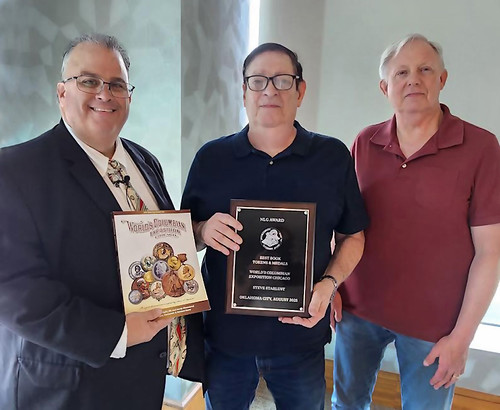
Jerry Jordan, Steve Starlust, Wayne Homren
For more information, or to bid, see:
https://www.HA.com/63365/

JOHN A. BOLEN'S NUT CARVINGS
 Website visitor Cindy Adler writes:
"I have a carving that I would like to find out about and I am hoping you might be able to help me or put me in the right direction. The overall size is 4 inches."


J. A. Bolen is a famed token engraver. Could it be the same artist? I grabbed my copy of Neil Musante's 2002 book "The Medallic Work of John Adams Bolen, Die Sinker &c.", and lo and behold, similar carvings are illustrated on pp 251-252. I reached out to Neil for more information. -Editor
Neil writes:
"In his advanced age Bolen would make these carvings for his family and maybe kids in the neighborhood I guess. They were made from a hard nut called a tagua nut and not for any reason other than as a way to pass the time. I don't believe he ever tried to sell any of them. They were simply given away to friends. I've seen a number of them over the years. They've sold at auction in the $400 to $600 range. This one is interesting in that it is in two parts and both are signed and dated."
Here's another group I saw online. I passed this information on to Cindy. She'd like to sell the carving. If anyone is interested in purchasing or auctioning it, I'll put you in touch with her. -Editor


To read the complete article, see:
John Adams Bolen
American, 1826–1906
Three Figural Carved Nuts., 1905
(https://www.artnet.com/artists/john-adams-bolen/three-figural-carved-nuts-ZA3d10DH5jybKV2mEorzXA2)

U.S. MINT ARTIST CHRIS POLENTZ
I enjoy finding articles in local publications about the artists and sculptors who design our coins. The San Diego Tribune published one about Artistic Infusion Program artist Chris Polentz. Here's an excerpt - see the complete article online. -Editor

U.S. Mint Artist Chris Polentz
A San Marcos-based artist and teacher who designs coins for the U.S. Mint took top honors at the recent American Numismatic Association's World's Fair of Money, which drew hundreds of submissions from around the world.
Chris Polentz was named a Coin of the Year champion for his American Liberty High Relief Gold Coin, which was about a year and a half in the making and was minted last year.


The coin, which depicts a sunflower on the front and swirling eagle on back, initially was picked as one of the top 100 coins out of 600 submissions from dozens of mints, banks and collectors around the world. His coin was top 10 in the Best of Gold category and then was a runner-up for top gold coin. A panel of more than 100 judges voted for Polentz's design as the winner in the gold coin category.
Polentz has worked on 20 coin design projects with the U.S. Mint over the past 2 1/2 years since he joined a team of more than 30 artists from across the country to create designs for U.S. coins as part of the Mint's Artististic Infusion Program. So far, three of his designs have been minted. Two designs were on the front and reverse sides of the 2025 Liberty coin and one on the front of the 2026 Declaration of Independence Coin.

Designs for the 2025 American Liberty High Relief Silver Medal and Gold Coin
Coin designs are reviewed by two committees, the U.S. Commission of Fine Arts and Citizens Coinage Advisory Committee. Their independent recommendations are given to the Secretary of the Treasury, who makes the final decision on which design will be minted.
"When I was selected to work on these historic projects, it felt like a once in a lifetime opportunity and I wondered if I was out of my league" Polentz said.
To read the complete article, see:
Local artist's coin he designed for U.S. Mint wins top honors internationally
(https://www.sandiegouniontribune.com/2026/10/01/local-artists-coin-he-designed-for-u-s-mint-wins-top-honors-internationally/)

KEVIN LIPTON OPENS BEVERLY HILLS GALLERY
Kevin Lipton announced that he is opening a new rare coins, fine art & antiques gallery in Beverly Hills. Here is the press release. -Garrett
Lipton Coins, Fine Art & Antiques (www.LCFAA.com), a new gallery specializing in expert assistance to rare coin and paper money collectors and investors in Southern California and nationwide, has opened at 9478 W. Olympic Blvd. in Beverly Hills, California.
Current displays of rare numismatic items for sale at the new store include a selection of pre-1800 U.S. gold coins, a large array of rare, early $100 denomination notes, and a unique uncut sheet of currency from the Indian Territory.


"We are an important local, regional, and national resource for buying, selling, and obtaining professional evaluations of rare coins, gold, silver, platinum, and palladium precious metal items as well as original works of fine art from masters to moderns. We also have an amazing array of decorative arts, historic antiques, and original Tiffany Studios lamps," said Bryan Abbott, gallery director.
The gallery's extensive current numismatic displays include:
- A first year and first type 1796 Capped Bust right Quarter Eagle, no stars on the obverse, graded NGC MS60.
- 1796/5 overdate Capped Bust right Half Eagle, NGC MS64, an exceptional survivor of one of the great rarities in early United States gold coinage.
- 1879 Flowing Hair $4 Stella, NGC PF65 cameo, a landmark rarity and one of the most famous and enigmatic patterns in all of United States numismatics.
- 1804 Capped Bust right Eagle with crosslet 4, PCGS MS62, one of the premier rarities of early United States gold coins.
Rare banknotes in the gallery display include:
- A unique, uncut sheet of three $10 and one $20 Indian Territory 1882 Brown Back National Bank Notes from Holdenville in the area of the Native American Creek Nation settlement in Oklahoma. Only two uncut sheets are known from Indian Territory, and this highly important discovery is the only one from Holdenville.
- A collection of early $50 and $100 denomination bank notes, including 1869 Allison/Spinner Legal Tender $100, Friedberg #168, graded PMG 25; 1891 Rosecrans/Nebeker Treasury Note $50, Friedberg #376. PMG 45 from the Dean Oaks Collection; Blackstone National Bank of Boston Original Charter #514 $100 National Bank Note, PCGS 55; and First National Bank of Puerto Rico at San Juan Series 1902 Red Seal $10, Friedberg #613, PMG 20.
- A Series 1902 Plain Back $10, Friedberg #633, PMG 63 from the Crescent Hills Bank that is the only known surviving example of a banknote issued in West Hollywood, California.
"Another numismatic highlight on display at the gallery is a rare three-and-a-half-foot-tall gilded bronze statue of the early 20th-century New York City landmark ‘Victory' statue created by acclaimed sculptor and coin designer Augustus Saint-Gaudens," said Kevin Lipton of Kevin Lipton Rare Coins.
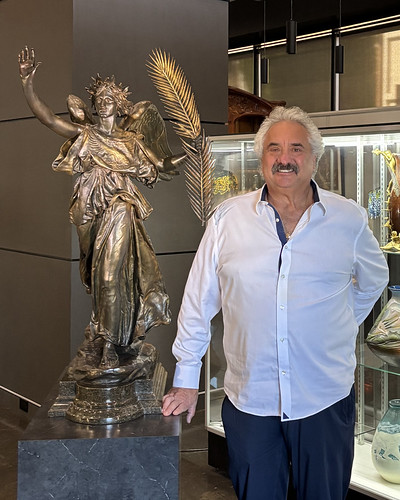
Insured for $3 million, it is one of only three known privately held bronze reductions and was last publicly displayed at the American Numismatic Association 2023 World's Fair of Money®.
"The statue is reminiscent of the great artist's renowned 1907-1933 U.S. Double Eagle gold coin design. The same female model, Harriette Eugenia Anderson, posed for Saint-Gaudens for both the statue and the similar Liberty striding coin design," explained Abbott.
After Saint-Gaudens died in 1907, his widow, Augusta Fisher Homer Saint-Gaudens, authorized the creation of eight reductions of the ten-foot-tall statue that is part of the General William Tecumseh Sherman Monument in Grand Army Plaza at the Southeast corner of New York's Central Park. In addition to the three privately held reductions, five are in museum or institution collections, including The Metropolitan Museum of Art in New York, the Carnegie Museum of Art in Pittsburgh, and Arlington National Cemetery in Virginia.
The Lipton Coins, Fine Art & Antiques gallery, 9478 W. Olympic Blvd., Beverly Hills, is open Monday through Friday from 8 am to 5 pm. Evening and weekend appointments are available by calling 310-939-9399. For additional information, visit online at www.LCFAA.com.
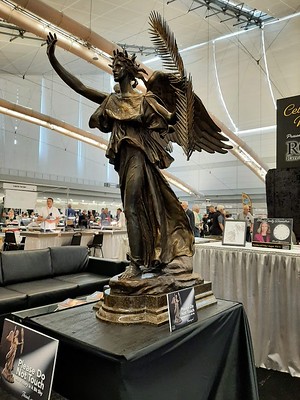
Gotta love the St. Gaudens Victory statue. Here's a photo I took while it was on display at the 2023 Pittsburgh ANA. -Editor
To read the earlier E-Sylum articles, see:
SAINT-GAUDENS STATUE AT 2023 PITTSBURGH ANA
(https://www.coinbooks.org/v26/
esylum_v26n21a14.html)
MINT ARTIST SAINT-GAUDENS VICTORY PRINTS
(https://www.coinbooks.org/v26/
esylum_v26n31a24.html)
WAYNE'S NUMISMATIC DIARY: 2023 ANA, PART TWO
(https://www.coinbooks.org/v26/
esylum_v26n33a18.html)
VOCABULARY TERM: STUDY COPY
Here's another entry from Dick Johnson's Encyclopedia of Coin and Medal Terminology. -Editor
Study Copy. Usually a plaster cast of a numismatic or medallic item intended for artistic or scholarly study. Museums sometimes provide this service – to supplement or in place of a photograph – for someone at a distance to study the three-dimensionality of a specimen in their collection. Such study copies are impermanent (the plaster may easily break), however, large cabinets of these have been formed. Their use beyond the original need for close-up study and comparison with similar specimens is extremely limited. Study copies are a form of private copies and are most often of one side only, thus two separate casts are required of a two-sided object. They have little resale value, but do make excellent objects for framing. See copies and replicas, plaster casting.
By extension, a study copy is also the term applied to a fully struck medal, of any composition, in the possession of a medallic artist for the purpose of studying the design or relief. A medallist can adapt a design element to a new project knowing it has been satisfactorily used previously (but this does reduce somewhat the creativity of the piece). However a skilled medallist can easily perceive how to model such a relief portion of a struck or cast piece from inspection alone of an existing medal. It often saves time to observe such designs and relief techniques. Medallist Joseph Di Lorenzo, noted for his rapid creation of medallic models, had a large collection of these study copies of other medalists' work in his studio for easy reference.
To read the complete entry on the Newman Numismatic Portal, see:
Study Copy
(https://nnp.washu.edu/Documents/Detail/study-copy/4362361)
DAVID RANDOLF DENIS (1923-2026)
E-Sylum Feature Writer and American Numismatic Biographies author Pete Smith submitted this article on another 100-year-old numismatist. Thanks! -Editor
David Randolf Denis (1923-2026)
This week I got an email from Bob Leonard notifying me of the death of David R. Denis. He was the oldest ANA member and the one with the longest membership.
David R. Denis was born in Chicago on January 17, 1923, the son of Alphonse Derbigny Denis (1891-1982) and Elvira Vognild (1890-1979). Alphonse was an insurance salesman.
As a boy of thirteen, David began publication of "The Gossip," a weekly newspaper in Winnetka, Illinois. The paper had two regular advertisers who were charged three cents a line and boasted a circulation of three hundred subscribers.
David studied mechanical engineering at the University of Illinois at Champaign and graduated in 1944. He enlisted with the Navy as an apprentice seaman and finished his education at Cornell University. He served as an ensign on the motor gunboat USS PMG 14 in the Philippines.
Denis was employed by R.R. Donnelley in Chicago, which was at one time the world's largest commercial printer.
He was married to Margaret Calhoun (1922-2008) and had four children. He studied his family history and could document his ancestry back seventeen generations to 1372.
 Denis joined the American Numismatic Association as member 13304 on February 1, 1947, and
was a life member. He joined while living at 1044 Tower Road in Winnetka, Illinois. He had an
address change in February 1948 to 411 Jackson Street in Waukegan. Illinois. At the 2022
WFOM. he was honored with seventy-five years of ANA membership presented by ANA
president Ralph Ross.
Denis joined the American Numismatic Association as member 13304 on February 1, 1947, and
was a life member. He joined while living at 1044 Tower Road in Winnetka, Illinois. He had an
address change in February 1948 to 411 Jackson Street in Waukegan. Illinois. At the 2022
WFOM. he was honored with seventy-five years of ANA membership presented by ANA
president Ralph Ross.
Denis joined the Chicago Coin Club on July 2, 1947, but resigned in April 1948 after moving to Waukegan.
He made custom coin holders that were advertised in Numismatic Scrapbook Magazine. His specialty was United States type coins. He also collected coins struck for the Philippines in proof.
Denis helped in the formation of the Lake County Coin Club and the Will County Coin Club. He served as president of the Lake County Coin Club in Waukegan around 1955-56.
He travelled the world after retirement and was a volunteer with the Executive Service Corps in El Salvador and Kenya. Back at home he enjoyed playing bridge and tried making wine.
David Denis died on June 12, 2026, at the age of 103 while living in Lincolnshire, Illinois.
Ken Bressett moves up to be the ANA member with the longest membership, dating back to July 1, 1947.
Edmund DeLaurentis may be the oldest ANA member. He was born on December 10, 1925, and joined the ANA June 1, 1950. Mail sent by the ANA has been returned. They cannot confirm if he is living or dead.
Internet sites show him living in Havertown, Pennsylvania. Can anyone living nearby confirm his status?

NUMISMAGRAM MEDAL SELECTIONS: OCTOBER 4, 2026
Numismagram's Jeremy Bostwick sent along these four medals from his most recent upload of new material to his site. For all of the new items, please visit https://www.numismagram.com/inventory. -Garrett

103634 | SWEDEN, DENMARK & GERMANY. Treaty of Travendal silver Medal. Issued 1700 for the peace treaty that returned Holstein-Gottorp to its duke (37mm, 18.18 g, 12h). Likely by Johann Reinhard Engelhardt in Breslau.
ORIENTES DISSIPAT UMBRAS (while rising, it breaks through the clouds), radiant sun [the sun as a symbol for Karl XII of Sweden] above clouds from which rain descends upon a view of the globe focused upon Northern Europe // SEPTEM IVNGIS TRINVNE TRIONES (Thou, oh Triune Lord, unitest the Northern Constellations), in center, radiant ???? (tetragrammaton); to right, the constellation of Ursa Major, represented by a large bear, moving upward; to left, the constellation of Ursa Minor, represented by a small bear, moving downward; both figures show the various stars of the two constellations in their proper places; in two lines in exergue, PAX SEPTENT / CI?I?CC (the Northern Peace of 1700). Edge: + PAX, PAX, TIBI ET PAX ADIVTORIBVS TVIS. I. PARAL. 13 v. 18 (peace, peace be unto you, and peace unto your helpers, –adapted from I Chronicles 12:18).
Pax in Nummis 396; Hildebrand I, p. 498, 36; Delzanno 52; Erbstein 4393; van Loon IV, p. 306; "Stars and Constellations on Coins" in AJN (Oct. 1892), p. 31, 4. Choice Very Fine. More darkly toned nearer the edges, with some scattered marks noted throughout; typical die flaw near 9h on the obverse. A rare and engaging type featuring two constellations.
Signed in Travdendal in the duchy of Holstein-Gottorp in 1700, the peace established there returned the realm to its rightful duke, Friedrich IV, who was an ally of Karl XII, the king of Sweden. Holstein-Gottorp lies at the base and lower tier of the Jutland Peninsula, and was besieged by the Danes in early 1700. Given alliances through marriage, Sweden was an ally of Holstein-Gottorp, and was able to negotiate a peace and a return of the duchy to its duke. Sweden's attention then turned to Russia, with whom she would battle for naval supremacy, ultimately unsuccessfully, over the next two decades. Interestingly, while Sweden and Holstein-Gottorp were allied at this time, it is that very duchy that would produce a future Russian emperor in the form of Pyotr (Peter) III (born Karl Peter Ulrich von Schleswig-Holstein-Gottorp, a grandson to the aforementioned a Friedrich IV).
To read the complete item description, see:
103634 | SWEDEN, DENMARK & GERMANY. Treaty of Travendal silver Medal.
(https://www.numismagram.com/product-page/103634)

103713 | UNITED STATES & NETHERLANDS. Colonial America and Holland silver Medal. Issued 1764. The Treaty of Hubertusburg and the end of the Seven Years' War (French and Indian War in America) and the beginning of 1764 (44mm, 12h). By Martin Holtzhey.
MAGNAS INTER OPES INOPS (poor though among great riches, —adapted from Horace), a seminude and astonished Mercury facing, head left, as Peace approaches among the clouds from behind and grabs at his petasos (winged hat); in background to left, the boisterous winds of war blow away profits, with bills of exchange, or even currency itself, being scattered about; unloaded merchandise and bales of goods to right // NON CESSIT MALIS SED CONTRA AUDENTIOR IBIT (he did not yield to misfortunes, but will go more boldly against them), togate male figure standing facing slightly left, holding radiant caduceus and leaning upon altar to right; in background, marine view with rising sun and numerous ships under sail, one of which flies the banner of the city of Amsterdam, while another that of the city of Hamburg; in two lines in exergue, INITIO ANNI / MDCCLXIV.
Pax in Nummis 611; van Loon supp. pl. XXXIV, 370; Fieweger 828; Betts –; Strothotte 1764-1; Julius 2487. NGC MS-62. Highly lustrous and deeply toned, with intense areas of cobalt across both sides. An intriguing satirical issue that serves as a great companion to Oexlein's medal from the previous year (Betts 446 & 447). Despite this type not being listed in Betts, it celebrates the treaty that ended the conflict which, in the American Colonies, was known as the French & Indian War. Here, this medal alludes to the great losses suffered by the commerce of Amsterdam and Hamburg—negative effects of the war—and to the fact that the foresight, humanity, and prudence of the magistrates of both cities saved them from even greater disaster.
Sometimes referred to as 'World War Zero,' given its scale overall number of belligerent powers, the Seven Years' War began primarily with Austria's desire to recover Silesia from the Kingdom of Prussia. Since Great Britain had been aiming to increase her colonial possessions in the New World at the expense of France, the strife in the American theater began to merge with that in Europe, resulting in a legitimate global conflict, with every major European power taking the side of either Great Britain/Prussia or France/Austria. In addition to North America and Europe, skirmishes also played out in Central America, the western coast of Africa, India, and the Philippines. Ultimately, a peace was achieved through the Treaty of Paris, formally ending all conflicts save for the Silesian question; the Treaty of Hubertusburg, signed five days later, ended the issue between Prussia and Austria, formally ending the war.
To read the complete item description, see:
103713 | UNITED STATES & NETHERLANDS. Colonial America and Holland silver Medal.
(https://www.numismagram.com/product-page/103713)

103706 | GERMANY. Richard Wagner & Franz Liszt bronze Medal. Issued 1928 on the occasion of the Marian Days at the Wartburg (65mm, 93.82 g, 12h). By Karl Goetz at the München mint.
1811–1886 • 1813–1883, busts of Liszt and Wagner facing one another; in two lines in exergue, RICHARD WAGNER / FRANZ LISZT // WARTBVRG MAIENTAGE, minstrel, in medieval attire and resting hands upon harp, and St. Elisabeth standing in front of Wartburg Castle at a distance; 1928 to left, coat-of-arms to right. Edge: BAYER HAUPMÜNZAMT.
Kienast 404; Niggl 1119a. Gem Mint State. Olive-brown surfaces, with a pleasing matte nature. A great type that crosses two popular areas: Goetz medals and musica in nummis.
The minstrel with a harp refers to the opera "Tannhäuser" by Richard Wagner, which takes place at Wartburg Castle, while St. Elisabeth, with her coat-of-arms, refers to the sacred oratorio "Die Legende von der heilige Elisabeth" by Franz Liszt, which is connected to the castle.
To read the complete item description, see:
103706 | GERMANY. Richard Wagner & Franz Liszt bronze Medal.
(https://www.numismagram.com/product-page/103706)

103578 | ITALY, FINLAND & SWEDEN. Leonardo da Vinci three-piece bronze Medal. Issued 1974 for the 455th anniversary of the death of the High Renaissance polymath (59mm, 338.7 g, 12h). By Kauko Räsänen for Sporrong in Norrtälje.
Top piece, obverse: LEONARDO DA VINCI, fourfold face of an older da Vinci, borrowed from a self-portrait, with movement from left to right showing an increasingly open mouth and angrily widening and narrowing of the eyes // Top piece, reverse: The position of man in the cosmos: incuse square, astronaut standing facing, with face partially hidden and with arms outstretched in the style of da Vinci's Vitruvian Man; to left, small sphere containing smaller figure with arms similarly outstretched. /// Middle piece, obverse: Raised square, with da Vinci gazing to right, showing increasingly smaller reflections as one moves inward—a symbol of his enduring legacy // Middle piece, reverse: Raised square, with da Vinci's architectural designs and inventions: glider spiral (helicopter), parachute, repeating cannon (machine gun), armored car, waterwheel, submarine, diving suit, etc., with his birth year (1452) and death year (1519) in field to left and right, respectively. /// Bottom piece, obverse: Horse galloping left, with nude male rider looking right—a paraphrase of the equestrian monument planned and sketched by da Vinci for Duke Francesco Sforza // Bottom piece, reverse: Incuse square featuring facing female head modeled after the Mona Lisa, with her skull superimposed to and facing left—a symbol of the transience of life. Edge: 0736•5000 / SPORRONG.
Hackl & Klose 63. As Made. Deep brown surfaces, with some lighter hues in the recesses. An extraordinary work of modern medallic art in triplicate. The very definition of a Renaissance man, Leonardo da Vinci excelled in seemingly all aspects, with this complex, three-part medal by Räsänen capturing many of those important areas.
To read the complete item description, see:
103578 | ITALY, FINLAND & SWEDEN. Leonardo da Vinci three-piece bronze Medal.
(https://www.numismagram.com/product-page/103578)
THE BOOK BAZARRE
HERITAGE: U.S. ERROR COINAGE SHOWCASE
Heritage Auctions will be hosting their U.S. Error Coinage Showcase Auction on October 5. Select items are discussed below. -Garrett


1918 1C Lincoln Cent -- Double Struck, 2nd Strike 40% Off Center -- VG10 PCGS.(Registry values: N1)
To read the complete item description, see:
1918 1C Lincoln Cent -- Double Struck, 2nd Strike 40% Off Center
-- VG10 PCGS.
(https://coins.ha.com/itm/errors/1918-1c-lincoln-cent-double-struck-2nd-strike-40-off-center-vg10-pcgs/a/60573-52009.s?ctrack=200071&type=bodylink-1b-coinus-picks-60573-Error-tem093026)
1964-D 1C Lincoln Cent -- Struck on a Silver Dime Planchet -- MS63 PCGS.(Registry values: P1)
To read the complete item description, see:
1964-D 1C Lincoln Cent -- Struck on a Silver Dime Planchet --
MS63 PCGS.
(https://coins.ha.com/itm/errors/1964-d-1c-lincoln-cent-struck-on-a-silver-dime-planchet-ms63-pcgs/a/60573-52042.s?ctrack=200071&type=featured-1-coinus-news-tem092926)


1998 1C Lincoln Cent -- Broadstruck, Close Overlap Double Struck -- MS65 Red PCGS.(Registry values: N1)
To read the complete item description, see:
1998 1C Lincoln Cent -- Broadstruck, Close Overlap Double Struck
-- MS65 Red PCGS.
(https://coins.ha.com/itm/errors/1998-1c-lincoln-cent-broadstruck-close-overlap-double-struck-ms65-red-pcgs/a/60573-52090.s?ctrack=200071&type=bodylink-2b-coinus-picks-60573-Error-tem093026)


(1943)-P 5C Jefferson Nickel -- Struck on a Steel Cent Planchet -- MS64 NGC. 2.7 grams.(Registry values: N1)
To read the complete item description, see:
(1943)-P 5C Jefferson Nickel -- Struck on a Steel Cent Planchet
-- MS64 NGC.
(https://coins.ha.com/itm/errors/-1943-p-5c-jefferson-nickel-struck-on-a-steel-cent-planchet-ms64-ngc-27-grams/a/60573-52156.s?ctrack=200071&type=featured-2-coinus-news-tem092926)


1888 10C Seated Dime -- Struck 10% Off Center on a Type One Planchet -- AU55 PCGS. Mintage 5,496,487.(Registry values: N208)
To read the complete item description, see:
1888 10C Seated Dime -- Struck 10% Off Center on a Type One
Planchet -- AU55 PCGS.
(https://coins.ha.com/itm/errors/1888-10c-seated-dime-struck-10-off-center-on-a-type-one-planchet-au55-pcgs-mintage-5-496-487/a/60573-52193.s?ctrack=200071&type=featured-3-coinus-news-tem092926)
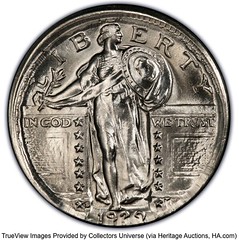

1929-S 25C Standing Liberty Quarter -- Uncentered Broadstrike -- MS62 PCGS. Mintage 1,764,000.(Registry values: N491)
To read the complete item description, see:
1929-S 25C Standing Liberty Quarter -- Uncentered Broadstrike --
MS62 PCGS.
(https://coins.ha.com/itm/errors/1929-s-25c-standing-liberty-quarter-uncentered-broadstrike-ms62-pcgs-mintage-1-764-000/a/60573-52216.s?ctrack=200071&type=featured-4-coinus-news-tem092926)

Undated 50C Kennedy Half Dollar -- Struck on a Five Cent Planchet -- MS65 PCGS.
To read the complete item description, see:
Undated 50C Kennedy Half Dollar -- Struck on a Five Cent
Planchet -- MS65 PCGS.
(https://coins.ha.com/itm/errors/undated-50c-kennedy-half-dollar-struck-on-a-five-cent-planchet-ms65-pcgs/a/60573-52278.s?ctrack=200071&type=featured-6-coinus-news-tem092926)

HERITAGE: NEW DISCOVERY COINS IN GACC SALE
Heritage Auctions will be hosting the GACC Signature Sale on October 8-9. Here are two important newly discovered coins -Garrett


1867-S Half Eagle, MS63 PCGS.
1867-S Half Eagle, MS63 PCGS. This recently discovered and certified 1867-S half eagle is the new finest known example of the date by a margin of two full grade points. It is also the finer of just two pieces reported in Mint State. Overall, fewer than 100 1867-S half eagles are believed to exist across all grades.
The coin was discovered in the most romantic fashion. During the evaluation of an old estate in Buda, Texas, a green milk crate was found in the corner of a bedroom closet, which contained an old cigar box and two old shoe boxes — the latter full of Lincoln Wheat cent rolls. The cigar box, however, held the prize: an 1867-S half eagle in Mint State, along with some other coins of the same period. According to the heirs of the estate, these coins came from family members in Columbus, Ohio, and they are believed to have originated from the family's great-grandfather, who was a Union soldier during the Civil War. The cigar box, and the coins it contained, are said to have belonged to him following his discharge from the Union Army in 1865. The small collection of coins was passed down through two generations of the family before arriving with the current estate. There are many stories of old-time family collections being discovered hidden away for many years, but rarely do such stories involve the discovery of a true numismatic rarity. In this case, the discovery upsets current understanding of the Condition Census of a scarce issue.
More information about the 1867-S Half Eagle, MS63 PCGS available in this PCGS article.


1796 Small Eagle Quarter, B-2, R.3, NGC Details. VG.
1796 Small Eagle Quarter, B-2, R.3, NGC Details. VG. Tompkins Die State 2/1. This coin was an exciting recent "dig find" from New Hampshire, and a video of the find filmed on a GoPro-style camera in the moments of the discovery is viewable as part of our online listing for the lot.
Finding old coins buried in the ground is always exciting, but rarely does such a find produce a rare issue like a 1796 Small Eagle quarter. An interesting countermark was punched onto Liberty's neck truncation prior to this coin's burial, appearing to be the initials "OC" from a prepared punch. The origin of this countermark is unknown to us, and it is unlisted in any of our references. Most likely, this is the mark of a tradesman or perhaps a silversmith, jeweler, or simply the initials of an unknown individual. During the late 18th and early 19th centuries, countermarking circulating coins was common practice for advertisement. This piece having such a countermark simply adds to the intrigue of its discovery more than 200 years after it was dropped in the grass and forgotten.
See these and other great rarities in our October 8-9 GACC Signature® auction. Live lot viewing will occur at the Donald E. Stephens Convention Center for the GACC Show, September 30 - October 3. We'll see you there!
STACK'S BOWERS: CAINE COLLECTION OF OBSOLETES
Stack's Bowers will be selling The Caine Collection of Obsolete Bank Notes on October 15. Select items are discussed below. -Garrett

Cahawba, Alabama. State of Alabama. Comptroller's Warrant. 1821 $20. PCGS Currency Very Fine 35 Apparent. Cross-Cut Cancelled; Missing Upper Right Corner Tip; Small Edge Tear at Top. No. 3753. Plate A. From the earliest days of Alabama Statehood, this rather unassuming piece was authorized by the State Legislature via the Act of December 15, 1820 and was used to facilitate state payments and the payment of state taxes and other uses. This individual piece was made payable to one Samuel Dale who was among one of the state's earliest settlers and informally known as the "Daniel Boone of Alabama." Dale had previously served under the command of General (later President) Andrew Jackson during sporadic conflicts with the Creek from 1813 to 1814 and later served as a member of the Alabama General Assembly from 1817 to 1829 making this piece contemporary to his service in that position. A rather subtle cancellation is nonetheless evident and noted upon the encapsulation, a trait that hints at the circumstances that led to the unlikely preservation of this piece of history from what was once an untamed frontier along the surveyed boundaries of a young and expanding nation. PCGS Currency comments "Cross-Cut Cancelled; Missing UR Corner Tip; Small Edge Tear at Top."
Estimate: $1,000 - $1,500.
Provenance: From the Caine Collection.
To read the complete item description, see:
Cahawba, Alabama. State of Alabama. Comptroller's Warrant. 1821 $20. PCGS Currency Very Fine 35 Apparent. Cross-Cut Cancelled; Missing Upper Right Corner Tip; Small Edge Tear at Top.
(https://auctions.stacksbowers.com/lots/view/3-1WQ1GS/cahawba-alabama-state-of-alabama-comptrollers-warrant-1821-20-pcgs-currency-very-fine-35-apparent-cross-cut-cancelled-missing-u)

A Great Antebellum Rarity from Alabama Eufaula, Alabama. Eastern Bank of Alabama. 1859 $50. PCGS Currency Very Fine 25. Offered here is a distinct rarity from East Alabama dating to the late 1850s. Issued by the Eufaula-based Eastern Bank of Alabama, bidders may observe a vignette of what appears to be a stately plantation at center, but this composition is actually the Union Female College out of Eufaula which opened in 1854 and again reopened roughly a year after the Civil War ended in 1866 before ultimately closing for the final time in 1903. This composition is notably encircled by the bank title seen in the top margin and "FIFTY DOLLARS" underprinted beneath the primary vignette which arches inwards. The subsidiary vignette entitled Union seen at left opposite an unidentified female allegorical figure at right offers what appears to be a noted political statement as "UNION" is completely obliviated from the pillar and this apparent statement can be seen on other survivors of this denomination on the Eastern Bank. In all, this is not only a rare note, but also a great opportunity for the specialist of numismatic material from Alabama.
Estimate: $1,500 - $2,500.
Provenance: From the Caine Collection. Whitman Plate Note.
To read the complete item description, see:
A Great Antebellum Rarity from Alabama
(https://auctions.stacksbowers.com/lots/view/3-1WQ1IJ/eufaula-alabama-eastern-bank-of-alabama-1859-50-pcgs-currency-very-fine-25)

Bethel, Connecticut. Hatters Bank. 18xx $1. PCGS Currency Very Choice New 64 PPQ. ABNCo. Proof. (CT-020-G010a). Plate C. Imprint of Baldwin, Adams & Co. New York. Hat-making scene at center with bank title and associated guarantee text staggered below above signature panels and manufacturer's imprint. Ovoid counters emblazoned "ONE" at left opposite a milkmaid vignette that was later adapted and reused for the T-39 and T-40 issued under the authority of the Confederate States of America. A total of (4) rounded POCs may be seen above the signature panels and manufacturer's imprint. This institution ultimately became the First National Bank of Bethel (Charter# 1141) in 1865. PCGS Currency comments "Hole Punch Cancelled."
Estimate: $1,000 - $1,500.
Provenance: From the Caine Collection.
To read the complete item description, see:
Bethel, Connecticut. Hatters Bank. 18xx $1. PCGS Currency Very Choice New 64 PPQ. ABNCo. Proof.
(https://auctions.stacksbowers.com/lots/view/3-1WQ1PI/bethel-connecticut-hatters-bank-18xx-1-pcgs-currency-very-choice-new-64-ppq-abnco-proof)
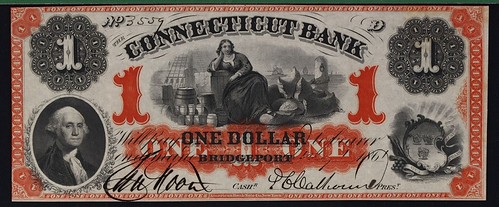
Bridgeport, Connecticut. Connecticut Bank. 1861 $1. PCGS Currency Choice New 63 PPQ. No. 3559. Plate D. A noted rarity from Connecticut dating to the early 1860s. This handsome $1 Obsolete issued by the Connecticut Bank of Bridgeport offers a veritable explosion of color complemented by bold penned signatures that collectively betray this note as an issued specimen that avoided the ruthless redemption typical of New England-based banks. This institution ultimately became the Connecticut National Bank of Bridgeport (Charter# 927) in 1865.
Estimate: $2,000 - $3,000.
Provenance: From the Caine Collection. Whitman Plate Note.
To read the complete item description, see:
Bridgeport, Connecticut. Connecticut Bank. 1861 $1. PCGS Currency Choice New 63 PPQ.
(https://auctions.stacksbowers.com/lots/view/3-1WQ1QZ/bridgeport-connecticut-connecticut-bank-1861-1-pcgs-currency-choice-new-63-ppq)

Hartford, Connecticut. Hartford Bank. 18xx $5. PCGS Currency Gem Uncirculated 65 EPQ. Proof. (CT-165-G216aP). Plate C. Imprint of Danforth, Wright & Co. New York & Philadelphia. Light red tint throughout with stately retreat at center with street in the foreground. Below bank title and associated guarantee text. Subsidiary vignette of a Native mother and child at left opposite an unidentified male portrait at right. Rounded counters emblazoned "5" just above each staggered below the top margin. A total of (6) rounded POCs may be seen above the signature panels and manufacturer's imprint at left. This institution ultimately became the Hartford National Bank (Charter# 1338) in 1865.
Estimate: $800 - $1,200.
Provenance: From the Caine Collection.
To read the complete item description, see:
Hartford, Connecticut. Hartford Bank. 18xx $5. PCGS Currency Gem Uncirculated 65 EPQ. Proof.
(https://auctions.stacksbowers.com/lots/view/3-1WQ1WA/hartford-connecticut-hartford-bank-18xx-5-pcgs-currency-gem-uncirculated-65-epq-proof)

Monroe, Michigan Territory. Bank of Monroe. 1836 $1. PMG Fine 12. Oliver Cowdery Signature. No. 6556. Plate B. Offered here is a well-circulated Obsolete issued by the Bank of Monroe during Michigan's Territorial period. Yet this note is more than just another well-circulated Obsolete from Michigan. Looking right, the astute bidder may observe the penned signature of Oliver Cowdery who was an important personality in the early days of the LDS Movement during the 1830s before his disagreements with Joseph Smith prompted his excommunication in 1838. Now Cowdery's work in Michigan offers a fine counterpoint to the activities of the Kirtland Safety Society in neighboring Ohio for which he had previously negotiated a contract with Underwood, Bald, Spencer & Hufty in Philadelphia to provide for printing plates and sheets of notes for the Kirtland Safety Society Bank. The Bank of Monroe ultimately proved short-lived however as the prevailing economic pressures of the period claimed the Bank of Monroe in 1838 hardly a year after the LDS movement took control of the bank under Cowdery's supervision making this lot an important piece of LDS history from long before the Saints ultimately relocated to Utah after a years-long continental trek.
Estimate: $1,250 - $1,750.
Provenance: From the Caine Collection.
To read the complete item description, see:
Monroe, Michigan Territory. Bank of Monroe. 1836 $1. PMG Fine 12. Oliver Cowdery Signature.
(https://auctions.stacksbowers.com/lots/view/3-1WQ38L/monroe-michigan-territory-bank-of-monroe-1836-1-pmg-fine-12-oliver-cowdery-signature)

Minneapolis, Minnesota. Minneapolis Bank. 1864 $2. PCGS Currency Very Choice New 64 Apparent. Hole Punch Cancelled; Minor Stains; Mounted on Cardstock. Proof. (MN-80-UNL). Plate A. Imprint of the American Bank Note Company. Portrait of a well-dressed young girl at center lounging with jewelry and other luxurious items all while enclosed by the bank title and associated guarantee text along with a pair of numerical "2" counters. Subsidiary vignette of a multi-point buck at left opposite a vignette of a defiant eagle that was favored among a variety of Federal Proofs during the 1860s. A pair of counters emblazoned "2" may be found below the top margin. This institution ultimately became the First National Bank of Minneapolis (Charter# 710) in 1865. PCGS Currency comments "Hole Punch Cancelled; Minor Stains; Mounted on Cardstock."
Estimate: $1,000 - $2,000.
Provenance: From the Caine Collection. Ex. Eric P. Newman Collection.
To read the complete item description, see:
Minneapolis, Minnesota. Minneapolis Bank. 1864 $2. PCGS Currency Very Choice New 64 Apparent. Hole Punch Cancelled; Minor Stains; Mounted on Cardstock. Proof.
(https://auctions.stacksbowers.com/lots/view/3-1WQ3EG/minneapolis-minnesota-minneapolis-bank-1864-2-pcgs-currency-very-choice-new-64-apparent-hole-punch-cancelled-minor-stains-mounte)

Vicksburg, Mississippi. Bank of Vicksburg. 18xx $10. PMG Gem Uncirculated 66 EPQ. Proof. (MS-210-G10P). Plate C. Imprint of Underwood, Bald, Spencer & Hufty. Allegorical duo at center with rectangular counters emblazoned "X" evident at left and right. Below bank title and associated guarantee text. Identical end panels at left and right emblazoned "TEN" executed in intricate script.
Estimate: $700 - $1,000.
Provenance: From the Caine Collection.
To read the complete item description, see:
Vicksburg, Mississippi. Bank of Vicksburg. 18xx $10. PMG Gem Uncirculated 66 EPQ. Proof.
(https://auctions.stacksbowers.com/lots/view/3-1WQ3OQ/vicksburg-mississippi-bank-of-vicksburg-18xx-10-pmg-gem-uncirculated-66-epq-proof)

St. Joseph, Missouri. Western Bank of Missouri. 18xx $10. PCGS Currency Choice About New 58 Apparent. Hole Punch Cancelled; Hinge Remnants on Back. Proof. (MO-77-G44a). Plate C. Imprint of the American Bank Note Company - Philadelphia. Transportation vignette at center with horses in the foreground along with an evident locomotive and steamboat evident in the background. Below bank title and associated guarantee text with an underprinted "X" protector evident. Portrait of a young girl at left opposite a subsidiary vignette of a female farmhand seen at right. A total of (4) rounded POCs may be seen above the signature panels and manufacturer's imprint. PCGS Currency comments "Hole Punch Cancelled; Hinge Remnants on Back."
Estimate: $2,000 - $3,000.
Provenance: From the Caine Collection.
To read the complete item description, see:
St. Joseph, Missouri. Western Bank of Missouri. 18xx $10. PCGS Currency Choice About New 58 Apparent. Hole Punch Cancelled; Hinge Remnants on Back. Proof.
(https://auctions.stacksbowers.com/lots/view/3-1WQ3ST/st-joseph-missouri-western-bank-of-missouri-18xx-10-pcgs-currency-choice-about-new-58-apparent-hole-punch-cancelled-hinge-remnan)

Pittsburgh, Pennsylvania. Mechanics Bank of Pittsburgh. 18xx $50. PMG Choice Uncirculated 63. Proof. (PA-540-UNL-50aP). Plate A. Imprint of Draper, Welsh & Co. Philadelphia. Trio of workmen just right of center with a rounded counter emblazoned "50" immediately at left. Below bank title and associated guarantee text with an underprinted protector that exclaims "FIFTY" evident. Subsidiary vignette of Columbia at left opposite a vignette entitled Boy Holding Rabbits at right. This institution ultimately became the Mechanics National Bank of Pittsburgh (Charter# 700) in 1865.
Estimate: $500 - $700.
Provenance: From the Caine Collection.
To read the complete item description, see:
Pittsburgh, Pennsylvania. Mechanics Bank of Pittsburgh. 18xx $50. PMG Choice Uncirculated 63. Proof.
(https://auctions.stacksbowers.com/lots/view/3-1WQ42Y/pittsburgh-pennsylvania-mechanics-bank-of-pittsburgh-18xx-50-pmg-choice-uncirculated-63-proof)

GADOURY: AUCTION XXI ROMAN AUREI
Gadoury will be hosting their Auction XXI Roman Aurei Selections on October 17. Select items are discussed below. Lot descriptions have been machine-translated to English; see the complete original descriptions online. -Garrett

Titus 79-81 Aureus, 75, Rome, AU 7.35 g. Obverse: T CAESAR IMP VESPASIAN. His laureate head to right. Reverse: PONTIF TR P COS IIII. Victory standing left on an altar between two snakes, holding a palm and a wreath. Ref: Cal. 750, Cohen 163, BMC 173. Ex Vinchon, 09/12/1997, lot 41. Ex Triton, 01/12/1998, lot 855. Grading: NGC Choice XF 5/5, 4/5. Condition: Superb, broad flan and an attractive coin.
To read the complete item description, see:
Titus 79-81 Aureus, 75, Rome
(https://www.biddr.com/gadoury/auction?a=7428&l=9106869)

Domitian 81-96 Aureus, 76-77, Rome, AU 7.32 g. Obverse: CAESAR AVG F DOMITIANVS, laureate head to right. Reverse: COS IIII, large cornucopia accompanied by a pair of bunches of grapes and ears of wheat. Ref: Cal. 817, RIC II.1 918 (Vespasian), Biaggi 395. Ex NAC 10/05/2021, lot 1263. Grading: NGC Choice XF, 5/5, 2/5, Fine Style. Condition: scratches. Superb.
To read the complete item description, see:
Domitian 81-96 Aureus, 76-77
(https://www.biddr.com/gadoury/auction?a=7428&l=9106870)

Antoninus Pius 138-161 Aureus, Rome, 140-4, AU 7.28 g. Obverse: ANTONINVS - AVG PIVS P P Laureate, draped bust to right. Reverse: TR - POT - COS III The Emperor as Romulus advancing in military dress, holding a spear and a trophy over his shoulder. Ref: Cal 1650, C. 909, RIC 90. Grading: NGC AU 5/5 - 4/5 Fine Style - edge marks. Condition: Superb. Rare.
To read the complete item description, see:
Antoninus Pius 138-161 Aureus, Rome, 140-4
(https://www.biddr.com/gadoury/auction?a=7428&l=9106872)

Commodus, Augustus 177-192 Aureus, Rome, spring, 179, AU 7.25 g. Obverse: L AVREL COM-MODVS AVG, laureate, draped and cuirassed bust of Commodus to right. Reverse: TR P IIII-IMP III COS II P P, Mars walking right, holding a transverse spear in his right hand and carrying a trophy over his left shoulder. Ref: Cal. 2339, RIC III (Marcus Aurelius) 659. Ex Calico "The Roman Aurei", 01/01/2003, lot 2339. Ex NAC, 03/04/1995, lot 859. Grading: NGC MS 5/5 - 5/5. Condition: FDC (Fleur de Coin). Magnificent specimen. Superb portrait on a brilliant flan.
To read the complete item description, see:
Commodus, Augustus 177-192 Aureus, Rome, spring, 179
(https://www.biddr.com/gadoury/auction?a=7428&l=9106873)
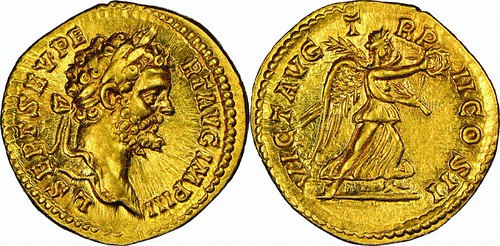
Septimius Severus 193-211 Aureus, 194, Rome, AU 7.27 g. Obverse: L SEPT SEV PE-RT AVG IMP III, laureate head of Septimius Severus to right. Reverse: VICT AVG-T-R P-II COS II, Victory advancing right, holding a raised wreath in her right hand and a palm resting on her shoulder in her left hand. Ref: Cal. 2550, RIC IV.I 38. Ex Künker, no. 318 of 11 March 2019, lot 1376. Ex Dr. Klaus Berthold Collection; Grün, Auction 31 (2000), Lot 191. Grading: NGC AU 5/5, 5/5. Condition: Magnificent specimen on a broad flan. Superb.
To read the complete item description, see:
Septimius Severus 193-211 Aureus, 194, Rome
(https://www.biddr.com/gadoury/auction?a=7428&l=9106874)
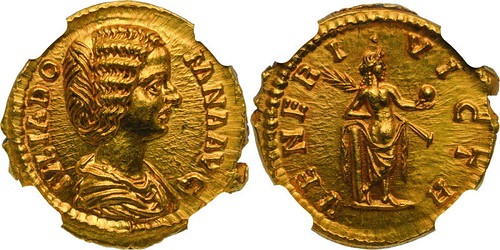
Julia Domna, wife of Septimius Severus, Aureus 193–196, AU 7.37 g. Obverse: IVLIA DO – MNA AVG. Draped bust to right. Reverse: VENERI VICTR. Venus standing right, leaning her left elbow on a column, holding an apple in her right hand and a palm in her left. Ref: Cal. 2641, C 193, BMC Septimius Severus 47, RIC Septimius Severus 536. Ex Berk, Buy or Bid Sale, 23/03/1995, lot 231. Grading: NGC MS 5/5 - 4/5 brushed. Condition: Virtually as struck, almost FDC.
To read the complete item description, see:
Julia Domna, wife of Septimius Severus, Aureus 193–196
(https://www.biddr.com/gadoury/auction?a=7428&l=9106875)
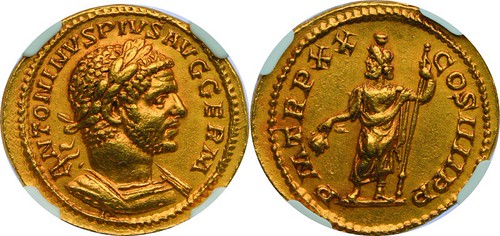
Caracalla 198–217 Aureus, Rome, struck in 217, AU 6.43 g. Obverse: ANTONINVS PIVS AVG GERM, laureate and cuirassed bust to right. Reverse: P M TR P XX COS IIII P P, Serapis, wearing the polos, draped, standing facing, head left, holding a lowered wreath in his right hand and a vertical scepter in his left. Ref: Cal. 2761, RIC IV 289b. Ex Calico "The Roman Aurei", 01/01/2003, lot 2771. Ex M&M Sale 17, 2-12-1957, lot 521. Ex Raymond Serrure, 30/03/1914, lot 459. Grading: NGC Choice XF 5/5 - 3/5 Fine Style, brushed. Condition: almost Superb.
To read the complete item description, see:
Caracalla 198–217 Aureus, Rome, struck in 217
(https://www.biddr.com/gadoury/auction?a=7428&l=9106876)

Gordian III 238-244 Aureus, 240, Rome, AU 4.88 g. Obverse: Laureate, draped and cuirassed bust to right. Reverse: Aequitas, draped, standing facing, head left, holding a balance in her right hand and a cornucopia in her left. Ref: Cal. 3185, RIC 72a. C.24. Grading: NGC Choice AU 5/5, 3/5 light marks. Condition: Superb.
To read the complete item description, see:
Gordian III 238-244 Aureus, 240, Rome
(https://www.biddr.com/gadoury/auction?a=7428&l=9106877)

Maximian Herculius 286-310 Aureus, Cyzicus, 286-287, AU 5.48 g. Obverse: IMP C MAXIMIANVS AVG, laureate and draped bust of Maximian to right. Reverse: VIRTVTI HERCVLIS, Hercules standing right, leaning on a club resting on a rock; lion skin over his right arm; S C in exergue. Ref: Cal. 4759 (R3), C. 663, RIC 605b. Ex NGSA 4, 11/12/2006, lot 250. Grading: NGC MS 5/5, 3/5 light marks. Condition: Practically Fleur de Coin.
To read the complete item description, see:
Maximian Herculius 286-310 Aureus, Cyzicus, 286-287
(https://www.biddr.com/gadoury/auction?a=7428&l=9106882)
WAYNE'S NUMISMATIC DIARY: 2026 ANA, PART 5
This segment discusses my time after the Pittsburgh ANA on Saturday, August 29. The morning began with the wonderful annual breakfast meeting of the Rittenhouse Society. It's always a pleasure to gather with numismatic scholars to catch up on their recent work and personal lives, and learn about upcoming projects.
 I went back to my hotel to check out, but I wasn't leaving Pittsburgh. I was staying until Sunday for the Celebration of Life for my old friend Pat McBride. My hotel wouldn't extend my stay a day without extracting a $400-$600 ransom (the price was different every time I asked). So I made a reservation elsewhere.
Having Saturday afternoon available gave me an opportunity to revisit my old stomping grounds. After driving through all the new housing development in the city's Strip District, I stopped for lunch at Taipei, a favorite Chinese restaurant in Fox Chapel. I had a nice meal and snapped this photo on the way out.
From there I drove through the neighborhood where I grew up, then took a scenic tour across the city's residential interior, passing through multiple neighborhoods en route to my new hotel. The city looked great, with new development and renovated properties throughout. My destination was Fifth Avenue in the Shadyside neighborhood, close to Carnegie Mellon University and my alma matter the University of Pittsburgh. My new room (priced under $200) was at a bed and breakfast called Mansions on Fifth. Not too shabby.


Artwork

Yes, this place has its own Chapel

... and a Bar. Worship at the alter of your choosing

More stained glass
A Walk Around the Neighborhood
My hotel was a renovated home on Pittsburgh's Millionaire's Row. I always loved the architecture when walking or biking through the neighborhood. Here are some photos I took before dinner. Wow!

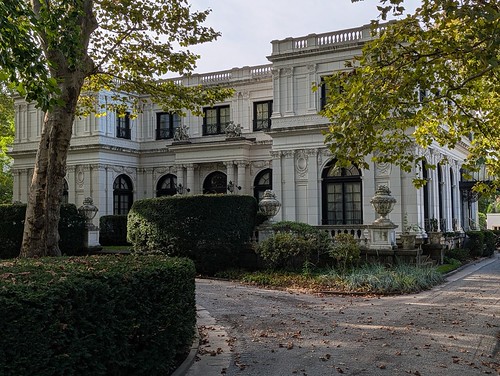

I could share dozens more. I had a delightful stay and the next time you travel to Pittsburgh, consider some lodging off the beaten path.
In the next diary segment I do some more exploring on Sunday before the event honoring Pat McBride (aka Ben Franklin).
To read the earlier E-Sylum articles, see:
WAYNE'S NUMISMATIC DIARY: 2026 ANA, PART 1
(https://www.coinbooks.org/v29/esylum_v29n35a16.html)
WAYNE'S NUMISMATIC DIARY: 2026 ANA, PART 2
(https://www.coinbooks.org/v29/esylum_v29n37a20.html)
WAYNE'S NUMISMATIC DIARY: 2026 ANA, PART 3
(https://www.coinbooks.org/v29/esylum_v29n37a21.html)
WAYNE'S NUMISMATIC DIARY: 2026 ANA, PART 4
(https://www.coinbooks.org/v29/esylum_v29n38a19.html)
WAYNE'S NUMISMATIC DIARY: 2026 ANA, PART 6
This final segment discuses my time after the Pittsburgh ANA on Sunday, August 30. See other articles this week and next on the convention exhibits.
South Side Stroll
After walking a few blocks to a bagel shop for breakfast, I went back to my room to work a bit on The E-Sylum and pack up my things again. I drove across the river and took a long stroll along Carson Street in Pittsburgh's South Side Flats neighborhood.

South Side Market House
I kept going until I reached 12th street, also known as Bedford Square. I always enjoyed this little corner of the city, where vintage buildings surround the old South Side Market House (today it's a community center). The street had recently been transformed into a movie set for a biography of Milton Hershey, founder of the Hershey candy company/

Transformed for filming Milton Hershey biopic


Other landmarks on the street are Jack's dive bar and the Club Cafe. I remember standing in the square one night back in the 1980s when another movie was being filmed on the very spot - "Gung Ho" starring Michael Keaton and directed by Ron Howard. Howard was hoisted up on a cherrypicker directing a scene. Filmmaking is slow, but it was enlightening to watch. The Pittsburgh crowd and I were mortified when an old drunk stumbled out of one of the bars, looked up and said, "Heeey, Opie...!"
12th Street - Jack's Bar and the Club Cafe
Sunday morning is a quiet time for the neighborhood, but Friday and Saturday nights are still jumping - a little too much sometimes, when crowds of young people can get out of hand.

The Priory - Remembering Patrick McBride
After grabbing a light lunch I headed over to the North Side for the Celebration of Life for Pat McBride. His wife Dawn said she'd prefer just calling it "Paddy's Party". And a great party it was, complete with an Irish band and a bagpiper. It was held at another great venue, Pittsburgh's Grand Hall at the Priory, which I learned is owned by the same group that operates the Mansions on Fifth. Here you can see the Pittsburgh skyline in the background.
The Priory is a bed and breakfast in a converted former Benedictine monastery, and the Grand Hall is the adjoining former St. Mary's German Catholic Church.


This neat old safe is built into a wall.
Barnes Safe & Lock Co. Safe


Bagpipes awaiting their piper
When I arrived I sat down for a chat with Dennis Boggs. He was out of uniform, away from his role of Abraham Lincoln. It was hard to picture him as anyone but Honest Abe. It was Dennis who'd encouraged Pat to take on the Ben Franklin role, and they were constant companions at coin shows around the country.

Dennis Boggs as Abe Lincoln, with David Fanning and Pat McBride as Ben Franklin
This summer Dennis had a health scare at the Summer FUN show. He told me that after he'd blacked out, he felt a hand on his shoulder and heard Pat's voice saying, "Go back - it's not your time." When he awoke some time later, more than one medical attendant told him, "Welcome back." We're glad you're back too, Dennis. Your Pint with Paddy will have to wait.
There was a great turnout of family and friends from all over, including a good numismatic contingent. I spoke with locals Ed Krivoniak, Richard and Eva Crosby, Stu Strickland, Tom Uram, Don Carlucci and others.
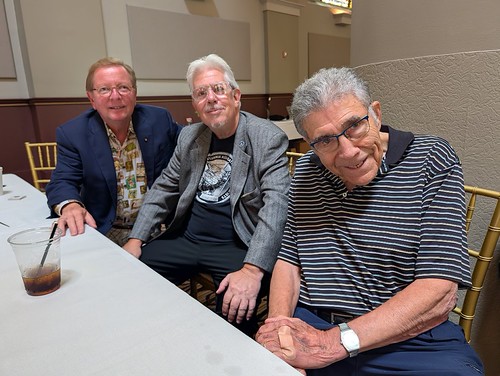
Tom Uram, Jaimie Franki, Don Carlucci
When he wasn't in his Ben Franklin costume, you could usually count on Pat to be wearing a colorful t-shirt, often with a Ben Franklin theme. Dawn displayed these on a table with a note encouraging friends to help themselves. I picked up this souvenir of a good friend and great patriot.


It being a Sunday, I hit the road before the event ended so I could get back home to Virginia in time to wrap up the week's E-Sylum. But it was a great event honoring a life well lived. Rest in Peace, Pat.

Patrick E. McBride 1952-2026
To read the earlier E-Sylum articles, see:
PATRICK E. MCBRIDE (1952-2026)
(https://www.coinbooks.org/v29/esylum_v29n23a03.html)
NOTES FROM E-SYLUM READERS: JULY 19, 2026 :
Fundraising for Dennis Boggs (aka Abraham Lincoln)
(https://www.coinbooks.org/v29/esylum_v29n29a09.html)
WAYNE'S NUMISMATIC DIARY: 2026 ANA, PART 1
(https://www.coinbooks.org/v29/esylum_v29n35a16.html)
WAYNE'S NUMISMATIC DIARY: 2026 ANA, PART 2
(https://www.coinbooks.org/v29/esylum_v29n37a20.html)
WAYNE'S NUMISMATIC DIARY: 2026 ANA, PART 3
(https://www.coinbooks.org/v29/esylum_v29n37a21.html)
WAYNE'S NUMISMATIC DIARY: 2026 ANA, PART 4
(https://www.coinbooks.org/v29/esylum_v29n38a19.html)
THE ODYSSEY ON ANCIENT COINS
Mike Markowitz wrote an article in CoinWeek on The Odyssey on Ancient Coins. -Garrett
Christopher Nolan's The Odyssey has brought Homer's ancient world back into popular culture. Yet for coin collectors, Odysseus, Homer, Scylla, the Sirens, and even the hero's faithful dog have never completely disappeared.
They Survive in Metal
The legendary events surrounding the Trojan War belong to the Late Bronze Age. Ancient tradition usually placed the war in the 12th or 13th century BCE. Coinage, however, did not emerge in western Asia Minor until the seventh century BCE. Therefore, centuries separate the supposed age of Odysseus from the first coins.
Homer came later.
Tradition places the poet in or around the eighth century BCE, although scholars still debate when the Iliad and Odyssey reached something close to their surviving form . Scholars also continue to debate whether one poet composed the works, whether several poets contributed, and how writing interacted with a long oral tradition.
Whatever the answer, later Greeks and Romans revered Homer. His poetry became part of their shared cultural inheritance.
Inevitably, Homer and the unforgettable characters of his epics found their way onto coins.
Homer: A Poet Claimed by Many Cities

IONIA. Smyrna. Circa 190-180 BC. Drachm (Silver, 20 mm, 4.19 g, ),. Laureate head of Apollo to right, with two locks of hair falling down his neck. Rev. S??????O? The Poet Homer seated left, holding scroll in his right hand and scepter in his left. BM 1920,1122.1. Of the highest rarity, arguably the finest of a very few known examples. A wonderful coin of magnificent full Hellenistic style, with an exceptional rendering of the most famous ancient poet on the reverse.
Many Greek cities and islands claimed Homer as their own. Ancient traditions connected him with Smyrna, Chios, Cyme, Colophon, Athens, and several other places. Meanwhile, the island of Ios developed a particularly strong tradition that Homer died there .
The rivalry even reached the coinage.
A magnificent silver drachm of Smyrna, today Izmir, Türkiye, dated to circa 190/189-180 BCE, depicts the bare-chested poet seated and holding a scroll. The 20 mm silver coin weighs 4.19 grams.
The obverse bears the laureate head of Apollo, god of poetry and music. Homer dominates the reverse.
Tradition describes Homer as blind. Nevertheless, the engraver gives him a scroll. That apparent contradiction opens another ancient mystery. Scholars still debate how literacy, writing, dictation, and oral performance contributed to the creation and preservation of the Homeric poems. The Odyssey itself certainly belongs to a culture in which oral performance remained fundamental.
Leu Numismatik called this drachm one of the finest known examples and praised its exceptional Hellenistic portrait of the poet. It hammered for CHF 26,000 in 2023, equivalent to more than $28,000 at the time .
For a poet who lived centuries before this coin appeared, Homer had become remarkably marketable civic property.
Another City Lays Claim

AEOLIS. Cyme. Pseudo-autonomous issue. Assarion (Bronze, 20 mm, 5.00 g,), time of Commodus, circa 184-190. OMHPOC Homer seated to right, holding scroll in his left hand and resting his right on seat. Rev. KYM/A/ION within oak wreath. BMC 109-110. RPC IV.2 online 2469. Extremely rare, apparently the fourth known example.
The ancient coastal city of Cyme, near modern Aliaga, Türkiye, made the same claim.
A Roman-era bronze assarion struck during the time of Commodus, circa 184-190 CE, shows Homer seated with a scroll. His name, OMHPOC, identifies him. The reverse places the name of Cyme inside an oak wreath .
The coin measures 20 mm and weighs 5.00 grams.
According to one tradition, Homer married Aresiphone, daughter of Gnotor of Cyme. Whether history or legend, the story strengthened the city's connection with the poet.
Coins offered cities something monuments could not. They traveled.
Every Homer coin that left Cyme carried the city's claim into markets, ports, military camps, and neighboring communities.
To read the complete article, see:
The Odyssey On Ancient Coins
(https://coinweek.com/the-odyssey-on-ancient-coins-homers-epic-struck-in-metal/)
1715 FLEET SOCIETY: ODDLY SHAPED MEXICAN COBS
The 1715 Fleet Society's October 2026 Treasure of the Month is a pair of oddly shaped Mexican silver cobs, -Editor

Our Treasure of the Month for October are two silver reales from the 1715 Fleet that illustrate bizarre shapes found among coins produced in the Spanish Colonial mint located in Mexico City. Collectors of these coins are familiar with these unusual shapes. The question is: how did they get this way? Was this deliberate? Was it a planned attempt to create a special figure? Actually, it was not either. It was not deliberate or overt. Rather, it was accidental. But how could this be? What is the explanation?
The answer lies in the minting process. One theory has it that a specified amount of molten silver would be poured into a wide, flat trough, which would produce silver straps of irregular contours, resulting in bizarre shapes. Some parts of the straps were thinner and narrower than others, causing thin, elongated pieces or crazy curves resulting in "S–shaped " or "L-shaped" coins. Square coins and coins with holes, spurs (sharp points), and even accidental animal shapes have been recovered from Fleet wreck sites. In short, the shapes could be just about anything, as demonstrated by our featured coins. For a comprehensive analysis of the Mexico City mint and its production methods, see the article Straps for Cash written by Daniel Frank Sedwick, reproduced in its entirety below.
The first half of our Treasure of the Month is a Mexico City cob 4 reales, Philip V, assayer not visible (J), style of 1705-12. Strange, curved shape resembling a cardinal (below). It is a 1715 Fleet piece, ex-Ullian. Weighing in at 12.91 grams, it shows a good full cross, with most of the shield within the confines of a narrow, odd-shaped flan. It is lightly toned, a VF+, with a desirable shipwreck pedigree. It is also pedigreed to Lou Ullian's famous "40-lb clump".

Mexico City cob 4 reales in the shape of a cardinal
The second half of our Treasure of the Month is a Mexico City cob 8 reales, Charles II, assayer not visible, very odd shape (looks like a pirate's hat), A 1715 Fleet piece, ex-Bamberg, weighs 23.11 grams. Choice cross, most of the shield, flat peripheries, VF with surface corrosion on obverse only. Nicely toned, a desirable shipwreck origin, and original (and accidental) unique natural shape. Pedigreed to Sedwick Auction 9 (Lot 818).

Mexico City cob 8 reales shaped like a pirate's hat
Our featured treasure (the 8 reales and 4 reales) is actually part of a large collection of silver cobs that are pedigreed to various other shipwreck and non-shipwreck sources. This collection was assembled over many years as an example of the bizarre and unusual results of Spanish colonial mintage and artistry. Referred to as "The Special Collection of Odd Shaped Mexican Cobs," this group, including our two showcased pieces, will appear in Sedwick Auction # 40, November 5-7, 2026. The group is massive, containing 67 pieces and offers a unique opportunity to acquire a rare and unusual piece of numismatic history. Because we consider this collection to be of great educational importance, we will be highlighting various pieces from the collection in our newsletter throughout the month of October.
To read the complete article, see:
October 2026 — Treasure of the Month
(https://1715fleetsociety.com/october-2026-treasure-of-the-month/)
1835 NORWAY HALF SPECIEDALER STAR TYPE
An article by Stack's Bowers Senior Numismatist Henrik Berndt highlights an interesting coin from the L.. E. Bruun Collection -Editor
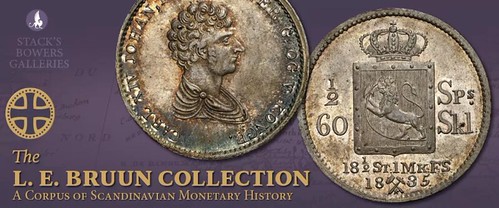
Choosing a coin from the L. E. Bruun Collection to promote should be an easy task; there are so many unique and spectacular pieces in the collection that could easily be chosen. But the overwhelming number of showstoppers can make choosing difficult.
Selecting items to highlight for the October 27-28 Bruun V auction is no exception: the catalog is simply crammed with spectacular coins and medals, some not offered in a public sale for centuries. I must, however, choose, so here I focus on the ‘star' 1835 Norwegian Half Speciedaler.
An exceptionally rare issue, it is believed the star added to the mintmark on the reverse signified that the coin was minted under the auspices of Caspar Hermann Langberg. He was not yet officially the mintmaster but was substituting for Johann Michael Kruse, who had fallen ill. Langberg is believed to have added the star to distinguish his 1835 coinage from Kruse's.


Less than a handful of these exist today; exactly how many we cannot say for sure. We can be fairly certain this is the best preserved in private ownership.
As there are so many marvellous coins in this sale, I also want to mention the two Norwegian patterns of 1837: the Skilling and Half Skilling. The scarce Half Skilling is a very handsome AU-58, and the exceedingly rare Skilling is a mind-boggling MS-64 – another showstopper.
These are just three of more than 500 coins and medals offered in The L. E. Bruun Collection Part V, all of which have a pedigree that stretches back at least 100 years. Many are so rare that the auction will be one now-or-never moment after another. The sale takes place on October 27 and 28 at the Odd Fellow Palace in the heart of Copenhagen. We hope to see you there – it really is unmissable.
To read the complete article, see:
The Legendary Norway 1835 ‘Star' Half Speciedaler
(https://stacksbowers.com/the-legendary-norway-1835-star-half-speciedaler/)
To read the complete lot description, see:
NORWAY. 1/2 Speciedaler, 1835 (Star). Kongsberg Mint. Carl XIV Johan. NGC MS-62.
(https://auctions.stacksbowers.com/lots/view/3-1WQC1M/norway-12-speciedaler-1835-star-kongsberg-mint-carl-xiv-johan-ngc-ms-62)
HERITAGE: SPANISH CIVIL WAR CURRENCY
Heritage published the following article in their latest Currency News email entitled Spanish Currency and La Dama de Elche by Olivia Collier. -Garrett
The coup d'état which sparked the Spanish Civil War in July 1936 was followed by widespread violence between the Republicans and Nationalists. By 1938, Spain was two years into a civil war that had completely split the country. By the height of the conflict, the opposing Nationalists and Republicans both produced paper money in the territories they controlled.


Barcelona, the capital of autonomous Catalonia, had already shown a strong pro-Republican sentiment since the restoration of the monarchy in 1874, and was under Republican control in 1938. Fearing for the security of Madrid, the government of the Second Spanish Republic relocated its financial administration to Barcelona, and the Banco de España designed banknotes with Barcelona as the issuing branch by way of an additional precaution.
The Republican issues for Barcelona are some of the most beautiful designs for the period and seem more of a continuation of the previous styles and motifs, displaying the familiar and detailed engraving of Thomas de la Rue. They are unlike other distinctive regional issues: plainer issues, printed in haste in other Republican regions; the artistic Bilbao issues, which appear almost Tubist or Léger-esque in their curved and stylised designs; the Nationalist regional issues, which were printed in either Germany or Italy, and are very reminiscent of German paper money.


Though the three 1938 Barcelona designs were never issued, a small number have survived as Proofs, Specimens or Colour Trial Specimens. All designs are scarce as a result. The 100 Pesetas (Pick 90) is, perhaps, the most intriguing. It features the Dama de Elche, a statue over two thousand years old, and we are fortunate enough to be offering this design for the first time in five years, in our October 14-15 World Paper Money Signature Auction.


Spain Banco de Espana 100 Pesetas 11.3.1938
The Dama de Elche, or 'Lady of Elche', was excavated in 1897 in La Alcudia, the modern site of the ancient city of Ilici, in Alicante, Spain. The Lady of Elche was only named so by the French, as she was sold to the Louvre quickly after her discovery. The inhabitants of Elche originally named her Reina Mora, linking her to the Muslim Maghrebis who once ruled the Iberian Peninsula.
Through her lifetime, the bust has been witness to huge changes in her homeland, but also the subject of debate in her own right. In 1941, she was returned to Spain as part of a larger repatriation of artistic works. She has also been accused of being a forgery, though this theory has subsequently been debunked. Separately, research has confirmed fragments of cremated human remains found inside the statue, pointing to possible use as a cinerary urn-though we still do not know who the statue represents, or who was buried within it.
The 1930s were a devastating and violent period for Spain. Rather than a Republican symbol, or even the vignettes of industry and labour we see in the stylistic Bilbao notes, what is chosen for this banknote is a statue which, at the time of the note's production, was in fact residing in France. Even in absentia, the Lady of Elche represented a Spanish identity which, in 1938, was being brutally fought over. She reappeared on the 1948 1 Peseta, depicted again in a three-note series. The Lady of Elche represents much more than just a modern Spain: she is a pre-Roman Iberian burial, a work of European art protected from war, and a figure whose identity-Reina Mora to some, Dama de Elche to others-has never been fully settled.
ABOUT THIS ISSUE: OCTOBER 4, 2026
Not much numismatically this week other than my normal E-Sylum correspondence and editing. Payments with cash and coins went smoothly this week. While having a salad at Chic-fil-a, a young staff member asked about the newspaper I was reading (Wall Street Journal). He told me that when his family came here from Morocco they carried along a newspaper printed in Arabic. "I have it on my bedroom wall!"
I didn't get a chance to tell him that a high school friend back in Pittsburgh was born in Morocco, too. When he had to fill out paperwork calling for his place of birth, he'd put down "Casablana, Morocco" and the teachers would tell him to quit clowning around and put down his real birthplace. But he wasn't clowning - his parents were on a cruise and were docked in Casablanca when his mother gave birth.
Anyhoo, here are some interesting non-numismatic articles I came across this week, with topics all over the map, as usual.
8 Playful Facts About the Game Monopoly (https://interestingfacts.com/monopoly-facts/)
Surprising Facts About Every U.S. President (https://historyfacts.com/famous-figures/article/surprising-facts-us-presidents/)
10 TV Shows Everyone Watched in 1970 (https://historyfacts.com/arts-culture/article/popular-tv-shows-in-1970/)
The frightening economics of haunted houses (https://thehustle.co/the-frightening-economics-of-haunted-houses)
Last call? Not for this 103-year-old bartender. (https://www.washingtonpost.com/dc-md-va/2026/10/04/103-worlds-oldest-bartender-isnt-turning-off-lights-yet/)
The Blaquier-Arrieta Collection (https://www.sothebys.com/en/digital-catalogues/legendary-the-blaquier-arrieta-collection)
How Jimmy Stewart in It's a Wonderful Life Embodies the Best of America (https://lithub.com/how-jimmy-stewart-in-its-a-wonderful-life-embodies-the-best-of-america/)
Why barcodes are about to go extinct (https://thehustle.co/originals/why-barcodes-are-about-to-go-extinct)
So You Think You Could Be An Electrician? (https://asteriskmag.com/issues/15/so-you-think-you-could-be-an-electrician)
A letter to our kids: It's your time (https://www.axios.com/2026/09/26/ai-jim-vandehei-young-people-letter-future)
-Editor

Editor Wayne Homren, Assistant Editor Garrett Ziss
Wayne Homren
Wayne Homren is the founding editor of The E-Sylum and a consultant for the Newman Numismatic Portal. His collecting interests at various times included U.S. Encased Postage Stamps, merchant counterstamps, Pittsburgh Obsolete paper money, Civil War tokens and scrip, Carnegie Hero Medals, charge coins and numismatic literature. He also collects and has given presentations on the work of Money Artist J.S.G. Boggs. In the non-numismatic world he's worked in artificial intelligence, data science, and as a Program Manager for the U.S. Department of Defense.
Garrett Ziss
Garrett Ziss is a numismatic collector and researcher, with a focus on American paper money and early U.S. silver and copper coins. He is also a part-time U.S. coin cataloger for Heritage Auctions. Garrett assists Editor Wayne Homren by editing and formatting a selection of articles and images each week. When he's not engaged in numismatics, Garrett is pursuing a Master's Degree in Quantitative Economics at the University of Pittsburgh.

Contributors Pete Smith and Greg Bennick
Pete Smith
Numismatic researcher and author Pete Smith of Minnesota has written about early American coppers, Vermont coinage, numismatic literature, tokens and medals, the history of the U.S. Mint and much more. Author of American Numismatic Biographies, he contributes original articles to The E-Sylum often highlighting interesting figures in American numismatic history.
Greg Bennick
Greg Bennick (www.gregbennick.com) is a keynote speaker and long time coin collector with a focus on major mint error coins and US counterstamps. He is on the board of both CONECA and TAMS and enjoys having in-depth conversations with prominent numismatists from all areas of the hobby. Have ideas for other interviewees? Contact him anytime
via instagram @minterrors.
He can also be reached by email at
minterrors@gmail.com.


Website host John Nebel and webmaster Bruce Perdue
John Nebel
Numismatist, photographer, and ANS Board member and Fellow John Nebel of Boulder, CO helped the ANA and other clubs like NBS get online in the early days of the internet, hosting websites gratis through his Computer Systems Design Co. To this day he hosts some 50 ANA member club sites along with our
coinbooks.org site, making the club and our E-Sylum archive available to collectors and researchers worldwide.
Bruce Perdue
Encased coinage collector (encasedcoins.info) Bruce Perdue of Aurora, Illinois has been the volunteer NBS webmaster from its early days and works each week to add the latest E-Sylum issue to our archive and send out the email announcement.

|
|
The E-Sylum is an electronic publication of the Numismatic Bibliomania Society Copyright © 1998 - 2026 | |