Visit our NBS Sponsors









About UsThe Numismatic Bibliomania Society is a non-profit association devoted to the study and enjoyment of numismatic literature. For more information please see our web site at coinbooks.org SubscriptionsThose wishing to become new E-Sylum subscribers can go to the following web page
Subscribe
MembershipThere is a membership application available on the web site Membership Application To join, print the application and return it with your check to the address printed on the application. Print/Digital membership is $40 to addresses in the U.S., and $60 elsewhere. A digital-only membership is available for $25. For those without web access, write to: Jeff Dickerson, Treasurer AsylumFor Asylum mailing address changes and other membership questions, contact Jeff at this email address: treasurer@coinbooks.org SubmissionsTo submit items for publication in The E-Sylum, write to the Editor at this address: whomren@gmail.com BUY THE BOOK BEFORE THE COIN |
- WAYNE'S WORDS: THE E-SYLUM OCTOBER 11, 2026
- NEW BOOK: STEEL CENTS TO BELGIAN FRANCS
- PERIODICAL: ORIENTAL NUMISMATIC SOCIETY AUTUMN 2026
- THE EDWARD WORTH LIBRARY EXHIBITION
- NUMISTA ADDS FORRER'S BIOGRAPHICAL DICTIONARY
- NEWMAN PORTAL MIGRATION UPDATE
- VIDEO: WOMEN MEDALLIC SCULPTORS
- ANA HONORS DEISHER AND FIVAZ
- DEISHER ELECTED TO ACEF BOARD
- HOW THE SMITHSONIAN IS USING AI
- NOTES FROM E-SYLUM READERS: OCTOBER 11, 2026
- MORE ON THE ANA'S FEDERAL CHARTER
- WHY WWII JEFFERSON NICKELS LAMINATE
- VOCABULARY TERM: STYLE AND TECHNIQUE
- FRANCIS WENDELL DUVALL
- NUMISMATIC AUTHOR M. SORENSON/SORENSEN
- HERITAGE: BYZANTINE ANCIENT COINS
- NOONANS: SPECIMEN BANKNOTES OF THE WORLD
- GADOURY: AUCTION XXI FRENCH GOLD ROYALES
- SEDWICK AUCTION 40
- HOLABIRD JACK HADDOCK NEVADA TOKENS, PART 1
- COIN OF KING ETHELRED THE UNREADY FOUND
- RARE COIN OF OLAF THE HOLY IDENTIFIED
- KING HAROLD II'S BAYEUX TAPESTRY DEPICTION
- 15TH CENTURY MOSCOW COIN HOARD FOUND
- MORE ON THE BUFFALO BILL CENTER PEACE MEDALS
- WWII PRISONER OF WAR AND OTHER MEDALS
- TRUMP AWARDS 2026 NATIONAL MEDALS
- THE QUANTUM COIN
- LOOSE CHANGE: OCTOBER 11, 2026
- FEATURED WEBSITE: ÆTHELMEARC MONEYERS GUILD
- ABOUT THIS ISSUE: OCTOBER 11, 2026
Content presented in The E-Sylum is not necessarily researched or independently fact-checked, and views expressed do not necessarily represent those of the Numismatic Bibliomania Society.
WAYNE'S WORDS: THE E-SYLUM OCTOBER 11, 2026
 New subscribers this week include:
Carol Hartman, courtesy Richard Lobel;
Patrick Wall, courtesy Roger Burdette; and
Bob Black.
Welcome aboard! We now have 6,336 subscribers.
New subscribers this week include:
Carol Hartman, courtesy Richard Lobel;
Patrick Wall, courtesy Roger Burdette; and
Bob Black.
Welcome aboard! We now have 6,336 subscribers.
Thank you for reading The E-Sylum. If you enjoy it, please send me the email addresses of friends you think may enjoy it as well and I'll send them a subscription. Contact me at whomren@gmail.com anytime regarding your subscription, or questions, comments or suggestions about our content.
This week we open with one new book, a periodical, an online numismatic literature exhibit, updates from the Newman Numismatic Portal, ANA, ACEF, and more.
Other topics this week include WWII Belgian steel francs and Jefferson nickels, the Oriental Numismatic Society, the Edward Worth library, Beth Deisher, Bill Fivaz, the ANA's Federal Charter, auction previews, coin finds, prisoner of war medals, and the National Medals of Science and Technology.
To learn more about numismatic references from the sixteenth, seventeenth and early eighteenth centuries, Forrer's Biographical Dictionary of Medallists, Women Medallic Sculptors in America, William Ashbrook, Frank Duvall, Style and Technique, specimen banknotes, Nevada tokens, the Quantum coin, ferrotypes in Tagua nuts, Ethelred the Unready, Olaf the Holy, "Brenner foot" and "Menconi mouth", read on. Have a great week, everyone!
Wayne Homren
Editor, The E-Sylum

Image of the week
NEW BOOK: STEEL CENTS TO BELGIAN FRANCS
Roger Burdette alerted me to a new book about the production of Belgian Francs at the Philadelphia Mint during WWII. Thanks! -Editor
 From Steel Cents to Belgian Francs: A Collector's Investigation into the 1944 Belgian 2 Franc
by Patrick E Wall
Why was a Belgian coin struck in Philadelphia during World War II?
From Steel Cents to Belgian Francs explores the story of the 1944 Belgian 2 Franc, a coin produced by the United States Mint while Belgium remained under German occupation. Drawing on archival records, historical correspondence, and a study of surviving specimens, this book traces the events that brought Belgian coinage to Philadelphia and examines one of the lesser-known numismatic stories of the Second World War.
Inside, readers will discover:
- The wartime circumstances that led to production at the Philadelphia Mint
- Archival documents and historical correspondence relating to the coinage program
- The relationship between the Belgian 2 Franc and the 1943 U.S. steel cent program
- A die study based on surviving specimens
- Historical photographs, illustrations, and primary source material


Blending historical research with numismatic analysis, this book offers collectors and historians a detailed account of the origin, production, and legacy of the 1944 Belgian 2 Franc.
About the author
Patrick E. Wall is a mechanical engineer and longtime collector with a particular interest in the history, manufacture, and varieties of twentieth-century coinage. His research into the 1944 Belgian 2 Franc began with a simple question about the coin's wartime origins and grew into the investigation documented in From Steel Cents to Belgian Francs. He lives in upstate New York with his family and continues to collect, research, and document the stories behind the coins in his collection.
Here's a short excerpt from the book's introduction. -Editor
References to the 1944 Belgian 2 franc often repeated familiar claims regarding Philadelphia production, U.S. steel-cent blanks, and wartime minting arrangements, but detailed supporting discussion was comparatively limited. Information frequently appeared in brief summaries, collector anecdotes, secondary references, or repeated statements whose documentary foundations were not always immediately clear.
Instead of providing answers, deeper investigation raised additional questions. What precisely was meant by "steel cent blanks"? Were the Belgian coins struck on identical blanks? Modified blanks? Related material prepared differently? How should reported weights be interpreted? What evidence existed in contemporary documentation, specimens, or published numismatic literature? How much of the accepted narrative rested on demonstrable evidence, and how much on repetition?
Eventually, it became clear the answers being sought did not appear to exist in one clear, consolidated source.
The investigation broadened.
Online references led to correspondence, shared archival material, collector discussion, institutional inquiry, and increasingly close examination of the coins themselves. Helpful early guidance from experienced numismatic researchers provided direction, but many questions remained open. The deeper the inquiry progressed, the clearer it became that the 1944 Belgian 2 franc occupied a surprisingly interesting intersection of wartime production, international coinage, U.S. Mint capability, and physical specimen study.


This small wartime coin is more interesting than it first appears.
Few foreign coins offer American collectors such a direct connection to U.S. Mint history. The reported use of U.S. blanks, U.S. presses, and production in Philadelphia naturally invites closer attention from collectors more accustomed to studying Lincoln cents than Belgian coinage. Yet despite that connection, the coin remains relatively obscure within mainstream American numismatic discussion.
This book represents an attempt to document, investigate, and consolidate what can be understood about the 1944 Belgian 2 franc.
It is not intended as a complete history of the United States steel cent, nor as a comprehensive history of World War II. It does not claim to provide a final documentary reconstruction of every production detail surrounding the issue. Rather, it seeks to assemble available historical context, documentary evidence, specimen observation, research questions, and working interpretations into a single source focused specifically on this coin.
Publisher : Independently published
Publication date : September 8, 2026
Language : English
Print length : 209 pages
ISBN-13 : 979-8188659257
Item Weight : ? 10.1 ounces
Dimensions : ?6 x 0.48 x 9 inches
Congratulations to Patrick Wall for his research efforts and the new book. Announcing new works like these is one of my favorite chores as E-Sylum editor. -Editor
Roger adds:
"There are many such stories hidden among the US Mint's archives; each demanding understanding and awaiting discovery."
Indeed! Who will be next to step and up solve a cool numismatic mystery? -Editor
For more information, or to order, see:
From Steel Cents to Belgian Francs: A Collector's Investigation into the 1944 Belgian 2 Franc
(https://www.amazon.com/dp/B0HJDNW3S6/)
PERIODICAL: ORIENTAL NUMISMATIC SOCIETY AUTUMN 2026
The Autumn 2026 issue of the Journal of the Oriental Numismatic Society has been published. -Garrett
 Journal of the Oriental Numismatic Society
265 | Autumn 2026
Editorial
Paula Turner
Record of a coin inscribed with the name Sarimitra from Gandhigram village in Akola, Maharashtra, India
S. D. Misar
Travellers' tales: Implications of a treasure-trove hoard of silver Indo-Sasanian Bhillamala drammas (‘gadhaiyas')
John Deyell
Coins of Sa?karavarman and Gopalavarman: Early rulers of the Utpala dynasty of medieval Kashmir
Gul Rahim Khan
A revised reading of three dirhams struck by the Maghrawa of North Africa
Ludovic Liétard
An unexpected la?nat falus of Herat
B. Millancourt
A donative dinar from the twelfth century ascribed to the ?Abbasid caliph al-Mustadi? bi-amri-llah
Nicolas Consiglio, Beat A. Klein and Abdullah Saggara
The early regnal years of Aurangzeb Alamgir: ‘Focus on Aurangabad mint'
Ritvik Rekhi and Jan Lingen
ONS News?
Book review?
For more information, see:
https://www.orientalnumismaticsociety.org/

THE EDWARD WORTH LIBRARY EXHIBITION
The Edward Worth Library is a rare books collection at Dr Steevens' Hospital in Dublin, Ireland. Many important numismatic references from the sixteenth, seventeenth and early eighteenth centuries are highlighted in a new online exhibition. -Garrett

The Edward Worth Library is a rare books collection, bequeathed to Dr Steevens' Hospital, Dublin, by Dr Edward Worth (1676–1733), who was one of the Hospital's earliest Trustees. This web exhibition celebrates Worth's extensive collection of numismatic texts and was curated by Dr Elizabethanne Boran, the Librarian of the Edward Worth Library, and Mr David S. Dunlop, Independent Researcher, Bookbinder and Member of the Numismatic Society of Ireland – Northern Branch; with photographic contributions from Mr Antoine Mac Gaoithín (Worth Library staff). It is the twentieth in a series of websites exploring the holdings of the Worth Library. For further details please contact our website: https://edwardworthlibrary.ie/.
 Worth was clearly a very interested collector of numismatic texts in all their forms and his extensive numismatic collection offers readers a tour of some of the most important writers on numismatics in the sixteenth, seventeenth and early eighteenth centuries. Leading commentators on numismatic collections in sixteenth-century Europe included the Italian antiquarian Jacopo Strada (c. 1515–88); the painter, engraver, printer and numismatist Hubert Goltzius (1526–83), who became famous for, among other things, drawing up a list of contemporary collectors; and Fulvio Orsini (1529–1600), who was well-placed in Rome to aid his patron Cardinal Alessandro Farnese (1520–89), in his quest for numismatic treasures.
The seventeenth century witnessed the rise of the French commentators, leading numismatists such as Charles Patin (1633–93) and Jean Foy-Vaillant (1632–1706), each heavily influenced by the machinations of the Sun King himself, Louis XIV (1638–1715). Louis XIV was not the only monarch to utilise numismatics as a tool of propaganda: German princes sought to build up their collections and Lorenz Beger (1653–1705), a German librarian, would play an important role at both Heidelberg and Brandenburg. This trend was continued into the early eighteenth century as witnessed by the Gotha collections described by Christian Sigismund Liebe (1687–1736). Zeal for numismatic collecting had also been rising in Scandinavia and Worth was keen to acquire material by Nils (Nicolas) Keder (1659–1735), who had been given the task of cataloguing the royal Swedish collections. As his multi-volume set by Paolo Pedrusi (1644–1720), which sought to glorify the dukes of Parma and Piacenza, demonstrates, Worth also continued his interest in Italian collections.
In all, Mr Dunlop has identified 402 works of numismatic relevance – almost a tenth of Worth's entire collection – covering all the Dekesel categories. The Dekesels (twenty-first century bibliographers), spread their net wide, including a host of material, and have provided numismatists with an overarching categorization which is now undoubtedly the standard reference work. As Mr Dunlop has noted, Worth too cast his net wide. Nor did he neglect literature about coins minted in Ireland for among the coins described by Keder are ones dating to the Viking period. To find out more about these and later Irish collections see the National Museum's exhibition ‘Airgead: A Thousand Years of Irish Coins & Currency', as well as the website of the Numismatic Society of Ireland. We hope that our exhibition highlights the fact that the Worth Library is a vital resource for all historians of early modern numismatics.
That's a wonderful idea for an exhibition! Worth's library is a true gem. Many thanks to Elina Screen of the British Museum and Edward Worth Library Librarian Dr Elizabethanne Boran for making us aware of this. By sure to click through the navigation links to access all of the content. What a joy for numismatic bibliophiles! -Editor
To view the online exhibition, see:
Collecting Numismatics at The Edward Worth Library
(https://collecting-numismatics.edwardworthlibrary.ie/)

Ezechiel Spanheim, Dissertationes de praestantia et usu numismatum antiquorum (London, 1706)

NUMISTA ADDS FORRER'S BIOGRAPHICAL DICTIONARY
Dzmitry Huletski passed along this notice of a new resource on the Numista website: Leonard Forrer's Biographical Dictionary of Medallists. Thank you. -Editor
 Leonard Forrer's Biographical Dictionary of Medallists, covering engravers, mint masters and gem-cutters from 500 BC to 1900, remains a fundamental reference in numismatic research. Compiled between 1902 and 1930, it preserves biographical information and historical evidence that might otherwise have been lost.
Numista has digitised the complete work and made it accessible through a dedicated search engine, enabling researchers and collectors to explore its extensive contents more efficiently. The structured data also improves accessibility for modern AI-powered search tools.

The project's technical development, including data architecture and processing pipeline, was carried out within Numista with contributions from Dzmitry Huletski, a Belarusian numismatist and computer science specialist with expertise in AI technologies.
This initiative is part of Numista's broader mission to make numismatic knowledge and literature more accessible worldwide.
Explore Forrer's Dictionary: https://forrer.numista.com/
To read a complete article, see:
Numismatic encyclopaedia of medallists and mint masters is available in full on Numista
(https://www.sixbid.com/en/blog/forrers-dictionary-is-available-in-full-on-numista/)

NEWMAN PORTAL MIGRATION UPDATE
Newman Numismatic Portal Project Coordinator Len Augsburger provided the following report on its migration to a new technology platform. -Editor

Newman Portal Migration Update
The new Newman Portal is now live and we appreciate the user feedback submitted over the last couple weeks. We resolve some issues quickly while others are more complex. The new site has additional capabilities, one of which I will highlight here. There has been demand to search within auction catalogs of a specific firm, and this is now possible. Taking the Chapman's, for example, I can ask NNP for to search within their catalogs for specific text. Navigating to the Chapman's home page (from the front page, Library -> Auction Catalogs -> Chapman, S.H. & H.), we then enter a search phrase in the "Search Chapman, S.H. & H." box to the right. In this case we'll enter "Libertas Americana" (include the quote marks to search for the entire phrase) and this will pull up a list of Libertas Americana medals appearing in the Chapman sales.
This context sensitive search capability is present throughout the new site, for example in the periodical and fixed price list series as well. We encourage users to try out different features as they appear. As one user recently noted "Still getting used to the new site but it's growing on me!" As always, assistance with Newman Portal is available at nnpcurator@wustl.edu.
Link to Newman Numismatic Portal:
https://nnp.washu.edu/
To read the earlier E-Sylum article, see:
THE NEW NEWMAN PORTAL!
(https://www.coinbooks.org/v29/esylum_v29n34a05.html)

VIDEO: WOMEN MEDALLIC SCULPTORS
The David Lisot Video Library on the Newman Numismatic Portal can be found at:
https://nnp.wustl.edu/library/multimediadetail/522852
We highlight one of his videos each week in The E-Sylum. Here's one from 2016 about Women Medallic Sculptors in America. -Editor

R. Lee Barrett speaks at the 2016 ANA World's Fair of Money in Anaheim, CA.
To watch the complete video, see:
History of Women Medallic Sculptors in America
(https://youtu.be/OUH_0mRDrKo)
History of Women Medallic Sculptors in America
(https://archive.org/details/ANA16022HistoryofWomen_1)

ANA HONORS DEISHER AND FIVAZ
The ANA honored numismatic legends at the Pittsburgh World's Fair of Money. Here is the press release. -Garrett
Two long-time collectors were celebrated during the Pittsburgh World's Fair of Money®, August 25-29, at the David L. Lawrence Convention Center in Pittsburgh, Pennsylvania. Their contributions to the numismatic community have made waves over the years, earning them recognition during the 135th Anniversary Banquet on Friday, August 28.
 The Elvira Clain-Stefanelli Memorial Award for Achievement in Numismatics is presented annually to a woman who has made significant contributions to numismatics through her research, leadership, and/or mentorship, and who has demonstrated a longtime commitment to the betterment of numismatics. This year's recipient is Beth Deisher.
Serving in several editorial roles at Coin World from 1981 to 2012, Deisher has advocated for the hobby and numismatic education. She was the founding editor of several subsidiary publications for Coin World, and she has received more than 200 awards from the Numismatic Literary Guild for her writing and editorial work. She testified before five Congressional committees on numismatic issues, and she served on two commissions to recommend designs for Ohio's state quarter and bicentennial medal.
The author of several numismatic references, Deisher helped organize the Anti-Counterfeiting Task Force (now the non-profit Anti-Counterfeiting Educational Foundation). She also assisted in developing Customs and Border Protection's numismatic protocols and coordinated numismatic specialists' efforts to prevent the importation and sale of counterfeit money. She received the Burnett Anderson Memorial Award in 2006 and the Farran Zerbe Award for Distinguished Service in 2010. She was inducted into the ANA's Hall of Fame in 2013.

Bill Fivaz, recipient of the ANA's 2026 Lifetime Achievement Award, has influenced countless collectors and researchers through his teaching, leadership, scholarship, mentorship, and service. A collector for 75 years and an ANA life member since 1959, Fivaz has demonstrated extraordinary accomplishments in numismatics.
Best known as the coauthor of the Cherrypickers' Guide to Rare Die Varieties, Fivaz helped popularize the study of U.S. die varieties and mint errors. His published works, articles, videos, and educational materials have become essential references.
Equally important is his extraordinary dedication to education. Fivaz taught ANA Summer Seminar classes for more than 20 years and is one of the most popular and respected educators in the field. He is well known for his humor and ability to make complex topics accessible and exciting. As Q. David Bowers observed, "When Bill Fivaz does anything, he does it with enthusiasm, correctly, and in a way that everyone appreciates."
Fivaz has been a tireless mentor and supporter of young numismatists, funding scholarships, supporting YN programs, and encouraging discovery and learning. His induction in to the ANA Hall of Fame in 2002 recognized that his lifetime contributions have left a lasting and invaluable mark on American numismatics.

DEISHER ELECTED TO ACEF BOARD
In related news, Beth Deisher is back working with the Anti-Counterfeiting Educational Foundation. Here's the press release. -Editor
Beth Deisher has been elected to serve as a board member of the Anti-Counterfeiting
Educational Foundation effective Sept. 15. She succeeds Mary Sauvain, who moved
from board member to ACEF Executive Director Aug. 1. Sauvain was elected to the
board in January 2024.
The ACEF Board of Directors welcomes Beth in her new capacity. She stepped down from her role as executive director Aug. 1 to allow more time to pursue other interests. "Her past experience operating within ACEF will be a tremendous asset to our organization and the numismatic community as a whole," ACEF Barry Stuppler said.
Deisher served as editor of Coin World for 27 years until retiring in 2012. During her Coin World tenure, she frequently testified on numismatic issues before Congressional committees; served on three Ohio commissions to recommend designs for Ohio's State Quarter, Ohio's Bicentennial medal, and a set of medals to celebrate the US 250 th Anniversary; wrote or edited more than 12 books on various numismatic topics and received more than 200 awards from the Numismatic Literary Guild, including NLG's Clemy Award. She was elected to the Numismatic Hall of Fame in 2013. Her most recent recognition was the American Numismatic Association's Elvira Clain-Stefanelli Award for Achievement in Numismatics.
An advocate for education in the numismatic community and fighting against coin counterfeiting, she coordinated the work of numismatic specialists and helped to develop training for federal law enforcement agencies in identification of counterfeits and intercepting counterfeit coins being imported into the United States.
Initially recruited to organize the Anti-Counterfeiting Task Force for the Industry Council for Tangible Assets, now known as the National Coin and Bullion Association, she moved to the role of ACEF executive director in April 2024.
Among other organizations, Deisher is a Fellow of the American Numismatic Society, a member of the American Numismatic Association, the Numismatic Literary Guild, Women in Numismatics until dissolution, the National Federation of Press Women, and the Society of Professional Journalists.
For more information, see:
https://acefonline.org/

HOW THE SMITHSONIAN IS USING AI
I don't believe this effort has come to the National Numismatic Collection yet, but this article discusses how Artificial Intelligence (AI) is helping the Smithsonian discover connections between artifacts from the American Revolution. -Editor
 The distance in the march from the American Revolution to the age of artificial intelligence is almost beyond comprehension. But leaders of the Smithsonian Institution are using AI to bridge the divide.
As the United States celebrates its 250th anniversary of independence, Smithsonian leaders are turning to AI to better understand items in its collection tied to the fight that led to the country's founding.
The goal is to allow the public and scholars to both search the institution's collection and draw connections across the Smithsonian and other organizations, such as the Library of Congress, to gain a deeper sense of how communities formed and functioned at the nation's birth.
Since researchers on the project, known as Revolution Crossroads, began applying AI models in the spring, they have quickly drawn links that would have previously required extensive manual searches across multiple catalogs. They located, for instance, a silversmith who was running newspaper advertisements for a creamer around 1774, similar to one held at the Smithsonian's National Museum of American History.
The ultimate ambition is to scour records and surface new stories about people whose lives have faded away over the centuries.
"An ideal scenario is that we get to a place where we're actually adding to the public record," said Becky Kobberod, the chief digital and innovation officer at the Smithsonian. "Maybe they're not Thomas Jefferson or George Washington, but they did live in a community and build that community, and that name is now known."
The ultimate ambition is to scour records and surface new stories about people whose lives have faded away over the centuries.
"An ideal scenario is that we get to a place where we're actually adding to the public record," said Becky Kobberod, the chief digital and innovation officer at the Smithsonian. "Maybe they're not Thomas Jefferson or George Washington, but they did live in a community and build that community, and that name is now known."
This could be a way for numismatic researchers to get new leads on connections to items they're investigating. As more and more information gets digitized and made available to AI, the more useful it becomes. -Editor
To read the complete article, see:
How the Smithsonian is using AI to connect artifacts from the American Revolution
(https://apnews.com/article/artificial-intelligence-smithsonian-american-revolution-crossroads-history-5653502a18f0e476bcb2b540ddf01637)

NOTES FROM E-SYLUM READERS: OCTOBER 11, 2026
Wikipedia Editing Assistance Complete
Joe Ceravone writes:
 "Just want to send out a huge thank you to the person that made the Wikipedia changes for me on Dorothy Cox. I really appreciate it as she is now getting some proper recognition as a resident of my home town, Cheshire, CT."
Whoever you are out there, thanks! And thanks to all the volunteer Wikipedia contributors and editors out there for dotting the i's and crossing those t's to keep the details accurate. -Editor
To read the Wikipedia entry, see:
https://en.wikipedia.org/wiki/Dorothy_Cox_(archaeologist)
To read the earlier E-Sylum articles, see:
DOROTHY HANNAH COX (1892-1977)
(https://www.coinbooks.org/v29/esylum_v29n25a11.html)
NOTES FROM E-SYLUM READERS: SEPTEMBER 27, 2026 : Wikipedia Editing Assistance Sought
(https://www.coinbooks.org/v29/esylum_v29n39a10.html)
"Read Aloud" Features
John Phipps writes:
 "Regarding the E-Sylum reader's request for audio numismatic books, I purchased one of Fred Schwan's recent books that was offered in hardback bound and in a PDF electronic version. I opened the PDF with MS Edge, clicked on the "Read Aloud" icon (an A with two small arcs at top right). Then an AI voice read the book to me. It was a little chopped up and not perfect but good enough for no additional cost.
"So, I tried it with this issue of E-Sylum. It worked pretty well with the article text, but it is chopped up reading around illustrations, links and when there are two columns. So chopped up that I need to follow along on the screen. The AI voice did read the text content of the ads."
Thanks - that's a great option. Your browser may be different, but look for a similar feature and check it out.
I also found the free Read-Aloud page where you can paste in text to be read to you. That would get around some of the issues John found, but takes an extra step. See: https://read-aloud.com/ . -Editor
To read the earlier E-Sylum article, see:
NOTES FROM E-SYLUM READERS: OCTOBER 4, 2026 : Audio Books
(https://www.coinbooks.org/v29/esylum_v29n40a12.html)
Webinar to Honor Haym Salomon
Mel Wacks writes:
"For over a half century, the Jewish-American Hall of Fame has been producing commemorative medals, raising over $300,000 for non-profits ranging from the Magnes Museum in Berkeley to the American Numismatic Society. In recent years, they have been producing an annual zoom webinar with the assistance of the Combat Antisemitism Movement. This year, the program will honor Haym Salomon, who according to the 1975 U.S. postage stamp was "a businessman and broker [who] was responsible for raising most of the money needed to finance the American Revolution and later to save the new nation from collapse." Speakers include Mel Wacks, Director of the Jewish-American Hall of Fame; Andrew Sperling, Historian at the American Jewish Historical Society; and Jonathan Goldstein, Archivist of Mikveh Israel Synagogue. The free webinar will take place on zoom on November 8th starting at 1 PM EST (10 AM PST). You can register at https://jahf.combatantisemitism.org.
"By the way, only ten of the 3 1/2 inch, bonded bronze Haym Salomon medals are still available for $180 out of the 76 maximum authorized. For information about the medal or the zoom program contact me at (818) 225-1348."


Nice medal for a great patriot. -Editor
The History Blog
Larry Dziubek writes:
"This is a fun website for ancient coin finds."

Thanks - see the link below. The articles cover a wide range of archeological finds - not just coins, but medieval boat burials, cuneiform tablets, seals, glassware and more. -Editor
To read the History Blog, see:
The History Blog
(https://www.thehistoryblog.com/)
Coin Photo Rorschach Test
Regarding Jim Haas's shiny penny find,
Joe Barnosky of Camden, Michigan writes:
"If you enlarge the image and look between the ears at the bottom, the shapes observable are like one frame of a show that never ends. Low-ball collecting, such as from truck-stop parking lots, is what got me restarted in numismatics after my post-paper-route hiatus. More and stranger things than recognized shapes in clouds, but harder to shake off look like that. Clouds - you know it has to be coincidence, no? A wine bottle shaped alien between the wheat ears of a penny? That could have been on purpose, but how or why?
"Frowning upon is not a lost art."

Here's the original image as large as I can make it. Like looking at clouds, one can see just about anything in there, whether it exists or not. Some people drive themselves batty once they convince themselves that something is there, and can't understand why no one else can see it. -Editor
To read the earlier E-Sylum article, see:
NOTES FROM E-SYLUM READERS: SEPTEMBER 27, 2026 : Shiny Penny Find
(https://www.coinbooks.org/v29/esylum_v29n39a10.html)
Political Ferrotypes in Tagua Nuts
Alan Weinberg writes:
"Neil Musante's comments on use of the Tagua nuts carved by JA Bolen reminded me of a series of Civil War era political and Union officer ferrotypes inserted in floral carved Tagua nuts. Apparently these nuts were soft enough to be easily hand- carved but also inclined to easily split while carving or drying up.
"Here is a particularly rare 1864 Lincoln campaign ferrotype inserted in a splitting Tagua nut. There are also necklaces to be worn by ladies of smaller Tagua nuts with Civil War Union notable officers."


Interesting! Thank you. -Editor
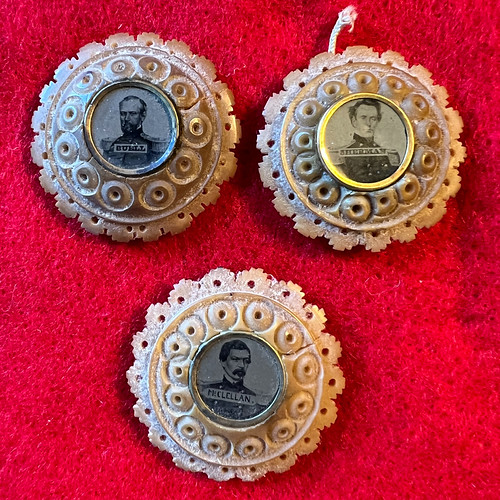
Civil War Union General ferrotypes in carved Tagua nuts
To read the earlier E-Sylum article, see:
JOHN A. BOLEN'S NUT CARVINGS
(https://www.coinbooks.org/v29/esylum_v29n40a13.html)
Alaska Rare Coins 83rd Fairbanks Auction
Len Augsburger writes:
The Alaska Rare Coins current mail bid sale concludes with an amusing lot:
305 SURPRISE PACKAGE: The Democratic Socialist branch of the Democratic Party has notified us that we should just give the Surprise Package away. We want to honor our Socialist friends, but simply cannot figure out how to do this. If a bidder bids "nothing," how can another bidder bid "more than nothing?" And if another bidder bid "less than nothing," we would have to pay them to take it. Only a socialist would understand this. Some how this just doesn't seem fair. So... We continue our traditional capitalist practice - bid a bunch for this lot so that we can flourish.
Nothing surprises me anymore, but this one did. There are some other interesting items at the end of the sale, including 1949 and 1953 Presidential Inaugural Programs, an ICG-graded coin lot, and an impressive Walrus Ivory Cribbage Board. The sale closes Friday, October 30th, 2026. For information, contact akcoins@mosquitonet.com . -Editor

MORE ON THE ANA'S FEDERAL CHARTER
Jeff Reichenberger submitted this interesting how-the-sausage-gets-made view into how the American Numismatic Association obtained its Federal Charter. Thanks! -Editor
 In 2007 I published a monograph concerning the ANA's Federal Charter and its congressional sponsor, William Ashbrook. (Charter Legacy, Numismatic Chronicle from the Diaries of William A. Ashbrook, 1905-1920). Ashbrook was an avid coin enthusiast and board member of the ANA at the time. He kept a daily
diary from which I extracted all the numismatic entries as the subject of the monograph.
In 2007 I published a monograph concerning the ANA's Federal Charter and its congressional sponsor, William Ashbrook. (Charter Legacy, Numismatic Chronicle from the Diaries of William A. Ashbrook, 1905-1920). Ashbrook was an avid coin enthusiast and board member of the ANA at the time. He kept a daily
diary from which I extracted all the numismatic entries as the subject of the monograph.
Fast forward to the present; I received correspondence from a gentleman who is a collector of political memorabilia from a county in Ohio that Ashbrook represented. He caught wind of the monograph and was interested in obtaining a copy, which I happily sent him.
On his next email he expressed thanks and, to my delight, attached a scan of a document he has in his Ashbrook collection. Having read the monograph, he was able to surmise that this letter was indeed about the ANA Charter. The letter from Ashbrook to Henry Chapman (who also served on the ANA board at the time) is dated January 30, 1912, apparently just shortly after the Charter Bill passed Congress.
Looking through archival copies of The Numismatist, the language concerning the Charter and Ashbrook's work to secure it drew great praise and suggested that it was a tough fight to get passed, but with this letter to Chapman, we get a first-hand account:
 January 30, 1912.
Henry Chapman, Esq.,
1348 Pine St., Philadelphia, Pa.
Dear Mr. Chapman:-
Well, I have just secured the passage of our Charter Bill, by the House, and had the fight of my life. I was in charge of the bill and was under running fire for two and one-half hours. Had two roll calls and much opposition. I will send you a copy of the Record in the morning, by which you will be able to see that I did not have easy sailing, and it was carried by only a small majority. However, it passed the House and I think I can now get it through the Senate without much trouble. I would not shoulder such a job again for much less than an 1804 Silver Dollar. J. Hampton Moore helped me out well. I wish you would write him and thank him.
With kind regards, I am, Very respectfully,
William Ashbrook
Here is Ashbrook's diary entry for the same day:
Tuesday, January 30, 1912
Had a very trying experience today. Ben Johnson, the chairman of the District committee, telephoned me that my charter bill to incorporate the American Numismatic Association had been reached and yielded the floor to me. For about three hours I had a running fire of questions with two roll calls. Sisson of Mississippi, and Shackelford of Missouri tried hard to defeat my bill, but it finally passed by a bare six votes. If it had not been that my card friends stood by me, I would have been licked. The Southern members are so afraid the states will lose some of their rights to the Federal Government. Very few charter bills have ever passed Congress, and I have occasion to feel good.
Clearly, the task was difficult, but perseverance paid off. Unfortunately, Ashbrook was never able to add that well-deserved 1804 Dollar to his collection.
*Joseph Hampton Moore was a member of the House from Pennsylvania (1906-1920) and later became the Mayor of Philadelphia.

WHY WWII JEFFERSON NICKELS LAMINATE
John Lorenzo writes:
 "I think non-error collectors may also be interested in this article I recently published in Mint Error News Issue # 97 on why WWII Jefferson Nickels laminate.
"Also on the Newman Portal. Readers can enter SEM/EDS in SEARCH in the Portal to see my other research papers.
"People are requested to contact me if they feel this "COMBINED" dual method analysis (XRF & SEM/EDS) can help them in their numismatic inquires.
"Here is the link: https://minterrornews.com/issue97.pdf. The article starts on page 144."
Thanks. A couple weeks back we published an analysis of the Roper New England sixpence which also involved XRF and SEM analysis. The article is very detailed, but here's the abstract. -Editor
Lamination in wartime Jefferson nickels reflects a multistage metallurgical failure rooted in both internal alloy behavior and later surface transformations. Bulk XRF measurements confirm that manganese levels remain below the Red Book's 9% reference value, demonstrating that the interior alloy retains its intended Cu–Ag–Mn proportions. Yet SEM/EDS exposes a more complex surface condition: thin, discontinuous zones of true Mn enrichment that migrate toward the upper metal layer and oxidize over time. These enriched layers are too subtle for XRF to detect, but their presence is metallurgically significant and directly tied to surface instability.
The internal structure shows its own vulnerabilities. During solidification, manganese's strong affinity for oxygen, sulfur, and chlorine produces brittle Mnoxide, Mnsulfide, and Mnchloride inclusions that fail to dissolve into the matrix. Rolling elongates these inclusions into stringers, creating weak internal planes that later manifest as lamination seams. SEM/EDS mapping confirms that these internal phases persist and remain chemically reactive, providing a structural foundation for delamination.
Surface processes compound these internal weaknesses. Over time, manganese migrates toward the exterior, forming mixed metallic/oxide transition zones that crack, oxidize, and interact with environmental sulfur and chloride species. Although XRF does not register these layers, EDS consistently identifies localized Mn enrichment that destabilizes the surface. Environmental exposure accelerates this degradation, as Mnbearing sulfides and chlorides react readily with moisture and pollutants, weakening both internal stringers and surface layers.
Together, the evidence demonstrates that lamination in WWII nickels arises from the combined effects of internal Mnoxide stringers and true Mn surface enrichment, with environmental reactions further driving the peel phenomenon. Both mechanisms are present, both are metallurgically credible, and current data does not allow prioritizing one over the other. Continued SEM/EDS mapping of enriched zones will help refine the relative contributions of each process.

VOCABULARY TERM: STYLE AND TECHNIQUE
Here's another entry from Dick Johnson's Encyclopedia of Coin and Medal Terminology. -Editor
Style and Technique. The manner and method of presenting a creative object. Style is the manner in which the object or any part of it is displayed, often done repeatedly on several objects until this becomes a mannerism of the artist. Technique is the method in which some creative action is accomplished. Such style and techniques are very personal, each artist must develop his own; he cannot have another artist hold his pen or brush or chisel or modeling tool, he must create on his own, develop his (or her) own style.
Mannerisms Influence Style
Artists often develop mannerisms – consciously or unconsciously – for any creative act that is repeated. This is evident in the numismatic and medallic field because of the ease of studying numerous pieces by the same artist. A medalist who prepares several dozen portraits, for example, will tend to do some portion of all portraits alike; an aspect of his design or modeling that is satisfactory to him on one portrait will be repeated on subsequent portraits. This is how a mannerism develops, and the repeated use of such mannerisms is said to be the artist's style.
American medallic sculptor Ralph Joseph Menconi prepared a mouth in a certain way; he did this in much the same manner on almost all portraits from the more than 600 medals in his life's work. The "Menconi mouth" was a mannerism, typical of his style. Medalist Victor David Brenner did the nude human foot in a certain way; hence the "Brenner foot." British medalist Paul Vincze most noted mannerism is his kneeling figure. When studying a large number of an artist's work such mannerisms can be ascertained. For art historians it is necessary to do such studies; occasionally they can attribute an unsigned work to a particular artist based on a study of style and mannerisms. The criteria for style is that: 1) it must be distinctive, and 2) it must be repeated.
Technique is an Acquired Skill
Once an artist learns of a method to prepare a certain portion of his work, and he is satisfied with this technique, he tends to repeat the same steps again in later works. This is part of the learning process and the total skillfulness of the artist; it is his knowhow and becomes a part of artistic repertory.
Artists learn such techniques from a variety of sources: from literature, from an associate, from a teacher, from the finished work of other artists (and masters!) and speculating on how it was done previously, or if he develops it on his own, perhaps by intuition, or just trial and error. He is seeking the methodology to solve the design or modeling task, the "how to" to proceed with the job at hand.
Once the artist meets and masters the problem, tries it and is satisfied with it, the technique becomes fixed in his mind and the skill remains his to be used again in the future when a similar design or modeling problem confronts him. If the mannerism, style or technique is passed on to other artists, who in turn utilized the same style in their work, this may create a school of art. The collective work of a group with a similar style in some capacity may become recognized by art historians as an important artistic development.
Not all mannerisms are limited to individual artists. Manufacturing companies may have their mannerisms as well. The Lombardo Company of Canada issued all their medals with an oblique border. Medallic Art Company issued medals with an integral loop with a small bead on each side of the loop. It is often obvious what firm manufactured a medal by the style, finish and mannerisms evident on the piece (even if unsigned).
To read the complete entry on the Newman Numismatic Portal, see:
Style and Technique
(https://nnp.washu.edu/Documents/Detail/style-and-technique/4362362)

FRANCIS WENDELL DUVALL
E-Sylum Feature Writer and American Numismatic Biographies author Pete Smith submitted this article on Society for U. S. Commemorative Coins founder Frank Duvall. Thank you - interesting subject. -Editor
 Two weeks ago, I noticed that Frank Duvall was born in July of 1926. I wondered if he was the
most recent numiscentenarian. This is a story with some big gaps. To learn more, read on.
Two weeks ago, I noticed that Frank Duvall was born in July of 1926. I wondered if he was the
most recent numiscentenarian. This is a story with some big gaps. To learn more, read on.
I believe Frank W. DuVall was born in Arkansas on July 16, 1926. I believe he graduated from Benton High School. His parents may have been Frank and Irma. Some early records are unreliable. This is the first gap in the story.
Frank was an aviation cadet in the U. S. Army near the end of World War II. He attended the University of Arkansas during 1946 to 1949 and received a B. S. in electrical engineering.
His obituary has the cryptic comment, "Frank made significant contributions to successful "Cold War" activities at the DOD." He worked for the Department of Defense for 27 years in "Rocket City," Huntsville, Alabama. One title was chief long range planning, research and development, Army missile command. That sounds impressive. What happened during this time is the next gap in the story.
In 1986 he was a director of American Investors Trust Company and affiliated with Trans- Southern Company.
He was married to Kathryn Josephine "Jo" Coffin in Saline, Arkansas, on August 21, 1948. They had two sons and a daughter and were married for 76 years.
Frank joined the ANA in December 1974 as member R-83268. DuVall lectured and exhibited at ANA conventions.
He was a founder of the Society for U. S. Commemorative Coins. He served as secretary in 1983 and as the president of the club in August 1985 to August 1986. He received life membership No. 1 in 1986. The club disbanded around 2011.
Duvall served on the board of the Alabama Numismatic Society for 1986-1989.
In the Fall 1998 issue of The Commemorative Trail, Duval announced that he had discovered a new variety of the Lafayette Dollar designated as DuVall 4-E. with the fourth obverse and fifth reverse. The coin was offered with his collection of commemorative coins in the Heritage ANA sale of August 9, 2007, as lot 2090. The piece realized $18,400.
 An obituary stated, "he also was the author of over 40 books on gravity, calculus, physics and
religion." One was New Gravitational Physics: Convergence of Science and Religion (2023). His
body of work may have included advances in science. There is probably a story in each of these
books.
An obituary stated, "he also was the author of over 40 books on gravity, calculus, physics and
religion." One was New Gravitational Physics: Convergence of Science and Religion (2023). His
body of work may have included advances in science. There is probably a story in each of these
books.
Late in life, Duvall lectured on scientific concepts. He made a presentation on May 3, 2015, at the Main Huntsville Library on "A Universal Theory of Gravitational Physics." The lecture was described as "simply explained." I wish I could have attended.
Frank DuVall died on January 9, 2025, at the age of 98 years and six months. He fell short of 100 by a gap of eighteen months.

NUMISMATIC AUTHOR M. SORENSON/SORENSEN
Adrián González-Salinas submitted this article on his search for information about a numismatic author. Thank you! -Editor
Identifying a Numismatic Author
A few months ago, I wrote a numismatic article about the Connecticutian Howard Lincoln Elton (1871–1916) who participated in the design of the 1916 Oaxaca $60 pesos gold coin and was executed by Mexican federal troops in Oaxaca, Mexico during the Mexican Revolution.
One of the numismatic references I used was the article "The Oaxaca Coinage of 1915" by M. Sorenson, published in "The Numismatist" in April 1920 (pages 142–145).

I always wondered about the author's identity (M. Sorenson). Upon reviewing information about him at the Newman Numismatic Project at WashU and in "The Numismatist" (ANA), I was able to confirm that he wrote several numismatic articles for various publications; in every instance, he appeared simply as M. Sorenson and never specifying what the initial "M." stood for.
Through all the searches mentioned earlier, I was able to confirm that he lived in Cedar Rapids, Iowa. So, I decided to look into genealogical records, taking into account the initial of his first name, his surname and his city of residence. I discovered that there was another person named M. Sorensen living at the same address. This led me to believe that it was actually the same person: M. Sorenson is also M. Sorensen.
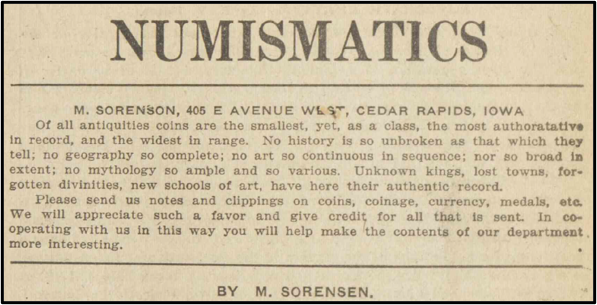
Column "Numismatics" in "The Philatelic West" of January, 1922.
Both M. Sorenson and M. Sorensen appear here.
In "The Numismatist" of March 1918, page 123, appears the Application for Membership de M. Sorensen (collector of U.S., Central and South American) with the address: 405 E. Avenue West, Cedar Rapids, Iowa and proposed by L. T. Brodstone and B. Max Mehl (1884-1957). Then, in April 1918 page 179, he appears as new member #1970 admitted on 01 April 1918 with the same address. In "The Philatelic West" of 01 January 1920 appears M. Sorensen like new member of the Chicago Coin Club.
According to "The Numismatist", M. Sorensen was ANA Iowa District Secretary since July 1923 thru October 1925 and, in November, 1925 he resigned. M. Sorensen changed of address from 405 E. Avenue West to 1030 No. 17th St. East in Cedar Rapids, Iowa. Again, he changed of address from 1030 17th Street East to 1923 C Avenue East in Cedar Rapid, Iowa.
"The Numismatist" (March 1924, page 254) published that M. Sorensen was taking charge of press notices in newspapers. Finally, in "The Numismatist" (September 1949), B. Max Mehl announces the purchase of the collection of Mr. M. Sorensen of Rapid Cedar, Iowa.


The Philatelic West. March 1926


The Numismatist, September 1949, A397
Michael Sorensen, whose Danish name was Mikkel Sørensen, was born in Aarhus (then spelled Århus), Denmark, on 15 November 1863.
His parents were Maren Jensdatter (born in Aarhus, Denmark, on 25 July 1828, and died in Skanderborg, Denmark, on 27 June 1888) and Søren Mikkelsen (born in Aarhus, Denmark, on 19 September 1831, and died there on 07 May 1864). They married in Aarhus on 31 March 1855. Michael's siblings were Karen Marie Sørensen (born in 1856), Abellone Sørensen (born in 1858), and Karen Sørensen (born in 1861).
Michael immigrated to the United States in 1883. On 04 September 1888, he was naturalized as a U.S. citizen in Warren County, New Jersey, renouncing his Danish citizenship.
On 19 August 1898, Michael married Andrea Karoline Nielsine Nielse (1877–1957) in Skanderborg, Denmark. They had two children: Martin Sorensen (1897–1965) and Alfred Eitel Sorensen (1904–1985).
Following the death of her first husband, Maren Jensdatter (his mother) married Christian Kristiansen (1827–1883) in Aarhus on 31 May 1865. Their children were Søren Michael Kristiansen (1866–1866), Jensine Severine Kristiansen (1867–1889), Dorthea Marie Kristiansen (1871–1872), and Jens Karl Kristiansen (1874–1957).

Signature of Mikkel Sørensen (1888)

Aarhus (Århus), Danmark
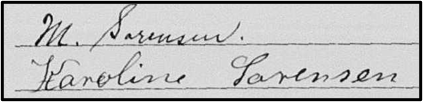
Signatures of Michael Sorensen and Karoline Sorensen (1919)

Michael Sorensen's death certificate states that he died of generalized arteriosclerosis at his home, located at 2460 Portsmouth in Toledo, Ohio on 16 October 1946. His age was recorded as 85 years and 11 months. His usual occupation was listed as translator, and his son Alfred E. Sorensen provided the information for the death certificate.
Michael Sorensen is buried in Oak Hill Cemetery in Cedar Rapids, Iowa, alongside his wife, Caroline. Unfortunately, I was unable to find a photograph of him.
Adrián identified a total of 52 articles published in the names M. Sorensen (32 articles) and M. Sorenson (20 articles). -Editor


HERITAGE: BYZANTINE ANCIENT COINS
Heritage Auctions will be hosting their Byzantine Ancient Coins Showcase Auction on October 12. Select items are discussed below. -Garrett


Phocas (AD 602-610). AV solidus (20mm, 4.50 gm, 7h). NGC MS 5/5 - 4/5. Constantinople, 10th officina, ca. AD 607-610. d N FOCAS-P?RP AVG, draped, cuirassed bust of Phocas facing, wearing crown surmounted by cross, globus cruciger in right hand / VICTORIA-AV?? I, Angel standing facing, grounded staff surmounted by staurogram in right hand, globus cruciger in outstretched left; CONOB in exergue. Sear 620.
To read the complete item description, see:
Phocas (AD 602-610). AV solidus (20mm, 4.50 gm, 7h). NGC MS 5/5
- 4/5.
(https://coins.ha.com/itm/ancients/byzantine/byzantine-phocas-ad-602-610-av-solidus-20mm-450-gm-7h-ngc-ms-5-5-4-5/a/61662-25019.s?ctrack=200071&type=featured-1-coinus-news-tem100626)


Heraclius with Heraclius Constantine (AD 613-641). AV solidus (20mm, 4.44 gm, 6h). NGC MS 5/5 - 4/5. Constantinople, 10th officina, ca. AD 626-629. dd NN h?RACLI?S ?T h?RA CONST PP AV, facing busts of Heraclius, bearded (on left), and Heraclius Constantine, slightly smaller and beardless (on right), both wearing chlamys and simple crown surmounted by cross; cross above between them / VICTORIA-AV?? I T, cross potent with base on three steps; CONOB below. Sear 746.
Heraclius' reign began after he and his father, Heraclius the Elder, a prominent general, successfully revolted against Emperor Phocas in AD 608. After Heraclius killed Phocas in Constantinople, alliances easily shifted and he was crowned emperor in AD 610 - Heraclius the Elder dying soon after of natural causes. Heraclius quickly took control of the Byzantine-Sasanian War, turning the tides and defeating the Persians by AD 627. This was not without help from his eldest son, Heraclius Constantine, who was crowned co-emperor AD 613. Unfortunately, their victory would open the door for the Muslim Arab Caliphates, who used the Persians defeat to expand their territory. This would begin the Arab-Byzantine wars that would go on to last for three centuries. The reach of the Byzantines wanned, losing the Levant and most of Egypt to the Caliphates over the next decade. Shortly after, Heraclius would die of illness in AD 641, leaving Heraclius Constantine as sole emperor for three months before he too died of illness
To read the complete item description, see:
Heraclius with Heraclius Constantine (AD 613-641). AV solidus
(20mm, 4.44 gm, 6h). NGC MS 5/5 - 4/5.
(https://coins.ha.com/itm/ancients/byzantine/byzantine-heraclius-with-heraclius-constantine-ad-613-641-av-solidus-20mm-444-gm-6h-ngc-ms-5-5-4-5/a/61662-25035.s?ctrack=200071&type=featured-2-coinus-news-tem100626)


Irene, Sole Reign (AD 797-802). AV solidus (19mm, 4.40 gm, 5h). NGC Choice AU 3/5 - 4/5. Constantinople. ?IRIhH-bASILISSH, bust of Irene facing, wearing loros and crown with pendilia, two pinnacles, and cross in center, globus cruciger in right hand, transverse cruciform scepter in left / •-?IRIhH-bASILISSH T, bust of Irene facing, wearing loros and crown with pendilia, two pinnacles, and cross in center, globus cruciger in right hand, transverse cruciform scepter in left. Sear 1599.
To read the complete item description, see:
Irene, Sole Reign (AD 797-802). AV solidus (19mm, 4.40 gm, 5h).
NGC Choice AU 3/5 - 4/5.
(https://coins.ha.com/itm/ancients/byzantine/byzantine-irene-sole-reign-ad-797-802-av-solidus-19mm-440-gm-5h-ngc-choice-au-3-5-4-5/a/61662-25077.s?ctrack=200071&type=featured-3-coinus-news-tem100626)

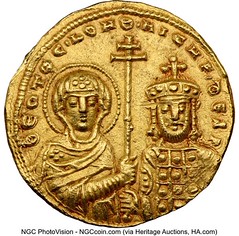
Nicephorus II Phocas (AD 963-969). AV histamenon nomisma (20mm, 4.38 gm, 6h). NGC Choice AU 5/5 - 2/5, scuffs, clipped, edge bend. Constantinople, AD 963-969. + IhS XIS R?X' R??NANTInm, bust of Christ facing, wearing nimbus cruciger with two pellets in top arm and three pellets in side arms, pallium and colobium, raising right hand in benediction, book of Gospels cradled in left arm / + T?OTOC' ? OHT nICHF d?SP, half-length facing busts of the nimbate Virgin (on left), wearing stola and maphorium, and Nicephorus II (on right), wearing loros and crown with pendilia and surmounted by cross, jointly holding patriarchal cross with pellet on shaft between them. Sear 1778 var. (M-T flanking Virgin Mary).
One of the greatest generals of his age, Nicephorus Phocas led the armada that reclaimed Crete for Byzantium after 130 years of Arab rule. He followed up by annexing Cyprus and capturing Aleppo. These stupendous victories led the army, following the death of Romanus II in March AD 963, to acclaim Nicephorus as Emperor. Returning to Constantinople, he married Theophano, the widow of Romanus II, and proclaimed himself protector of her two young sons Basil II and Constantine VIII, who became subordinate Emperors. Nicephorus continued the offensive against the Caliphate, which fell back on all fronts before the disciplined Byzantine forces. Theophano, however, found him physically repulsive, remote and austere, and sought refuge in the arms of a dashing soldier, John Tzimisces. Together they plotted and carried out the murder of Nicephorus in December of AD 969.
It is during this reign that the term "solidus" is replaced by "histamenon nomisma" as a name for the standard Byzantine gold coin. A second, slightly lighter denomination, the "tetarteron nomisma," was also introduced.
To read the complete item description, see:
Nicephorus II Phocas (AD 963-969). AV histamenon nomisma (20mm,
4.38 gm, 6h). NGC Choice AU 5/5 - 2/5, scuffs, clipped, edge
bend.
(https://coins.ha.com/itm/ancients/byzantine/byzantine-nicephorus-ii-phocas-ad-963-969-av-histamenon-nomisma-20mm-438-gm-6h-ngc-choice-au-5-5-2-5-scuf/a/61662-25079.s?ctrack=200071&type=featured-4-coinus-news-tem100626)


Phocas (AD 602-610). AV solidus (20mm, 4.43 gm, 7h). NGC Gem MS 5/5 - 5/5. Constantinople, 10th officina, ca. AD 607-610. d N FOCAS-P?RP AVG, draped, cuirassed bust of Phocas facing, wearing crown surmounted by cross, globus cruciger in right hand / VICTORIA-AV?? I, Angel standing facing, grounded staff surmounted by staurogram in right hand, globus cruciger in outstretched left; CONOB in exergue. Sear 620.
Ex Heritage Auctions, Auction 231350 (12 December 2013), lot 62188.
To read the complete item description, see:
Phocas (AD 602-610). AV solidus (20mm, 4.43 gm, 7h). NGC Gem MS
5/5 - 5/5.
(https://coins.ha.com/itm/ancients/byzantine/byzantine-phocas-ad-602-610-av-solidus-20mm-443-gm-7h-ngc-gem-ms-5-5-5-5/a/61662-25018.s?ctrack=200071&type=featured-5-coinus-news-tem100626)


Nicephorus I and Stauracius (AD 803-811). AV solidus (20mm, 4.42 gm, 6h). NGC MS 4/5- 3/5, brushed, light marks. Constantinople, AD 803-811. hICI-FOROS bASIL?', crowned facing bust of Nicephorus I, wearing mustache and short beard, chlamys pinned at right shoulder, cross potent with base in right hand, akakia in left; pellet in left field / StAVRA-CIS d?SPO' ?, crowned facing bust of Stauracius, beardless, chlamys pinned at right shoulder, globus cruciger in right hand, akakia in left. Sear 1604.
To read the complete item description, see:
Nicephorus I and Stauracius (AD 803-811). AV solidus (20mm, 4.42
gm, 6h). NGC MS 4/5- 3/5, brushed, light marks.
(https://coins.ha.com/itm/ancients/byzantine/byzantine-nicephorus-i-and-stauracius-ad-803-811-av-solidus-20mm-442-gm-6h-ngc-ms-4-5-3-5-brushed-light-m/a/61662-25078.s?ctrack=200071&type=featured-6-coinus-news-tem100626)

NOONANS: SPECIMEN BANKNOTES OF THE WORLD
Noonan's is selling a collection of world specimen banknotes to raise funds for the British Heart Foundation. Here's the press release. Nice notes! -Editor

Lot 24 - Board of Commissioners of Currency Malaya and British Borneo
Almost 160 lots of Specimen Banknotes of the World will be sold on behalf of British Heart Foundation (BHF) at Noonans on Wednesday, October 14, 2026. The collection, which was donated in albums to the BHF store in Edinburgh is expected to fetch in the region of £70,000.
Allison Swaine-Hughes, Chief Commercial Officer at British Heart Foundation, said: "We're hugely grateful to the donor for entrusting this extraordinary collection to British Heart Foundation. While donations of this scale and rarity are unusual, many people choose to donate special items to us knowing they can help make a lasting difference. Through our retail operation and eBay site, our teams are able to connect collectable treasures with passionate collectors who will cherish them for years to come. We're hugely grateful to Noonan's for their support with this particularly rare donation and ensuring the proceeds go towards lifesaving research. "This remarkable collection will help create a legacy that benefits both collectors and the millions of people affected by cardiovascular disease."
As Andrew Pattison, Head of Banknotes Department at Noonans commented: "Noonans are greatly honoured to be working with the British Heart Foundation to auction this tremendous group of specimen banknotes. Such a collection comes up so infrequently that collectors are certain to respond extremely positively. With rarities on offer from all over the world, we estimate the notes could be making their way to as many as fifty different countries. In addition, we are sure that our bidders will respond well to the fact that the sale proceeds are going to fund vital research and can be relied upon to go that little bit further on the day."
Among the highlights is an uncirculated and rare note bearing the portrait of a young Queen Elizabeth II from the Board of Commissioners of Currency Malaya and British Borneo which is estimated at £3,000-£4,000 [lot 24], while from the National Bank of Iraq is a an extremely rare example of a colour trial 10 Dinars note dating from 1947 with the serial number A000000 that carries an estimate of £3,000-£4,000 [lot 46]


Lot 56 - South African Reserve Bank

Lot 12 - Government of Fiji
A rare specimen 100 Riyal note from the Saudi Arabian Monetary Agency, dating from 1961 with serial number 5/000000 is estimated at £2,000-£3,000 [lot 116] and a particularly rare £100 note dating from 1952 from the South African Reserve Bank bearing the Afrikaans language and serial number 000000 is estimated at £1,200-£1,600 [lot 56]. An example of a colour trial of a £20 note from the Government of Fiji, also featuring a portrait of a young Elizabeth II and dating from 1953, with no serial numbers or signatures is expected to fetch £800-£1,200 [lot 12].


Lots 136 and 137
There is also a sizeable group of Scottish material, including two different hand painted designs for Royal Bank of Scotland notes that were never put into production. Each of the unique designs is housed in its own presentation album and shows workmanship of the highest quality. They are estimated at £500-£600 each. [lots 136+137].
GADOURY: AUCTION XXI FRENCH GOLD ROYALES
Gadoury will be hosting their Auction XXI French Gold Royales Selections on October 17. Select items are discussed below. Lot descriptions have been machine-translated to English; see the complete original descriptions online. -Garrett

Henry VI, King of France and England 1422-1453 Angelot d'or for Rouen (initial mark leopard), AU 2.35 g. Obverse: The archangel Gabriel half-length facing, holding the joined shields of France and France-England. Reverse: Plain Latin cross flanked by a fleur-de-lis and a leopard. Ref: Dup. 444, Fr. 300. Ex Silberstein Collection. Grading: PCGS MS 61. Condition: An exceptional coin.
To read the complete item description, see:
Henry VI Angelot d'or of Rouen
(https://www.biddr.com/gadoury/auction?a=7428&l=9107137)

Henry VI, King of France and England 1422-1453 Salut d'or, Saint-Lô (fleur-de-lis mark), 1423, AU 3.50 g. Obverse: HENRICVS: DEI: GRA: FRACORV: Z: AGLIE: REX. The archangel Gabriel standing before the Virgin Mary, to whom he extends a scroll bearing the word AVE; behind, the joined shields of France-England, above a blessing hand. Reverse: XPC'* VINCIT'* XPC'* REGNAT'* XPC'* IMPERAT. Ref: Dup.443, Fr. 301. Ex Parsy Sale, 13-12-2005, lot 207. Ex Lucerne Hoard (La Haye-Pesnel, 1968). Grading: NGC MS 66+. Condition: Magnificent specimen, FDC.
To read the complete item description, see:
Henry VI Salut d'or of Saint-Lô
(https://www.biddr.com/gadoury/auction?a=7428&l=9107139)

Louis XIV 1643-1715 Double Louis d'or "au soleil" 1712 A, Paris, AU. Ref: G.264 (R), Fr.443, Dy. 1448. Grading: NGC MS 64. TOP POP: the finest graded example. Condition: Well struck on a broad, regular flan, showing very high relief. A specimen of exceptional quality. Unique in this state. Fleur de coin.
To read the complete item description, see:
Louis XIV Double Louis d'or au Soleil, 1712-A
(https://www.biddr.com/gadoury/auction?a=7428&l=9107182)

Louis XIV 1643-1715 Piedfort Quadruple Double Louis d'or with Short Wick, Paris, 1644, AU 53.91 g. Inscribed edge: PONDERE . SANCTUARII . Obverse: Childlike head of the king to right, laureate, with short hair. Reverse: Cross formed of eight back-to-back L's, cantoned by four fleurs-de-lis. Mintmark letter in a circle at the center. Ref: G. 257 (R5), Ciani 1783. Grading: PCGS SPECIMEN 53. TOP POP. Condition: almost Superb. Of the highest rarity. Weight of 8 louis d'or. A very fine specimen.
To read the complete item description, see:
Louis XIV Piedfort Quadruple Double Louis d'or, 1644
(https://www.biddr.com/gadoury/auction?a=7428&l=9107183)
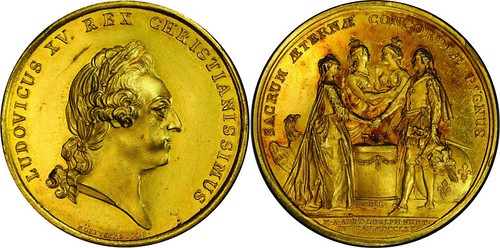
Louis XV 1715-1774 Gold medal struck on the occasion of the marriage of the Dauphin Louis (XVI) and the Dauphine Marie-Antoinette, by Lorthior, 1770, Paris, AU 31.05 g. 34.6 mm. Obverse: LUDOVICUS XV REX CHRISTIANISSIMUS. Aged head of the King, laureate, to right; below, signature LORTHIOR. F. Reverse: SACRUM ÆTERNÆ CONCORDIÆ PIGNUS. The couple holding hands above an altar. Behind, France, with the globe of the three lilies, and Austria, with a double-headed eagle, intertwined; signature LORTHIOR. F. In exergue: M. A. AUSTR. L. DELPH. NUPT. / XVI MAII MDCC LXX. Ref: Divo 178. Ex Silberstein Collection. Grading: PCGS MS 62. TOP POP. Condition: Superb specimen with an attractive golden patina and very high relief. Very rare, especially in this state of preservation.
To read the complete item description, see:
Louis XV Gold Medal for the Dauphin's Marriage, 1770
(https://www.biddr.com/gadoury/auction?a=7428&l=9107197)

Louis XVI 1774-1792 Louis d'or with draped bust, Paris, 1784 A, 1st semester, AU. Ref: G.359, Dy.1704. Grading: PCGS MS 61. TOP POP. Condition: Superb specimen, the finest graded by PCGS.
To read the complete item description, see:
Louis XVI Louis d'or with Draped Bust, 1784-A
(https://www.biddr.com/gadoury/auction?a=7428&l=9107198)

Louis XVI 1774-1792 Double Louis d'or of Béarn with draped bust, Pau, 1778, AU 16.28 g. Ref: G.362b (R5), Fr. 470. Ex Collection Dr. F. Grading: NGC MS 62. TOP POP: the finest graded. Condition: Superb and extremely rare.
To read the complete item description, see:
Louis XVI Double Louis d'or of Béarn, 1778
(https://www.biddr.com/gadoury/auction?a=7428&l=9107203)
SEDWICK AUCTION 40
Sedwick's Treasure, World Coin and Paper Money Auction 40 is now online. Here is the press release. -Garrett
Our November 5 and 6 sessions will be held on the floor, with live bidding beginning at 9:00 a.m., followed by an online only session on November 7, www.auction.sedwickcoins.com. The sale brings together important rarities and substantial specialized offerings, including superb Chilean gold and silver, an extensive selection of Colombian coinage, and rare banknotes from both countries.
More than 500 shipwreck coins include selections from the J. M. Morse III Collection, whose Atocha artifacts also feature in the sale. Historic gold and silver bars and the Special Collection of Odd Shaped Mexican Cobs add further interest, while several unique coins and numerous examples at the highest certified grades appear throughout the catalog. Many coins also carry important pedigrees from earlier sales and the collections of well known numismatists, with provenance recorded in several sections of the auction.

The gold cobs begin with a fine selection of mainland Spanish issues, followed by Mexican and South American gold. Leading this section is the Mexico City 1714 J Royal 8 escudos from the 1715 Fleet, NGC MS 65 (lot 21). The Bogotá 1753 cob 8 escudos, NGC AU 55 (lot 39), is another important highlight, illustrated in several standard references and with a documented pedigree extending back to 1936.
Collectors of Mexican gold will find a particularly significant opportunity in the three denominations of 1732, the first year of machine struck gold coinage in the Americas. Offered individually in lots 1205 through 1207, the 4 escudos in NGC MS 60 (lot 1205), 2 escudos in NGC AU 58 (lot 1206), and 1 escudo in NGC MS 61 (lot 1207) form an exceptional group, all at the top of their respective NGC censuses.
Our shipwreck selections range from choice individual coins to substantial groups from well documented recoveries. Among them, the Morse Collection contributes Atocha coins, artifacts, and a substantial gold "finger" bar. Another gold bar from the Santa Margarita accompanies early silver "tumbaga" bars and large colonial silver ingots, offering collectors a strong representation of the bullion carried aboard the treasure fleets. The artifacts include gold jewelry, navigational instruments, silverware, and porcelain, as well as a massive Spanish bronze naval cannon cataloged as a recovery from the 1588 Armada (lot 517). Among the opening lots of Mexican silver is a very rare Charles and Joanna "Early Series" 3 reales, assayer Rincón, PCGS XF45 (lot 579). This short lived denomination belongs to the earliest coinage of the Mexico City mint, with the present example the finest graded by either PCGS or NGC for the variety with three dots indicating the denomination.
The Special Collection of Odd Shaped Mexican Cobs provides an engaging look at colonial mint production. Assembled over many years, its 67 pieces demonstrate the extraordinary forms created in the preparation and cutting of silver blanks, including elongated flans, unusual projections, and natural holes. With examples from the 1715 Fleet and other documented recoveries, this distinctive collection has much to offer collectors of cobs in general.

Chile is especially well represented in the difficult colonial gold denominations of 4, 2, and 1 escudos. The celebrated Santiago 1758 J 2 escudos from the Segarra Collection, NGC AU 53 (lot 860), leads this offering as one of only three known. Further selections from the Val y Mexía Collection accompany an extensive run of colonial portrait silver and smaller denominations. The rare La Serena countermarked 4 reales from the Virgil Brand Collection (lot 916) deserves particular attention.
The Colombian offering presents hundreds of coins at a range of levels suitable for both advanced collectors and those beginning to explore the series. With many uncertified examples and unusually complete selections, it provides a rarely seen opportunity to follow the development of Colombian coinage from its early Bogotá and Cartagena cobs through colonial portrait issues, Republican gold and silver, and patterns.
The Bogotá 1769 JV "rat nose" 8 escudos, NGC MS 62 (lot 958), represents one of the principal Colombian rarities in the sale, while the 1870 Popayán gold 10 pesos (lot 1057) and 1869 silver 5 décimos (lot 1066) are important Republican highlights. Together, the group offers both significant individual pieces and the breadth needed to build or expand a collection across the history of Colombian coinage. Important pedigrees from established collections and earlier auctions appear throughout this section as well.
 Another notable early colonial rarity is the Santo Domingo 4 reales of Charles and Joanna, assayer F (lot 1113). From the Rudman Collection and illustrated in Calicó, it is one of only five known of its type, an important opportunity for collectors of the earliest silver coinage of the Americas.
Paper money brings another important specialty to the sale. Early Chilean local currency, private bank issues, and fiscal overprints are complemented by Colombian proofs, specimens, and rare private emissions. The 1840 Valdivia 4 reales (lot 1472), the unique Banco de Colombia 50 pesos proof of 1875 (lot 1475), and the Banco de Bogotá 10 pesos of the same year (lot 1476) are among the principal attractions. Several notes are illustrated in specialist references, making this a valuable opportunity to acquire documented rarities from these challenging series.
Be sure to review the final online only session on November 7, with additional coins and collecting groups across a wide range of estimates. We thank our consignors for entrusting us with this material and wish all our bidders the best of luck in Auction 40!
To read the complete catalog, see:
Sedwick Auction Printed Catalog # 40
(https://www.paypal.com/ncp/payment/Q9Q3MCB398NMQ?mc_cid=7e6bcc90c5&mc_eid=119ff47984)
To read a related earlier E-Sylum article, see:
1715 FLEET SOCIETY: ODDLY SHAPED MEXICAN COBS
(https://www.coinbooks.org/v29/esylum_v29n40a26.html)

HOLABIRD JACK HADDOCK NEVADA TOKENS, PART 1
While Fred Holabird has retired and closed his auction business, he left the door open some special private sales from time to time. One of those will take place November 6, 2026 when Holabird offers the Nevada Town token collection of Jack Haddock. The sale announcement is far more than just that - Fred delves into the history of Nevada token collecting, research and rarity as well as new digging and detecting techniques and advanced digital research platforms. It's lengthy and quite useful. Here's the first of four parts. -Editor

Jack started collecting tokens before he could count his toes. I met him in 1976 when I was enthralled by embossed local drugstore bottles. The concept that these could come from remote Nevada ghost towns was one I couldn't get away from. Then the fact that as a mining geologist, I got to go all over Nevada to many of these sites … and get paid for it! Wow! Then Jack says "Wait a minute! There's tokens that go with these places!" I was hooked. Oh yeah – that was fifty years ago.
Jack worked for the First National Bank of Nevada, and he too got to get out and about a bit, as he got involved with bank real estate deals. A jovial character, he found and met many collectors across Nevada, and introduced me to many. I wasn't after tokens at first, but what really got me going later was after a number of years in the mining exploration business, I had been to so many of these crazy, nutty little mining camps that I just had to collect stuff rom them. Paper, tokens, bottles … it didn't matter. Bring it on!
We put together the first Nevada token and bottle book in 1977. It was a softbound book with yellow cover. Jack had a great idea of putting a copy of a blank Virginia and Truckee Railroad stock certificate on the back, and we would fill in the collector's name that bought the book. I loved the idea. Back then, the only reference work that even remotely covered the fact that Nevada Ghost Town tokens existed, was a book by Adele Reed in 1974, "We Dug Those Dumps." Adele and her husband Bill were wonderful folks, and as I did geologic work in the White Mountains east of Bishop, I got to spend a lot of time with them. Her Nevada token collection was the first big Nevada tokenc ollection that Jack purchased, and it really got him going. Me? I was still stuck on gold/silver deposits and old bottles!
John Schilling, one of the co-authors of the first book exclusively devoted to Nevada Tokens along with Sheriff Hal Dunn (of Carson City) and Len Hoskins (of Elko) was a good friend and another mining guy. He got his start in New Mexico, and years later became the chief geologist for the Nevada Bureau of Mines for 17 years. Naturally, he collected Nevada and New Mexico tokens, so I got to meet all his collecting buddies in both states too! I sold John's Nevada token collection, along with mine (at the time) many moons past … maybe in the 1990s … memory fades. It was a lot of fun for everybody. Later, I sold Hal's collection too.
Meanwhile Jack got picky. His favorite were tokens with the state name spelled out entirely. In a quick statistical study, that's about 15% of all different Nevada tokens by variety in 1990. In short, 295 different Nevada tokens have the word spelled out "NEVADA" out of 1919 tokens listed in the 1990 Nevada token catalog. Jack's collection is so special that perhaps 25% of the collection is, was, or was thought to be unique. Another 25% may be only two specimens known. Another fun fact is that most of the businesses issuing tokens were saloons, hence the twelve and a half cent value, or "one bit" drink.
Collectors have chosen to collect in many ways:
- County
- Specific towns (165 different in this collection)
- Saloons (tokens that state "saloon") (40 in this collection)
- One token per town
- Pictorial (8 in this collection)
- Brunswick, Balke, Collender reverses (6 in this collection)
- Chas. Pick reverses (2 in this collection)
- Pool halls
- Drug stores
- Mining tokens
For more information on the sale, or to bid, see:
Jack Haddock Nevada Town Token Collection Auction(Session 1)
(https://holabirdamericana.liveauctiongroup.com/auctionlist.aspx?t=JH1)

COIN OF KING ETHELRED THE UNREADY FOUND
Jim Haas passed along this one about a coin of King Ethelred the Unready unearthed in the Shetland Islands. Thanks. Weirdly, the article does not include an image of the side of the coin depicting Ethelred. -Editor

Archaeologists in Scotland recently uncovered an Anglo-Saxon coin dating back 1,000 years that was minted under a king known as "the Unready."
The coin was unearthed during an excavation in Nesting, a coastal community in Scotland's eastern Shetland Islands, according to Jam Press.
The excavation was originally conducted to investigate prehistoric structures threatened by coastal erosion, according to Archaeology Shetland.
The archaeological investigation included an examination of nearby Iron Age structures.
The artifact was minted between 991 and 997 A.D., Jam Press noted.
The coin's face depicts King Ethelred the Unready, who ruled England from 978 to 1013 A.D.
Ethelred, best known for his failed attempts to fend off Viking invasions, was eventually driven from the throne by Danish King Swein Forkbeard.
He regained power in 1014 and ruled until his death in 1016, making him the longest-reigning Anglo-Saxon monarch.
To read the complete article, see:
Rare coin bearing face of king with infamous nickname unearthed after 1,000 years
(https://www.foxnews.com/travel/rare-coin-bearing-face-king-infamous-nickname-unearthed-after-1000-years)
THE BOOK BAZARRE
RARE COIN OF OLAF THE HOLY IDENTIFIED
A rare coin of Olaf the Holy has been found in the Mørstad Hoard. -Editor

Anne Skogsfjord had initially classified the coin as an English Æthelred II coin.
Since the summer, she has catalogued hundreds of coins from the Mørstad Hoard – Norway's largest coin hoard from the Viking Age, which was discovered by two metal detectorists this spring.
But then she read what was written on it: ONLAF R+ NORMANORV.
"Could I really be holding an Olaf Haraldsson coin in my hands? And it turned out that I actually was!" Skogsfjord says in a press release from the Museum of Cultural History.
Only 20 coins issued by Olaf Haraldsson – Olaf the Holy himself – have been found, and most of them were discovered outside Norway.
Only four examples of the type now found in the Mørstad Hoard have previously been discovered, with just one of them in Norway.
Olaf the Holy was king of Norway from 1015 to 1028.
According to the Great Norwegian Encyclopedia, he was 'without doubt the most significant of the Norwegian kings during the Viking Age and the Middle Ages.'
He played an important role in the introduction of Christianity. He died at the Battle of Stiklestad, but lived on as Norway's patron saint after his death.
The Olaf Haraldsson coin depicts the king in profile, wearing a conical battle helmet. ONLAF R+ NORMANORV is written around the image. It means Olaf, king of the Norwegians.
On the reverse side of the coin, there is a cross and a Christian tribute.
To read the complete article, see:
Sensational coin discovery: "We have found a national treasure"
(https://www.sciencenorway.no/archaeology-culture-the-viking-age/sensational-coin-discovery-we-have-found-a-national-treasure/2721235)
Rare coin of Norway's King Olaf Haraldsson found in the country's largest Viking hoard
(https://archaeologymag.com/2026/10/rare-coin-of-norways-king-olaf-haraldsson-in-viking-hoard/)
KING HAROLD II'S BAYEUX TAPESTRY DEPICTION
Arthur Shippee passed along this British Museum video about King Harold II and one of the most famous years in English history. The Museum is hoping to acquire a coin hoard "discovered in Yorkshire, England, that shows Harold in a different light." -Editor
 You may know King Harold II for one thing: losing the Battle of Hastings in 1066. But is this Harold's whole story?
In 2023 a remarkable coin hoard was discovered in Yorkshire, England, that shows Harold in a different light.
This is the first recorded hoard of coins which can definitely be dated to the year 1066. Containing only coins struck during Harold's brief reign of 282 days, the hoard reveals a king whose authority was recognised across England, and whose government could produce new coins with great speed.
Join Elina Screen, Curator of Medieval and Modern Coin Collections at the British Museum, to find out what this discovery tells us about this king and one of the most famous years in English history.
To watch the complete video, see:
How Harold was depicted before the Bayeux Tapestry (and what it tells us) | Curator's Corner Ep101
(https://www.youtube.com/watch?v=qHLr0QeJcSc)

15TH CENTURY MOSCOW COIN HOARD FOUND
Paul Horner passed along this article about a 15th century coin hoard found near Moscow. Thanks. -Editor
 A hoard of over 2,600 silver coins were found during rescue excavations in Kolomna, the Russian Academy of Sciences' Institute of Archaeology announced in a statement late last week, marking it the the largest hoard of silver coins minted in the second and third decades of the 15th century ever found.
Many of the coins are dengi of the Grand Princes Vasily I Dmitriyevich (1389-1425) and Vasily II Vasilyevich "the Blind" (1425-1462), while there is a near-complete absence of coins minted by appanage princes.
The large sum has led archaeologists to conclude that its owner had been wealthy, likely belonging to the upper class at the time.
As the latest coins in the hoard date to the second half of the 1420s, researchers theorize that the owner may have fallen victim to one of the epidemics that swept through Russia between 1425-1427.
Notably, a significant number of the coins from Dmitriyevich's reign were minted in Kolomna itself and bear the likeness of a flying bird, a rarity in such coins found in other regions of Russia.

Coin of Grand Duke Vasily Dmitrievich, minted in Moscow
Within the hoard, researchers discovered over 350 previously unknown varieties of Kolomna coins, as well as other types of coins absent from collections displayed at many of Russia's museums.
The hoard also allows for the identification of the final Kolomna coins issued with the bird's likeness, dating to the end of Dmitriyevich's reign.
To read the complete article, see:
(https://www.yahoo.com/news/world/articles/silver-coin-hoard-found-outskirts-190337940.html)
MORE ON THE BUFFALO BILL CENTER PEACE MEDALS
This Cowboy State Daily article highlights the Indian peace medals in the Buffalo Bill Center of the West collection that we recently discussed. Thanks to Tim Coil for passing this along. -Editor

Two rare Jefferson peace medals that have been part of the Buffalo Bill Center of the West collection for decades have been confirmed as authentic artifacts from the 1804 Lewis and Clark expedition.
One is a large Thomas Jefferson "shell" medal — a hollow medal assembled from silver outer pieces. It is one of only three of that size carried by the Corps of Discovery from 1804 to 1806. The other is a 2-inch Jefferson shell medal, one of 16 of that size carried by the expedition.
Historical research suggests the large medal might be the one presented to a Mandan chief known as Black Cat during an October 1804 council. The smaller medal could be linked to Cameahwait — Sacagawea's brother — a Shoshone leader the expedition met in 1805.
These identifications have not been described as final but have a high likelihood, according to professional numismatist Lawrence Lee, who was hired to sort out the authenticity and historical background of the High Plains Museum's collection of 33 peace medals.
Four of the rarest medals are now on display in the Rendezvous Hall of the Center of the West. Later, a more permanent location will be developed for these historically significant artifacts.
Lewis and Clark took 89 peace medals of varying sizes on their 1804 Discovery Corps expedition, but only three of the largest-sized medals, which were reserved for the most important American Indian chiefs of the time.
Peace medals were meant to signify an agreement between nations to maintain peace, and were in common use before the Corps of Discovery by countries such as France, England, and Spain.
"Medals were given as a source of reciprocity," Hunter Old Elk, the Buffalo Bill Center of the West's Plains Indian curator, told Cowboy State Daily. "They only ever gifted these to the highest and revered leaders of a tribal community. Mostly the chief, or the military leader, and then they were passed down through families."
The medals were framed as gifts of peace and friendship. They were meant to replace any peace medals given by other countries.
Lee was also able to verify two bootleg, fur trader medals, which he said are also rare.
"Private individuals were giving out lookalike medals," he said. "These were diplomatic medals. They were supposed to be the sign of a treaty between one nation and another nation. When you get fur traders giving these out, they don't have that level of government authority."
Congress passed a law in 1844 to ban that practice, Lee said.
"What they did then was predate all their medals to 1843," he said, adding, "There's only seven known of them."
To read the complete article, see:
Buffalo Bill Center Confirms It Has Rare 1804 Lewis & Clark Expedition Peace Medals
(https://cowboystatedaily.com/2026/09/13/buffalo-bill-center-confirms-it-has-rare-lewis-clark-expedition-peace-medals/)
To read the earlier E-Sylum article, see:
LIKELY LEWIS & CLARK INDIAN PEACE MEDALS
(https://www.coinbooks.org/v29/esylum_v29n36a11.html)

WWII PRISONER OF WAR AND OTHER MEDALS
Jim Haas submitted this memorable story of two WWII B-24 Bomber crewmembers and a fellow prisoner of war. Every medal has a story behind it. Thanks for this one. -Editor
My friendship with WWII veteran Edwin E. Kamaraininen began in February 2005 when I was doing research on another airman, Herman Bauer, whose roots were in in my hometown, College Point, NY. He was Navigator on the Dorty Treek, a B-24 Bomber shot down on November 26, 1944 over Misburg Germany near Hannover.

Ed Kamaraininen's B-24 Bomber the Dorty Treek

Ed Kamaraininen - top row middle
Discovering Ed's story on the Internet, I was able to contact him and learned that Bauer did not survive. Ed, the plane's Radioman, did. He was captured and became a Prisoner of War at Stalag Luft IV that held mostly downed fliers. On February 6th, 1945, his captors, knowing the Russian Army was nearing the camp, ordered about 6,000 prisoners to leave, beginning an eighty day, six-hundred-mile march across Germany. It is referred to in history as the "Black March" or the "Great March".
While on the march, Ed shared his food and blankets with a man named Ben. Over time, they became good friends and swapped stories; Ed talking about his farm life in Wisconsin, and Ben telling him tales about New York City and swimming at Coney Island. It being a frigid winter, Ben began having trouble with blisters. Ed gave him a spare pair of socks that helped, but only for a short time. At risk of being shot, Ben fell out, usually resulting in getting shot by their captors.
Ed came safely home, but one thing bothered him - he and Ben had exchanged neither home addresses nor last names. Ed wanted Ben to know he was owed a pair of socks; more importantly, he wanted to reconnect with his war-time buddy. Becoming intrigued by Kamarainen's sixty-year, unsuccessful quest for Ben, I began another Internet search that led me to a government website enabling me to identify all WWII airmen from New York City with any form of "Ben" in his name who had also been imprisoned at Luft Stalag IV. There were very few; one stood out, Benedict Tieniber from Brooklyn, but was he the right Ben? With such an unusual surname, it was not difficult to find all persons named Tieniber, information I shared with Ed; but a photograph was necessary.
His search led to Vincent Tieniber, Ben's son, but sadly, he did not have the desired photograph. Three attempts on, an email from Michael Tieniber, another one of Ben's sons, brought the desired result, a photo of Ben in his airman's uniform. He was both Flight Engineer and Top Turret Gunner aboard a B-17 Flying Fortress Lucy that was shot down over Steyr, Austria on February 24, 1944. He and the entire crew survived and became POWs in Luft Stalags I, VI and IV, where Ed was imprisoned.


The picture was proof-positive. Ben Tieniber was indeed the same Ben who had spent so many weeks and months on the forced march with Ed Kamarainen. Sadly, Ed also learned that Ben had died on March 26, 1973 and was buried in the Long Island National Cemetery in Farmingdale, New York.
While Ed never did get back his pair of socks, the mystery of Ben's identity was solved. For his wartime service, Edwin Kamarainen was awarded four medals, Prisoner of War, Purple Heart, Efficiency and Air Medal. He died in Washington State on February 10, 2011. Ben was awarded the Prisoner of War Medal, Air Medal and Legion of Merit Medal.

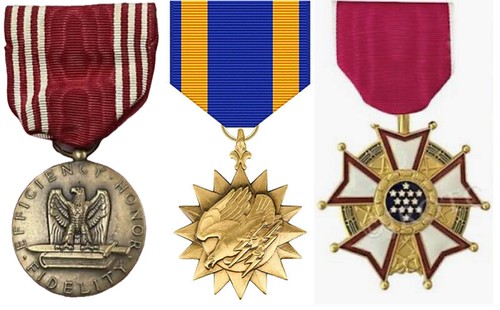
For anyone interested in reading the complete Ed Kamaraininen story, I recommend This is War and We are Prisoners of the Enemy available on Amazon.
TRUMP AWARDS 2026 NATIONAL MEDALS
This week President Trump awarded the National Medals of Science and Technology. -Editor
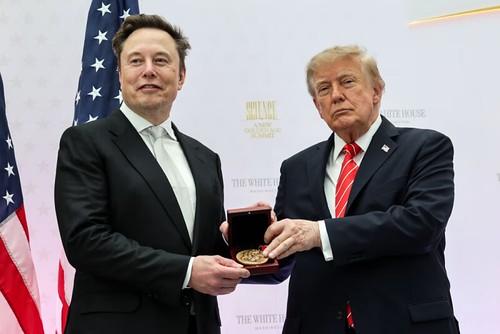
Musk receives the National Medal of Science from Trump
President Donald Trump joined some of America's most powerful tech leaders Thursday at a summit the White House billed as the start of a "golden age" of American science.
Elon Musk, Google co-founder Sergey Brin, Nvidia CEO Jensen Huang, AMD CEO Lisa Su, Microsoft CEO Satya Nadella and Dell founder Michael Dell gathered with Trump and a host of administration officials and scientific luminaries for the Science: A New Golden Age Summit at the U.S. Institute of Peace.
Trump awarded the National Medal of Science to Musk, Brin, Huang and Su. He awarded the National Medal of Technology and Innovation to Nadella and Dell.
Trump presented each of the recipients with medals and certificates of honor, later asking some of their families to join him onstage to take photos.
White House spokesperson Liz Huston said in a statement: "The Trump Administration is grateful for the contributions of these incredible leaders in science and technology. These recipients are helping ensure America keeps leading the world in innovation."
Several of the summit's speakers emphasized the importance of immigrants to America's scientific power.

Sergey Brin, Donald Trump and Jensen Huang
"I was an immigrant, and my parents brought us here to pursue the American dream," Huang told NBC News as he walked through the venue with his parents. "It's an incredible honor and something that could only happen here in America."
The event kicked off with a series of announcements about funding for new scientific initiatives. Among them is a pledge of around $2.4 billion of AI computing credits and scientific tools by America's leading AI companies for federal agencies working on a variety of scientific issues prioritized by the White House. The areas include quantum algorithms, AI-driven physical laboratories and improvement of the efficiency of nuclear engineering.
To read the complete articles, see:
Trump awards Musk and other tech titans National Medals of Science
(https://www.nbcnews.com/tech/tech-news/trump-awards-musk-tech-titans-national-medals-science-rcna602104)
Trump Awards ‘Modern-Day Thomas Edison' Elon Musk National Medal Of Science—Culminating Reconciliation (Photos)
(https://www.forbes.com/sites/antoniopequenoiv/2026/10/08/trump-awards-modern-day-thomas-edison-elon-musk-national-medal-of-science-culminating-reconciliation-photos/)
THE QUANTUM COIN
Jason Burton has produced the eighth work in ongoing series of struck art medals exploring ideas from science, mathematics, philosophy and the natural world. -Editor
Jason writes:
"The Quantum Coin brings together two complementary ideas in quantum physics. One side is inspired by Hugh Everett III's Many-Worlds Interpretation, using a branching tree to represent possible realities. The other draws from Richard Feynman's work on quantum pathways and computation, using a circuit structure to represent possible computational paths.
"The medals are struck one at a time from solid metals using antique coin presses in the United States.
"I thought the project might be of interest to E-Sylum readers as a contemporary example of using the medallic form to explore scientific ideas."

Background
The Quantum Coin is the eighth design in The Natural Philosopher Collection, an ongoing series of struck art medals exploring ideas from science, mathematics, philosophy and the natural world.

The collection currently includes the Fibonacci, Platonic, Relativity, Euclidean, Currents, Radioactive, Tai Chi and Quantum themes.
The collection uses the traditional two-sided medal format as a way of bringing related ideas into conversation with one another. The Quantum Coin focuses on two complementary perspectives in quantum physics.
Optional engraved acrylic Exhibit Modules are also created for each theme, extending elements of the coin artwork into a larger display format designed to be modular and grow with the ongoing COINCIDE collection.
The Quantum Coin
The obverse is inspired by Hugh Everett III's Many-Worlds Interpretation. A branching tree represents the unfolding of countless possible realities from a single quantum origin, with two possible branches highlighted through mathematical notation.
The reverse draws from Richard Feynman's contributions to quantum theory and computation. A circuit structure represents a network of possible computational paths, with two paths followed through the circuit toward measurement outcomes.
Together, the two sides explore the relationship between the idea that possible paths contribute to an outcome and the idea that possible outcomes persist.
Artist / Designer
Jason Burton, Founder of COINCIDE
Die engraving and minting
Shire Post Mint
West Fork, Arkansas, USA
www.shirepost.com
The steel dies are engraved by Shire Post Mint from my original drawings and specifications, and the medals are struck individually on antique coin presses. Additional pieces can therefore be struck over time in response to demand.
Specifications
Diameter: 1.3125 in.
Thickness: .125 in.
Weight: approximately 1 oz.

Materials:
Solid bronze
Solid copper
.999 solid silver
24K gold vermeil over .999 solid silver
Each coin also includes a folded informational pamphlet, featuring original illustrations and information specific to the coin's theme. Additional pieces can therefore be struck over time in response to demand.
Mintage / Availability
The Quantum Coin is not a limited-edition medal with a predetermined final mintage. Each new design in the collection is introduced through Kickstarter, with the initial production quantity determined by Kickstarter pledges.
Additional pieces can therefore be struck over time in response to demand.
After those orders are fulfilled, the design becomes part of the permanent COINCIDE collection and remains available through the COINCIDE website. Additional pieces can therefore be struck over time in response to demand.
A little about why I make these
I've always been interested in objects that can function as more than decoration. With the Natural Philosopher Collection, I use the medal as a small, durable canvas for exploring ideas that have shaped how we understand the world. The two-sided format is especially interesting to me because it allows related concepts to coexist physically within a single object. With The Quantum Coin, that gave me a way to place branching possibilities on one side and computational pathways on the other, so the object itself becomes part of the conversation.
The Kickstarter story page is probably the easiest place to see the project in context. The top of the page contains a short video, the full background, artwork, specifications and fabrication details for The Quantum Coin. If you continue scrolling, there is also an overview of the entire Natural Philosopher Collection.
The Quantum Coin is currently available through the Kickstarter campaign here. Following the campaign and post-campaign fulfillment, it will become part of the permanent collection available through the COINCIDE website: https://www.kickstarter.com/projects/coincide/the-quantum-coin?ref=e8m0b6 .
For more information, see:
https://www.coincideco.com/
LOOSE CHANGE: OCTOBER 11, 2026
Here are some additional items in the media this week that may be of interest. -Editor
In this week's Red Book Podcast, Jeff Garrett and Jeff Shevlin discuss So-Called Dollars. See the earlier article linked below for Jeff's latest book on the topic. -Editor
So-Called Dollars are historically important medals, generally about the size of a silver dollar, that commemorate events in American history. But as Jeff Shevlin explains, these aren't simply ordinary medals—they can feature incredible artwork, famous engravers, fascinating historical stories, extreme rarity, and surprisingly affordable prices.
The conversation covers everything from Augustus Saint-Gaudens and George Morgan to the Erie Canal, World's Fairs, the Columbian Exposition, Fort Sumter, and the Wilson Dollar.
One incredible example is the 1826 gold Erie Canal medal. Only a handful were struck, with just two known in private collections according to the interview, and examples have sold for tens of thousands of dollars—and as much as $200,000.
To read the complete Greysheet article, see:
Red Book Podcast: Rare & Undervalued? Yes! The So-Called Dollars Most Collectors Miss! [Video]
(https://www.greysheet.com/news/story/red-book-podcast-rare-undervalued-yes-the-so-called-dollars-most-collectors-miss-video)
To read the earlier E-Sylum article, see:
NEW BOOK: INSPIRATIONS: SO-CALLED DOLLARS
(https://www.coinbooks.org/v29/esylum_v29n35a03.html)
The ANS held a groundbreaking ceremony for its new headquarters in Toledo, OH. -Editor

The American Numismatic Society held a groundbreaking, signaling the building's transformation into a museum.
To watch the complete video, see:
Groundbreaking marks new era for historic Toledo building
(https://www.youtube.com/watch?v=f1TujaRqimE)
To read Toledo Blade article, see:
American Numismatic Society plans 2028 opening of Money Museum
(https://www.toledoblade.com/local/city/2026/10/05/american-numismatic-society-plans-2028-opening-money-museum/stories/20261002106)
Don Cleveland of Australia passed along this article about the demonetization of old Fiji banknotes. Thanks. -Editor
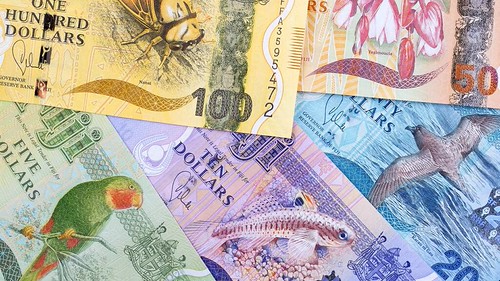
Australian travellers are being warned to exchange old banknotes from Fiji before they become worthless.
The old "paper" notes, made from a cotton-linen blend with a flora and fauna design, will only remain legal tender until December 31, 2026.
A new series of polymer banknotes were unveiled last December and issued into circulation in January this year to replace the old notes.
To read the complete article, see:
Aussie travellers warned to exchange old Fiji notes before they become worthless
(https://www.news.com.au/travel/travel-updates/warnings/aussie-travellers-warned-to-exchange-old-fiji-notes-before-they-become-worthless/news-story/52da92f8c99ce4a526586bc9481069c5)
Everyone loves estate sale find stories. Here's a New York Times piece about an artwork found in Michigan. -Editor
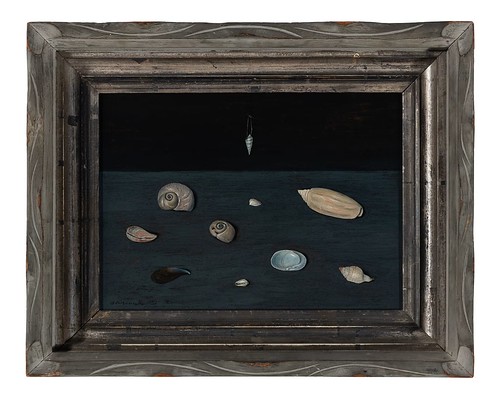
A cryptic, somber painting of 10 scattered seashells — purchased by a collector for $30 at an estate sale this summer — sold for $1.35 million on Thursday at Freeman's auction house.
The work, "Alderman Merriam's Shells," was created in 1951 by Gertrude Abercrombie, a Surrealist painter based in Chicago who died in 1977.
The discovery of the work came about in July when a man, nosing around at an estate sale in Kalamazoo, Mich., stumbled upon the enigmatic painting on the wall of a dimly lit corridor leading to the garage. The man, who wishes to remain anonymous, was familiar with Abercrombie's work and was stunned to see the still life bearing the artist's distinct signature.
Zachary Wirsum, a senior vice president at Freeman's, said the man told him he "was shaking as he walked out to his car," with his discovery.
"I think, objectively, had he not purchased it, this would have just ended up in the dumpster," Mr. Wirsum added. "So I think that he saved it from forever being lost in time."
Last June I visited the Carnegie Museums of Art and Natural History in Pittsburgh with my E-Sylum assistant Garrett Ziss. While there we encountered a temporary exhibit of the works of Gertrude Abercrombie. They weren't Garrett's cup of tea, but I enjoyed the surreal, dreamlike compositions. I recognized the style immediately when I saw the photo of the estate sale painting. Too bad I hadn't been to any Kalamazoo estate sales. -Editor
For more information on the Gertrude Abercrombie exhibit, see:
Gertrude Abercrombie:
The Whole World Is a Mystery
(https://carnegieart.org/exhibition/gertrude-abercrombie/)
To read the complete article, see:
Bought Months Ago for $30, This Painting Set Off a $1.35 Million Bidding War
(https://www.nytimes.com/2026/10/06/arts/design/gertrude-abercrombie-painting-estate-sale-auction.html)
To read the earlier E-Sylum article, see:
WAYNE'S NUMISMATIC DIARY: JUNE 1, 2025, PART ONE
(https://www.coinbooks.org/v28/esylum_v28n22a17.html)
FEATURED WEBSITE: ÆTHELMEARC MONEYERS GUILD
This week's Featured Website is the Æthelmearc Moneyers Guild. I missed their club table at the Pittsburgh ANA and learned about them from Clifford Mishler's Summer Numismatic Travels column in the October 20, 2026 Numismatic News.
The goal of the Æthelmearc Moneyers Guild is to provide a forum for medieval recreationists who have an interest in numismatics and medieval coins. It is our task to provide the monarchs of Æthelmearc with official coins for Their use during Their reign (in whatever manner They see fit). We strive to create replicas that are similar in appearance to actual medieval coins from a specific time and place. We also strive to make recreated medieval currency ubiquitous in the Sylvan Kingdom, and to include as many gentles as possible in the process of coinmaking. In accordance with modern law, we do not create exact replicas of ancient coins.

https://coins.aethelmearc.org/
ABOUT THIS ISSUE: OCTOBER 11, 2026
Here's another penny rounding situation I ran into on Monday. I stopped at our pharmacy to pick up a couple prescriptions. I'd forgotten to bring along any change and proffered a $20 bill. They rounded my change down from 47 cents to 45 - two dimes and a quarter, no pennies. I would have complained, but I'd already given them my two cents worth.

The quarter was a beat-up bicentennial, still bouncing around 50 years later. I'm still waiting to see a semiquincentennial coin in circulation.
Tuesday morning I participated in a Zoom meeting with the Newman Numismatic Portal, and in the afternoon I met with our financial consultant. It was a beautiful fall day, so afterwards I took a stroll around the plaza. Fall was in the air and on display everywhere. I took a photo of this colorful scene.

Autumn in Ashburn
On the way back to my car I passed a male grooming storefront. I'd never heard of this place, but "Hammer and Nails" offers not just a haircut and shave, but manly versions of manicures, pedicures, face & scalp treatments, even eyebrow, ear and nose waxing, whatever that is. Did I mention that beer and wine are included? This was not my Dad's barbershop from the old neighborhood in Pittsburgh. The sign said "Walk-ins accepted". So I walked in and asked, "WTF is this place?" And no, you pervs, I didn't ask about Happy Endings. This is an upscale place.
They tried to sell me on the manly mani-pedi, but I have no fingernails to speak of and was just curious to try a pedicure and get my nasty toenails trimmed. They give first-timers an upgrade, so I got the Signature Pedicure with a "warm soak, nail care, massage, callus resurfacing, sugar scrub, paraffin, and hot towel treatments." Now my feet are smooth as a baby's bottom and I feel like a million bucks. An impressive amount of work went into all that and I was very happy to get it done. It wasn't cheap, but with the upgrade I got my money's worth even though I turned down the booze before learning it was included.
My podiatrist says I've got healthy feet and the pedicurist concurred - she said they were in good shape. So basically, now I'm Homer Simpson with the feet of Adonis. Where are those nice sandals I bought three vacations ago?
I have a PayPal account and sometimes our advertisers use that to pay their invoices. This week I got an email from PayPal saying "Good news! We noticed that you've maintained a consistent sales history and developed great relationships with your customers. That's why we're giving you instant access to $160,400.00 USD in sales per month." Maybe we should raise our prices...
I preordered a medal for the 2026 Pittsburgh ANA and it arrived this week. Very nice. I'll bring it to my Nummis Nova dinner this month.
Part 6 of my ANA Diary last week highlighted my Saturday lodging at Pittsburgh's Mansions on Fifth. This week I found more information about the building in a Facebook post (or did that post find me? You never know how these things work anymore). "Built in 1906–1907 for attorney Willis F. McCook, his wife Mary, and their ten children, the McCook House is one of the great survivors of Pittsburgh's Fifth Avenue "Millionaires' Row." Learn more and check out the photo gallery here:
https://www.facebook.com/groups/pittsburghphotos/
permalink/1411237440503597/
To read the earlier E-Sylum article, see:
WAYNE'S NUMISMATIC DIARY: 2026 ANA, PART 5
.
Found online:
- I do not want to turn on notifications. Stop asking.
- I miss the days when spelling potato wrong was career-ending for politicians.
And here are some non-numismatic articles I came across this week. The first has interesting history of the peanut butter and jelly sandwich, my choice this past Thursday while waiting around for a repairman to show up.
How PB&J Became America's Favorite Lunch (https://historyfacts.com/us-history/article/how-peanut-butter-and-jelly-became-popular/)
The Oldest Soda Shop in St. Louis (https://opensince.substack.com/p/the-oldest-soda-shop-in-st-louis)
1 big thing: Tiny hobby boom (https://www.axios.com/newsletters/axios-finish-line-fcd261d5-f3f0-4070-aa5a-5afbd9ca9e62.html)
This Photo Is an A.I. Fake. Can You Tell? (https://www.nytimes.com/interactive/2026/10/08/technology/ai-generated-image-look-close.html)
The ghetto on the lagoon (https://aeon.co/essays/the-making-of-the-ghetto-on-a-venetian-island-in-1516)
Manhattan's evolution over centuries captured via meticulous animation (https://aeon.co/videos/manhattans-evolution-over-centuries-captured-via-meticulous-animation)
The Start-Up That Wants to Build ‘Microrobots' With A.I. (https://www.nytimes.com/2026/10/07/science/atomic-machines-ai-micro-robots.html)
Why Did Old Airplanes Have Black Noses? (https://historyfacts.com/science-industry/article/why-did-airplanes-have-black-noses/)
Margaret Hamilton, Who Developed Software for First Moon Landing, Dies at 90 (https://www.wsj.com/science/space-astronomy/margaret-hamilton-who-developed-software-for-first-moon-landing-dies-at-90-07b982a1?st=z6FkYJ)
Club Med, a Disney Cruise and an Exploding Starship: SpaceX Used Bystander Videos to Track Falling Debris (https://www.propublica.org/article/spacex-starship-caribbean-explosion-report)
-Editor

Editor Wayne Homren, Assistant Editor Garrett Ziss
Wayne Homren
Wayne Homren is the founding editor of The E-Sylum and a consultant for the Newman Numismatic Portal. His collecting interests at various times included U.S. Encased Postage Stamps, merchant counterstamps, Pittsburgh Obsolete paper money, Civil War tokens and scrip, Carnegie Hero Medals, charge coins and numismatic literature. He also collects and has given presentations on the work of Money Artist J.S.G. Boggs. In the non-numismatic world he's worked in artificial intelligence, data science, and as a Program Manager for the U.S. Department of Defense.
Garrett Ziss
Garrett Ziss is a numismatic collector and researcher, with a focus on American paper money and early U.S. silver and copper coins. He is also a part-time U.S. coin cataloger for Heritage Auctions. Garrett assists Editor Wayne Homren by editing and formatting a selection of articles and images each week. When he's not engaged in numismatics, Garrett is pursuing a Master's Degree in Quantitative Economics at the University of Pittsburgh.

Contributors Pete Smith and Greg Bennick
Pete Smith
Numismatic researcher and author Pete Smith of Minnesota has written about early American coppers, Vermont coinage, numismatic literature, tokens and medals, the history of the U.S. Mint and much more. Author of American Numismatic Biographies, he contributes original articles to The E-Sylum often highlighting interesting figures in American numismatic history.
Greg Bennick
Greg Bennick (www.gregbennick.com) is a keynote speaker and long time coin collector with a focus on major mint error coins and US counterstamps. He is on the board of both CONECA and TAMS and enjoys having in-depth conversations with prominent numismatists from all areas of the hobby. Have ideas for other interviewees? Contact him anytime
via instagram @minterrors.
He can also be reached by email at
minterrors@gmail.com.

Website host John Nebel and webmaster Bruce Perdue
John Nebel
Numismatist, photographer, and ANS Board member and Fellow John Nebel of Boulder, CO helped the ANA and other clubs like NBS get online in the early days of the internet, hosting websites gratis through his Computer Systems Design Co. To this day he hosts some 50 ANA member club sites along with our
coinbooks.org site, making the club and our E-Sylum archive available to collectors and researchers worldwide.
Bruce Perdue
Encased coinage collector (encasedcoins.info) Bruce Perdue of Aurora, Illinois has been the volunteer NBS webmaster from its early days and works each week to add the latest E-Sylum issue to our archive and send out the email announcement.

|
|
The E-Sylum is an electronic publication of the Numismatic Bibliomania Society Copyright © 1998 - 2026 | |